
Chimneys fail from the inside.
From the inside — in the flue, in the mortar joints, in the liner, in all the hot hidden places nobody has looked at since the house was built — while the brick face on the street side still looks respectable, still passes the glance-from-the-sidewalk test, still gives the neighbours nothing whatsoever to talk about. That is why fireplace budgeting starts with the chimney — the chimney, always the chimney, before a single other decision gets made. Not with the unit. Not with the showroom. With the stack of aging brick above your roofline and what a camera — a small camera, on a rod, lowered into the dark — finds inside it.
Wood, gas and electric are also genuinely different projects. Different costs. Different daily routines — the splitting and stacking, the button, the remote — so the fuel decision deserves real thought, actual thought, before any money is spent. This guide gives the 2026 BC ranges for each option, the chimney repair bands, and the order the work should be done in, because in fireplace projects the order is not a preference. It is the difference between a renovation and a demolition performed in the wrong sequence.
The short version: an electric fireplace or insert runs $1,000–$3,500 installed. A gas insert into an existing fireplace runs $4,500–$9,000. A new direct-vent gas fireplace runs $7,000–$14,000. A wood stove replacement runs $5,000–$10,000. Chimney work is the wildcard: repointing starts around $1,500–$5,000, a flue reline runs $3,000–$7,000, and a full masonry rebuild can reach $15,000–$30,000+. Get the chimney assessed before you fall in love with a fuel type, because its condition often makes the decision for you — quietly, completely, and with no interest in your plans. All figures are planning ranges, not quotes.
1. Costs by Option
2026 BC planning ranges, installed:
| Option | What it involves | 2026 planning range |
|---|---|---|
| Electric fireplace or insert | Unit plus trim work; minimal venting or construction | $1,000–$3,500 |
| Gas insert into existing masonry fireplace | Insert, gas line, flue liner, surround finishing | $4,500–$9,000 |
| New direct-vent gas fireplace | New unit, framing, venting through wall or roof, gas line, finish | $7,000–$14,000 |
| Wood stove replacement | Modern certified stove, flue liner or new chimney section, hearth | $5,000–$10,000 |
| Masonry fireplace restoration or rebuild | Repointing through full tear-down and rebuild of the firebox and stack | $10,000–$30,000+ |
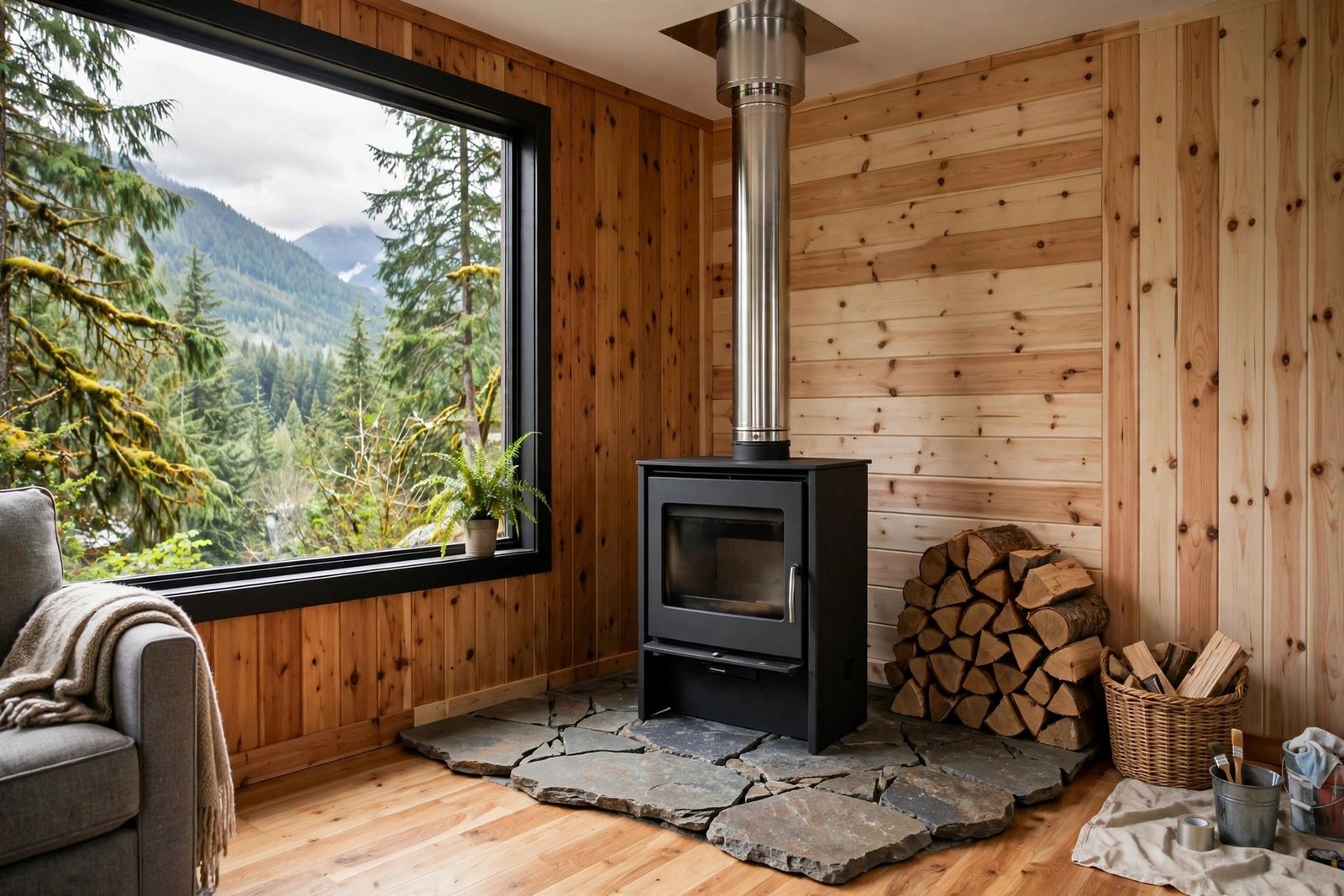
The gas fireplace installation cost BC homeowners pay most often lands in that $4,500–$9,000 insert band. There is a reason. The Fraser Valley has a huge stock of original masonry fireplaces from the seventies and eighties — thousands of them, street after street of them — and the bones are there, the firebox is usually sound, the chimney, whatever its interior secrets, is standing in the right place. Dropping in a direct-vent gas insert with a proper flue liner converts a smoky, inefficient relic into a push-button heat source without rebuilding anything structural. A relic. That is what most of those fireplaces are now — beautiful brick arches that smoke into the room, warm the chimney more than the house, and get lit twice a year out of nostalgia.
Wood stove replacement sits in a similar band but buys something different: real, serious heat. A modern certified stove puts out dramatically more usable heat than the old smoke dragon it replaces — dramatically, the kind of difference you feel in the back bedrooms — with a fraction of the emissions and a fraction of the wood consumption. The catch is the daily life. Wood heat is a hobby that heats your house. A hobby. With an axe. If that sounds like a chore rather than a pleasure, be honest about it before you spend $8,000, because the stove will ask you the question every single day from November to March.
2. Choosing a Fuel: Wood, Gas or Electric
Three questions separate the options.
Backup heat. Think about January, not the showroom. A winter power outage in the Fraser Valley — the windstorm, the ice, the transformer down the street giving up at midnight — is the scenario that separates these options. Wood stoves keep heating with no electricity at all. Many direct-vent gas units keep working through an outage too, though features like fans and remote controls will not, so confirm what your specific model does without power before you buy. Electric fireplaces go dark with everything else. Dark. Cold. Decorative. If backup heat matters to you, and in our storm season it reasonably might, that alone can settle the fuel question.
Running costs. Wood is cheapest per unit of heat if you have access to affordable firewood and do not count your labour — your Saturdays, your truck bed, your lower back. Natural gas sits in the middle and asks nothing of you beyond a bill. Electric costs the most per unit of heat — the most, and it is not particularly close — but the units are cheap to buy and install, which is why electric makes sense as ambiance in a room that already has proper heating.
Local rules. Some Fraser Valley municipalities restrict wood burning on poor air-quality days, and the rules have tightened over the years rather than loosened — tightened, steadily, in one direction only. That does not make wood heat impractical. It does mean you should confirm the current local rules before investing in a wood setup. A quick check with your municipality takes ten minutes and prevents an expensive surprise.
Match the fuel to the job the fireplace is actually doing. Primary heat source, backup heat, or atmosphere: three different purchases.
3. Chimney Work: Repair, Reline or Rebuild
Every wood or gas fireplace project starts at the chimney.
Every one — because the chimney decides what is possible, what is safe, and what is a waste of money, and it decides before you do. A level-one visual check by a chimney professional usually costs little and answers the big question: is this a repair, a reline or a rebuild?
On the chimney repair cost BC homeowners ask about, the 2026 bands look like this:
- Repointing deteriorated mortar joints runs $1,500–$5,000 depending on how much of the stack is affected.
- A stainless flue liner, which is what most older chimneys need to vent a modern insert or stove safely, runs $3,000–$7,000.
- A partial rebuild of the top courses runs $8,000–$15,000.
- A full tear-down and rebuild of the stack runs $15,000–$30,000+, and at that point the chimney alone can cost more than the fireplace it serves.
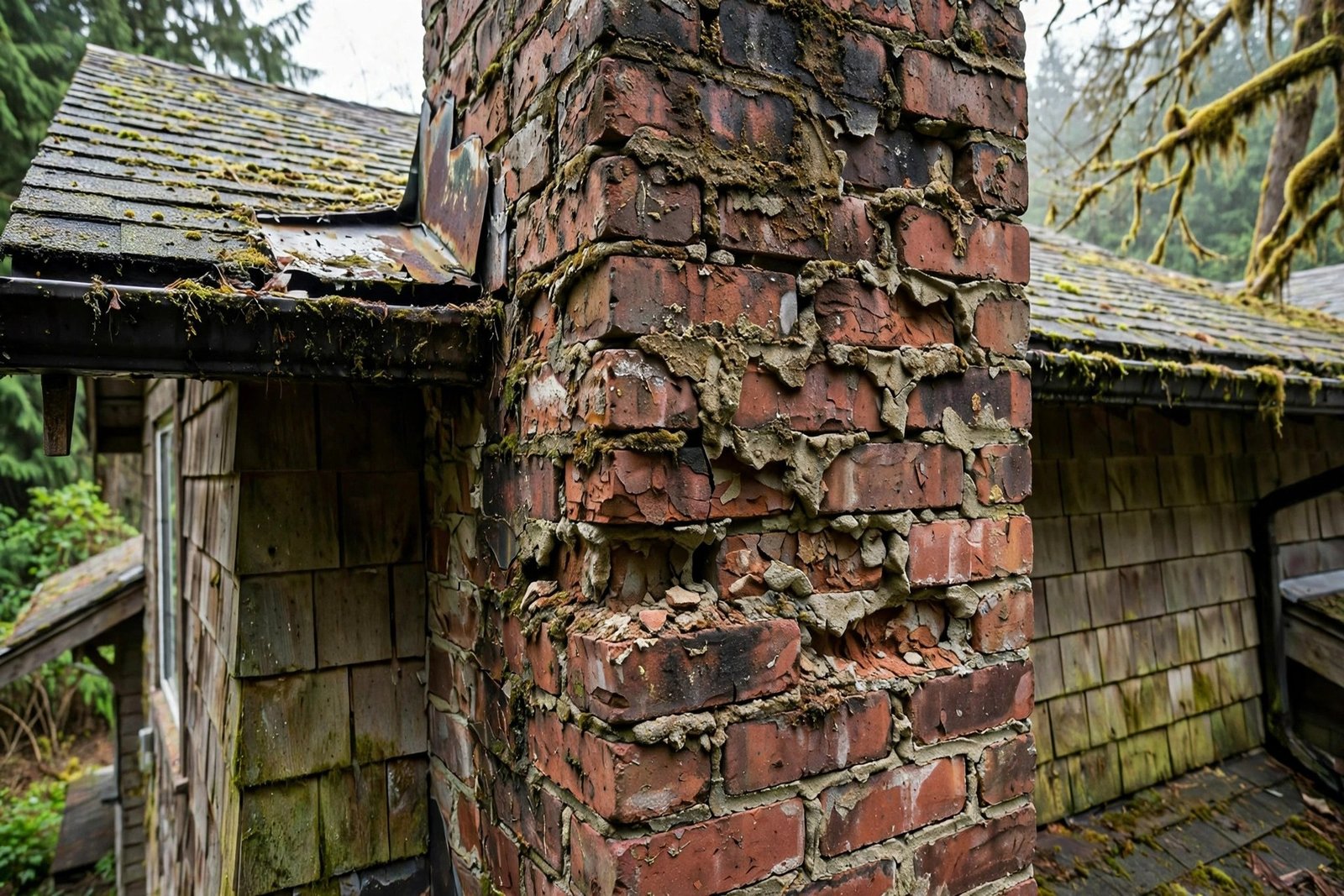
The warning signs are visible from the ground if you know what to look for. Spalling brick faces. Crumbling mortar. A leaning stack. White staining on the masonry, or water marks on the ceiling around the chimney breast. All of it — every flake, every stain — says the chimney needs attention before any fireplace money gets spent, before the insert, before the surround, before the catalogue photos. Interior clues matter too: a fireplace that has always smoked, always, since the day you moved in, or a damper that no longer seals, often points to flue problems rather than fireplace problems.
One habit to build in from day one: wood-burning chimneys need sweeping and inspection every year. Every year. Creosote buildup is the actual fire risk in wood heating — not the stove itself, not the wood, the glossy black residue painting the inside of your flue a little thicker with every fire — and an annual sweep by a chimney professional is standard practice across BC. It costs a few hundred dollars and it is the cheapest safety money in the whole project. The cheapest. Gas chimneys and liners need far less attention, but a periodic check still catches the issues, like venting obstructions or liner damage, that are cheap early and expensive late.
4. Surround and Hearth Costs
Once the fuel and chimney decisions are made, the visible part of the project is the surround.
The visible part. The photographed part. And this is where budgets quietly double — quietly, in the showroom, one upgrade at a time. A simple refacing of an existing fireplace with tile or stone veneer runs $2,000–$5,000. A full new surround with a proper mantel, built from scratch around a new unit, runs $5,000–$10,000+ depending on materials. Natural stone costs more than manufactured veneer and takes longer to install. A custom wood mantel from a local millwork shop is a different price again from a stock one — a very different price, for a piece of wood whose entire job is to be looked at, which is, when you think about it, exactly why people pay it.
The hearth deserves its own line in the budget. Wood stoves and inserts have clearance requirements — measured in inches, enforced without sentiment — that often mean extending or rebuilding the hearth pad, typically $500–$2,000 in stone or tile. This is not cosmetic. It is the non-combustible surface the safety clearances are measured from, and inspectors check it. They measure. With a tape.
If the fireplace is part of a bigger living-room or whole-home project, budget it inside that larger number rather than as a standalone. Our whole-home renovation cost guide for Abbotsford shows how fireplaces typically sit inside full-house budgets, and our per-square-foot cost guide for BC helps you sanity-check whether the overall project math still works with the fireplace included. A $12,000 fireplace in a $40,000 living room renovation is a different decision than the same fireplace as a standalone splurge. Different arithmetic. Different sleep at night.
5. Permits and the Order of Work
Permits are standard for fireplace work in BC whenever fuel-burning appliances, gas lines or structural changes are involved. A straight electric fireplace swap may not need one. Anything involving a gas line, a new vent penetration or masonry structural work generally does. Gas work in particular has to be done by a licensed gas fitter, with the appropriate permits and inspections. Confirm the requirements with your municipality at the planning stage. It is a short conversation — ten minutes, usually — and fireplace projects are exactly the kind where skipping it causes problems at sale time, when the buyer’s inspector starts asking questions nobody can answer.
The order of operations matters more here than in most renovations:
- Chimney assessment first, always.
- Fuel and unit decision, since the unit choice determines the venting and gas requirements.
- Gas line and venting rough-in.
- Surround and finish work.
Doing the pretty surround before the chimney is assessed is how homeowners end up tearing out $6,000 of new stonework to reline a flue. New stonework. Torn out — stonework they chose, stonework they waited for, stonework that was finished for perhaps a month. Every experienced hearth installer will tell you the same sequence — the same sequence, in the same order, with the same warning attached, usually delivered while shaking their head about somebody else’s house.
6. Frequently Asked Questions
How much does a fireplace renovation cost in BC?
For 2026, plan on $1,000–$3,500 for electric, $4,500–$9,000 for a gas insert into an existing fireplace, $7,000–$14,000 for a new direct-vent gas fireplace, and $5,000–$10,000 for a wood stove replacement. Chimney work ranges from $1,500–$5,000 for repointing to $15,000–$30,000+ for a full rebuild. Planning ranges. Not quotes — the chimney gets a vote on every one of these numbers.
Is converting a wood fireplace to gas worth it?
If convenience is the goal, then for most households, yes. A gas insert keeps the look of a real flame, eliminates wood handling and chimney sweeping, and heats at the push of a button. It costs more to run per unit of heat than wood, and it won’t heat through an extended power outage the way a wood stove does, so weigh backup heat needs before deciding — the outage test, again, because January does not care about your showroom impressions.
How much does chimney repair cost in BC?
Repointing runs $1,500–$5,000, a stainless flue liner runs $3,000–$7,000, a partial rebuild runs $8,000–$15,000, and a full rebuild runs $15,000–$30,000 or more. Get a professional chimney assessment first, because the visible symptoms don’t always match the actual problem. They often don’t. The brick can smile from the street while the flue is failing in the dark.
Do I need a permit to renovate a fireplace in BC?
For most fuel-burning fireplace work, yes. Gas line work, new venting and structural masonry changes generally require permits and inspections in BC, and gas work must be done by a licensed gas fitter. A simple electric fireplace installation may not. Confirm with your municipality before work starts.
How often should a wood-burning chimney be cleaned?
Every year. Every single year. Annual sweeping and inspection is standard practice for wood-burning chimneys in BC, because creosote buildup is the main fire risk in wood heating. It costs a few hundred dollars and catches liner damage and other problems while they’re still cheap to fix — while they’re still problems of hundreds, not problems of thousands with a fire truck in the driveway.
Planning a Fireplace Renovation in BC
Start at the top, literally.
Get the chimney assessed before you choose a fuel type or fall in love with a surround, because the chimney’s condition shapes the whole project and its budget. Then match the fuel to your real life: wood for serious heat and the work that comes with it — the splitting, the stacking, the sweeping, the whole beautiful chore of it — gas for push-button convenience, electric for looks in a room that already has heat. If you’re weighing fireplace renovation cost in BC against the rest of a renovation budget, remember that the chimney work is the part you can’t skip and the surround is the part you can phase. To talk through your fireplace, your chimney and what the project would realistically cost, call us at (236) 613-0038 and we will give you straight answers with no pressure.