
The most common pricing mistake BC homeowners make with heat pumps is treating the quote like a furnace quote. With a furnace, the unit is the unit: swap the box in the corner of the basement, reconnect the ducts, done. A heat pump doesn’t work that way. One Abbotsford rancher with baseboard heaters, a 100-amp panel and no ductwork can legitimately land at twice the installed price of an identical-looking house one street over that already has ducts and a 200-amp panel — and both quotes can be fair. People who shop the sticker number and then get blindsided by an electrical upgrade on day two are living out the classic error: assuming one price fits all homes. Understanding heat pump installation cost BC in 2026 means understanding what goes into the number, because that’s where your actual price is decided.
Heat Pump Installation Cost BC by System Type
Nothing below is a quote — just 2026 BC planning ranges for a standard residential install, before rebates, that brand choice, the crew’s day rate, or an awkward site can all nudge around. Use them as a reality check against the bids landing in your inbox.
| System type | Best for | Typical installed range |
|---|---|---|
| Single-zone ductless mini-split (one indoor head) | A basement suite, an addition, one hard-to-heat floor | $3,500–$8,000 |
| Multi-zone ductless (2–4 indoor heads) | Homes with baseboard heat and no ducts | $8,000–$16,000 |
| Centrally ducted air source (existing ductwork) | Homes that already have furnace ducts in good shape | $10,000–$18,000 |
| Cold-climate / dual-fuel system | Older homes, gas-heated homes keeping a furnace for the coldest snaps | $12,000–$20,000+ |
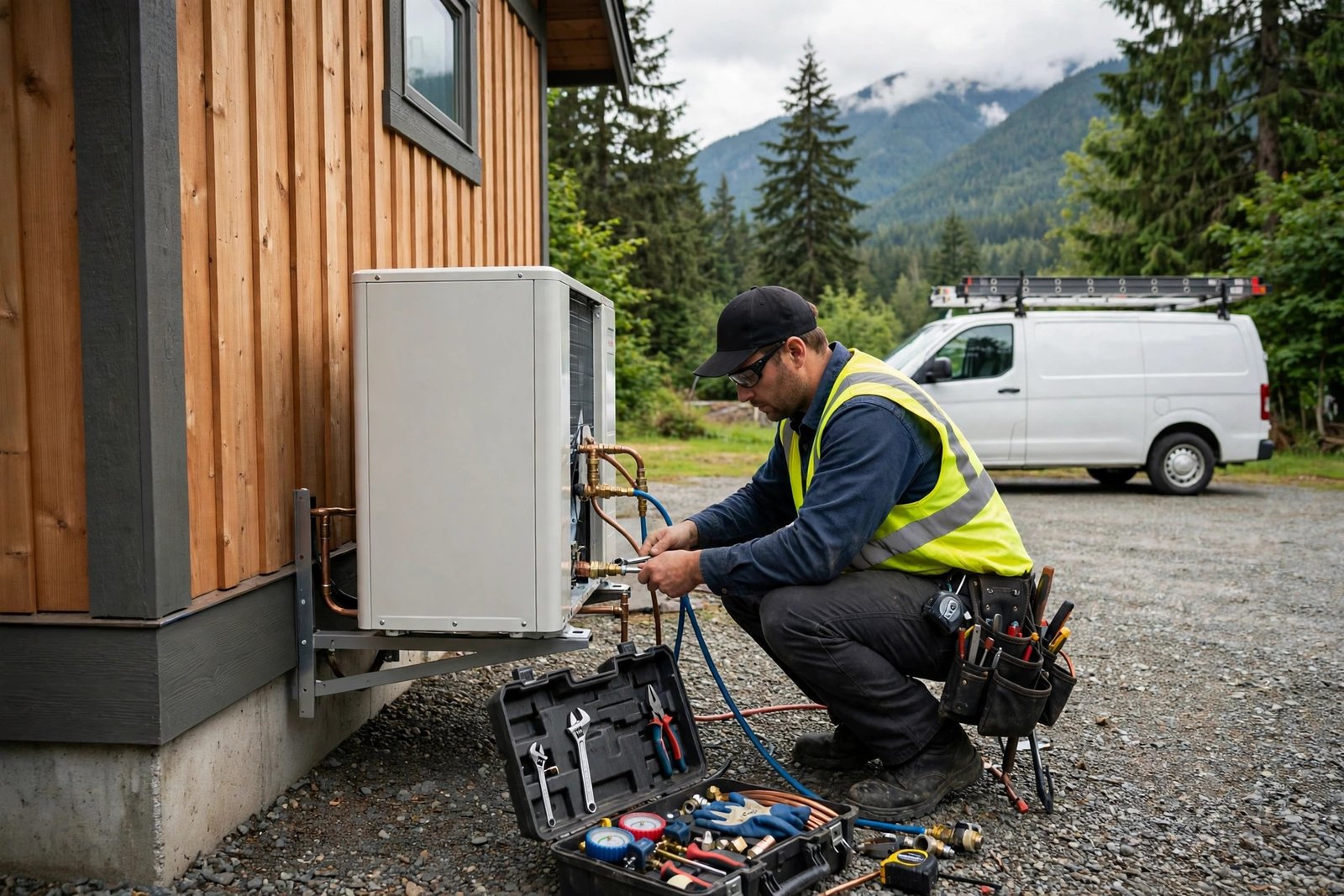
Ductless heat pump installation cost in BC is where the floor of the market lives. A single head over a bedroom or basement suite takes a day — outdoor unit, one indoor head, one line set through a small wall penetration, a dedicated circuit — but heads two, three and four each add their own equipment, their own refrigerant line, their own labour. That stacking is the quiet reason a four-head whole-house ductless job climbs into five figures.
Centrally ducted air source heat pump cost BC starts higher — outdoor unit plus an air handler or coil on the existing furnace, with every metre of ductwork verified. When the ducts are sound, you’re in the $10,000–$18,000 band. When they’re leaky, undersized or missing entirely, the ductwork becomes its own project, and the total can pass $20,000 before anyone mentions rebates.
What Drives the Price Up or Down
Once you’re holding three quotes and they disagree by five grand, it’s almost always one of these factors. None of them is a scam. They’re just the things that make your house different from your neighbour’s.
Your existing heating setup. A gas-forced-air home with healthy ducts is the easiest heat pump conversion in BC — the infrastructure is already there. An electrically heated home on baseboards means the installer is starting from zero on air distribution, which pushes you toward multi-zone ductless or new ductwork, and both cost more. If you’re weighing a heat pump against simply swapping your old furnace, our furnace replacement cost breakdown lays out the gas-forced-air side of the math.
The electrical panel — the budget-killer nobody budgets. Older Abbotsford and Mission homes often still run on 100-amp service with a full panel, and a heat pump needs a dedicated 240-volt circuit plus headroom for everything else in the house. A 200-amp service upgrade means a separate invoice — panel swap, mast and meter work, electrical permit — that can add thousands before the heat pump crew even starts. Good contractors open the panel during the quote visit. If a bidder never asks to see it, that’s a red flag, not a bargain.
Ductwork condition and layout. Ducts only count as an asset when they’re sized right and actually sealed — a bigger ask than it sounds, since runs laid out for a high-temperature gas furnace can under-deliver once a heat pump is pushing larger volumes of cooler air through them. Sealing, resizing or adding returns adds labour and material line items — and removing an old oil tank or electric furnace carries its own disposal fee, so check it’s in the quote.
Line-set length and unit placement. Every extra metre of refrigerant line costs more. The outdoor unit has its own placement rules — clear airflow, somewhere for defrost water to drain, setback clearance from the property line in some municipalities — which is why a straightforward wall-mount behind the house stays cheap, and routing around a finished basement or a long driveway does not.
Cold-climate rating and capacity. A standard air-source unit is cheaper than a cold-climate-rated one built to hold capacity below −15°C, and variable-speed inverter models cost more than single-stage. You’re paying for winter performance — a legitimate upgrade in BC’s colder pockets, arguably overkill in mild Abbotsford.
Sizing and Efficiency: The Plain-Language Version
Tonnage and BTUs. On a quote, capacity shows up as BTUs — 12,000 BTUs equal one ton — just the industry shorthand, nothing more mysterious behind it. The typical detached Abbotsford home — call it the 1,600–2,400 square-foot range — usually lands in the 2- to 3-ton band. Square footage moves that number less than you’d expect; insulation, window area and ceiling height move it more. Oversize it and the unit short-cycles, costs more upfront and dehumidifies poorly. Undersize it and it never stops running, leaning on backup heat. A proper load calculation (Manual J — the term to ask for at the quote visit) is how a good contractor picks the size instead of eyeballing it.
SEER2 and HSPF2. These are the two efficiency numbers on the yellow label, and they’re simpler than they look. SEER2 is summer cooling efficiency — higher means cheaper air conditioning. HSPF2 is heating-season efficiency, which matters far more in BC, where a heat pump heats for roughly eight months and cools for a few weeks. In the Fraser Valley, where design temperatures hover around −5°C to −8°C rather than the −25°C of the Interior, most modern variable-speed heat pumps handle the load comfortably — it’s the shoulder-season efficiency, running gently on mild October days, that determines your annual savings.
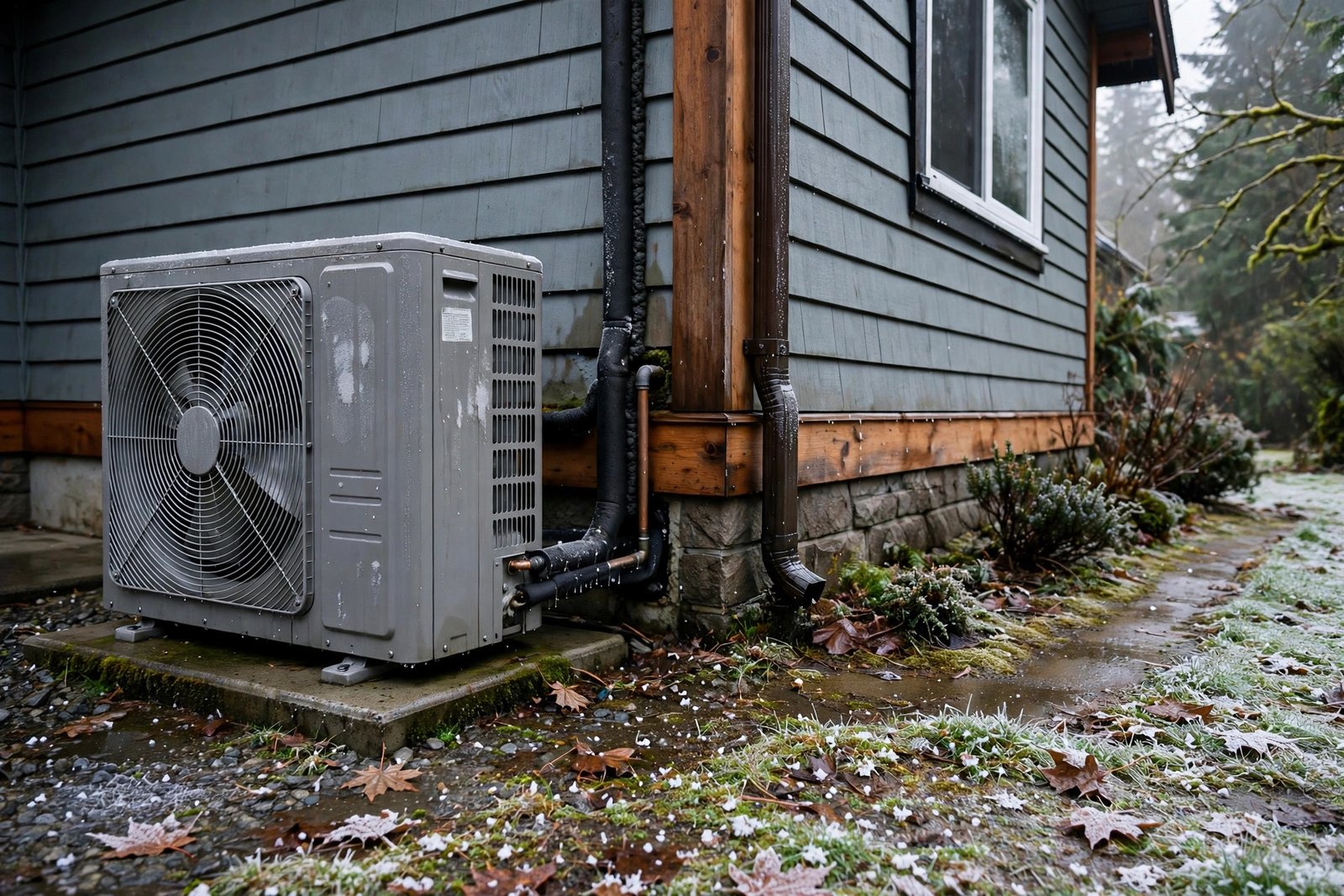
Fraser Valley climate notes. Abbotsford winters run damp rather than brutally cold — about as good as heat-pump territory gets, honestly — except the dampness brings defrost cycles. Every so often the outdoor unit melts frost off its coil and leaves water that has to go somewhere. Local installers route that condensate away from walkways deliberately — a sheet of ice by the back door in February counts as a liability, not a feature. If you heat with natural gas today, a dual-fuel setup — heat pump doing the bulk of the work, furnace covering the coldest nights — is the common local compromise that keeps winter hydro bills predictable.
Rebates: CleanBC and BC Hydro Program Types (Check Current Offers)
This is the section where every BC homeowner asks for a number, and where we’re deliberately not giving you one. Rebate amounts move — programs were restructured as recently as mid-2026 — so any specific dollar figure you find online is a snapshot, not a promise. What follows is only the shape of the landscape: which programs exist, how they work, and how they fit together. Before you spend anything, confirm the current offers on the official program pages or walk through our longer rundown of BC renovation rebates and grants.
CleanBC’s Energy Savings Program. The provincial program for income-qualified households, working in tiers: the rebate level depends on household income, the fuel you’re switching away from, and the type of heat pump going in. Central ducted systems and multi-head installs generally sit in higher tiers than a single mini-split head. There’s a pre-registration step — you apply for a code before the work starts, the rebate typically flows through a registered contractor, and the code is only valid for a limited window, so timing your install matters.
BC Hydro’s Power Smart heat pump rebates. The utility-side program for BC Hydro customers, aimed at electrically heated homes switching to a heat pump. It distinguishes between whole-home systems — a heat pump sized to carry the full heating load — and partial systems that cover part of it. Whole-home installs sit in the higher rebate category. Eligibility hinges on your home being electrically heated today and on the equipment meeting the program’s efficiency requirements, generally with installs done by an approved contractor network member.
Stacking. The useful part: these two programs are funded and administered independently, and they are designed to stack — the same install can claim both, and one doesn’t shrink the other. That combination is why income-qualified households switching off gas, oil or propane see the steepest effective discounts.
The sequencing warning. Get the paperwork order wrong — buy the equipment before pre-registering, or skip the approved-contractor requirement — and you can forfeit a rebate you’d otherwise have qualified for. Sort out eligibility and registration before anyone orders equipment. A contractor experienced with these programs will know the drill; if yours seems vague about it, that’s information too.
Frequently Asked Questions
What is the average heat pump installation cost BC homeowners pay in 2026? Most standard residential installs land between $8,000 and $16,000 before rebates: single-zone ductless at the low end ($3,500–$8,000), centrally ducted with healthy existing ductwork in the $10,000–$18,000 band. Multi-zone ductless and cold-climate/dual-fuel setups run higher. Your existing heating system, electrical panel capacity and ductwork condition move any quote within — or outside — these bands.
Why do two quotes for the same house differ by thousands of dollars? Usually because they’re not quoting the same scope. One bid may quietly include a panel upgrade, duct sealing or a longer line-set run that the other left out — or plans to discover on install day. Compare them line by line: equipment model and capacity, electrical work, duct modifications, permits and disposal.
Does ductless heat pump installation cost less than a centrally ducted system in BC? For partial coverage, yes — a single-zone ductless install ($3,500–$8,000) is the cheapest way into heat pump heating and cooling. But four or five ductless heads for whole-house comfort ($8,000–$16,000 and up) can cost as much as — or more than — a centrally ducted system ($10,000–$18,000) in a home whose ducts are already usable.
Will I need an electrical panel upgrade for a heat pump in Abbotsford? Often, yes, if your home still has 100-amp service — common in older Abbotsford and Mission neighbourhoods. A heat pump needs a dedicated circuit with room to spare — a service upgrade carries its own permit and its own electrician invoice on top of the heat pump quote. Have the contractor open your panel during the quote visit, so this lands in the bid instead of arriving as a mid-install surprise.
Can I stack CleanBC and BC Hydro rebates on the same heat pump install? Yes — CleanBC and BC Hydro are designed to stack, so the same qualifying install can claim both, and neither program reduces the other. Rebate amounts change with program updates — confirm the current offers before you buy. And get the paperwork order wrong — pre-registration, equipment eligibility, approved-contractor requirements — and one or both rebates can slip away.
Getting a Number You Can Trust
Planning ranges are useful for budgeting, but your house is the quote. If you want to pin down the heat pump installation cost BC homeowners face for a home like yours — panel, ducts, rebates and all — call (236) 613-0038 and we’ll walk through it with you.