
Countertops are the most-touched surface in your kitchen and one of the most visible. They’re also a line item where the price spread is enormous: the difference between laminate and quartz on an average kitchen can be $4,000 or more. So which one actually makes sense?
Here’s the honest breakdown of the three countertop materials Fraser Valley homeowners choose most — quartz, granite, and laminate — covering how each performs in real kitchens, what it costs installed in 2026, and which one fits your situation. No sponsored rankings. Just what we’d tell you standing in your kitchen.
Disclaimer: All prices in this guide are 2026 market ranges for the Abbotsford and Fraser Valley area, based on published local market data and typical installed pricing from Lower Mainland fabricators. Final pricing depends on slab selection, edge profiles, cutouts, and kitchen size.
The Three Contenders at a Glance
| Quartz | Granite | Laminate | |
|---|---|---|---|
| What it is | Engineered stone: ~90% quartz crystals bound with resin | Natural stone cut from quarried slabs | Plastic laminate bonded to particleboard/MDF |
| 2026 installed cost (Fraser Valley) | $75–$125/sq ft | $60–$110/sq ft | $25–$50/sq ft |
| Typical total, average kitchen | $3,000–$5,500 | $2,500–$4,800 | $1,000–$2,200 |
| Durability | Excellent — hard, non-porous | Very good — hard, but porous | Fair — scratches and burns |
| Maintenance | Wipe and go; no sealing | Seal every 1–2 years | Wipe and go; can’t be repaired easily |
| Heat resistance | Moderate — use trivets | Excellent | Poor — hot pans damage it |
| Stain resistance | Excellent | Good (when sealed) | Good, but seams can stain |
| Appearance | Consistent, stone-like patterns | Unique natural veining | Improving; mimics stone/wood |
| Resale perception | Premium | Premium | Budget |
A note on those totals. An “average kitchen” here means roughly 40–50 square feet of countertop. That’s typical for the 100–150 sq ft Abbotsford kitchens we renovate most. Your kitchen may differ. So measure your linear footage and multiply.
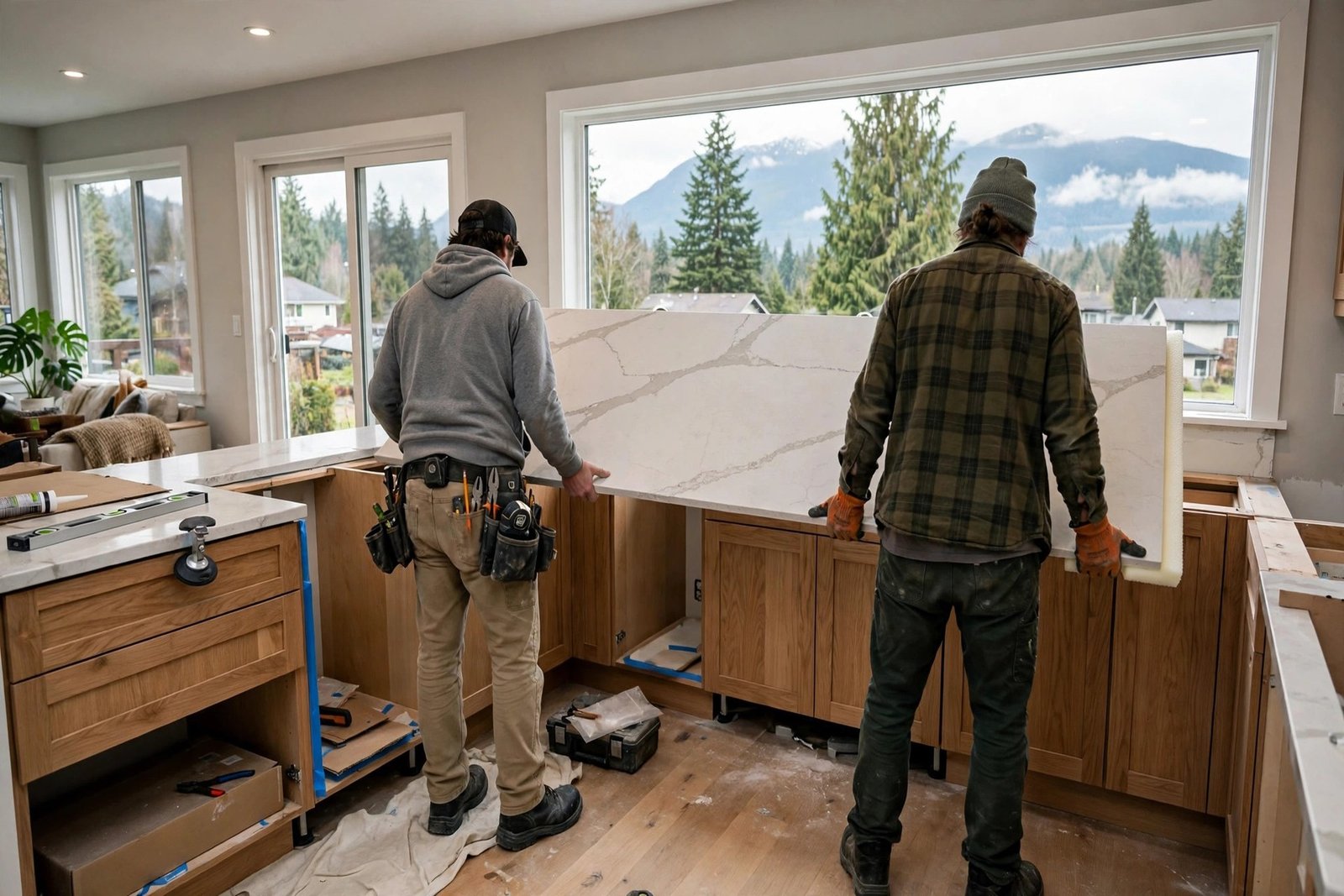
Quartz: The 2026 Default (and Why)
Quartz is engineered stone. Natural quartz crystals — about 90% of the slab — bound with polymer resins and pigments. And it dominates Fraser Valley kitchens in 2026. The reasons are straightforward. It looks like stone. It doesn’t stain. It asks nothing of you.
Pros:
– Non-porous. Red wine, coffee, turmeric, beet juice — the usual suspects in a working kitchen — wipe off without staining. This is quartz’s killer feature and the reason busy families choose it.
– No sealing, ever. Unlike granite, there’s no maintenance schedule. Install it and forget it.
– Consistent appearance. It’s manufactured. So the slab you pick is the slab you get. No surprise veins. No colour shifts. Two slabs that need to match, say for a large island? Quartz does it effortlessly.
– Hard and durable. Chips and scratches, in daily use? It resists them better than most natural stones do.
– Design range. Marble. Concrete. Modern quartz mimics both, convincingly. At a fraction of natural stone prices.
Cons:
– Heat sensitivity. The resin binder doesn’t love extreme heat. A scorching pan straight from the burner can discolour or damage the surface. Trivets are non-negotiable — a habit adjustment, not a dealbreaker, but worth knowing.
– Price. At $75–$125 per square foot installed, it’s the priciest of the three. Premium brands and dramatic veining push toward the top.
– Not “natural.” Some buyers specifically want real stone. Quartz won’t satisfy them, though most can’t tell the difference once it’s installed.
– Seams on large runs. Very long counters need seams; good fabricators make them nearly invisible, but they’re there.
Best for: families, anyone who cooks daily, rental suites (indestructible and tenant-proof), and resale — quartz is what Fraser Valley buyers expect in a renovated kitchen in 2026.
Granite: The Natural Stone Classic
Granite is cut directly from quarried stone. Then polished. Then sealed. And every slab is one of a kind. The veining in your counter? The mineral flecks? They exist nowhere else on earth. For two decades this was the premium default. It remains a strong choice now.
Pros:
– Heat resistance. Granite handles hot pans better than quartz — far more forgiving of a moment’s carelessness.
– Unique beauty. Natural variation means your kitchen doesn’t look like anyone else’s.
– Hardness. Granite is extremely hard and scratch-resistant — you can cut on it without damage (though your knives will suffer).
– Can cost less than quartz. Depending on the slab, granite at $60–$110/sq ft installed can undercut quartz by a meaningful margin, especially in common colours.
Cons:
– It’s porous — sealing is mandatory. Unsealed granite absorbs liquids and stains. Plan on resealing every 1–2 years. It’s a 30-minute job, but it’s a job, and forgetting it for five years invites stains.
– Slab lottery. You need to pick your actual slab (or at least approve it), because natural variation means the sample and the slab can differ noticeably.
– Can look dated in certain colours. The speckled browns and golds? They dominated 2000s kitchens. To buyers today, they read as dated. If resale matters, choose current colours. Whites, greys, blacks. With subtle movement.
Best for: cooks who want heat tolerance, anyone who values natural materials, and bargain hunters — a beautiful granite remnant or a common colour can deliver a stone kitchen for less than quartz.
Laminate: The Budget Option That’s Better Than Its Reputation
Laminate gets dismissed, often unfairly. Modern high-definition laminates convincingly mimic stone, concrete, and butcher block at a glance — and at $25–$50 per square foot installed, the price difference is dramatic. On an average kitchen, choosing laminate over quartz saves $2,000–$3,500.
Pros:
– Price. Nothing else is close. A full laminate kitchen can cost less than the upgrade charge for stone.
– Huge design range. Hundreds of patterns, including surprisingly convincing stone and wood looks.
– Easy on dishes and quiet. Softer surface than stone — fewer chipped mugs, less clatter.
– Fast and simple installation. No templating delays, no heavy slabs, no seamstress-level fabrication.
Cons:
– Scratches and can’t be refinished. Cut on it and you’ll see the marks — unlike stone, the damage is permanent.
– Heat damage. A hot pan will scorch or blister laminate. This is the material’s biggest practical weakness in a real kitchen.
– Seams and edges. Laminate shows its seams more obviously than stone does. And the edge profiles? That’s where the laminate wraps the substrate. Up close, they can look less premium.
– Moisture vulnerability. The particleboard core swells if water gets in at seams or around the sink cutout. In a Fraser Valley kitchen, sink-area discipline matters.
– Resale perception. Buyers read laminate as “budget renovation.” In a $48,000 kitchen reno, laminate counters can undermine the perception of everything else you paid for.
Best for: tight budgets, first. Rental properties, too, where replacement cost matters more than prestige. Laundry rooms and secondary spaces. And anyone planning a future upgrade. Because laminate buys you a good-looking kitchen now. For a fraction of stone.
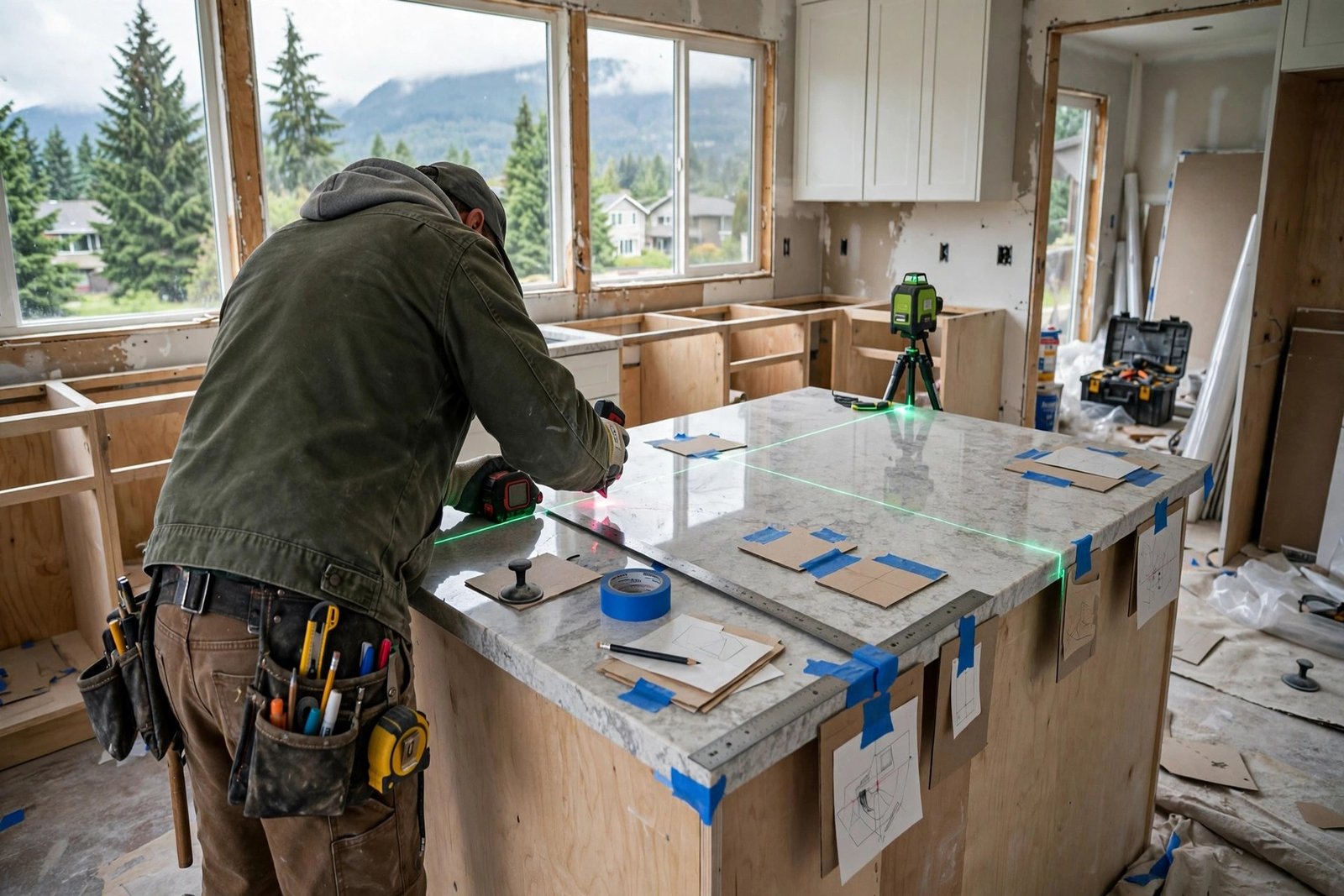
Head-to-Head: The Questions That Actually Decide It
Which lasts longest?
Quartz and granite both last decades. 25+ years is normal for either. Laminate is different. In a working kitchen it lasts 10–15 years before it looks tired. So stretch the horizon to 20 years. You might replace laminate once in that span. Which narrows the price gap. But doesn’t erase it.
Which is best for resale in Abbotsford?
Quartz, clearly. For a renovated Fraser Valley kitchen, it’s the 2026 buyer expectation. Granite in a current colour runs a close second. Laminate? In an otherwise renovated kitchen, it raises questions. Buyers start wondering where else money was saved.
Which handles a busy family kitchen?
Quartz. Stain-proof. No maintenance. Hard to damage in normal use. Granite is fine too. Provided you keep up with the sealing. Laminate is the risky one here. Young kids plus hot pans? That’s a recipe for visible wear within a few years.
Can I mix materials?
Absolutely. And it’s a smart budget move, too. The classic Fraser Valley compromise goes like this. Quartz on the island. That’s the visual centrepiece and the hardest-working surface. Then laminate or butcher block on the perimeter. You get the premium look where it counts. And you save $1,500–$2,500 where it doesn’t.
2026 Cost Comparison: Real Kitchen Scenarios
To make the numbers concrete, here are three typical Abbotsford kitchens:
| Kitchen | Size | Laminate | Granite | Quartz |
|---|---|---|---|---|
| Small galley (older bungalow) | ~30 sq ft | $750–$1,500 | $1,800–$3,300 | $2,250–$3,750 |
| Average family kitchen | ~45 sq ft | $1,125–$2,250 | $2,700–$4,950 | $3,375–$5,625 |
| Large kitchen + island | ~65 sq ft | $1,625–$3,250 | $3,900–$7,150 | $4,875–$8,125 |
These are material-and-installation ranges. Before extras, that is. Undermount sink cutouts. Edge profile upgrades. Cooktop cutouts. A waterfall island edge in quartz, for instance? On its own it can add $800–$1,500. Gorgeous, yes. But budget accordingly.
What We’d Recommend (Honestly)
- Renovating your forever kitchen and cooking daily? Quartz. The stain resistance and zero maintenance are worth it every single day for years.
- Want natural stone and watch for deals? Granite in a current colour — you might beat quartz pricing with a beautiful, unique result.
- Budget-constrained but want the kitchen to look great? Laminate. Ideally mixed with quartz on the island. Then spend the savings where buyers notice more. On cabinets. Or appliances.
- Outfitting a legal basement suite? Quartz or a durable granite. Either one is tenant-proof. Stain-proof, too. And it rents the suite faster.
Countertop FAQs (2026)
Is quartz better than granite?
For most kitchens, yes — marginally. Quartz wins on stain resistance. On zero maintenance, too. Granite wins elsewhere. Heat resistance. Natural uniqueness. In 2026 Fraser Valley kitchens, though, quartz is the more popular choice. The safer pick for resale, too.
How much do quartz countertops cost in Abbotsford?
Installed quartz typically runs $75–$125 per square foot in the Fraser Valley in 2026. For an average kitchen, that’s roughly $3,000–$5,500. What pushes toward the top of the range? Premium brands. Dramatic veining. Upgraded edge profiles.
Is laminate countertop still a good option?
Yes, for the right situation. Modern laminate looks far better than its reputation suggests. And it costs a third of quartz. Tight budgets? Rentals? Secondary spaces? It’s a smart choice for all three. Just know its limits. It scratches. It scorches with hot pans. And it doesn’t impress buyers in a premium renovation.
Do granite countertops need to be sealed?
Yes — every 1–2 years. Granite is porous. Sealing is what keeps it stain-resistant. The job itself is simple DIY. Wipe-on, wipe-off, 30 minutes. But skip it for years and that’s exactly how granite gets stained.
Can you put hot pans on quartz?
Not directly. Quartz can discolour under extreme, concentrated heat. It can crack, too. The resin binder is why. So always use trivets or hot pads. Granite is more forgiving. But trivets are still good practice for any stone.
What’s the cheapest way to get the stone look?
Two options: high-definition laminate that mimics stone ($25–$50/sq ft installed), or a budget-friendly granite in a common colour. The granite can sometimes be found at laminate-adjacent prices. Fabricators clearing slab inventory are where to look. Also consider mixing. Quartz island, laminate perimeter.
Choosing Countertops for Your Renovation?
Countertops are one component of a bigger decision. Cabinets interact with them. Layout, appliances, budget — all of it does. A $4,000 swing on counters might be better spent on soft-close cabinetry. Or it might be exactly what the kitchen needs to feel premium. Context matters.
If you’re planning a full kitchen project, take a look at our kitchen renovation services in Abbotsford to see how countertops fit into the complete renovation — from design and cabinetry through to the final install.
Reminder: Prices in this guide are 2026 Abbotsford/Fraser Valley market ranges for planning purposes, not a quote. Final pricing depends on your kitchen’s measurements, slab selection, and edge details. For an accurate figure, get templated quotes from local fabricators based on your actual layout.