
The backsplash is the smallest surface in the kitchen and somehow the hardest decision. Cabinets are a 20-year commitment, countertops are expensive to redo — but the backsplash sits right at eye level, in every photo, every day. Get it right and the whole kitchen clicks. Get it wrong and it dates the room faster than anything else in it.
2026’s direction is clear: warmer, calmer, and taller. The fussy mosaics and high-contrast grout of the last decade are fading; full-height slabs, handmade-look tile, and warm neutrals are taking over. Here is what is trending, what it costs as 2026 planning ranges, and how to choose for an Abbotsford kitchen specifically.
1. The Full-Height Slab: 2026’s Statement Move
Slabs top the 2026 list. People call them countersplashes. The idea is simple enough. Skip the tile. Run the countertop material — quartz, quartzite, porcelain slab — straight up the wall instead. Clear to the ceiling, sometimes. Or stop at the range hood. No grout lines. One continuous surface.
Two reasons it works. The first is visual. A slab wall reads calm, and kitchens feel bigger against it. Galley kitchens especially — older Abbotsford homes are full of them, and busy tile turns chaotic in a narrow galley fast. The second reason is practical. No grout behind the range. Nothing to scrub. Anyone who has dug grease out of mosaic grout lines gets it.
2026 planning range: $75–$150+ per sq ft installed, depending on the stone. It’s the premium option, no question. But on a typical 30–40 sq ft backsplash the total stays manageable. Especially next to the counters themselves. Already buying slabs for the counters? Ask your fabricator about the remnants. Offcuts can cover a backsplash wall for far less than a fresh slab.
2. Zellige and Handmade-Look Tile: Texture You Can Feel
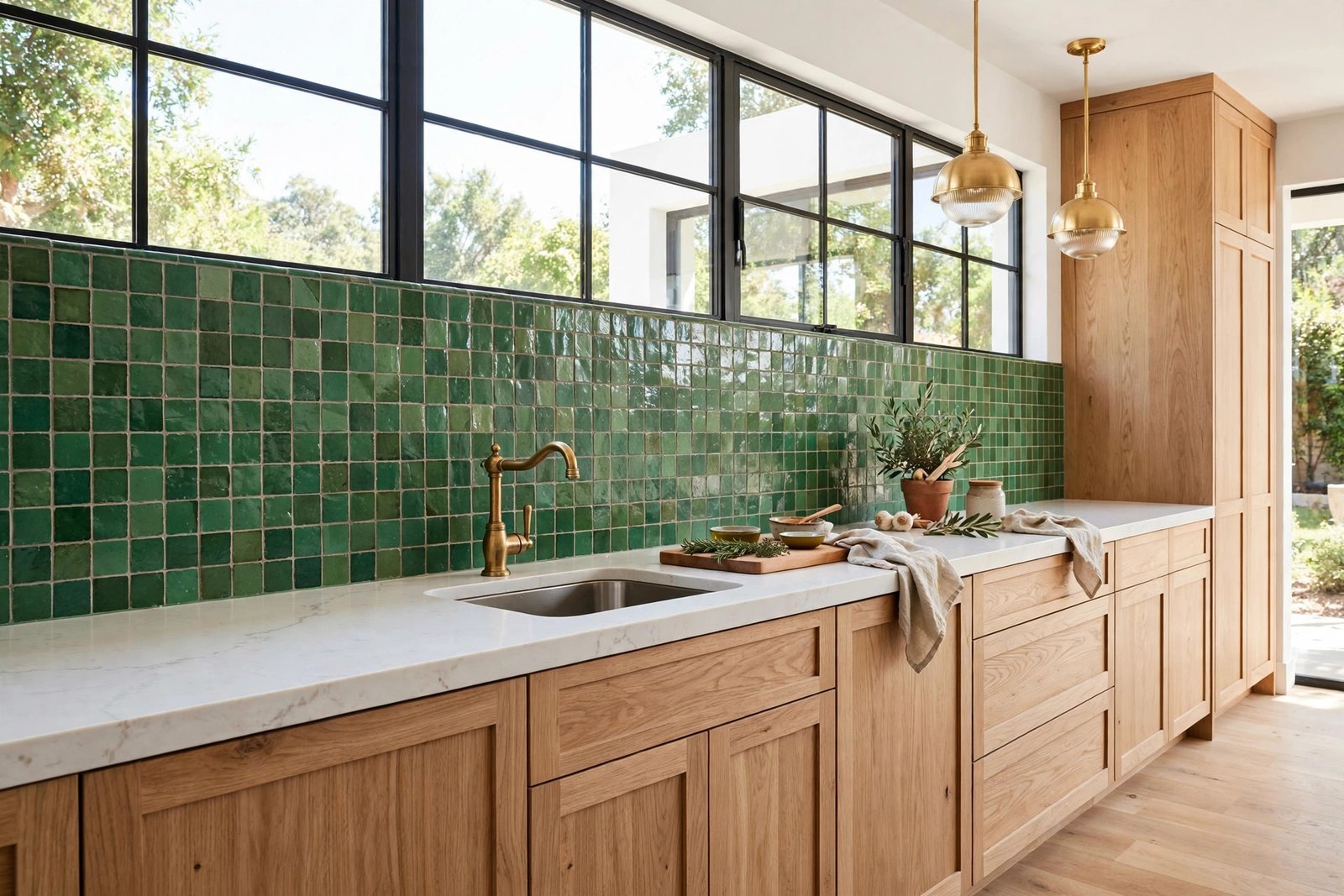
Zellige used to live in design magazines. Not anymore. The Moroccan hand-glazed tile — rippled surface, nothing quite even about it — is a mainstream staple for 2026. Why it works comes down to light. Every tile catches it differently. A plain cream zellige wall still has depth. Flat ceramic never will.
The 2026 version is curated, not chaotic. Soft creams. Warm whites. Bone, chalky blues, sage. Grout stays tone-on-tone, so the tile edges form the pattern. Not the grid. It pairs beautifully with this year’s kitchens, too. Warm wood. Brass tones. All of it (see our 2026 kitchen design trends).
2026 planning range: $30–$60 per sq ft installed. Real zellige takes time to set. Every tile varies, so labour costs more than the tile price alone suggests. Zellige-look ceramics get you most of the effect. For less.
3. Large-Format Tile: Fewer Grout Lines, Calmer Walls
Large-format porcelain keeps gaining ground. 12×24. 24×48. Full slab-look panels, even. The logic is hard to argue with. Fewer grout lines. Easier cleaning. A calmer wall. And in open-concept Fraser Valley homes, where the kitchen sits in full view of the living room, a quiet backsplash settles the whole space.
Marble-look porcelain is the standout here. All the veining drama of marble. None of the sealing. None of the staining or etching anxiety. Behind a real cooking range, that matters. Tomato sauce and marble are natural enemies.
2026 planning range: $25–$50 per sq ft installed for large-format porcelain. Full slab-look porcelain panels run higher due to specialized handling.
4. Warm Neutrals Replace Cool Grey
Colour is shifting with the rest of the 2026 kitchen. Warm. Not cool. The backsplash palette now runs cream, taupe, warm greige. Sage. Muted blue-greens. Stark white is receding. So is cool grey. The NKBA’s 2026 data backs it up: 96% of designers naming neutrals as the main kitchen palette. Green and blue took the top accent spots.
The practical advice: match the undertone to your countertop. Warm quartz against cool grey tile is the clash we see most often. Hold samples together in your kitchen’s actual light before committing to anything. Abbotsford’s overcast winters make undertones read stronger. Not weaker.
5. Full Height to the Ceiling
The 4-inch strip backsplash — that little nub of counter material running along the wall — is officially done. In 2026, backsplashes run countertop to cabinet at minimum. Increasingly, they run countertop to ceiling. Behind the range. Sometimes across the whole wall.
Coverage like that makes standard 8-foot ceilings feel taller. The range wall turns into a genuine focal point, too. Yes, it costs more in material. But the awkward painted strip above a short backsplash disappears. The strip that looks unfinished in every photo.
6. What Is Fading Out
Worth knowing what to avoid, especially if resale is on your horizon:
- Busy glass and stone mosaics — the mixed-material sheets that were everywhere in the 2010s now read dated.
- High-contrast grout (white tile, dark grout) — shows every imperfection and already feels like a period piece.
- Cool, stark grey — the whole grey kitchen is receding; grey tile dates fastest.
- The 4-inch strip — replaced by full-height coverage.
- Penny tile and trellis shapes — cute in 2018, tired now.
None of this means ripping out a backsplash you like. It doesn’t. But choose new in 2026 and know this: buyers are already reading these looks as “previous owner.”
7. Cost Comparison: What Each Option Runs
| Material | 2026 planning range (installed, per sq ft) | Maintenance | Best for |
|---|---|---|---|
| Standard ceramic subway | $15–$30 | Low; sealed grout | Budget refreshes, rentals |
| Zellige / handmade-look | $30–$60 | Medium; tone-on-tone grout | Character, warm kitchens |
| Large-format porcelain | $25–$50 | Low; minimal grout | Open concepts, easy cleaning |
| Marble-look porcelain slab | $50–$90 | Low; no sealing | Marble look without upkeep |
| Natural stone slab | $75–$150+ | Medium; periodic sealing | Luxury kitchens, countersplash |
Typical backsplash: 30–40 sq ft. Costs are 2026 BC planning ranges, per square foot installed. Not quotes. Labour varies with tile size, pattern complexity, and the condition of the wall.
One cost trap: pattern complexity. Lay that same tile in herringbone, or a vertical stack, and labour can jump 30–50% over a straight grid. Tight budget? Spend on the tile you love. Keep the layout simple.
8. Grout: The Detail That Makes or Breaks It
Nobody picks a backsplash for the grout. Grout still decides how the tile reads. The 2026 rule is tone-on-tone: grout that hugs the tile colour, so the surface reads as one continuous field. High-contrast grout — white tile, charcoal grout — is explicitly fading out this year. It shows every wobble in a handmade tile layout, too. Every one.
Two practical choices matter. Sanded vs unsanded: wider joints (1/8 inch and up) take sanded grout. Tight joints take unsanded. Get it wrong and you end up with cracking. Or shrinkage. Cement vs epoxy: standard cement grout is cheaper, and easier for a DIYer to work with. But it needs sealing, and it can stain behind a range. Epoxy costs more. It sets fast, too, so it is less forgiving to install. In exchange, it is essentially stain-proof and never needs sealing. Worth considering for the cooking zone, if the budget allows.
Whatever you choose, seal cement grout after it cures. Then plan on resealing every couple of years. Fraser Valley kitchens make it urgent. Kettle steam is a daily event here, and unsealed grout behind the range discolours fast. Faster than most people expect.
9. Pairing Backsplash With Countertops
The backsplash never stands alone. It lives between the countertop below and the cabinets above. So the pairing is the real decision, not the tile by itself. Three combinations that work in 2026 kitchens:
- Quartz counters + handmade-look tile: the most popular pairing locally. Quiet counters, consistent ones, let the tile’s texture be the star. Keep undertones aligned — warm with warm.
- Quartzite or marble-look slab + full countersplash: the luxury move. One material, counter to ceiling. It reads seamless. Intentional. And it photographs beautifully for resale listings.
- Butcher block or wood counters + simple ceramic: warm on warm, with a quiet tile that does not compete. Wood-forward kitchens are trending this year. This pairing suits them exactly.
When in doubt, simplify. One of the two, always. A dramatic countertop wants a quiet backsplash. A statement backsplash wants calm counters under it. Both shouting at once is how kitchens end up feeling busy — and it is the most common pairing mistake we see in local renovations.
Frequently Asked Questions
What is the most popular kitchen backsplash for 2026?
The full-height slab, followed closely by handmade-look zellige tile. Slab backsplashes run the countertop material straight up the wall. Often to the ceiling. That is the defining 2026 statement. The texture-forward alternative is zellige, and handmade-look tiles like it. Warm creams. Soft greens. Both sit inside the year’s warm-neutral palette.
How much does a kitchen backsplash cost in Abbotsford?
As a 2026 planning range: $15–$30 per sq ft installed for standard ceramic, $30–$60 for zellige or handmade-look tile, and $75–$150+ for natural stone slab. On a typical 30–40 sq ft backsplash, that lands you around $600–$6,000+. Material drives the number. Layout complexity drives it too. For the full kitchen budget picture, see our kitchen renovation cost guide.
Should the backsplash match the countertop?
Coordinate, don’t clone. The 2026 approach is undertone harmony. Warm counters with warm tile. Cool with cool. An exact material match — the full countersplash — is the deliberate exception, and it looks intentional. The mistake to avoid is mixing undertones. Warm quartz against cool grey tile clashes, and no grout colour can fix it.
Is zellige tile hard to maintain as a backsplash?
No harder than any glazed tile, with one caveat. The glazed surface wipes clean like ceramic. The caveat is the uneven surface, and the grout around it. Use tone-on-tone grout. Seal the grout lines. Then accept the handmade variation for what it is — the whole point of zellige. It will never look machine-perfect. If that bothers you, choose a zellige-look ceramic instead. One with a flatter face.
Can I tile a backsplash myself?
A straight-lay ceramic backsplash is about as DIY-friendly as tile projects get. The area is small. The working height is comfortable. Mistakes are cheap to fix. Slab installation is another story. So are large-format porcelain panels. And anything involving electrical — moving outlets, under-cabinet wiring — goes to the pros. Our DIY vs hiring guide breaks down where the line sits.
What backsplash works best for resale?
Timeless over trendy: warm neutrals in classic formats. A cream subway tile in a simple layout appeals to the widest range of buyers. So does a soft handmade-look tile. Both photograph well. Bold pattern has its place, in a forever home. For resale, restraint wins. Our countertop comparison covers the other half of the equation.
The Right Backsplash Ties the Kitchen Together
In 2026, the winning backsplashes share three traits: warm undertones, minimal grout, and enough height to feel intentional. Whether that means a full quartz slab to the ceiling or a handmade-look tile in warm cream, match it to your counters, test it in your light, and keep the layout simple if the budget is tight.
If the backsplash is part of a bigger kitchen project, our kitchen renovation services cover everything from layout to the final tile — so the backsplash, counters, and cabinets all get chosen together, not in isolation.
Trend references are to 2026 industry trend coverage; always view full-size samples in your own kitchen light before ordering.