
A countertop quote in BC is given per square foot installed.
One number. Three costs hiding inside it.
The slab or sheet material, the fabrication — cutting, edge work, sink cutouts — and the installation labour, all bundled into a single figure, and all three change with the material, which is why the gap between the cheapest top and the most expensive one is so wide it barely looks like the same product category. This guide sets out the 2026 per-square-foot prices by material, how the price is split, and what the quoted figure leaves out.
The short version: installed prices in 2026 run $30–$60 per square foot for laminate, $75–$150 for quartz, $70–$140 for granite, and $100–$200 for quartzite. A typical 40-square-foot kitchen runs $1,200–$2,400 in laminate or $3,000–$6,000 in quartz, installed. Removal of the old top, extra cutouts and backsplash pieces are often charged on top.
1. Prices by Material, Installed
Almost every countertop in BC is quoted per square foot installed. The figure bundles the slab, the fabrication and the installer’s labour, so it can be used to compare materials directly. The 2026 planning ranges:
| Material | 2026 installed price per sq ft | Typical 40 sq ft kitchen |
|---|---|---|
| Laminate | $30–$60 | $1,200–$2,400 |
| Butcher block (wood) | $50–$110 | $2,000–$4,400 |
| Solid surface (Corian-style) | $60–$120 | $2,400–$4,800 |
| Quartz | $75–$150 | $3,000–$6,000 |
| Granite | $70–$140 | $2,800–$5,600 |
| Quartzite | $100–$200 | $4,000–$8,000 |
Budget from the third column.
Most Fraser Valley kitchens — a standard L-shaped or galley layout with average cabinet runs — come to about 40 square feet once overhangs are counted, but islands change the total, sometimes dramatically: a large island adds 15–25 square feet by itself, and a waterfall edge, where the stone wraps down the sides of the island like it is pouring, is priced as material plus fabrication on a second finished surface.
Quartz is the default material in most BC kitchen renovations.
The default. The assumption. The thing the quote is built around unless you say otherwise.
It resists heat and stains, it never needs sealing — not once, not ever, not on some Saturday every second year — and the pattern is consistent, so templating and seam placement are predictable, while granite averages slightly less per square foot but varies more from slab to slab, sometimes wildly, which is why, with any natural stone, you view the actual slab at the yard before ordering, because a photo does not show the real veining, never has, never will. Laminate is the budget option. Current high-definition patterns look nothing like the laminate of twenty years ago — nothing — and at roughly a third of the quartz price it leaves money for cabinets or appliances. Our quartz vs granite vs laminate comparison sets out the trade-offs between the three.
2. How the Installed Price Is Split
The split between material, fabrication and labour differs by material:
| Cost component | Share of installed price (stone tops) | Share of installed price (laminate) |
|---|---|---|
| Slab / sheet material | 40–55% | 30–40% |
| Fabrication (cutting, edges, cutouts) | 25–35% | 15–25% |
| Installation labour | 15–25% | 40–55% |
With stone and quartz, the material and the shop time make up most of the bill. The installation itself is the smaller part. Laminate works the other way: the sheet is cheap, so the labour is the larger share. That is why laminate is the one material where a homeowner can cut the bill by installing it themselves.
Stone allows no such saving.
None.
The work that would have to be done by hand is the work that cannot be redone — a sink cutout placed in the wrong position means a ruined slab, full stop, no patch, no refund, no second chance — because a 300-pound quartz piece does not forgive a missed measurement.
3. What the Per-Square-Foot Price Leaves Out
Quotes diverge on the items the per-foot figure does not cover.
Two quotes on the same 40-square-foot kitchen can differ by a thousand dollars on these items alone — a thousand dollars of edges, cutouts and removals that never appear in the headline rate:
- Edge profile upgrades. An ogee edge or a waterfall edge adds fabrication time and is charged extra.
- Extra sink cutouts. One sink cutout is normally included. A second is not.
- Cooktop cutouts. Cut and finished separately on most quotes.
- Backsplash pieces cut from the same slab.
- Removal and disposal of the old top.
- Plumbing disconnection and reconnection for the sink and faucet.
Ask for each item as a separate line on the quote, or get written confirmation that it is included.
In writing. Always in writing.
4. The Three Stages: Measure, Fabricate, Install
Countertop installation is a process in three stages, spread over several weeks.
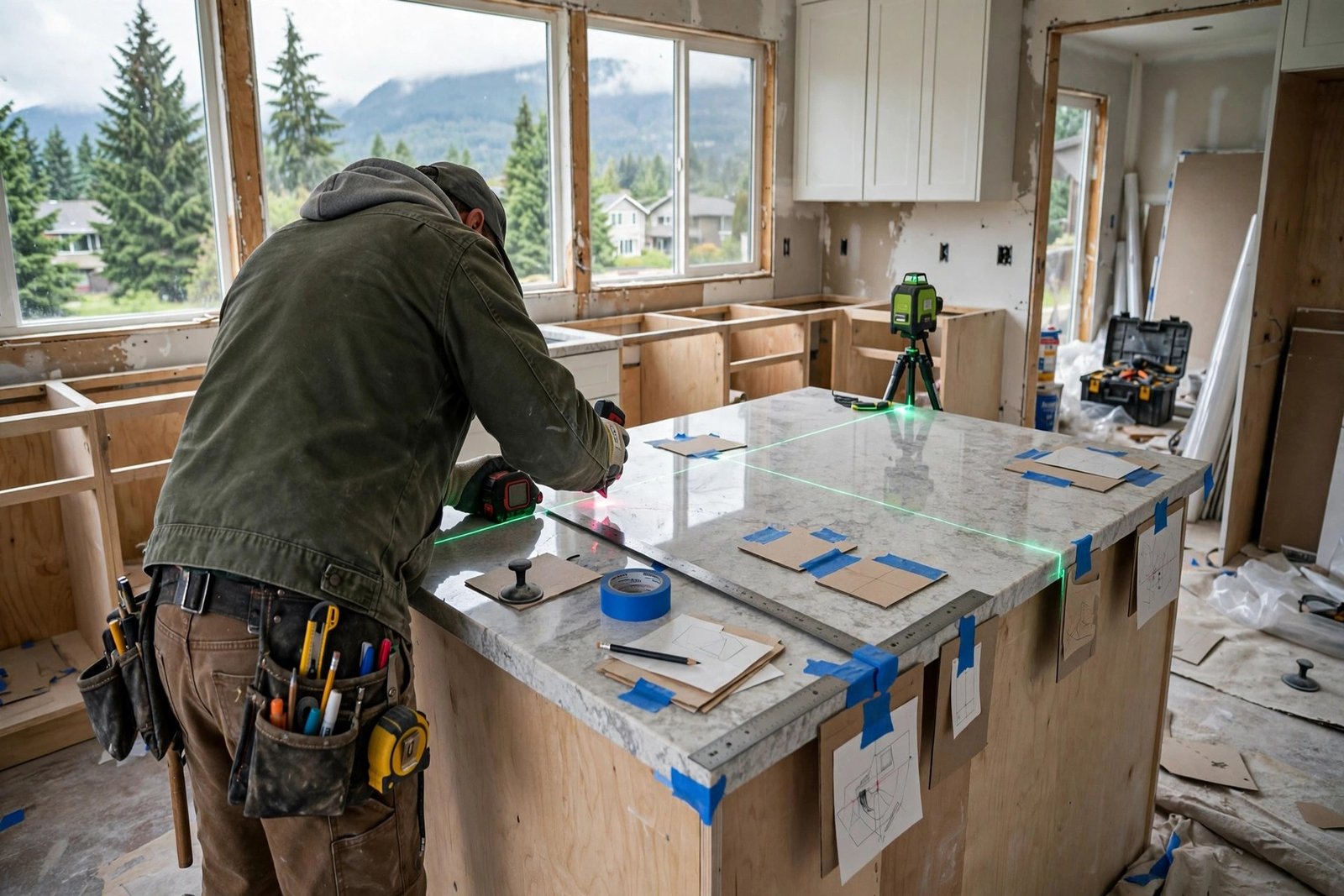
Stage 1: measurement and templating. This cannot happen until the cabinets are set and level — set, level, screwed to the wall, done being adjusted — because laminate and butcher block can be measured with a tape, but stone is measured with a laser template, a digital record of every wall irregularity, corner and overhang, and older Fraser Valley homes rarely have plumb walls. Not really. Not anywhere. The template converts a wavy wall into a scribe line the shop can cut to.
Stage 2: fabrication. The slab goes to the shop for cutting, edge profiling, sink and cooktop cutouts, and seam planning — one to three weeks of it, depending on the shop’s queue — with quartz patterns making seam placement predictable and granite and quartzite needing seams placed where the veining hides them, tucked into a dark vein where the eye slides past. The sink, faucet and cooktop must be on site in this window: the shop takes cutout dimensions from the actual fixtures, not from catalogue measurements.
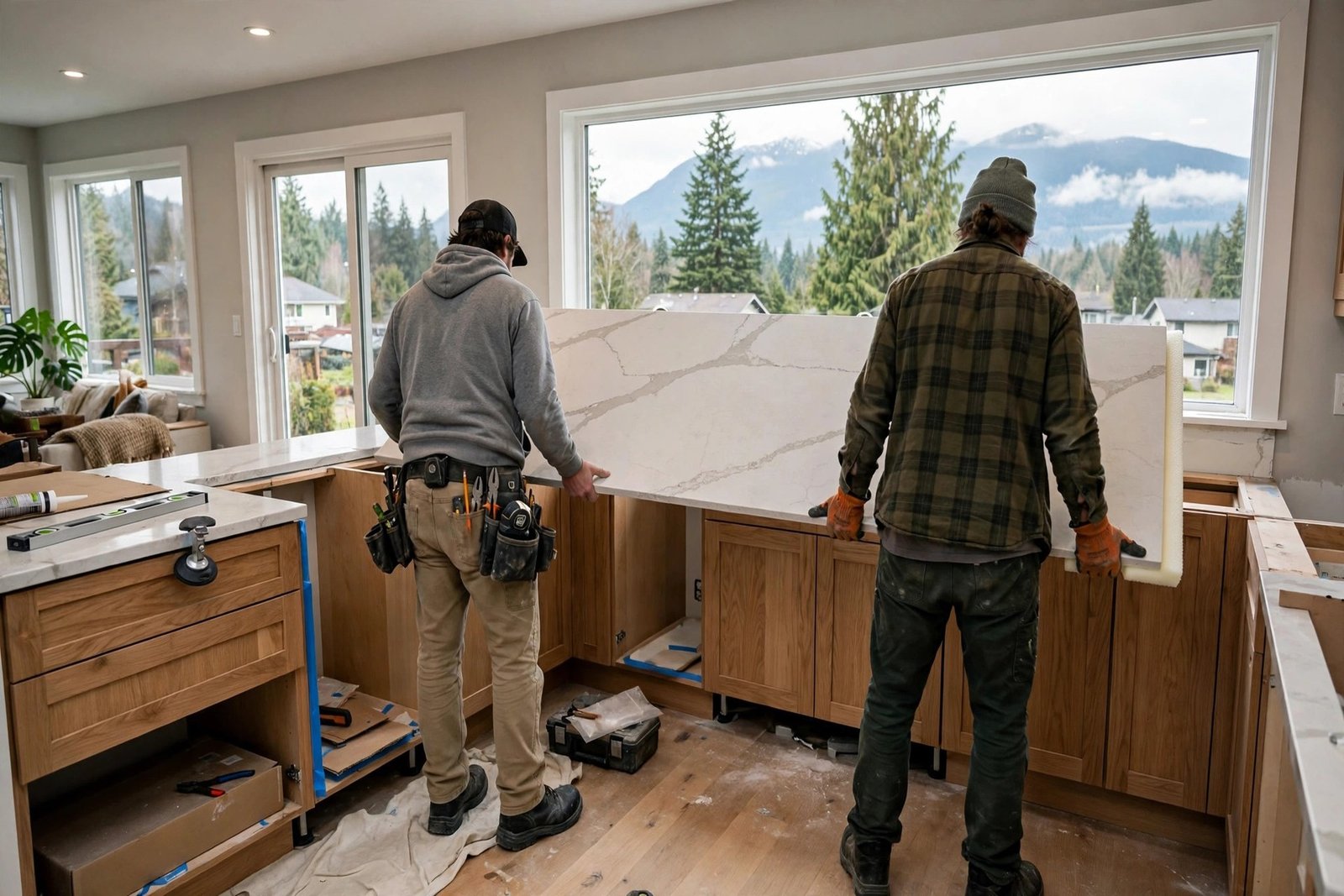
Stage 3: installation. The finished pieces are set in silicone or adhesive, levelled, seamed and polished — half a day to a full day for a standard kitchen, two installers moving very carefully and speaking very little — and the plumber then reconnects the sink, faucet and dishwasher.
The full process, from measurement to a working kitchen, runs three to six weeks. Put the countertop on the renovation schedule when the cabinets are ordered, not after they are installed. Countertops are also one of the larger single lines in a full kitchen project; our kitchen renovation cost guide for Abbotsford shows how they sit against cabinets, flooring and appliances.
5. Details That Move the Final Price
The sink. An undermount sink costs more to fabricate than a drop-in: the cutout is polished and the sink is bonded underneath. A farmhouse or apron-front sink needs the cabinet front modified. A double-bowl sink means two cutouts. Decide the sink before templating — before, while changing your mind is still free — because changing it after fabrication means buying a new top.
The edge. A standard eased edge is usually included. Bullnose, ogee and mitred profiles add fabrication cost per linear foot of edge — every foot, every profile, all the way around the room — and a waterfall edge on an island is priced as a second finished slab surface. On a tight budget, put the upgraded edge on the island only and run the standard edge around the perimeter.
The backsplash. A 4-inch matching backsplash is cheap and standard. A full-height slab backsplash behind the range is charged at the same per-square-foot rate, plus fabrication.
Removal of the old top. Taking out the old countertop, especially a tiled or stone one, and hauling it away runs $200–$600. Some installers include it. Many do not. Confirm before signing.
Seams. Any run longer than one slab — about 10 feet for quartz — gets a seam. There is no way around it, and good shops place seams at the sink or in low-visibility spots and colour-match the epoxy so the joint is hard to see — hard, not impossible, if you know where to look and the light is unkind. Treat a “no seams” promise on a 12-foot run as a warning sign and ask how it will be done.
6. Frequently Asked Questions
How much does kitchen countertop installation cost in BC?
For 2026, expect $30–$60 per square foot installed for laminate, $75–$150 for quartz, $70–$140 for granite and $100–$200 for quartzite. A typical 40-square-foot kitchen runs $1,200–$2,400 in laminate or $3,000–$6,000 in quartz, installed. These are planning ranges. Not quotes.
How much does quartz countertop installation cost in BC?
Quartz runs $75–$150 per square foot installed in BC. A standard 40-square-foot kitchen comes to $3,000–$6,000. The position inside the range depends on slab grade, edge profile, the number of sink and cooktop cutouts, and seam complexity. Premium patterns and waterfall edges sit at the top of the range.
What is the cheapest countertop option in BC?
Laminate. At $30–$60 per square foot installed — roughly a third of the quartz price, for a material that modern patterns have made genuinely hard to spot across a kitchen — with butcher block the next step up at $50–$110. Both are reasonable choices when the budget is needed for cabinets, appliances or structural work. Current laminate patterns are far better than the material’s old reputation suggests.
How long does countertop installation take?
The installation visit takes half a day to a full day. The full process — measurement after the cabinets are set, one to three weeks of shop fabrication, then installation — runs three to six weeks. Order and schedule the countertop when the cabinets are ordered, not after they are installed.
Can I install my own kitchen countertop?
Laminate and butcher block, yes — a homeowner with basic tools can install either. Stone tops — quartz, granite, quartzite — should not be attempted: the slabs weigh hundreds of pounds, the sink cutouts cannot be redone, and one wrong measurement ruins an expensive piece, permanently, in a way that no discount at the slab yard will soften. Most homeowners who install anything themselves hire the stone installation and handle the plumbing reconnection.
Planning a Countertop Installation in BC
Decide the material first.
It sets everything else — the per-square-foot price, the fabrication lead time, and whether self-installation is possible at all — so choose the sink, faucet and cooktop before templating, so the shop cuts from the real fixtures, and budget from the “typical 40 sq ft kitchen” column, not the per-square-foot figure, because nobody cooks on a per-square-foot figure. If you would like a second set of eyes on your plan, call us at (236) 613-0038 and we will talk through materials, lead times and a realistic 2026 budget. No pressure, just straight answers.