
A basement bar is two different projects wearing one name.
A dry bar, first, because it is the simpler animal: cabinets, a counter and a beverage fridge, and not one drop of water plumbed anywhere near it. Then the sink arrives — that is the wet bar — and a sink drags a whole system behind it: supply lines to feed it, a drain to empty it, a vent, each one threaded through walls and, on a bad day, through concrete, all of it travelling toward a bar that somebody has usually placed about as far from the basement’s pipes as the floor plan allows. Two projects, then. And two budgets that are not even cousins.
The short version: in 2026 the dry bar — no sink, no plumbing, remember — runs $1,500–$6,000. Give that bar a sink and the basic wet version lands at $7,000–$15,000, while the full treatment, stone counters, custom cabinetry and quality appliances, runs $15,000–$30,000+. And hovering over every one of those numbers sits a single question: how easily can plumbing actually reach the spot where the bar is going?
1. Dry Bar vs Wet Bar
| Dry bar | Wet bar | |
|---|---|---|
| Sink | No | Yes, bar sink with hot and cold |
| Plumbing needed | None | Supply lines, drain, vent |
| Typical 2026 budget | $1,500–$6,000 | $7,000–$30,000+ |
| Permits likely | No | Yes (plumbing and electrical) |
| Best for | Casual entertaining, kids’ snack station | Hosting, mixing drinks, glassware cleanup |
The honest test is not the Saturday-night version of the room, the one in your head with guests in it. It is a Tuesday — an ordinary Tuesday, nobody coming over, the bar doing whatever it does on a night like that. If what it mostly does is house the beverage fridge, somewhere to set down a coffee, a counter to line snacks up along, then the dry bar covers the job at a fraction of the cost, permits not required. But if the dinners actually happen down there — cocktails mixed, glassware piling up while the guests are still in the room — the sink starts paying for itself in trips upstairs nobody has to make anymore. Every trip. All winter long.
And then there is the option that sounds like a compromise and is not one: build the dry bar now, the thinking goes, and just add the plumbing later.
Retrofitting a drain into a finished bar — through finished walls, through finished flooring, around finished cabinetry that was never designed to move — costs far more than roughing it in while everything is open. Decide at the start. A dry bar chosen on purpose is a good project. A dry bar chosen as a placeholder is a down payment on a redo.
One BC-specific point. A wet bar with a sink, a fridge and a long run of counter starts to resemble a mini kitchen — and municipalities notice, they have seen this film before — so a bar sink on its own is fine, while adding a cooktop or a full-size range moves the project toward second-kitchen territory, with questions about suites, zoning and permits. Keep the bar a bar.
2. Plumbing and Electrical: The Hidden Half of the Budget
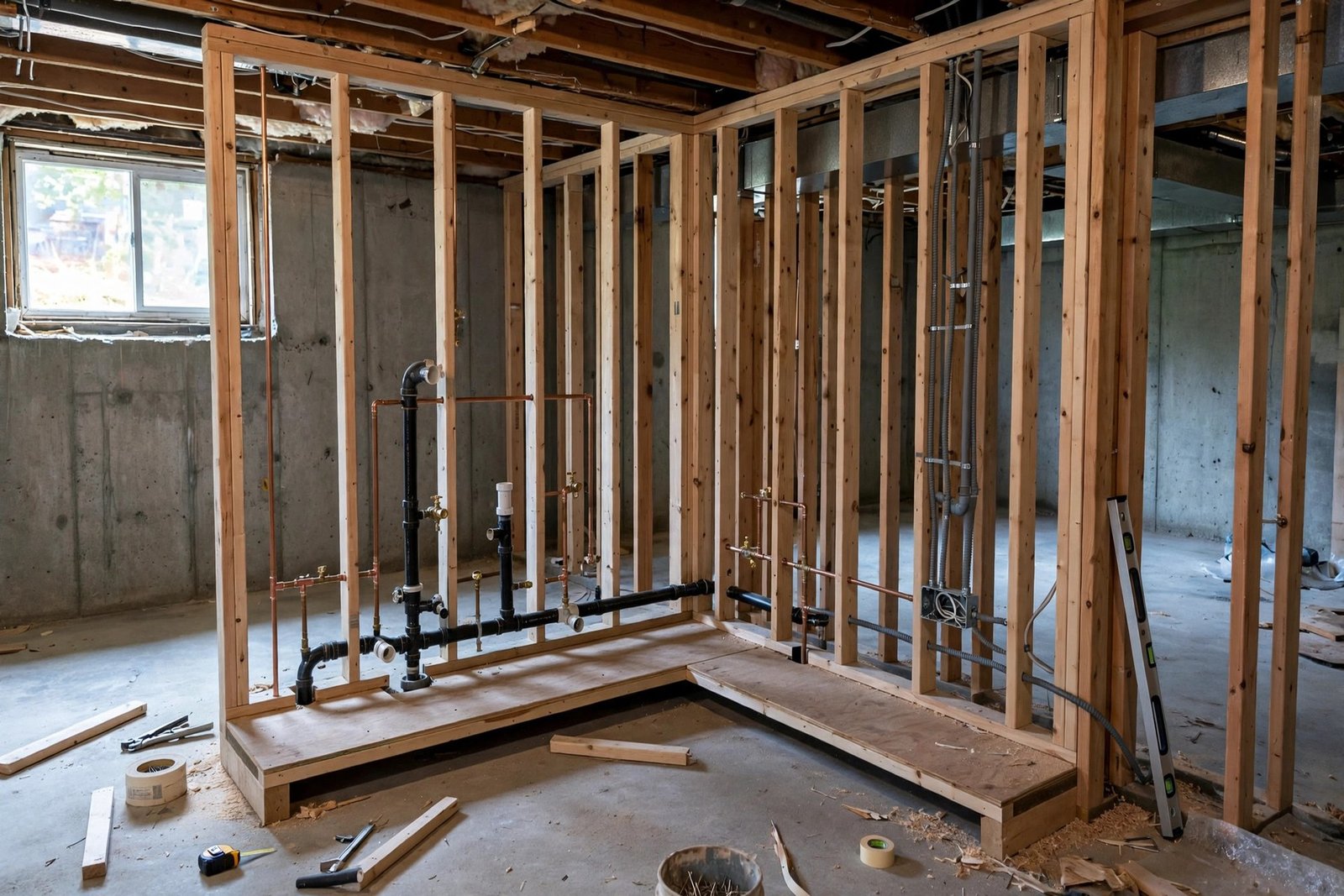
The visible part of a wet bar — cabinets, counter, faucet — is only about half the budget.
The other half is in the walls. And under the slab.
Plumbing. A bar sink needs hot and cold supply lines. The harder part is the drain: it has to slope back to the main stack, and it has to be vented, and in a basement this gets awkward fast, because drains often tie in below the slab or the run needs a lift to reach the stack. Rough-in plumbing for a bar sink typically runs $1,500–$4,000 in 2026 BC pricing when access is reasonable. Cutting concrete raises the price from there. Get the plumbing quoted as its own line before cabinet styles are chosen.
Location. Location is the main cost variable — the main one, the one that swallows the others. A bar under the kitchen or beside a bathroom, sharing a wet wall or dropping into existing drain lines, is straightforward. A bar on the opposite side of the basement from every pipe adds $2,000–$5,000 for the plumbing run alone. Drains need slope. Slope needs ceiling height to spare or a pump, and pumps cost money.
Electrical. The bar needs dedicated circuits for the fridge, and for a wine fridge or dishwasher drawer if they are in the plan. It also needs lighting and GFCI-protected outlets at the counter — the countertop outlet rules that apply in kitchens apply at a bar, no exceptions for it being a fun room — and budget $800–$2,500 for the electrical scope, more if the panel needs space or the run is long. Plumbing and electrical work in a BC basement needs permits and inspection. It is not a grey area. Nothing about that is grey, or close to grey, or even in the same neighbourhood as grey.
Ventilation. Moisture arrives at a bar from three directions at once: the sink, a dishwasher if one is fitted, and a room full of people. What handles it is unglamorous — a bathroom-style exhaust fan, on a humidistat, vented outside. A joist bay is the one place that vent must never go. Never. And if the basement carries any history of dampness, that gets solved ahead of the bar going in — not alongside it, not once the cabinets are already hanging — because cabinetry and moisture together end badly every single time. Our basement renovation cost guide for Abbotsford covers the moisture-proofing steps that should come first.
3. Wet Bar Budget Tiers
With the hidden costs understood, the visible costs sort into three bands:
| Tier | What it includes | 2026 planning range |
|---|---|---|
| Basic wet bar | Stock cabinets, laminate counter, bar sink and faucet, beverage fridge, simple backsplash, LVP or tile flooring already in place | $7,000–$15,000 |
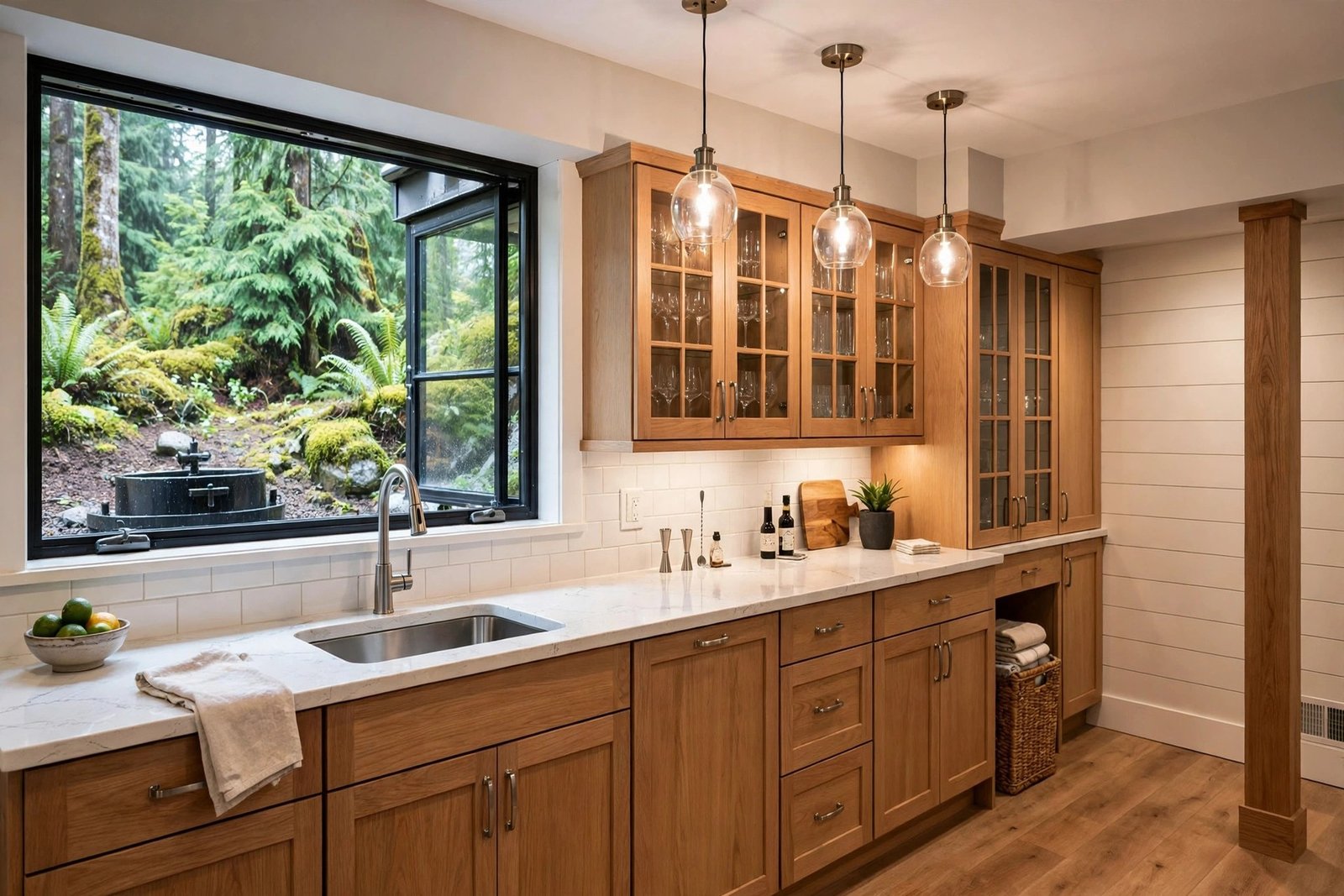
| Mid-range wet bar | Cabinetry steps up to semi-custom, counter to quartz or stone, undermount sink and a quality faucet, beverage fridge joined by a wine fridge or dishwasher drawer, tile backsplash, lighting dedicated to the bar | $15,000–$25,000 |
| High-end wet bar | Millwork built custom, stone counter run down a waterfall edge, premium fixtures, appliances integrated into the cabinetry, feature lighting, display shelving, a stone or feature wall | $25,000–$40,000+ |
Three notes on the table, and the first is the one budgets trip over: the basic tier is quietly assuming a basement already finished and plumbing that reaches the bar’s location without major work — hand it an unfinished basement or a difficult plumbing route instead, and every number moves up, all of them, together. Second, the jump from basic to mid-range is mostly cabinetry and counter, so those two decisions deserve more attention than the faucet — a beautiful faucet on the wrong counter is still the wrong counter. Third, the high-end tier is open-ended — custom millwork and integrated appliances have no natural ceiling at all — so the appliance list and the stone choice, and really nothing else, set the number in that band.
4. Appliance Prices
Price the appliances before the cabinetry. Not after. Before.
The appliances set the cabinet dimensions — the actual dimensions, in millimetres, with the ventilation clearance undercounter units need — and cabinetry ordered in the wrong size is an expensive correction, the kind where the correction costs more than the original mistake.
| Appliance | 2026 planning range |
|---|---|
| Beverage fridge (undercounter) | $600–$1,800 |
| Wine fridge (undercounter) | $800–$2,500 |
| Dishwasher drawer | $1,200–$2,000 |
| Ice maker (undercounter) | $1,500–$3,500 |
| Kegerator | $1,000–$2,500 |
So the tape measure comes out before the cabinet order does: the actual units, measured themselves, rather than the figures printed in a brochure. An ice maker, to pick the one that catches people, needs a water line, and that line belongs in the rough-in — arranged early, on paper — rather than surfacing as a phone call in the middle of finishing. Circuits get counted at the same moment, because a fridge, a wine fridge, a dishwasher drawer and the feature lighting, added up, can want two or three dedicated circuits between them. Which is why the panel question belongs in the planning stage, where it always belonged, and not in week three, electrician in the doorway, waiting on an answer.
5. Moisture Checks Before You Build
Hydrostatic pressure, seasonal dampness, heavy rain — a Fraser Valley basement lives with all three, all the time, which is why four checks come before any bar gets built in one:
- Test the slab. A square of plastic, taped down to the concrete and left alone for 48 hours, tells you plenty: condensation gathered underneath is moisture migrating up through the slab, and if that is what the plastic shows, then grading, gutters and drainage get fixed first — cabinetry can wait its turn.
- Ventilate the bar area. Sink steam and the moisture a roomful of guests generates both need somewhere to go; an exhaust fan on a humidistat, vented outside, sends it there without anybody having to remember a switch.
- Keep cabinetry off damp concrete. On the finished floor is where cabinets sit — never on the slab itself — and the wall behind the bar wants a proper vapour strategy of its own.
- Choose finishes that forgive moisture. On the floor, tile or luxury vinyl plank; laminate is the one to leave behind. Behind the sink, a tile backsplash — paint there will peel, and peeling is all it will ever do.
Set against the price of the bar itself, none of it amounts to much.
Retrofitted afterwards, all of it does.
And if the basement as a whole is still at the planning stage, our basement finishing ideas lay out the running order — moisture first, finishes second, that sequence, every single time.
6. What Pushes the Price Up or Down
- Plumbing distance. The variable that dominates all the others. A bar sitting under the kitchen costs little to feed; one across the house does not.
- Countertop choice. Laminate to quartz to natural stone is a $1,000 to $5,000+ swing on a typical bar run.
- Cabinetry tier. The same ladder as kitchens — stock, semi-custom, custom millwork — at roughly kitchen-per-foot pricing.
- Appliance count. Each undercounter appliance adds its purchase price plus its circuit, water line or ventilation requirement — nothing undercounter is ever just the box.
- Finishing scope. If the bar is going into an unfinished basement, the walls, ceiling, flooring and lighting around it are a separate project. The room gets priced first; the bar comes after that.
7. Frequently Asked Questions
How much does a basement wet bar cost in BC?
The 2026 planning numbers, then: $7,000–$15,000 buys a basic wet bar, stock cabinets and a bar sink included; the mid-range version, stone counters and quality appliances on it, runs $15,000–$25,000; and a high-end custom bar reaches $25,000–$40,000+. The dry bar, no plumbing anywhere in it, sits at $1,500–$6,000. Planning ranges, all of them — not quotes — and where a project lands inside them depends, as ever, on the route its plumbing has to travel.
Is a wet bar worth it over a dry bar?
It depends on how you host. If you have people over regularly and want to mix drinks and clean glassware without going upstairs, yes — the sink is the point, the whole point, the only point that matters at eleven o’clock with a counter full of glasses. If the bar is mainly for casual drinks and snacks, a dry bar with a good beverage fridge delivers most of the experience for a fraction of the cost and no permits. What you should not do is build a dry bar with a wet one secretly in mind. Adding the plumbing afterwards, into a bar already finished, costs far more than simply choosing it now.
Do I need a permit for a basement wet bar in BC?
For a wet bar, generally, yes. The trigger is the work itself: new plumbing and new electrical usually arrive with plumbing and electrical permits and inspections attached, while a dry bar — no plumbing changed, no electrical changed — generally needs none of that. Which municipality you are in still matters, and the rules vary, so the city or district hears from you before work starts, not after. One more wrinkle: cooking appliances, once they enter the picture, can change how the space is classified. That conversation is a bigger one. Considerably.
How long does it take to build a basement wet bar?
Two to four weeks for a basic wet bar once materials are on site. Four to eight weeks for a mid-range or custom bar with stone counters and multiple appliances. Permit processing and cabinet lead times sit on top of that — on top, always — so plan the schedule from the permit application, not from demolition day.
Can I put a wet bar anywhere in the basement?
Technically, anywhere you like. The budget has opinions, though. Near existing plumbing — tucked under or beside a kitchen or bathroom — a location keeps its costs in range; far from the drains, the run stretches out long and sloped, or a pump enters the picture, and thousands get added before one cabinet comes out of its box. Walk the basement with your plumber before committing to a spot. Tape measure in hand. Eyes open.
Planning a Basement Wet Bar in BC?
Decide wet versus dry first.
Then let the plumbing location set the budget: a bar near existing drains is a straightforward project, and a bar across the basement is a plumbing project with a bar attached — there is no third kind. Price the appliances before the cabinetry, ventilate for the damp climate, and get the plumbing quoted as its own line before anything else. If you have questions about basement wet bar cost in BC for your specific basement, call us at (236) 613-0038 for straight answers with no pressure.