
Doors are priced per door.
That is the headline, and it is true, and it is also how budgets go wrong — because the slab is only part of the cost, sometimes the smaller part, while the frame it hangs in, the hardware screwed to it, the paint rolled over it and the trim nailed around it each add their own line to the total, and those lines, the quiet ones, the ones nobody puts in the first spreadsheet, are the ones most often missed.
Count first.
Most three-bedroom homes in Abbotsford have eight to twelve interior doors — count them sometime, actually walk the house and count, because the number surprises people — and in homes over twenty years old the existing doors are usually hollow-core, light as balsa, while the frames have often shifted slightly out of square, a quarter inch here, a sticking latch there, the house settling into its third decade the way houses do. Both facts affect the price. Both are worth knowing before the quote, not after.
The short version: interior door replacement cost in BC runs $150–$800 per door installed in 2026. A full house of eight to twelve doors usually lands between $2,500 and $7,000, including hardware, painting and trim. The main variables are door type, whether the frame is replaced, and how much finishing is included.
1. Cost Per Door, Installed
2026 BC planning ranges, per door, installed:
| Door type | What you get | 2026 planning range per door |
|---|---|---|
| Hollow-core slab (existing frame kept) | New slab hung on the old frame and hinges | $150–$300 |
| Pre-hung hollow-core | New door, frame and casing; the standard replacement | $250–$450 |
| Pre-hung solid-core or panel | Heavier door, better sound and feel, new frame and casing | $400–$800 |
| French or bifold pair | Double doors for closets and room dividers | $500–$1,200 |
| Barn door with hardware | Slab plus track, rollers and mounting | $400–$900 |
Most homeowners do not pay the extremes. The cost per door for a typical Abbotsford project sits in the $300–$500 band — the middle, where most houses live. The common pattern is pre-hung hollow-core or entry-level solid-core doors through most of the house, with one better panel door in the rooms guests see. The front rooms get the good doors. The bedrooms get the sensible ones. The full-house total is mostly multiplication: the per-door price times the door count, plus the add-on costs in Section 3 — plus them, always plus them, because multiplication alone will lie to you politely.
Two factors create the spread in the table. The first is the door itself: a hollow-core slab costs a fraction of a solid-core pre-hung unit at the supplier. A fraction. The second is labour, and it does not work the way most people expect — hanging a slab in an existing frame is slow fitting work, shaving and planing and test-closing a dozen times, while installing a pre-hung unit is demolition and trim carpentry, faster per door in practised hands. The skills differ. The hours differ. And in the Fraser Valley, the finish carpenter’s hourly rate moves the total more than the door price does — the person, not the product, is the expensive line.
2. Slab or Pre-Hung
The terms matter, because the two products suit different houses.
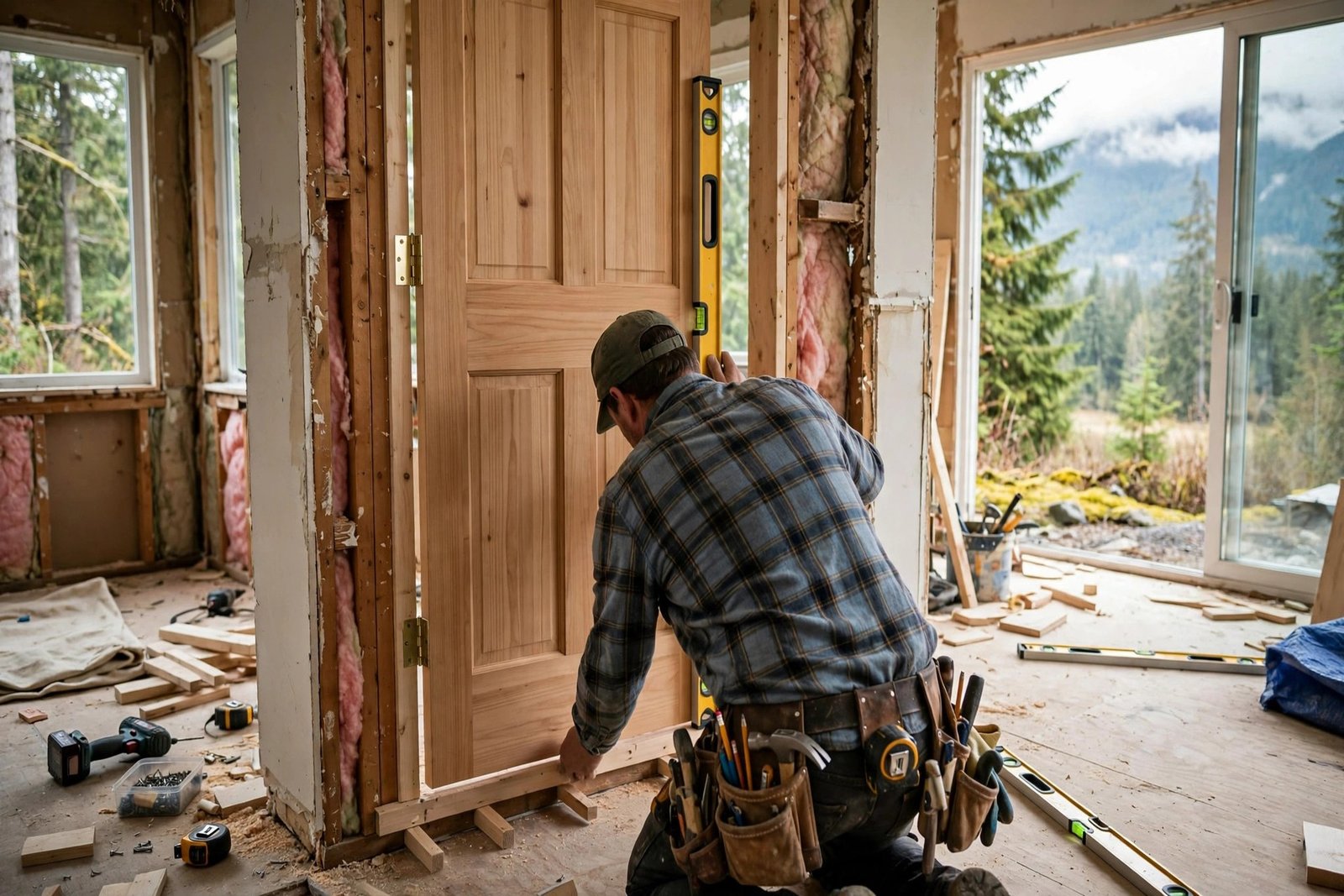
A slab is the door only, with no frame. A pre-hung door arrives mounted in its own frame, hinges set, ready to be levelled into the rough opening and trimmed out.
Slabs suit newer homes where the existing frames are square, solid and worth keeping. The installer mortises the hinges, bores for the handle and fits the slab to the frame by hand. By hand. It is precise work — the kind of precise where a millimetre is the difference between a door that glides and a door that argues — and note this, because it surprises everyone: the fitting labour on a slab can approach the cost of a pre-hung install. The cheaper door does not always produce the cheaper job. Sometimes it produces the same job wearing a disguise.
Pre-hung units suit older homes. Frames go out of square as houses settle. Old paint builds up in uneven layers — decades of it, coat over coat, archaeology you can sand. Hinge mortises wear loose. A pre-hung unit avoids all of it: the old frame comes out, the new frame goes in plumb, and new casing is included. BC contractors typically quote $250–$450 per door for standard hollow-core pre-hung units. Solid-core units cost more because the doors are heavier — genuinely heavier, two-person heavier — and the fitting takes longer. There is also this, which homeowners rarely hear until the work starts: a pre-hung unit forgives the house its history — the settling, the shifting, the forty years of small movements that no house escapes — because the new frame establishes its own truth inside the opening, plumb and square regardless of what the walls around it have decided to do.
Changing the opening itself is a different job. A different species of job. Widening a doorway, converting a single door to a double, or adding a door where none exists is framing work first and door work second. Budget it as a small construction project, not a door swap.
3. Costs Around the Door
The doors themselves are rarely the surprise in a whole-house project.
The smaller costs around them are.
- Hardware. Handles, hinges and stops run $30–$150 per door. Basic contractor-grade levers sit at the bottom of the range. Matched levers in matte black or brushed nickel sit in the middle. Matching matters more than the metal: matched hardware is what makes new doors look planned rather than piecemeal. Do not reuse twenty-year-old brass hinges on new doors. At roughly $8 per hinge, new hinges are the cheapest visual upgrade in the project — the cheapest, full stop, in a project full of three-figure lines.
- Paint. A pre-hung door arrives primed, not finished. Professional painting runs $75–$150 per door for both sides plus casing, and more for sprayed finishes or dark colours. Across ten doors this is a real budget line. Some homeowners paint the doors themselves and hire out only the carpentry. Either approach works. Leaving the line out of the budget does not.
- Casing and trim. Pre-hung installs usually include new casing. Upgrading the casing profile, going wider, or replacing baseboards to match adds $50–$150 per door in materials and labour. It is optional. It is also the detail that separates a door swap that looks new from one that looks finished, because the eye reads the trim around a door as much as the door itself — the frame around the painting, noticed by everyone, credited by no one.
- Small items. Door stops, shims, longer screws for strike plates, and patching where the old casing was wider than the new. Budget a few hundred dollars across the whole house.
Together, these lines can make up a third of the budget. A third. Homeowners remember the doors and forget the ring of costs around them, and the ring is where the estimate quietly becomes the invoice.
If painting is part of the wider plan, our interior house painting cost guide for Abbotsford sets out 2026 pricing for whole-house and room-by-room paint work. It helps you decide whether to bundle the doors into a larger painting project and save a separate visit — one painter, one setup, one round of drop sheets instead of two.
4. Order of Work: Flooring, Paint and Phasing
Sequencing affects cost.
Flooring is the main point — the point people get backwards. Door clearances are set for the finished floor height, so replacing doors before new flooring goes in can mean trimming or rehanging them afterwards, paying for the same fitting twice, once for a floor that no longer exists. The correct order is floors first, then doors fitted to the floors. If both jobs are happening anyway, one finish carpenter booked for the combined work costs less than two separate callouts, and the trim ties together cleanly. Our flooring installation cost guide for BC covers 2026 per-square-foot pricing if you want to budget the pair together.
Paint is the other natural bundle. New doors against tired walls look unfinished — visibly, naggingly unfinished, the new thing accusing the old thing every time you walk the hallway. Many homeowners roll the door swap into a whole-interior repaint, and the per-door painting cost drops when it is part of a larger job instead of a standalone visit.
The work can also be phased. A common pattern is the visible doors first: entry hallway, living areas and main bathroom, with bedrooms and closets following when the budget allows. Phasing suits real budgets — the doors guests see get replaced this year, the doors only family sees wait for next year — and it suits real houses, where living through a whole-home door swap, with every doorway in the building dismantled at once, is its own small adventure in privacy. One caution applies if you phase the work. Buy the hardware for the whole house at once. All of it. Finishes get discontinued — cheerfully, without notice, mid-renovation — and a half-matched house looks worse than an all-old one.
5. Reading a Quote
Door quotes vary more than the work warrants.
Considerably more. Check the following before you commit:
- The quote names the door type and brand or grade.
- It states whether each unit is slab or pre-hung.
- It states the hardware allowance per door.
- It states whether painting is included or excluded.
- It states what happens to the old doors. Disposal is a small line that causes outsized arguments when nobody mentions it.
Quotes come in two structures. Labour-only quotes are common: you supply the doors and the carpenter installs them, which lets you shop sales. Full supply-and-install costs more but puts the measuring risk on the contractor, and wrong-sized doors are expensive mistakes — expensive, heavy, non-returnable mistakes leaning against the garage wall, reminding you, every time you park, that a tape measure is only as honest as the person holding it. For pre-hung units, supply-and-install is usually the simpler option, because the person who measured is the person who answers for the result.
Permits are not an issue for straightforward door swaps in BC. The work does not touch structure, plumbing or electrical. The exception is a project that widens openings or moves walls. That is structural work — actual structural work, with a header holding up your house — and is permitted accordingly. If your project goes beyond swapping doors in existing openings, confirm the requirements with your municipality.
6. Frequently Asked Questions
How much does interior door replacement cost in BC?
Plan on $150–$800 per door installed for 2026, depending on type. A hollow-core slab in an existing frame is $150–$300, a standard pre-hung door is $250–$450, and a solid-core pre-hung unit is $400–$800. A full house of eight to twelve doors typically runs $2,500–$7,000 including hardware, painting and trim. Planning ranges. Not quotes.
Should I replace just the slab or buy pre-hung doors?
Look at your frames, not the door catalogue. Keep the slab route when the existing frames are square and solid, which is common in newer homes. Choose pre-hung when frames are out of square, damaged or buried under decades of paint, which is common in older Fraser Valley homes. Pre-hung also gives you fresh casing, which is half the visual upgrade — half, sitting there in the trim while everyone admires the door.
How long does it take to replace all the interior doors in a house?
A skilled carpenter typically installs two to four pre-hung doors per day, so ten doors is roughly three to five days of carpentry, plus painting after. Slab swaps run slower per door because of the fitting work.
Do new interior doors need to be painted?
Unless you buy factory-finished doors, yes. Pre-hung doors arrive primed and need topcoats on both sides plus the casing. Budget $75–$150 per door for professional painting, or plan to do it yourself. Leaving primed doors unpainted lets moisture in and looks unfinished — a grey, thirsty, temporary look that has a way of becoming permanent.
Will new interior doors increase my home’s value?
Not the way a kitchen does, no. Do not buy them expecting an appraisal bump. What they improve is perceived quality, which matters to buyers: how solid and cared-for the whole house feels — the weight of a door closing, multiplied by every room in the house, adding up to an impression nobody can name and everybody registers. Treat doors as a finishing upgrade that supports your price rather than one that raises it directly.
Planning an Interior Door Replacement in BC?
Count the doors first, then decide the scope.
Count them. Walk the house. If the frames are sound, slabs in the bedrooms and pre-hung units where frames have suffered keep the budget sensible. If the house has settled and nothing is square — nothing, not a frame in the building — pre-hung throughout is the simpler path, and the trim upgrade comes with it. Either way, budget the hardware, painting and trim from the start. The interior door replacement cost in BC that surprises people is never the doors. It is everything around them. To talk through your doors, your frames and what the project would realistically cost, call us at (236) 613-0038 for straight answers with no pressure.