
Cabinet painting sits in the sweet middle of kitchen updates. It costs a fraction of refacing or replacing. Days, not weeks. And done properly — sprayed, not brushed — the result reads as new cabinets to everyone except the person who paid for the old ones. Done badly? It chips within a year. And you get to pay for it twice. This guide covers what professional cabinet painting costs in BC in 2026, what the price actually buys, and how to tell which kind of quote you are looking at.
The short version: professional cabinet painting in BC runs roughly $2,000–$4,000 for brush-and-roll work and $4,000–$8,000 for a sprayed HVLP finish on a typical kitchen (25–40 doors and drawer fronts), or about $100–$175 per piece sprayed. The spray finish costs more because of the prep, the containment, and the cure — and it is the only version worth buying.
For context on where painting sits in the full range of cabinet options, our cabinet refacing vs replacing guide prices the two bigger interventions. Painting is the third path: same boxes, same layout, new finish.
1. Cabinet Painting Costs at a Glance
| Approach | 2026 BC planning range (typical kitchen) | Finish quality | Durability |
|---|---|---|---|
| DIY brush-and-roll | $200–$800 in materials | Hand-painted look, visible texture | Depends entirely on your prep patience |
| Pro brush-and-roll | $2,000–$4,000 | Clean but visibly painted | Good if prep is thorough |
| Pro HVLP sprayed | $4,000–$8,000 | Factory-smooth | Best — the finish cabinets are born with |
| Refacing (for comparison) | $8,000–$15,000+ | New doors and drawer fronts | 15–20 years |
| Replacing (for comparison) | $12,000–$25,000+ | All new | 20+ years |
“Typical kitchen” here means roughly 25–40 doors and drawer fronts. Think the standard Abbotsford suburban kitchen. A 1990s oak kitchen in a Matsqui Park two-storey, say. Or a 2000s maple kitchen in East Abbotsford. Smaller galley kitchens land below these ranges. Sprawling ones — pantries, islands, glass fronts — land above.
2. What Professional Cabinet Painting Actually Includes
The price gap between a $2,500 quote and a $6,500 quote? It is not margin. It is process. A proper sprayed cabinet job follows roughly these steps, and every skipped step is a future chip:
- Removal and labelling. Every door comes off. Every drawer front, too. Hinges and hardware come off. And each piece gets labelled — so it goes back exactly where it came from. Hinges are bagged per door. This alone is half a day in an average kitchen.
- Degreasing. Kitchen cabinets wear a film of cooking grease, even in clean kitchens — especially around the stove and on the doors nearest it. Pros wash everything with TSP substitute or a dedicated degreaser, sometimes twice. Paint does not bond to grease. This is the step DIY jobs skip and the reason DIY jobs fail.
- Sanding. Every surface gets a scuff-sand. The primer needs something to grip. Rough or damaged spots get a full sand. And between coats? A fine sanding knocks down dust nibs. It keeps the finish glassy.
- Priming. A bonding primer — shellac-based or high-adhesion acrylic — locks down the old finish. The topcoat gets a uniform base. Going from dark stain to white? That typically needs two primer coats. The primer does the heavy covering work, so the topcoat does not have to.
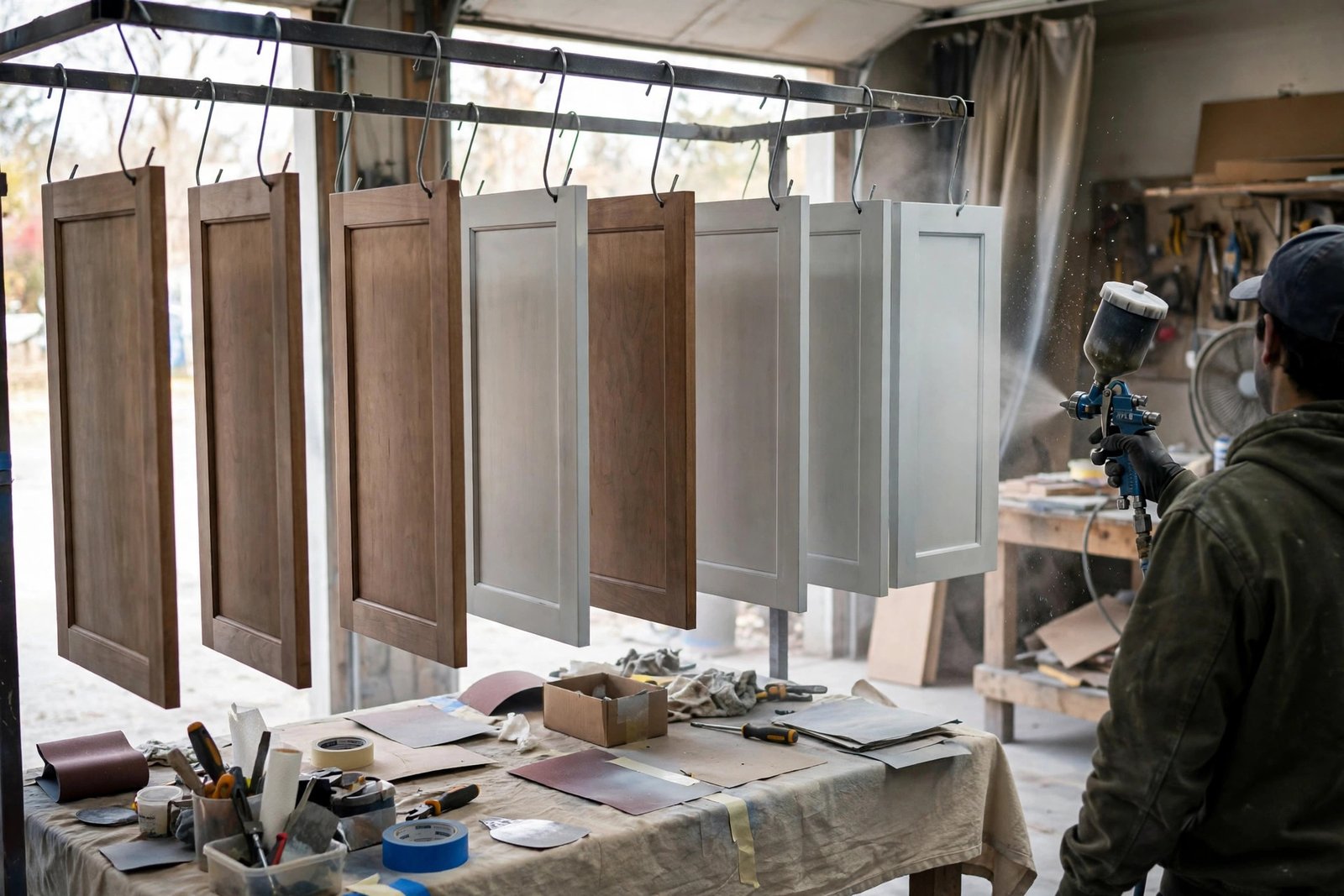
- Spraying the topcoats. Two coats of a cabinet-grade coating. Sometimes three. Usually a waterborne alkyd or urethane enamel — sometimes a 2K polyurethane, for maximum hardness — applied with an HVLP or fine-finish sprayer. Doors get sprayed in a controlled setup, often off-site in a shop. The cabinet boxes? Sprayed in place, inside a sealed containment.
- The boxes. While the doors cure in the shop, the frames get masked, primed, and sprayed in your kitchen. Side panels and face frames, too. This is the disruptive part. For a day or two, your kitchen becomes a plastic-sheeted spray booth.
- Cure and reassembly. Doors go back on, hardware is reinstalled (or new hardware goes on — the moment to upgrade), and then the finish needs to cure. This is the step everyone underestimates: see section 7.
Steps 2 through 5 — that is what you are paying for. The paint itself? The cheapest part of the job.
3. Per Door vs Per Linear Foot vs Flat Bid
Cabinet painters quote three ways, and knowing which you are looking at keeps comparisons honest:
Per piece ($100–$175 sprayed in BC). The most common method for spray specialists. Each door or drawer front counts as one piece; large pantry doors may count as 1.5–2. Count your pieces — open every cabinet and tally doors plus drawer fronts — and you can sanity-check any quote in thirty seconds. A 32-piece kitchen at $140 a piece is $4,480 before extras.
Per linear foot ($80–$150). Measured along the wall the cabinets occupy, uppers and lowers counted separately by some painters. Faster to quote, harder to compare, because a linear foot of drawers is far more work than a linear foot of plain doors.
Flat bid. One number for the whole kitchen. Fine if the scope is spelled out — piece count, primer type, number of topcoats, hardware handling, and what happens to the interiors (usually nothing; see below). A flat bid with no scope detail is a guess, not a quote.
Whatever the format, confirm these inclusions: degreasing method, primer type, topcoat product and number of coats, whether doors are sprayed off-site, hardware removal and reinstallation, and touch-up policy. Two quotes are only comparable when they describe the same job.
4. Why the Spray Finish Costs What It Costs
A brush-and-roll painter needs brushes. Rollers. A drop cloth. A spray specialist needs all of this:
- Containment. Your kitchen gets sealed in plastic sheeting — floors, countertops, appliances, ceilings, adjacent rooms — before a drop of paint is atomized. Building and removing the containment is a full day of labour across the project.
- Off-site spraying. Many specialists take doors to a shop. A proper spray booth — controlled temperature, filtered air, drying racks. Shop time is overhead you are renting.
- Equipment and coatings. An HVLP or fine-finish airless setup costs real money. So do cabinet-grade coatings — 2K poly or urethane enamel at $80–$120+ per gallon. Multiples of wall paint and a roller sleeve.
- Time. A sprayed kitchen takes 5–10 working days door-to-door. Brush-and-roll? 2–4. Most of that is cure time between coats, and cure time cannot be hurried without softening the finish.
The result is the difference between “nice paint job” and “are those new cabinets?” No brush marks. No roller stipple. Uniform sheen on every profile and edge. On a kitchen you will look at every day for a decade, that premium is usually money well spent. The brush-and-roll option has its place — rental properties, quick sale prep, laundry rooms — but go in knowing what it is.
5. When Painting Is the Wrong Call
Painting is a finish. It is not a repair — and it cannot fix what is wrong underneath. Walk away from painting — toward refacing or replacing — when:
- The substrate is failing. Peeling thermofoil — the vinyl wrap on many 2000s MDF cabinets — will not hold paint. Neither will water-swollen MDF around the sink. Or delaminating particle board. The finish will fail with the substrate, usually within a year or two.
- You have heavy oak grain and expect glass-smooth. Oak’s open grain shows through paint unless the grain is filled — a labour-intensive extra step ($500–$1,500 for a full kitchen) that many quotes omit. Unfilled oak painted white looks like painted oak, which is fine if that is what you want, but it is not the Instagram finish.
- The layout or function is the problem. Paint does not fix bad storage, a broken lazy Susan, drawers that stick, or a layout you hate. If you are painting cabinets you plan to rip out in three years, you are spending $5,000 to delay a decision.
- You want dark-to-white on laminate. Laminate (melamine) cabinets can be painted. The right bonding primer makes it possible. But adhesion is the weakest of any substrate — and dark-to-light needs extra coats. It works; it is also the scenario most likely to chip at edges and handles.
- The boxes are structurally tired. Stripped hinge screws. Sagging shelves. Carcasses that flex when you lean on them. Those are replacement signals. New paint on a dying box is the most expensive kind of false economy.
A good painter will tell you when your cabinets are not paintable. If every bidder says yes without looking closely at the substrate around the sink and dishwasher, keep looking.
6. What to Ask Before You Hire
Cabinet painting is a specialty — a great wall painter is not automatically a good cabinet painter. Five questions separate the specialists from the generalists:
- “What primer and topcoat do you use, specifically?” You want product names: a shellac or bonding primer and a cabinet-grade urethane enamel or 2K poly topcoat. “Premium cabinet paint” without a product name is a non-answer.
- “Do you spray the doors off-site?” Shop spraying signals a specialist setup. On-site-only spraying can still be good, but ask how they control dust.
- “How do you handle the oak grain / the dark stain?” (Whichever applies.) The answer should mention grain filler or extra primer coats, not “the paint covers everything.”
- “What is the cure schedule, and when can I use the kitchen normally?” See section 7 — anyone who says “24 hours and you are good” is rushing.
- “What does your workmanship warranty cover, and for how long?” Get it in writing. Note what it excludes — normal wear at handles and edges is the usual carve-out.
Also confirm the hardware question early: reusing old hinges and pulls saves money, but new soft-close hinges and modern pulls (roughly $5–$15 per piece of hardware plus installation) transform how the kitchen feels. Most homeowners doing a sprayed finish upgrade the hardware at the same time — it is the cheapest luxury in the project.
7. Living Through It: Timeline and Cure Time
A sprayed cabinet project runs 5–10 working days: a day or two of removal, degreasing, and masking; spray days for boxes; shop time for doors; reassembly. Your kitchen stays usable for most of it — the stove and fridge keep working — but expect plastic sheeting, no cooking during spray days (overspray and open flame do not mix), and doors missing for several days. Plan simple meals or a takeout budget for the spray window.
Then comes the part nobody warns you about: cure time. The paint feels dry in hours. But cabinet coatings take 14–30 days to fully harden, depending on the product. During that window, the finish is vulnerable. Set a heavy appliance down hard and you can dent it. Slam a door, scrub at a mark — marred, permanently. So treat the cabinets gently for the first month. No abrasive cleaners, ever — use a damp microfibre cloth. No wet dish towels hanging over doors. And reattach the door bumpers, so doors close softly. A finish that cures undisturbed will outlast one that gets abused in week two. By years.
Frequently Asked Questions
How much does it cost to paint kitchen cabinets in BC?
Roughly $2,000–$4,000 for professional brush-and-roll and $4,000–$8,000 for a sprayed HVLP finish on a typical 25–40 piece kitchen in 2026. Per-piece pricing for sprayed work runs about $100–$175. That’s per door or drawer front. DIY materials cost $200–$800 — but the finish quality depends entirely on your prep work.
Is it cheaper to paint or reface kitchen cabinets?
Painting is significantly cheaper. A sprayed paint job at $4,000–$8,000 runs roughly half the cost of refacing ($8,000–$15,000+). Refacing installs all-new doors and drawer fronts. Painting keeps your existing doors. Refacing replaces them. Our cabinet refacing vs replacing guide compares the bigger investments side by side.
How long does painted cabinet finish last?
A properly prepped and sprayed finish lasts 8–12 years in a normal kitchen. Brush-and-roll lasts 5–8. The variables? Prep quality, mostly — degreasing and priming matter more than the topcoat brand. Coating type counts too (2K poly outlasts standard enamels). So does how hard the kitchen is used. And where does wear show first? High-touch areas. Around the handles. Around the stove.
Can oak cabinets be painted smooth?
Only with grain filling, which is a separate labour step. Oak’s open grain telegraphs through paint. Filling it adds roughly $500–$1,500 to a full kitchen. Without filling, painted oak looks like painted oak — attractive in its own right, but not the glass-smooth finish most people picture. Confirm which result your quote includes.
Should I paint my cabinets before selling my house?
Often yes, if the cabinets are dated but sound. A $4,000–$6,000 sprayed finish in a neutral white or greige modernizes a kitchen for listing photos at a fraction of a remodel. It falls squarely in the “cheap updates before selling” playbook — but only if the underlying kitchen photographs well otherwise. Pair it with updated hardware. And if the budget allows, pair it with the countertop upgrade buyers actually touch.
Can I use my kitchen while the cabinets are being painted?
Mostly yes, with a disruptive middle. Doors are gone for several days. Spray days seal the kitchen in plastic — plan takeout for those. The longer constraint is cure time. Treat the finish gently for 14–30 days after completion, while the coating fully hardens.
Paint Is a Finish, Not a Renovation
Cabinet painting earns its place as the middle option: dramatically cheaper than refacing, dramatically better looking than living with 1990s oak. But it only works when the substrate is sound, the prep is obsessive, and the finish is sprayed and given its full cure. Get quotes that name the primer. The topcoat. The piece count. Ask how many cabinet jobs the painter does in a year — not wall jobs, cabinet jobs. And if the boxes are failing, put the painting money toward the full kitchen renovation you actually need. The cheapest paint job is the one you only pay for once.
Substrate condition varies by kitchen — have a painter assess yours in person before budgeting.