
The kettle lived on a folding table in the living room for six weeks, and the family in West Abbotsford ate dinner on the sofa for six weeks, and they washed dishes in the bathroom sink for six weeks, and they said it was fine, and it was fine, until week four, when the dust found the bedroom, and the noise found the baby’s nap, and the kitchen they had stopped using was the kitchen they missed most, and living at home during a renovation BC families picture as a small inconvenience is a small inconvenience, for a while, and then it is a way of life, and the way of life has a cost, and the cost is not money, it is patience, and patience runs out.
You can live in your house during most renovations. A kitchen renovation, yes, with a temporary kitchen in another room. A bathroom renovation, yes, if there is a second bathroom. A basement renovation, yes, if the work stays downstairs and the dust stays downstairs too. A whole home gut renovation, usually not, because a gut job takes the house apart, and a house taken apart has no kitchen, and no bathroom, and no quiet room, and no clean air, and living in it is not a renovation, it is camping, and camping for eight months is not a plan.
Living at Home During a Renovation BC: When Staying Put Works
Staying put works when the work is contained, and contained means one or two rooms at a time, and the rest of the house stays liveable, and liveable means a working kitchen or a workable substitute, and a working bathroom, and a bedroom with a door that closes, and air that is not full of dust, and the moment any of those four fails, staying put stops working, and the family should move out, or move the work, or move the schedule.
The best candidates for staying are the phased jobs, a kitchen in the spring, a bathroom in the autumn, a basement over the winter, and the worst candidates are the whole home jobs, and the single-bathroom jobs, and the jobs where the only bathroom is being rebuilt, because a house with no working bathroom is a house nobody can live in.
The Fraser Valley winter makes staying harder, and the reason is simple, because the windows stay shut, and the house stays sealed, and the dust stays inside, and the noise stays inside, and a renovation in January, lived in, is a renovation lived in with the house closed up tight, and the dust has nowhere to go, and the family breathes it.
Room-by-Room Phasing That Actually Works
Phasing is the art of keeping part of the house liveable while the rest is being rebuilt, and the phasing has to be agreed before the work starts, because a phase invented halfway through is a phase invented under pressure, and the pressure is dust, and noise, and a family that wants its kitchen back.
| Room being renovated | Where you live meanwhile | What makes it work |
|---|---|---|
| Kitchen | Living room with a temporary kitchen | Microwave, kettle, mini fridge, one working sink nearby |
| One bathroom | Second bathroom, or a neighbour’s shower | Keep the second bathroom untouched until the first is done |
| Basement | Main floor, sealed off | Dust barrier at the stairs, separate entrance if possible |
| Bedroom | Spare room, or the living room | Move out a week early, move back a week late |
| Whole main floor | Upper floor, or move out | Dust rises, noise rises, and the stairs are the only barrier |
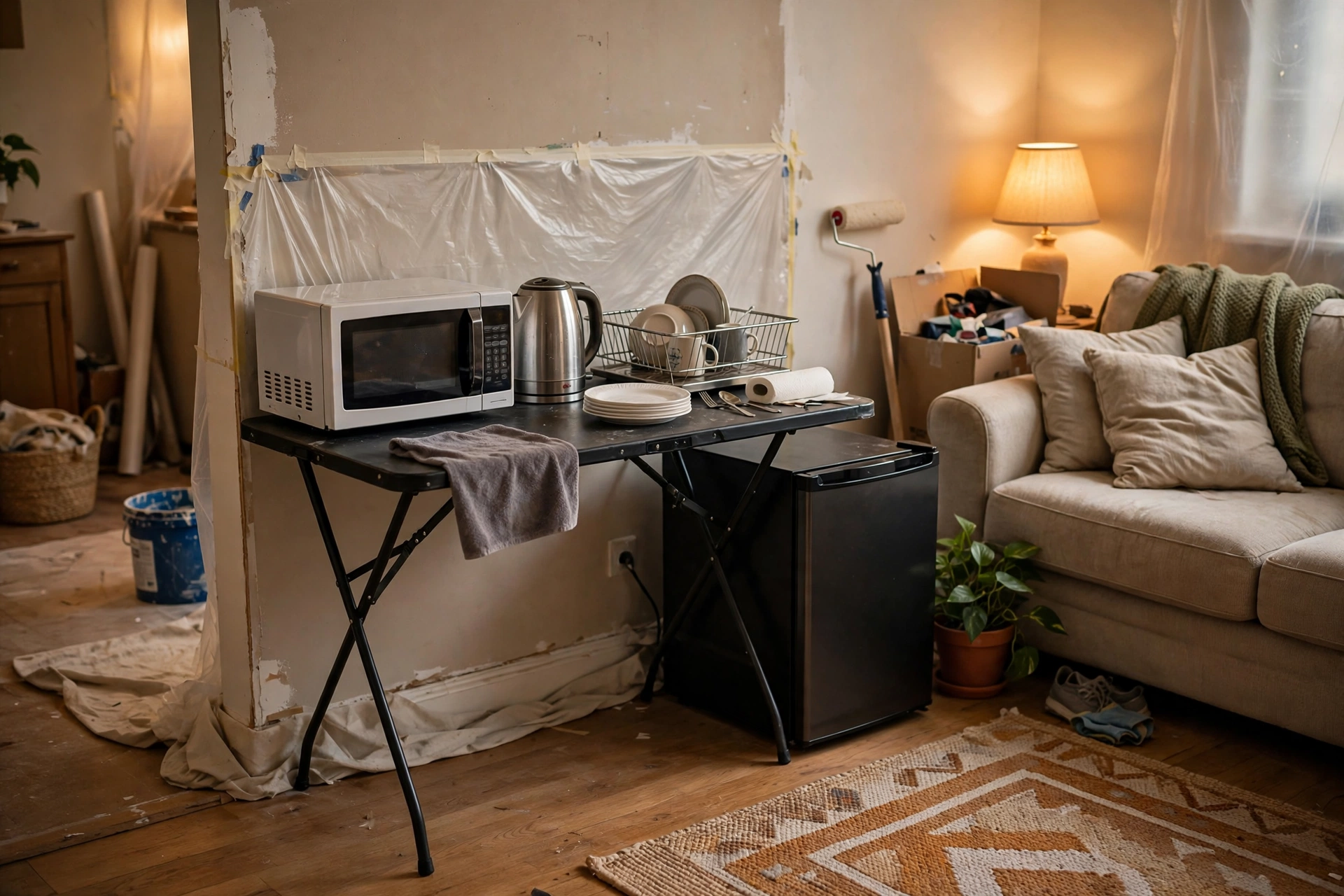
The kitchen is the most common room to live through, and the most disruptive, because the kitchen is where the family eats three times a day, and a temporary kitchen is a microwave and a kettle and a mini fridge on a folding table, and it works for two weeks, and it works for four weeks, and by week six the family is eating takeout every night, and a family that spends $60 a night on takeout for six weeks has spent $2,500 on food.
The bathroom is the room that decides the question, and the decision is simple, because a house with two bathrooms can live through one being rebuilt, and a house with one bathroom cannot, and the single-bathroom family has three options, and they are a portable shower, and a neighbour’s shower, and moving out, and the portable shower is a miserable option, and the neighbour’s shower is a generous option that wears thin, and moving out is the honest option, and the honest option is the one most single-bathroom families end up taking, usually a week later than they should have.
The basement is the easiest room to live through, because the work is downstairs, and the family is upstairs, and the stairs are a natural barrier, and a dust barrier at the top of the stairs, taped and zipped, keeps most of the dust down, and the noise is muffled by the floor, and the family can live above a basement renovation for months, and many do.
Dust: The Part Nobody Warns You About
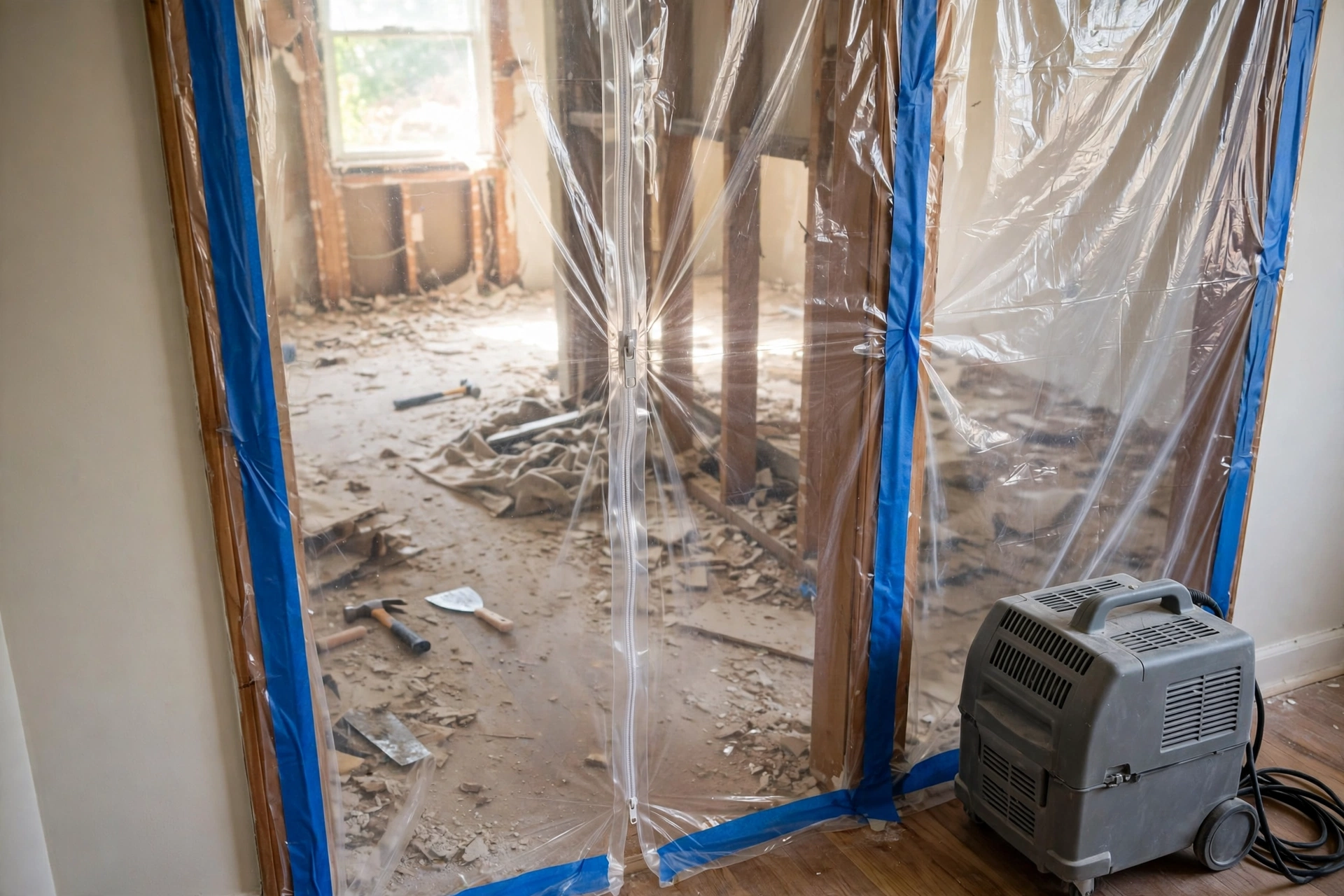
Dust is the part of a renovation that nobody warns you about, and it is the part that makes living at home hard, because the dust is fine, and the dust is everywhere, and the dust gets into the rooms that are not being renovated, and the dust gets into the clothes, and the dust gets into the food, and the dust gets into the lungs, and the cleaning never catches up, because the dust is made faster than it can be cleaned.
Containment is the answer, and containment is plastic sheeting, taped at the edges, zipped at the doorway, floor to ceiling, and the sheeting should go up before the demolition, and it should be checked daily, because the tape peels, and the zipper breaks, and a gap in the sheeting is a gap the dust walks through.
An air scrubber helps, and it is a machine with a HEPA filter that pulls the dusty air in and pushes clean air out, and the contractor should run one in the work area, and the family should ask for one, and the cost is a few hundred dollars a month, and the cost is worth it, because the air in the rest of the house stays cleaner, and the cleaning stays manageable.
Daily cleaning is the other half of the answer, and the cleaning is the family’s job, or the contractor’s job, and the contract should say which, because a contractor who cleans daily is a contractor who cares about the family living in the house, and the daily clean is a vacuum with a HEPA filter, and a damp mop, and a wipe of the surfaces, and fifteen minutes a day, and the fifteen minutes is the difference between a house that feels lived in and a house that feels abandoned to the dust.
The Bathroom, the Kitchen, and the Water
Water is the second thing that makes living at home hard, and the reason is that the water gets turned off, and the water gets turned off more often than anyone expects, because the plumber turns it off to change a valve, and to move a pipe, and to connect a fixture, and each shutoff is an hour, or a morning, and a family that is home during a shutoff is a family with no water, and no water means no toilet, and no shower, and no cooking, and the shutoffs should be scheduled, and the family should be told, the day before.
The kitchen water is the one that hurts most, because the kitchen is where the water is used most, and a kitchen renovation means the sink is gone, and the dishwasher is gone, and the family washes dishes in the bathroom sink, and the bathroom sink is small, and the dishes are many, and the washing is a chore, and the chore is daily, and the daily chore is the thing that wears the family down.
A temporary kitchen needs three things, and they are a microwave, a kettle, and a mini fridge, and it needs a fourth thing, and the fourth is a sink nearby, and the sink can be a bathroom sink, or a laundry sink, or a garden hose in the summer, and the sink is the part people forget, because the microwave and the kettle are obvious, and the sink is not.
When Moving Out Is the Smarter Call
Moving out is the smarter call when the job is a gut renovation, and the house has no kitchen, and no bathroom, and no clean room, and the family would be living in a construction site, and a construction site is not a home, and the family that moves out for a gut job is a family that made the right call, and the right call is usually made before the work starts.
Moving out is the smarter call when the house has one bathroom, and the one bathroom is being rebuilt, and the family has no second bathroom, and no neighbour with a shower, and no patience for a portable toilet, and the portable toilet is the option that looks cheap, and the portable toilet is the option that feels cheap, and the feeling is correct.
Moving out is the smarter call when someone in the house has asthma, or a breathing condition, or a small child, or a baby, and the dust is a health question, not a comfort question, and the health question has one answer, and the answer is to leave, because the dust is silica, and the dust is old paint, and the dust is not a risk worth taking for a baby.
Moving out is the smarter call when the renovation is going to take more than three months, and the family is going to be living in it for the whole three months, and the three months is a long time to live in a construction site, and a short rental in Abbotsford, a basement suite or a small apartment, runs $1,500 to $2,500 a month in 2026, and three months of it is $4,500 to $7,500, and that is real money, and it is also the price of a family that is not exhausted, and a renovation that is not rushed.
Our guide to whole home renovation cost in Abbotsford covers the money side of the same decision, including the cost of staying versus the cost of leaving, and our guide to how long a kitchen renovation takes gives the timeline for the room most families live through, so the two together answer the question of how long the inconvenience lasts, and what it costs to avoid it.
Making Staying Work, If You Stay
If you stay, make the deal with the contractor before the work starts, and the deal should name the working hours, and the hours should be reasonable, and reasonable means 8 in the morning to 5 in the afternoon, and not before, and not after, and the family should have quiet hours, and the quiet hours should be the evening, and the morning before 8, and the family that has quiet hours is a family that can sleep, and the sleeping is the point, because a tired family is a family that cannot make decisions.
If you stay, set up the temporary kitchen on day one, before the old kitchen comes out, and the setup should be complete, and the completeness should include the microwave, and the kettle, and the mini fridge, and the sink, and the dishes, and the cutlery, and the cleaning supplies, and the setup that is done on day one is a setup that works, and the setup that is done on day four is a setup that was improvised.
If you stay, plan the exit, and the exit is the date when staying stops working, and the date should be agreed in advance, and the agreement should be honest, and the honesty is that some families stay for two weeks and leave, and some families stay for two months and leave, and the leaving is not a failure, it is a decision, and the decision is better made early, when the family is calm, than late, when the family is exhausted.
Living at home during a renovation BC families manage every year, and they manage it by phasing the work, and by sealing the dust, and by setting up a temporary kitchen, and by keeping one bathroom working, and by knowing when to leave, and the knowing is the skill, and the skill is learned the hard way, by the families who stayed too long, and the lesson is simple, and the lesson is to plan the staying, and to plan the leaving, and to have both plans ready, before the first wall comes down.
Questions about living at home during a renovation, or the phasing and dust control behind it, can be raised with a local renovation professional before work starts, and general guidance on Abbotsford renovation costs is available by phone at (236) 613-0038.
Frequently Asked Questions About Living at Home During a Renovation in BC
Can you live in your house during a renovation in BC? Yes, for most phased renovations, such as a kitchen, a bathroom with a second one available, or a basement, as long as you have a working bathroom, a kitchen substitute, a bedroom with a door, and dust containment. A full gut renovation, or a job that takes the only bathroom, is usually a move-out job.
How do you control renovation dust while living at home? Seal the work area with plastic sheeting taped floor to ceiling and zipped at the doorway, before demolition starts. Ask the contractor to run a HEPA air scrubber in the work area, and agree on a daily clean of the rooms you live in, a HEPA vacuum, a damp mop, and a wipe of surfaces, because dust gets into every room through every gap.
What should a temporary kitchen include during a renovation? A microwave, a kettle, a mini fridge, and a sink nearby, plus dishes, cutlery and cleaning supplies. Set it up on day one, before the old kitchen comes out. The sink is the part people forget, and without one the dishes end up in the bathroom sink, which is the chore that wears a family down.
When is moving out during a renovation the smarter call? Move out for a full gut renovation, for a single-bathroom home where the only bathroom is being rebuilt, when someone in the house has asthma or a breathing condition or there is a baby, and when the job will run more than three months. A short rental in Abbotsford runs $1,500 to $2,500 a month in 2026, and it is often cheaper than the takeout, the cleaning, and the exhaustion of staying.
How long can a family live through a kitchen renovation? Two to four weeks is comfortable with a good temporary kitchen and a working second bathroom. By six weeks most families are eating takeout every night and washing dishes in the bathroom sink, and the hidden costs, the food, the cleaning, and the patience, start to outweigh the saving of staying. Plan the exit date before the work starts, not when patience runs out.