
The kitchen in East Abbotsford was supposed to cost $48,000. That was the number on the one-page quote, and the quote said kitchen renovation, and the homeowner signed it, and the crew started the following Monday. By week three the price was $61,000. The cabinets the homeowner had pictured were not the cabinets in the quote, because the quote never named a cabinet. The tile was extra, because the quote never named a tile. The electrician was extra, because the quote never mentioned electrical at all. None of it was a scam. Every extra was arguably fair. The problem was the paper, not the people, because a one-page quote is not a contract, and a renovation contract checklist BC homeowners can actually use would have caught every one of those gaps before the first hammer swung.
A contract is not paperwork for its own sake. It is the only version of the job that both sides agreed to, written down while everyone still likes each other, and it is the document you reach for when the job goes sideways, which is when liking each other stops being enough. The checklist below is the whole thing. Not a template. A list of what belongs in the paper, and what happens when it is missing.
The Scope Section Carries the Whole Job
Scope is the first item and the one that matters most, because everything else in the contract hangs off it. Scope is the answer to a plain question. What exactly is being built, with what materials, to what finish, and what is not included. A scope that says renovate kitchen is not a scope. A scope that says remove existing cabinets and countertop, supply and install maple shaker cabinets in white, quartz countertop in Calacatta, undermount sink, matte black faucet, pot lights, and paint walls in two coats, is a scope, and the difference between those two sentences is the difference between a $48,000 job and a $61,000 job.
Name the materials by brand and model where it matters, or at least by grade and finish, because a cabinet is not a cabinet. A stock cabinet and a custom cabinet differ by thousands, and a quote that names neither leaves the contractor free to install the cheaper one and the homeowner free to expect the dearer one, and both of them are right, which is how a friendship ends and a dispute starts. The same rule holds for tile, for flooring, for fixtures, for paint. If a material choice is still open when the contract is signed, write that down too, with the allowance attached to it, because an open choice with no allowance is an open bill.
Drawings belong in the scope section, or attached to it and named in it. A floor plan, an elevation, a tile layout, whatever the job has. If the job has no drawings, say so, and say what stands in their place, because a kitchen built from a conversation is a kitchen built from two different memories of the same conversation. The contract should name the drawings, the date on them, and the version, so a change later is a change to a known document, not a change to a moving target.
And the exclusions matter as much as the inclusions. A contract that lists what is not included is a contract that prevents the most common argument in Abbotsford renovations, which is the homeowner pointing at something and saying I thought that was included, and the contractor pointing at the paper and saying it was never in the price. Permits, for example. Appliances, very often. The old vanity haul-away. The paint for the trim. The plumber, if the contractor does not employ one. Write the exclusions down. A short exclusions list is worth more than a long inclusions list, because inclusions are what you agreed to buy, and exclusions are what you agreed to buy separately, or not at all.
What a Proper Payment Schedule Looks Like
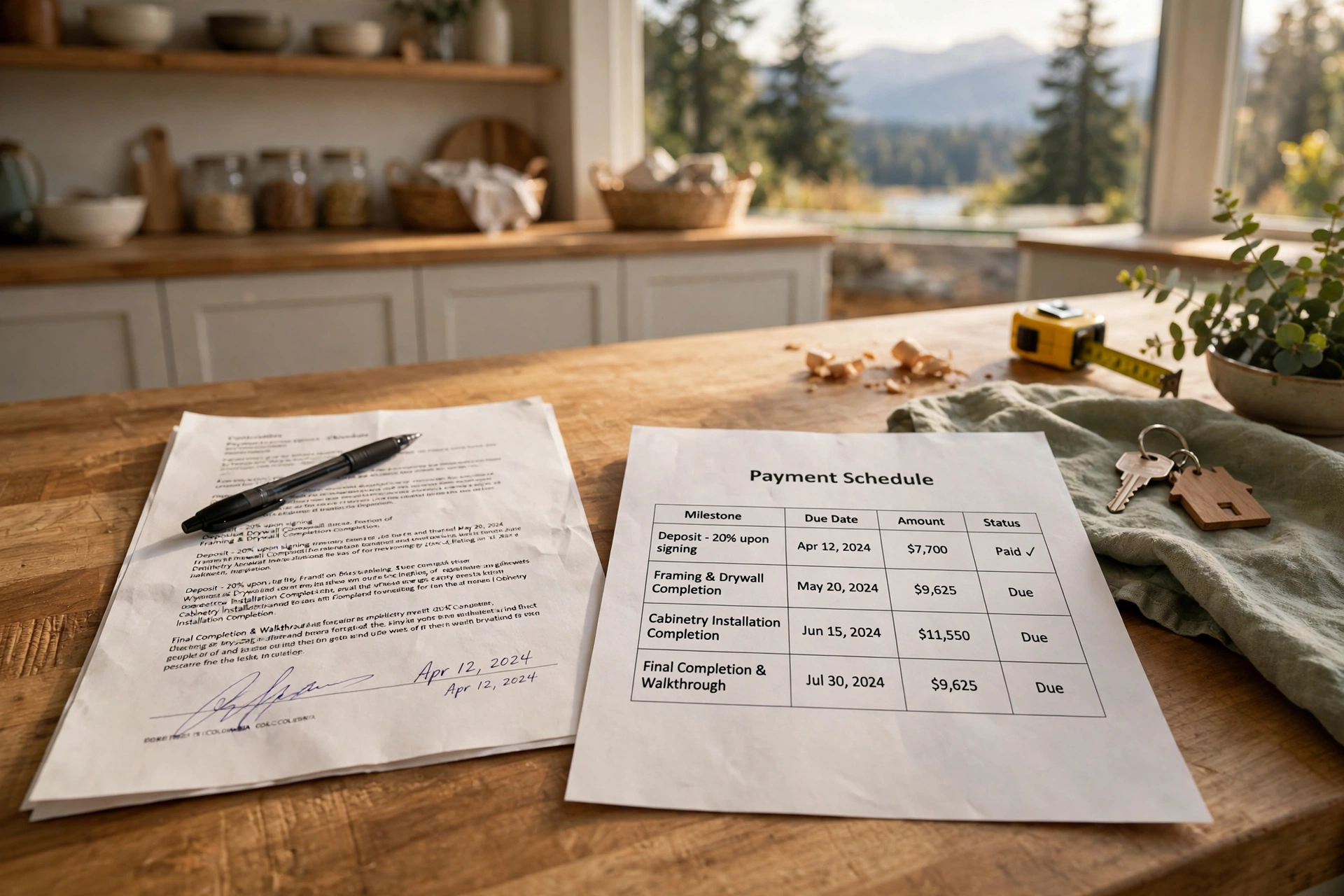
Money is the second item, and the shape of it matters more than the total. A renovation contract checklist BC homeowners should trust always starts with the same rule, which is that the payments follow the work, not the calendar, and the final payment follows the finished job, not the contractor’s schedule. A contractor who wants most of the money before most of the work is done is a contractor asking you to carry the risk, and the contract should say no to that, politely, in writing.
The shape most Abbotsford jobs follow is a small deposit to book the start date, then milestone payments tied to visible progress, then a final payment when the work is complete and the deficiencies are fixed. The deposit is the smallest payment, not the largest. The milestones are named after work you can see, demolition complete, rough-in complete, cabinets installed, tile complete, and each one is a line in the contract with a dollar figure or a percentage beside it, so nobody has to argue about whether a milestone was reached. The final payment is the lever that makes the last ten percent of the job happen, because the last ten percent, the caulking, the touch-ups, the missing trim, the drawer that sticks, is the ten percent that never happens if it has already been paid for.
How big should each payment be. There is no single right answer, and a contract that pretends otherwise is selling certainty it does not have, but the pattern that protects a homeowner is easy to hold in your head. Keep the deposit modest. Keep the middle payments tied to work you can walk through and inspect. Keep enough back at the end that the contractor still wants to come back for the deficiencies. If a contractor asks for half the job up front for materials, that is a conversation, not a refusal, and the contract should answer it with a materials receipt, or a supplier invoice, or a payment made directly to the supplier, because the risk you are guarding against is not a contractor who buys materials, it is a contractor who takes the money and never buys them.

The contract should also say how payment is made, and when, and what happens if a payment is late on either side. Cheque, e-transfer, bank draft. A due date tied to a milestone, not a vague net-30. And it should say what the price includes for tax, because a $48,000 quote that turns out to be $48,000 plus GST and PST is a $53,760 job, and that surprise is entirely avoidable, since the contract only has to say whether the price includes tax or not, in one line.
Change Orders: The Clause That Saves the Budget
Every renovation changes. A wall opens and the framing is worse than expected. A homeowner sees the tile laid and wants a different one. A pipe is in the wrong place. Change is not the problem. Undocumented change is the problem, and the change-order clause is the part of the contract that handles it, which is why it belongs in every renovation contract checklist BC homeowners sign, without exception.
The clause should say one simple thing. No change happens without a written change order, signed by both sides, before the work starts, with the price and the schedule effect written on it. That is the whole clause. A verbal yes in a hallway is not a change order. A text message that says go ahead is not a change order, or at least it is a bad one, because a text has no price on it, and a change with no price is a bill that arrives later, when the work is already done and the leverage is gone.
A good change order names the change, names the price, names the extra days if any, and names what it replaces. It is a small document, one page, and it is the document that keeps a $48,000 kitchen from becoming a $61,000 kitchen without anyone noticing until the invoice arrives. Keep a running total of the change orders beside the contract, because the running total is the real price of the job, and a homeowner who watches it weekly never gets a surprise at the end.
| Contract item | What it should say | What goes wrong without it |
|---|---|---|
| Scope | Exact work, materials by grade or model, drawings named | Extras appear for things never specified |
| Exclusions | Permits, appliances, haul-away, outside trades named | Arguments over what was included |
| Payment schedule | Deposit small, milestones tied to visible work | Most of the money paid before most of the work |
| Change orders | Written, signed, priced before work starts | Verbal changes billed later at full price |
| Holdback | 10% held per the Builders Lien Act | No leverage for deficiencies or liens |
| Timeline | Start date, milestones, completion date | No date to hold anyone to |
| Warranty | What is covered, for how long, in writing | Defects become the homeowner’s problem |
The Holdback, Explained Without the Legal Fog
The holdback is the part of the contract most homeowners have never heard of, and it is the part that protects them most, which is a strange combination, and it is worth understanding before you sign anything. Under BC’s Builders Lien Act, a homeowner holds back 10% of the price of the work, and that money is not the contractor’s until the holdback period runs out, because the holdback exists so that a subcontractor or supplier who was not paid by the contractor can claim against it, instead of putting a lien on the homeowner’s house.
That is the short version. The practical version is simpler. The contract should state the holdback, and the final payment should not be the full remaining balance, it should be the remaining balance minus the holdback, and the holdback should be released after the holdback period, once the work is complete and no liens have been filed. A contractor who asks you to waive the holdback is a contractor asking you to give up the one protection the law hands you for free, and the answer is no, and the contract should not contain a waiver, and if it does, that is a line to question before signing, not after.
This is also the point to say plainly that this guide is not legal advice, and a contract for a large job, a whole home renovation, a major addition, a six-figure kitchen, is worth an hour with a lawyer, because an hour with a lawyer costs less than a week with a dispute, and a lawyer reads the contract the way a contractor will not, which is line by line, looking for the gap. The checklist gets you to the signing table prepared. A lawyer gets you across it safely.
Timeline, Warranty and the Small Print That Is Not Small
A contract without dates is a wish. The timeline section should name a start date, name the milestones, and name a completion date, and it should say what happens when the dates slip, because dates slip on most jobs, and a contract that pretends otherwise is a contract that has no answer when it happens. The answer does not have to be a penalty. It can be a notice requirement, a revised schedule in writing, a weekly update, but it has to be something, because a job with no dates and no update requirement is a job that drifts, and a drifting job is a job that costs rent, or storage, or a second bathroom, while the first one sits half done.
Warranty is the same shape of clause. The contract should say what the contractor warrants, for how long, and what is not covered, because a verbal promise of a warranty is worth the paper it is not written on. A one-year workmanship warranty is common on Abbotsford jobs, and materials carry their own manufacturer warranties, and the contract should name both, and name who to call when something fails, and how quickly a deficiency gets fixed. The deficiency list, the walk-through at the end, the list of small things that are not right, belongs in the contract too, with a time limit for fixing them, because the end of a job is when the deficiencies are fixed, not when the crew leaves.
The small print deserves a read, not a skim. The dispute clause, mediation before litigation, or arbitration, or the courts. The termination clause, what happens if either side walks away, and what gets paid for work done. The insurance clause, the contractor’s liability coverage, and the WorkSafeBC registration, because a contract with a contractor who has no insurance is a contract with a contractor whose mistakes land on you. Our guide to questions to ask a renovation contractor in BC covers the full question list that sits behind these checks, and the two guides work together, because the questions pick the contractor and the contract holds the contractor to the answers.
One more line belongs in the contract, and it is the line most people skip. Who cleans up. Daily cleanup, haul-away of debris, protection of the floors that are not being renovated, dust containment, because a renovation that leaves the rest of the house filthy for eight weeks is a renovation that costs a second cleanup, and the contract should say the cleanup is part of the job, not a favour at the end.
Before You Sign, Run This Pass
Read the contract once for the money, once for the dates, and once for the gaps, because those are three different reads, and each one catches something the others miss. The money read checks the total, the tax, the deposit, the milestones, the holdback, and the change-order rule. The dates read checks the start, the milestones, the completion, and what happens when they slip. The gaps read checks what is missing, the permit, the appliances, the cleanup, the warranty, the exclusions, and the gaps read is the one that saves the most money, because a gap found before signing costs a sentence, and a gap found after signing costs a change order.
Compare the contract to the quote, line by line, because the contract should be the quote with the gaps filled, not a different document with a different price, and if the numbers differ, ask why before signing, not after. Check that the names are right, the address is right, the business name matches the business licence, and the person signing is the person who will run the job, because a contract signed by a salesperson is a contract with a person who will not be on site.
And keep a copy. A signed copy, in your hands, not a promise to email one later, because the copy in your hands is the copy you can read at midnight when something goes wrong, and the copy that never arrives is the copy that never existed. If you want a second opinion on the money side before you sign, our guide to how to finance a home renovation in BC walks through the options that sit behind the payment schedule, and the two guides together cover the two halves of the decision, what the job costs, and what the paper says.
A renovation contract checklist BC homeowners can hold in one hand is not a long document. Scope, exclusions, payment milestones, change orders in writing, the 10% holdback, dates, warranty, cleanup, and a copy in your hands. That is the list. A contract that has all of it is a contract that protects both sides, because a contractor who works to a clear contract is a contractor who can price the job properly, and a homeowner who signs a clear contract is a homeowner who knows what they bought. The $48,000 kitchen that became $61,000 did not become expensive because the work was bad. It became expensive because the paper was thin. Make the paper thick. Sign it. Then the work can start.
Questions about a contract you are about to sign, or a quote that does not match the paper, can be raised with a local renovation professional before work starts, and general guidance on Abbotsford renovation costs is available by phone at (236) 613-0038.
Frequently Asked Questions About a Renovation Contract Checklist in BC
What should be in a renovation contract in BC?
The scope of work with materials named, the exclusions, a payment schedule tied to visible milestones, a written change-order rule, the 10% holdback, start and completion dates, a warranty, cleanup terms, and insurance and WorkSafeBC details. A contract missing any of these is a contract with a gap, and the gap is where the extra cost appears.
How much deposit should I pay a renovation contractor?
Keep the deposit modest and tie the larger payments to visible milestones, with the final payment held until the work is complete and the deficiencies are fixed. A contractor asking for half the job up front should be able to show a materials receipt or a supplier invoice for that money. Never pay the full price before the work is done.
What is a change order in a renovation contract?
A change order is a short written document, signed by both sides before the changed work starts, naming the change, its price, and any extra days it adds. Verbal changes are the most common source of budget overruns, because a change with no price is a bill that arrives after the work is already done.
What is the 10% holdback in BC?
Under BC’s Builders Lien Act, a homeowner holds back 10% of the price of the work, released after the holdback period once the work is complete and no liens have been filed. It exists so an unpaid subcontractor or supplier can claim against it instead of putting a lien on the home. Do not waive it, and confirm the details with a lawyer for a large job.
Do I need a lawyer to review a renovation contract?
For a small job, this checklist covers the essentials. For a large job, a whole home renovation or a major addition, an hour with a lawyer is worth the cost, because a lawyer reads the contract line by line and finds the gaps a homeowner misses. This guide is general information, not legal advice.