
Most furnace replacements happen in a panic.
Not all. But most — a breakdown, in January, on the coldest night of the year, with the house cooling by the hour and a technician standing in the utility room explaining, gently, that the old unit has fired its last cycle and that whatever happens next is going to happen fast, at whatever price fast costs, because hurried purchases are always, always the expensive ones.
Here is the alternative.
A furnace that is still running — still heating, still cycling, still merely old rather than dead — can be replaced on a normal schedule instead, in September rather than during a cold snap, with time to compare systems properly, time to check the sizing instead of trusting the nameplate on the dying unit, and time to confirm rebate eligibility before anything gets signed, which matters because more than one rebate in BC evaporates the moment the work starts before the paperwork does.
This guide sets out the 2026 BC installed prices for gas furnaces and heat pumps, the repair-versus-replace calculation the trades themselves use, and how sizing — the quiet variable nobody talks about — moves the final figure.
The short version: a new high-efficiency gas furnace, installed, runs $4,500–$8,500 in 2026. A mid-range system with upgraded features runs $7,500–$12,000. A cold-climate heat pump system runs $12,000–$25,000+ depending on the home. Rebates exist and are worth checking, but amounts and eligibility rules change often — sometimes mid-season, sometimes with no announcement anyone outside the program office ever sees — so confirm the current terms directly with the program before budgeting around them. All figures are planning ranges, not quotes.
1. What a New System Costs in BC
2026 BC planning ranges, installed, for a typical Fraser Valley single-family home:
| System | Efficiency / type | 2026 planning range (installed) |
|---|---|---|
| Gas furnace, standard high-efficiency | 92–96% AFUE, single-stage | $4,500–$7,000 |
| Gas furnace, premium | 96–98% AFUE, two-stage or modulating | $7,500–$12,000 |
| Electric furnace | 100% at the unit, but costly to run | $3,500–$6,000 |
| Cold-climate heat pump (ducted) | Replaces or supplements furnace | $12,000–$20,000 |
| Heat pump + backup furnace (dual fuel) | Best of both for cold snaps | $15,000–$25,000+ |
AFUE.
Every quote will use it, usually without explaining it, so: it is the efficiency rating, the percentage of fuel that actually becomes heat. An old 80% furnace wastes a fifth of every gas dollar up the flue — a fifth, gone, on every single bill, for twenty years — and a 96% furnace wastes almost nothing, which is a gap so wide it does most of the payback math all by itself and explains why almost every replacement in BC today is a high-efficiency condensing furnace rather than the mid-efficiency boxes that were standard a generation ago.
Condensing units vent through PVC sidewall piping rather than the old chimney, too. Which sounds like a footnote. It is not — it means venting changes are often part of the installation, part of the quote, part of why two quotes for the same furnace can differ.
The cheapest line on the table deserves a caution. The electric furnace.
The unit is inexpensive. Installation is simple. And heating a Fraser Valley home with resistance electricity through a BC winter — through the damp cold of November, December, January, February — is still one of the most expensive ways known to stay warm, a fact that arrives monthly, in an envelope. Electric furnaces mostly show up in homes where gas was never run. If you have gas service, a gas furnace or a heat pump wins on operating cost in almost every comparison anyone has ever run.
2. Repair or Replace
Before pricing a replacement, confirm the old furnace actually needs to go.
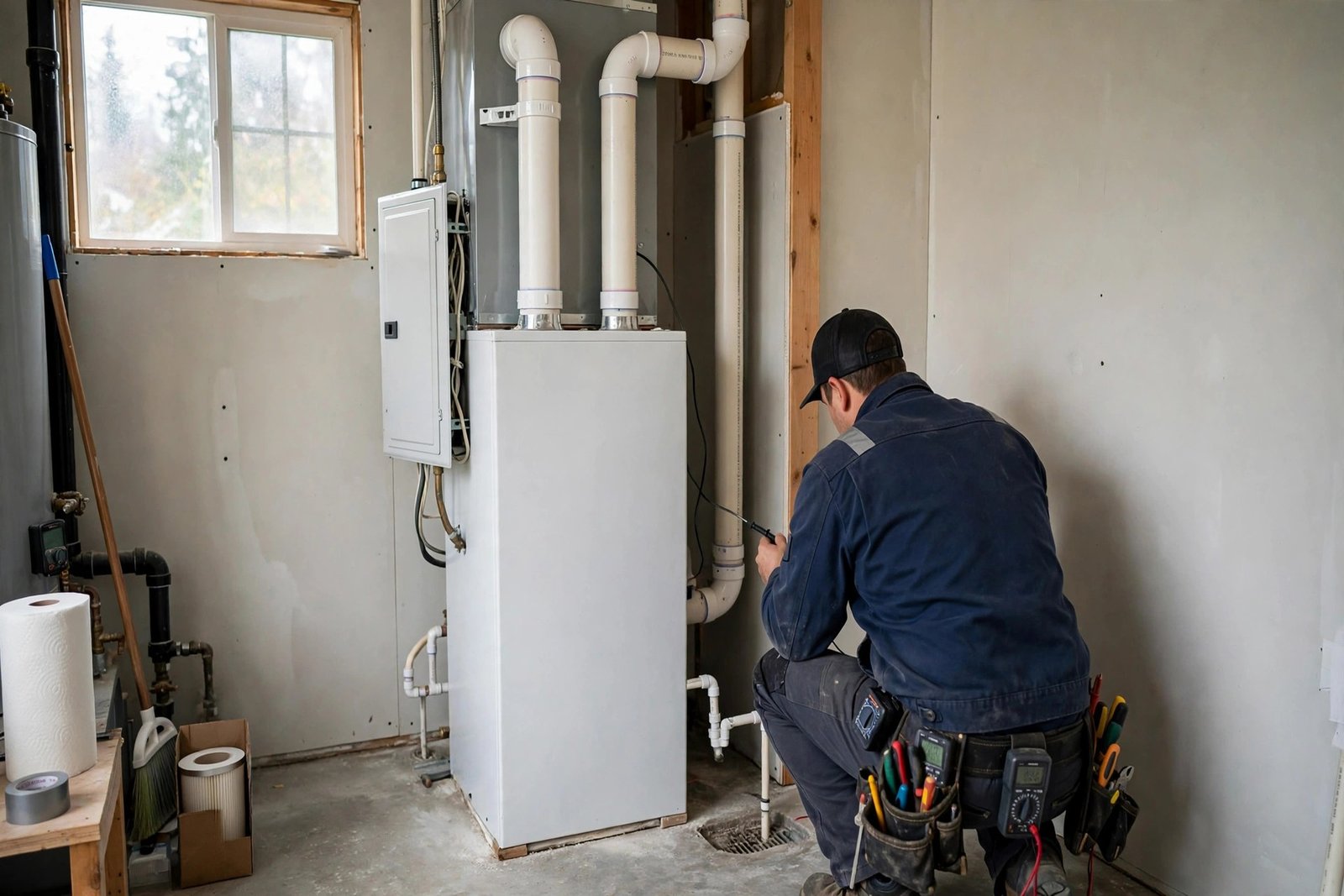
There is a rule. The trades use it, and it fits on an index card: multiply the repair cost by the furnace’s age in years. If the result comes out over roughly $5,000–$6,000, replacement usually wins. A $600 repair on a 10-year-old furnace is sensible money — spend it, gladly. A $1,200 repair on a 19-year-old furnace is money thrown at a unit already past its expected life, a unit that will be back in the same conversation, with a different broken part, before the heating season is out.
Replace rather than repair when:
- The heat exchanger is cracked. That ends the discussion immediately — not eventually, not after a second opinion, immediately — because it is also a carbon monoxide risk.
- The furnace is 18–20+ years old.
- Repairs are getting frequent.
- Heating bills are climbing for no other reason.
- The house has rooms that never get comfortable no matter what you do.
Repair is usually the right call when the furnace is under 12–15 years old, the failure is a single component — an ignitor, a flame sensor, a blower motor, one part with a name and a price rather than a pattern of decline — and the unit has otherwise been reliable. Those are few-hundred-dollar fixes. They buy real years.
The carbon monoxide point cannot be stated too plainly, so it will not be dressed up here: any cracked heat exchanger, any smell of exhaust in the house, or any CO alarm going off means the furnace stays off and a professional comes out.
Off. Out. In that order.
It is not a cost question. CO alarms belong on each floor of a home with fuel-burning appliances — cheap, unglamorous, non-negotiable — and a furnace replacement is the right moment to make sure the house actually has them.
One timing note. If the water heater is the same age as the furnace, ask about doing both. Our hot water tank replacement cost guide for BC covers that side, and bundling the two while the crew is already on site — already in the utility room, already set up, already billing the trip — usually saves on labour versus two separate visits.
3. Sizing the Replacement
The most common furnace mistake is not the brand.
It is the size.
An oversized furnace short-cycles: it blasts heat, shuts off, blasts again. Parts wear faster. Rooms heat unevenly. An undersized furnace runs constantly on the coldest nights — flat out, all night, spending everything it has — and still cannot keep up, and the right size, the size almost nobody ends up with when the job is rushed, runs long, steady, quiet cycles and keeps every room even, which is, when you think about it, the entire point of the purchase.
Sizing is done with a heat-loss calculation — Manual J is the industry standard — based on the home’s square footage, its insulation, its window area and orientation, its ceiling heights, and its air leakage, all of it, because a house is not a box of a certain size but a specific leaky, glazed, insulated object that loses heat at its own particular rate. In the Fraser Valley, a reasonably insulated 2,000 square foot home typically lands in the 60,000–80,000 BTU range. Treat that as a rough bracket. Not a specification. Any quote for a full replacement should be based on the calculation for your house — your walls, your windows, your ceiling — not on a rule of thumb carried in somebody’s head from the last forty houses.
Do not size by the old furnace.
The unit being replaced was probably sized decades ago, possibly oversized on purpose, and the house has likely changed since: new windows, added insulation, a finished basement. Sizing the new furnace off the old one’s nameplate is how oversizing gets handed down — furnace to furnace, decade to decade, like a family heirloom nobody wanted.
When you compare quotes, each should state the BTU input, the AFUE rating and the staging type. Two-stage and modulating units run at lower output most of the time — a murmur instead of a blast — which gives steadier temperatures and less noise. They cost more up front. They are usually worth it in a home you plan to stay in.
4. Gas Furnace, Heat Pump, or Dual Fuel
Both systems work in this climate.
They work differently. They cost differently. And the difference between them is not a detail — it is a twenty-year relationship with a machine.
- Gas furnace. Lower installed cost, proven in our climate, cheap to run on natural gas. If your home already has gas service and ductwork, a high-efficiency gas furnace is the lowest-cost replacement that heats reliably on the coldest nights — the minus-ten nights, the wind-off-the-mountains nights. Nothing about a BC winter challenges it.
- Cold-climate heat pump. Moves heat instead of making it, delivering two to four units of heat for each unit of electricity — a ratio that sounds like a misprint the first time you hear it and is, in fact, just physics doing you a favour. It also cools in summer, which matters more each year as Fraser Valley heat waves get longer. Installed cost is roughly double a gas furnace, but the cooling function and rebate programs aimed at electrification can close some of that gap.
- Dual fuel. A heat pump handles the mild months efficiently while a gas furnace takes over on the coldest days. Most expensive up front. Most flexible in operation.
The practical split: if the budget is tight and the house has gas and ducts, replace the gas furnace and do not look back. If you can stretch, want air conditioning, and the rebate math works for your home, the heat pump conversation is worth having — with an installer who does both, who sells both, who has no favourite child on the truck. Do not pick based on a rebate headline alone. The system has to suit the house for twenty years. Rebates come and go.
5. Rebates: Real Money, Moving Target
BC has real money available for heating upgrades.
Real money. Worth checking — foolish not to, honestly. It would be equally foolish to budget around a number you read last year, in a blog post, in a program that may have paused in March when the funding ran out, because programs change, amounts shift, eligibility rules tighten or loosen, and some programs simply stop, quietly, the way a tap stops. Treat every rebate as a question to answer. Not a fact to assume.
The programs to check:
- CleanBC. Provincial incentives for switching to efficient heating.
- BC Hydro. Rebate and financing programs for its customers.
- FortisBC. Rebate and financing programs for its customers.
- Federal programs, which have cycled in and out over recent years.
A good Fraser Valley HVAC contractor will know the current landscape. Verify the terms yourself anyway — on the program websites, in the current documents, before signing a contract that depends on the rebate, because the contract will not un-sign itself when the program turns out to have changed.
The practical rules matter as much as the amounts. Most programs require licensed contractors and pay out after the work is documented or inspected. And the sequence matters — it matters enormously, it is where people lose money they were entitled to — starting work before a required assessment or approval can disqualify you, so the paperwork starts before the installation. Not after. Never after.
Heating is usually the largest energy load in a BC home, so insulation, window and water heating upgrades often stack with heating incentives. Our BC home renovation rebates and grants guide keeps the wider picture in one place, including which upgrades pair well together when you are planning more than just the furnace.
6. Frequently Asked Questions
How much does furnace replacement cost in BC?
For 2026, a standard high-efficiency gas furnace installed runs $4,500–$7,000, a premium two-stage or modulating unit $7,500–$12,000, and a cold-climate heat pump system $12,000–$25,000 or more depending on the setup. Planning ranges. Not quotes. Proper sizing for your specific home — the calculation, not the guess — decides the final number.
How do I know what size furnace my house needs?
Only one way properly: a heat-loss calculation done by the installer, based on square footage, insulation, windows, ceiling heights and air leakage. Don’t size the new furnace off the old one’s nameplate. The old unit was likely oversized, and the house has changed since — windows, insulation, a basement that was mud and studs when the furnace went in and is a rec room now.
Are there rebates for furnace replacement in BC?
Yes — programs run through CleanBC, BC Hydro and FortisBC — but amounts and eligibility change frequently, so check the current terms directly before budgeting. Most require licensed contractors, and some need pre-approval or an energy assessment before work starts. Before. That word again, because it is the one that costs people money.
Should I replace my gas furnace with a heat pump?
Depends on the house. Depends on the budget. Genuinely. A gas furnace is the lowest-cost reliable replacement where gas service and ducts already exist. A heat pump costs roughly double installed but also provides cooling and may qualify for larger rebates. Dual-fuel systems combine both. Don’t choose on rebate headlines alone; the system has to suit the house for the next twenty years — twenty winters, twenty summers, long after the headline is forgotten.
How long does a furnace last in BC?
Plan on 15–20 years for a gas furnace with annual maintenance. Annual servicing, regular filter changes and keeping vents clear are what get a furnace to the long end of that range — the unglamorous habits, performed yearly, that nobody brags about. Once a unit passes 18 years or starts needing frequent repairs, plan the replacement on your schedule instead of waiting for a midwinter failure. Your schedule. Not the furnace’s.
Replacing a Furnace in the Fraser Valley
The furnace replacement cost in BC comes down to sizing, efficiency and fuel type, so get three quotes, each with a heat-loss calculation, the BTU input, the AFUE rating and the staging type in writing. Check the current rebate programs before you sign anything. For a second opinion on a quote, sizing, or whether repair still makes sense, call us at (236) 613-0038 — no pressure, just straight answers.