
Drywall is the quiet workhorse of every renovation. Nobody walks into a finished room and admires the drywall. But bad drywall? Everyone notices that. The wavy seams. The visible joints under a fresh coat of paint. The patch that telegraphs through like a scar. In Abbotsford, where basement finishing and suite conversions keep drywall crews busy year-round, knowing what this trade actually costs helps you budget honestly and spot a quote that is too good to be true.
The short answer: professional drywall installation in BC runs $2.00 to $4.00 per square foot of wall and ceiling surface in 2026, materials and labour included. Small repairs usually land between $200 and $600. But that per-foot number hides a lot. Finish level. Ceiling height. Moisture-resistant board. And how much of the job is taping and mudding versus just hanging sheets. This guide breaks it all down, so you can plan with real numbers.
A note on pricing: Every figure in this guide is a 2026 planning range for the Fraser Valley, not a quote. Labour rates move with demand, and your specific job — access, ceiling height, existing conditions — will shift the number. Get three itemized quotes before you commit.
What “Per Square Foot” Actually Means for Drywall
First thing that trips up homeowners: drywall isn’t priced by the room. It’s priced by square foot of wall and ceiling surface. Floor area doesn’t come into it. Take a 12×12 bedroom with 8-foot ceilings. The walls alone run roughly 380 square feet. Add the ceiling, another 144. You’re over 500 square feet of drywall — in a room that measures 144 square feet on the floor.
When a contractor quotes “$2.50 a foot,” confirm they measured surface area. A quote based on floor area at drywall rates will come in suspiciously cheap — and then grow. It is worth thirty seconds to clarify before anyone picks up a trowel. Our guide to home renovation mistakes in Abbotsford covers a few more of these expensive misunderstandings.
2026 Drywall Installation Costs in BC: The Full Breakdown
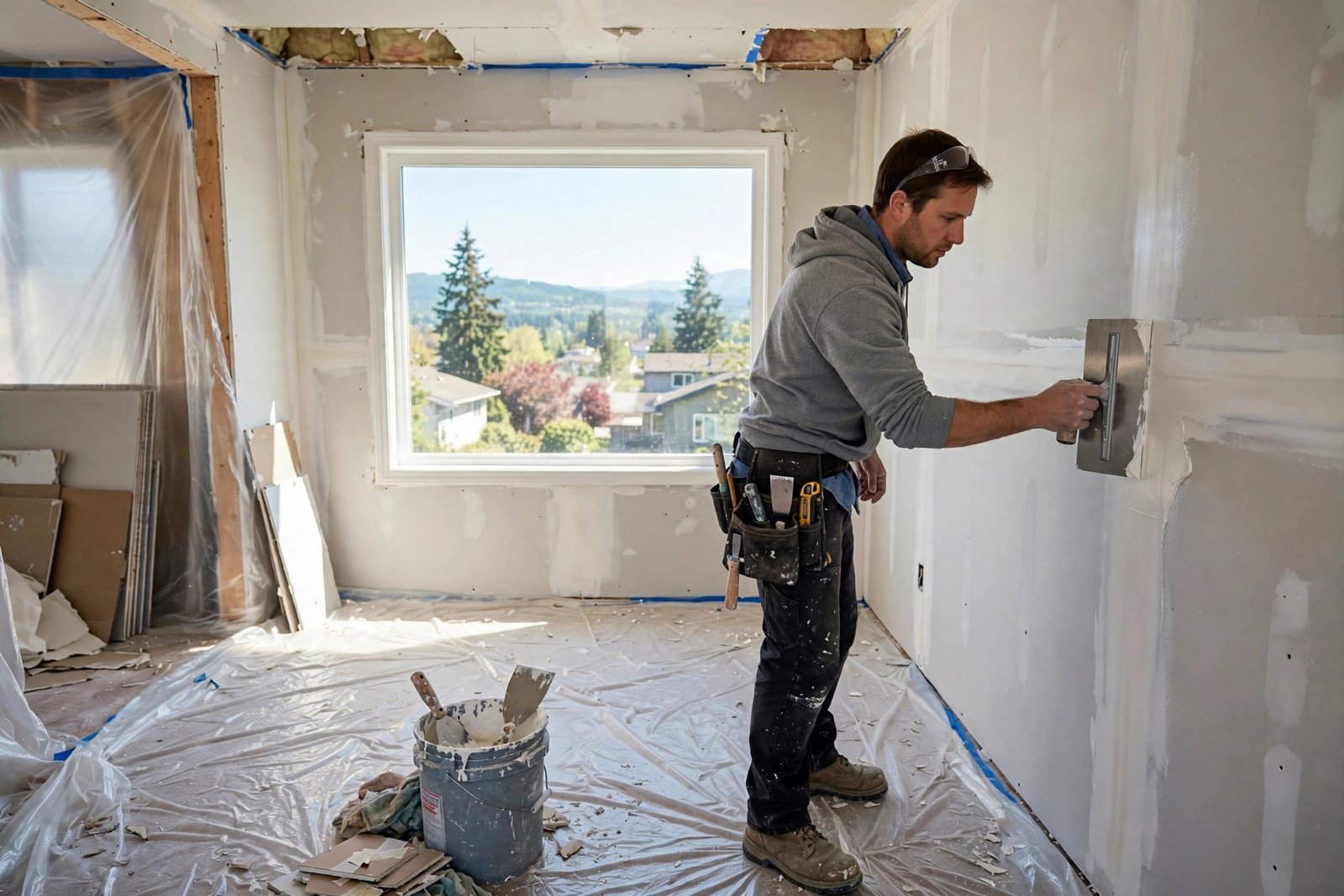
A standard job means 1/2-inch sheets on wood framing. Hung, taped, mudded, sanded to paint-ready. For that, expect $2.00–$4.00 per square foot across BC. Fraser Valley pricing? Middle of the range. Labour takes roughly two-thirds of the total. Materials — sheets, compound, tape, screws — take the rest.
What that looks like on real projects:
- Single bedroom (4 walls + ceiling, ~500 sq ft of surface): $1,000–$2,000
- Full basement, 800 sq ft of floor (~2,000 sq ft of surface): $4,000–$8,000
- Whole house, 2,000 sq ft of floor (~5,500 sq ft of surface): $11,000–$22,000
Plenty pushes a job toward the top of that range. Ceilings, for one. Vaulted or 9-foot-plus, they add labour time, and they often need a lift. Then there’s the fiddly stuff. Curved walls. Bulkheads wrapped around ductwork. Rooms chopped into small sections. All of it slows a crew down. And in older Abbotsford homes — the 1970s ranches in Clearbrook, the character houses near downtown — you may be dealing with plaster removal or asbestos testing before a single sheet goes up, which is a separate line item entirely.
Drywall Finishing Levels: What You Are Actually Paying For
Most of the cost difference between a $2.00 and a $4.00 job is not the sheets. It is the finishing. The industry uses five standard levels, and the one you choose should match your paint and lighting:
| Finish Level | What It Means | Typical Cost Adder | Best For |
|---|---|---|---|
| Level 0–2 | Taped joints only, minimal compound | Base price | Behind tile, unfinished garages |
| Level 3 | Two coats of compound, ready for heavy texture | +$0.20–$0.40/sq ft | Textured ceilings, knockdown finishes |
| Level 4 | Three coats, smooth and sanded — the standard | Included in $2.00–$4.00 range | Most painted walls, flat or eggshell paint |
| Level 5 | Level 4 plus a full skim coat over everything | +$1.00–$2.00/sq ft (up to $7+/sq ft total in premium markets) | Glossy paint, dark colours, walls hit by direct daylight |
Level 4 is the default you want for painted walls. It is what “paint-ready” means in a proper quote. Level 5 is the upgrade people ask about later. Usually after they’ve seen joints ghost through a dark accent wall. A full skim coat erases every trace of the seams — but it roughly doubles the finishing labour. If your quote doesn’t name a finish level, ask. A contractor who can’t tell you isn’t the contractor for a visible living space.
One Fraser Valley-specific note. Our long, grey winters mean interiors get a lot of raking natural light, and at low angles. Light like that is brutally honest about imperfect finishing. If your great room faces south with big windows, Level 5 on those walls is money well spent. For a fresh coat of paint over existing Level 4 walls, though, you rarely need to refinish — just repair and prime the damaged spots.
Specialty Drywall: When Standard Sheets Are Not Enough
Not every wall gets the basic 1/2-inch sheet. Three upgrades show up constantly in Abbotsford renovations:
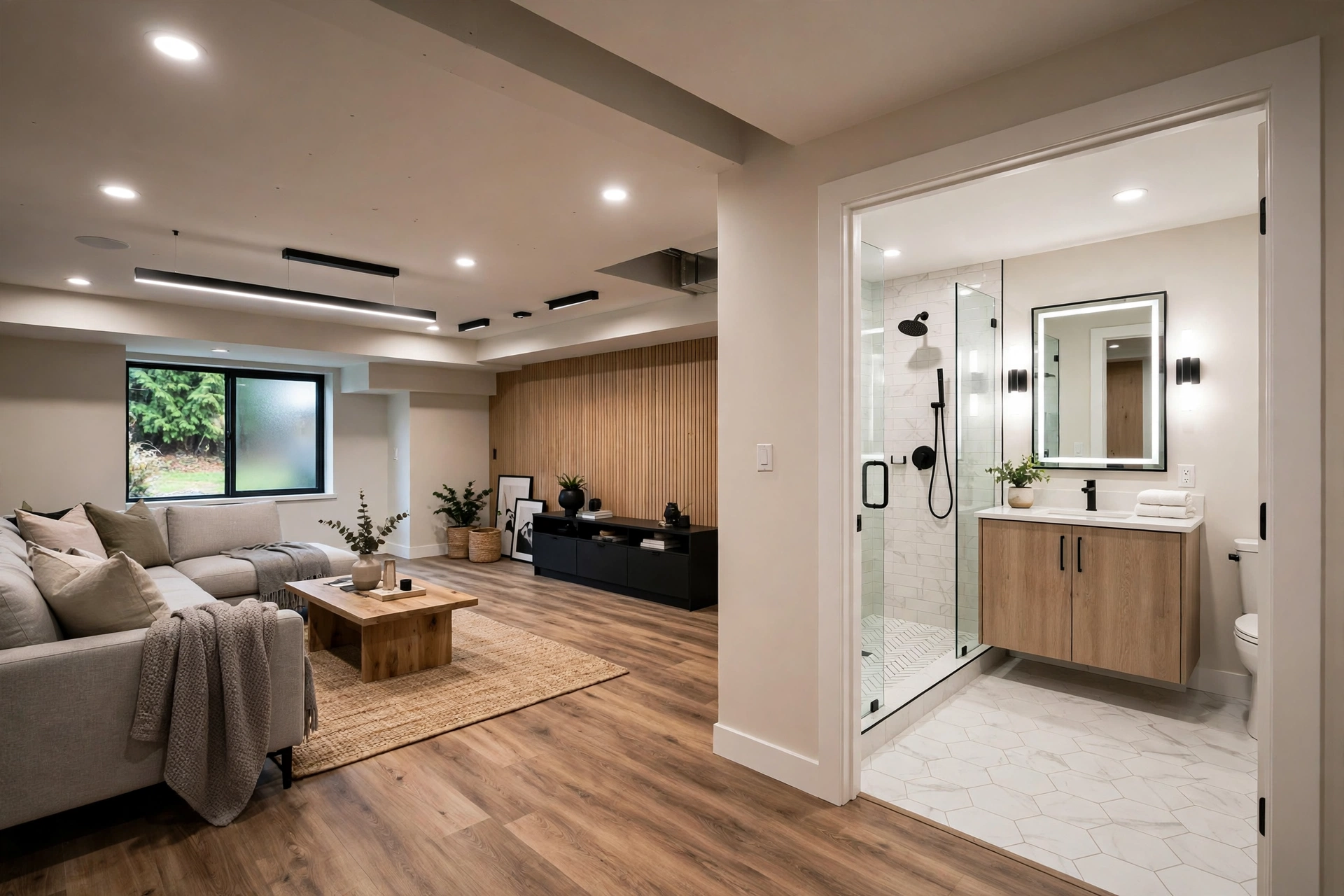
Moisture-resistant board (“green board”) — required by code behind tile in wet areas and smart anywhere humidity runs high: bathrooms, laundry rooms, and below-grade basement walls. Expect roughly $2.50–$3.50 per square foot installed. In the Fraser Valley, where November through February keeps everything damp, this is cheap insurance in a basement finishing project. See our basement renovation cost breakdown for how it fits the bigger budget.
Type X fire-rated board — 5/8-inch sheets required between a garage and living space, around furnace rooms, and in the fire separations that legal basement suites demand. Slightly more expensive in both material and labour (it is heavier and harder on tools): roughly $2.75–$4.00 per square foot.
Sound-dampening assemblies — double layers, resilient channel, or specialty acoustic board between a basement suite and the main floor. This is a “get a proper quote” situation; assemblies run $4.00–$7.00+ per square foot depending on the STC rating you are chasing. If you are building a legal suite, your designer will specify the assembly — do not value-engineer it away, because the inspector will check.
Common Drywall Repairs and What They Cost
Full installation is only half the story. Most homeowners meet a drywall contractor over a repair, and small jobs are priced by the visit more than the square foot:
- Small patch (doorknob hole, anchor damage): $200–$350
- Medium patch (a foot or two across, e.g. plumbing access): $300–$500
- Large repair or section replacement (4×4 ft and up): $450–$800+
- Ceiling repair (water damage, with texture matching): $400–$900
- Full-room re-mud and sand (fixing someone else’s bad taping): $800–$1,800
The minimum charge exists because a “quick patch” still means two or three trips: compound, dry, sand, recoat, prime. Anyone promising a same-day invisible repair on a textured ceiling is selling optimism. And texture matching is genuinely skilled work. Orange peel, knockdown, popcorn — there’s no faking any of them.
A word on water damage. Soft drywall? Discoloured? Smells musty? That repair isn’t cosmetic. Cut it out. Find the leak. Check for mould — all before anything gets covered back up. Leaks here run slow. A plumbing leak behind a wall can go for months in our climate before it shows itself. Patch over it and you’ve just reset the timer.
DIY vs Hiring a Pro: An Honest Split
Drywall is one of those trades that looks easy on video and humbles everyone who tries it. Hanging sheets is genuinely DIY-friendly — measure, cut, screw. Finishing is where it gets hard. Taping and mudding to an invisible Level 4 finish — most pros take hundreds of hours to learn that. Hundreds. And bad mudding? It’s the single most visible defect in a renovation. Paint won’t hide it. Paint advertises it.
If you’re handy, here’s a sensible split:
- DIY with confidence: demolition of old drywall. Hanging sheets, on straightforward walls at least. Small nail-pop and anchor repairs. Priming.
- Hire a pro: all taping and mudding in visible living spaces. Ceilings, too (gravity is undefeated). Texture matching. Anything involving fire-rated assemblies or suite separations. And any repair larger than a dinner plate — if you care about the result, that is.
The math usually supports hiring out the finishing even when you hang the sheets yourself. A pro taper can finish in a day what takes a homeowner a frustrating weekend per coat — and there are three coats. Weighing the bigger DIY question? Our DIY vs hiring a contractor breakdown walks through it — where homeowners actually save money, and where they don’t.
How to Get a Quote You Can Trust
Drywall quotes are refreshingly comparable — if you make sure each one includes the same things. Ask every contractor for the following:
- Surface area measured (not floor area) and the per-foot rate
- Finish level named explicitly — Level 4 minimum for painted walls
- Board type — standard, moisture-resistant, or Type X, and where each goes
- What is excluded — demo, disposal, priming, and paint are often separate
- Texture matching — named specifically if ceilings are involved
- Timeline — drying time between coats means a “two-day job” is often four calendar days
Get three quotes. Then be suspicious of the outlier — in either direction. The cheapest bid? Usually a lower finish level, or steps skipped. The most expensive one should explain exactly what extra you’re buying, and if it can’t, that’s your answer. Check the basics, too, the ones that apply to every trade in BC. Liability insurance. WorkSafeBC coverage, if they bring workers. References from recent local jobs. Our contractor interview checklist has the ten questions that separate professionals from risks.
Frequently Asked Questions
How much does it cost to drywall a 12×12 room in BC?
Typically, $1,000–$2,000 in 2026 for a 12×12 bedroom with 8-foot ceilings. Roughly 500 square feet of wall and ceiling surface, that is. At $2.00–$4.00 per square foot — hung, taped, finished to Level 4 (paint-ready). Vaulted ceilings push it higher. So do moisture-resistant board and Level 5 finishing.
Is $4 per square foot too much for drywall?
Not necessarily — it depends on what is included. At the top of the BC range you should be getting Level 4 finishing, straightforward access, and a clean job site. Specialty board reaches that territory legitimately. So do high ceilings and complex layouts. Level 5 skim coating does too — $4.00–$7.00 per square foot, all of it. What matters is the quote itself. Does it name the finish level? The board type? That’s what lets you compare like with like.
Can I just patch drywall myself?
Small patches — nail holes, anchor damage, doorknob dents — are very DIY-friendly with a $20 patch kit and some patience. The skill curve climbs fast, though: patches larger than about a square foot, any ceiling repair, and texture matching are where DIY results start looking DIY. If the wall will be painted a dark colour or lit by direct sun, hire it out.
How long does drywall installation take?
A professional crew hangs and finishes an average room in 3–5 working days, mostly because joint compound needs drying time between its three coats. A full basement takes one to two weeks; a whole house takes two to four. Anyone promising a finished, painted-quality job in a single day? They’re skipping drying time. The seams will tell on them within a year.
Does drywall need to be primed before painting?
Yes — always. Fresh drywall compound is thirsty and absorbs paint unevenly, which leaves a blotchy finish called “flashing.” A proper drywall primer (PVA primer) seals the surface so your topcoats go on even. Skipping primer to save $40 on a room is one of the most regretted shortcuts in home finishing.
When does drywall work need a building permit in Abbotsford?
Replacing drywall like-for-like usually does not need a permit, but the project around it might. If you are opening walls as part of structural, plumbing, electrical, or suite work, the City of Abbotsford requires permits for that work — and the drywall goes back up under inspection. Fire separations in legal suites must use the specified board type and assembly. When in doubt, our Abbotsford building permit guide walks through what triggers a permit.
Get Drywall Done Right the First Time
Drywall is the surface everything else sits on — paint, trim, tile, and your daily impression of every room. It is also one of the most affordable trades per square foot in a renovation, which makes it a strange place to cut corners. Spend the money on the finish level your paint and lighting demand, hire the taping out, and get your quotes itemized.
If your drywall is part of a bigger project — a basement finishing, a kitchen overhaul, a suite conversion — talk to a renovation team that handles the whole scope. Coordinating drywall with electrical, plumbing, and paint in the right sequence is where renovations stay on schedule instead of stalling between trades.