
The kitchen-table office had a good run. Three years of it. Laptop on the counter. Video calls with the dishwasher running behind you. A “desk” that doubles as the kids’ homework station. Most remote and hybrid workers in Abbotsford have hit the limit of what improvisation can do.
A proper home office isn’t about square footage. Some of the best ones? 80-square-foot spare bedrooms. What matters is the unglamorous stuff. Light that doesn’t strain your eyes. Sound control, so calls stay professional. Power where you need it. And a door. One that closes. Get those right and almost any room works. Get them wrong? Even a large room feels like a compromise.
Here are 10 ideas. The ones that separate a real home office from a desk shoved in a corner. Honest cost notes for the Fraser Valley included.
1. Choose the Room by Noise, Not Size
Forget biggest. The first decision is which room is quietest. Quietest during your working hours, specifically. Walk the house at 10 a.m. on a weekday. Just listen.
- Spare bedroom: the default choice, and usually the right one. Real window, real closet, door that closes. The downside is losing guest space — weigh that honestly.
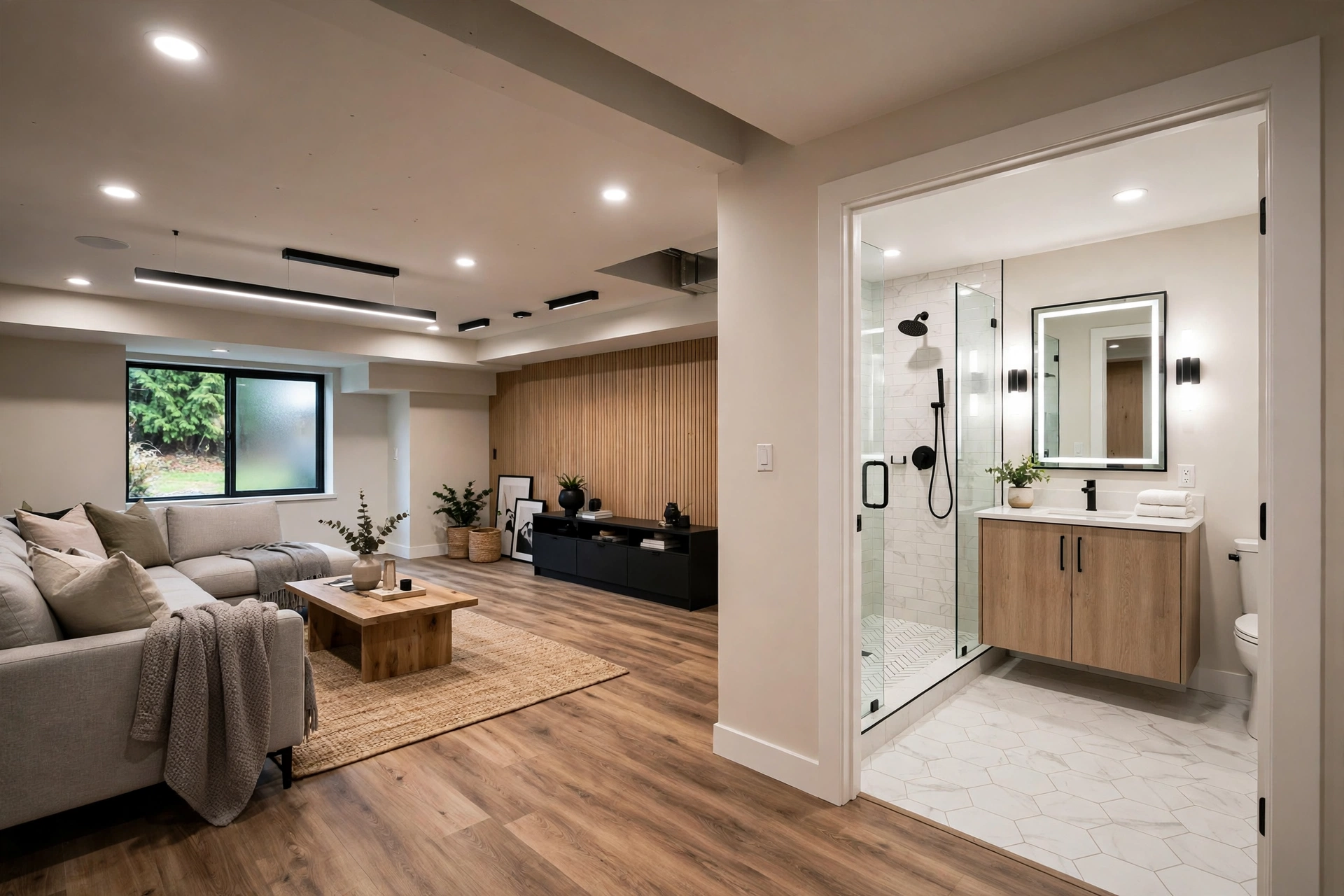
- Basement: naturally quiet and cool, and often the only underused space in the house. The challenge is light and the feeling of being underground (solvable — see below). A basement office pairs well with a broader basement finishing project.
- Den or formal living room: many Abbotsford homes have a formal living room nobody sits in. Converting it is often the highest-value move in the house — you’re activating dead space.
- Avoid: the kitchen, the main hallway, and any room that doubles as a thoroughfare. If people walk through your background on calls, it’s not an office.
2. Fix the Lighting Before Anything Else
Bad lighting tops the complaint list for home offices. It’s the #1 gripe. And it’s almost always fixable. What you’re after: bright, even light. No glare bouncing off your screen.
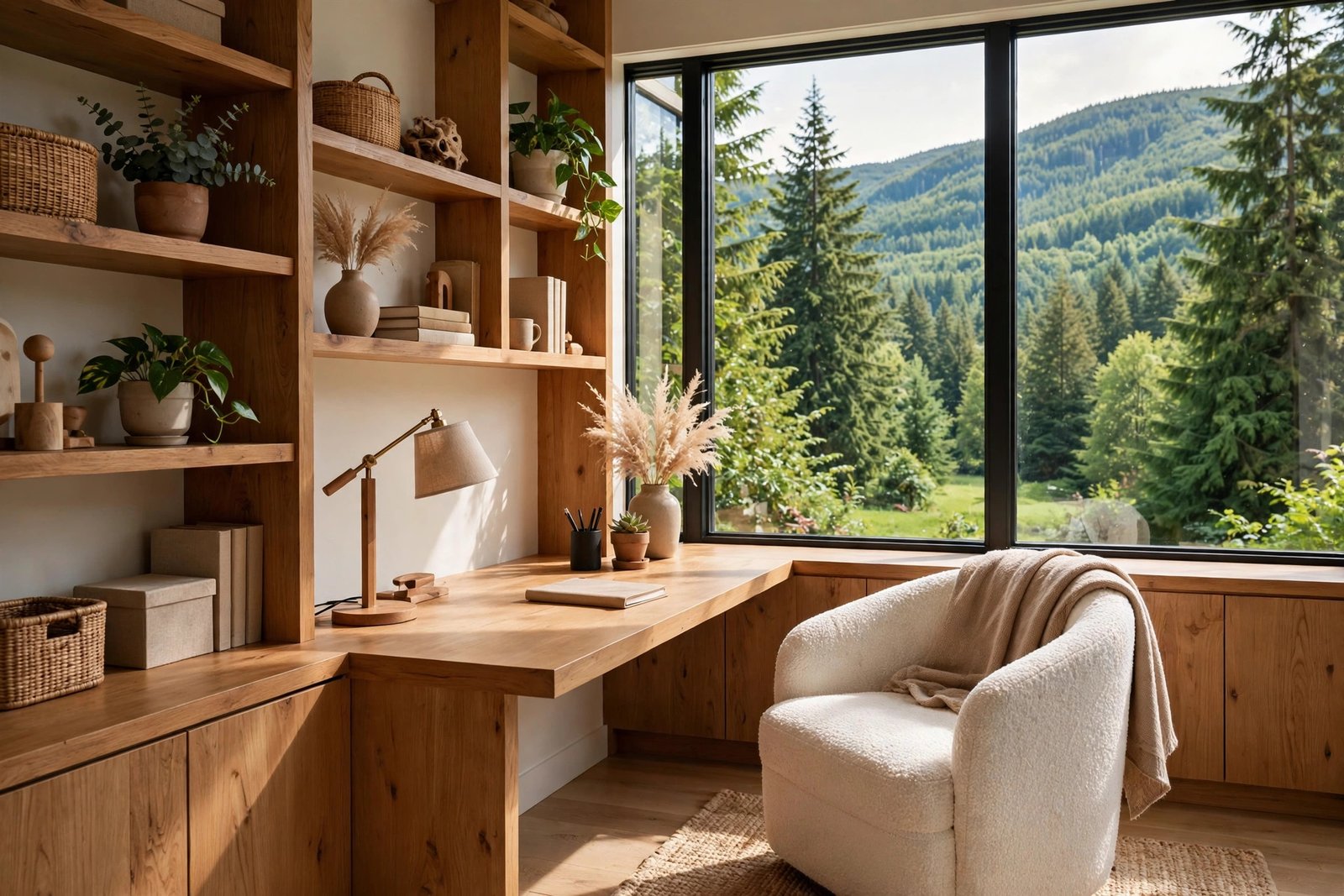
Natural light first. Put the desk perpendicular to the window. Not facing it — glare. Not with your back to it either, unless you enjoy looking like a silhouette on video calls. North-facing light is the most even. Window faces south or west? Plan on blinds. Sheer curtains work too.
Then layer task lighting. Overhead room lighting alone creates shadows on your desk. Add:
- A quality desk lamp with adjustable colour temperature (warm for evenings, cool-white for focused daytime work)
- If the room has no overhead light on a proper circuit, that’s an electrician visit — budget $300–$800 for a new fixture and switch
For video calls specifically: a simple ring light or a softbox-style lamp behind your monitor, at face height, eliminates the “witness protection” look. Under $100, enormous difference.
Aim for roughly 300–500 lux at the desk surface. That’s the comfort zone for sustained work. Most people are working in far less. And wondering why their eyes ache by 3 p.m.
3. Sound Control: The Professionalism Upgrade
You can have a beautiful office, but if every call includes the dog, the dishwasher, and the neighbour’s lawn crew, it doesn’t feel professional. Sound control has two parts:
Blocking sound from getting in (and out):
- A solid-core door instead of a hollow one — the single biggest upgrade, roughly $400–$900 installed
- Weatherstripping around the door frame (sound leaks through gaps, not walls)
- A rug and soft furnishings if the room has hard floors — bare floors bounce sound everywhere
Improving sound inside the room:
- Bookshelves full of books are excellent diffusers
- Acoustic panels have come a long way aesthetically — fabric-wrapped panels in neutral colours look like design choices, not recording-studio foam
- Soft window coverings instead of bare blinds
For basement offices, the ceiling is the weak point — footfall from above transmits straight through. Resilient channel and a second layer of drywall with acoustic sealant during a basement finish makes a dramatic difference, and it’s cheap to do while walls are open.
4. Power: Plan for More Than You Have Now
Count what’s plugged in at your desk right now. Now add more. The monitor upgrade. The printer. The chargers, the lamp. The space heater you’ll inevitably buy in January. Most spare bedrooms offer two outlets on a shared 15-amp circuit. Not enough. Not for a real workstation plus peripherals.
What to plan:
- Dedicated 20-amp circuit for the office if you’re running multiple monitors, a printer, and heating/cooling — an electrician visit, roughly $500–$1,500 depending on panel access
- Outlets at desk height, not just down at baseboard level. Power strips snaking across the floor? Ugly. A trip hazard too
- Wired ethernet to the desk. Wi-Fi is fine for browsing. For all-day video calls, though? Large file transfers? A hardwired connection is noticeably more reliable. It just is. Running Cat6 during any wall-open renovation costs very little
This is the least glamorous item on the list. It’s also the one people regret skipping most. Not close.
5. Built-In Storage Beats Furniture
A home office accumulates stuff. Files. Reference books. Equipment, supplies. The printer that needs a home somewhere. Freestanding bookcases? They eat floor space. They collect visual clutter too. Built-ins — a desk with integrated shelving, wall-mounted cabinets, a proper printer nook — work the room’s vertical space instead. And they look intentional.
Budget-wise: custom built-ins run $2,000–$8,000. Size and finish decide where you land. There’s a middle path, and it works well. IKEA-style modular storage (BESTÅ, PAX), installed wall-to-wall. Trim it out with filler panels so it reads as built-in. Roughly half the cost of true custom millwork. You get 80% of the look.
Whatever you choose, plan storage for the equipment you have and the equipment you’ll acquire. Offices grow.
7. Ergonomics: The Chair and Desk Are the Job
You’ll spend 2,000 hours a year in this chair. This is not where to economize.
- Chair: a proper ergonomic task chair ($400–$1,000 for a good one) beats a dining chair by a margin your back will feel within a month
- Desk height: standard 29–30 inches suits most people; a sit-stand desk ($500–$1,200) is worth it if you’re at the desk all day
- Monitor position: top of the screen at or slightly below eye level, about an arm’s length away — a $50 monitor arm beats a stack of books
- Keyboard and mouse: at elbow height, wrists neutral. The number of home offices with a laptop flat on a too-high desk and the user hunched over it is staggering
None of this requires renovation — but if you’re renovating anyway, it’s the moment to get desk height, monitor placement, and cable routing right from the start.
8. Climate: Basements Are Cold, Spare Bedrooms Are Stuffy
Every home office location in the Fraser Valley has a climate quirk:
- Basements run cool and damp. A dehumidifier helps. So does an area rug — together they go a long way. In-floor heating is the luxury answer. Worth it if you’re finishing the space anyway.
- South/west-facing spare bedrooms overheat on summer afternoons. Every summer, same story. Blackout-lined cellular shades cut heat and glare together.
Don’t discover it in February. That’s when people learn their office is the coldest room in the house. Test the room through a season first. Can’t wait? Then budget the climate fix into the renovation.
9. Keep It Separable From Home Life
The psychological research here is consistent: people who work from home do better with a physical and ritual boundary between work and everything else. Design for it:
- A door that closes — non-negotiable if the office shares space with family life
- Separate lighting scenes if the budget allows. Bright task lighting for work hours. Warmer ambient light for the room’s other life
- Hide the work. Office doubling as the guest room? Get a desk with doors that close over the monitors. Or a murphy-style fold-down desk. Either way, the room changes identity in 30 seconds
- No work visible from the bed. If you must combine office and bedroom, position the desk so it’s not the first thing you see waking up — your sleep will thank you
10. What a Home Office Renovation Costs in Abbotsford
Most home office projects fall into clear tiers. They really do. As 2026 planning ranges:
| Scope | Typical range | What it includes |
|---|---|---|
| Cosmetic refresh | $2,000–$5,000 | Paint, lighting, flooring refresh, no structural/electrical changes |
| Proper conversion | $8,000–$18,000 | New circuits, lighting, built-ins, solid-core door, sound treatment, flooring |
| Basement office as part of a finish | $12,000–$25,000 (office portion) | Insulation, drywall, egress, HVAC tie-in, finishes — within a larger basement project |
| Dedicated addition or garage conversion | $40,000–$80,000+ | New structure, foundation work, full services |
The most common mistake? Under-budgeting the invisible work. Electrical. Sound control. Lighting. That’s where the money goes — and it’s also what makes the office actually work. A $3,000 paint-and-furniture refresh changes little. Put it in a room with two outlets and a hollow door and it’s still a compromised office.
All figures here are 2026 planning ranges for Abbotsford. Not quotes. Electrical work in BC requires permits. Licensed electricians too.
Frequently Asked Questions
What’s the best room for a home office in a typical Abbotsford house?
The quietest spare bedroom, usually. Most Abbotsford homes have a bedroom that can be spared. Easier than homeowners think, usually — whether it’s a 70s rancher in Clearbrook or a newer two-storey in Auguston. Choose by noise. Noise during your working hours, not size. A small quiet room beats a large noisy one. Every time.
Do I need a permit to convert a bedroom into an office?
For cosmetic work, no. Paint, flooring, furniture, plug-in equipment — none of it needs a permit. New electrical circuits are different. Structural changes too. Anything affecting the building envelope crosses into permit territory. When in doubt, check our building permit guide — cosmetic office refreshes are among the simplest projects going.
Is a basement a good location for a home office?
Yes, with two conditions: light and moisture control. Basements are naturally quiet — ideal for calls — but they need adequate lighting (don’t rely on one small window) and verified dryness before you invest in finishes. Never build an office over an unresolved moisture problem; address waterproofing first. A finished basement office is also one of the highest-value uses of basement space that isn’t a legal suite.
How much does it cost to soundproof a home office?
A meaningful upgrade runs $1,000–$3,000 — solid-core door, weatherstripping, acoustic panels, and soft furnishings. Full room-within-a-room construction runs much higher — $5,000–$10,000+. Resilient channel, double drywall, the works. It’s usually only justified for recording. Or for shift workers sleeping during the day. Most remote workers? The door-plus-soft-furnishings tier is enough.
Can I claim home office renovation costs on my taxes in Canada?
The CRA allows home office expense claims. Employees required to work from home can claim. So can the self-employed. But capital renovations? Those get treated differently from ongoing expenses. Generally, you can claim a portion of maintenance. Utilities too. The capital cost of a renovation is different — it may affect your home’s adjusted cost base instead of being directly deductible. Tax rules change and personal situations vary — talk to an accountant before making renovation decisions based on tax treatment.
What’s the biggest home office mistake?
Treating it as a furniture project instead of an infrastructure project. The chair and desk matter. Sure. But the projects people regret? The invisible ones they skipped. Too few outlets. No wired internet. A hollow door. Bad lighting. Spend the renovation budget on infrastructure first. Furniture can be upgraded anytime. Opening walls twice is the expensive way to learn.
Build the Office Around the Work, Not the Other Way
The home offices that work share one trait. They were designed from the work backwards. What do you actually do all day? Calls. Deep focus. Creative work. Client meetings. Each answer points somewhere different — lighting, sound, layout, equipment.
If your office plans are part of a bigger project — a basement finish, a spare-room refresh, rethinking how your home’s space gets used — take a look at our basement finishing services to see how a dedicated workspace fits into a whole-home plan. And avoid the classic pitfalls our renovation mistakes guide covers. Most of them apply double to offices. The invisible work matters most there.
Cost figures in this article are 2026 planning ranges for Abbotsford. They’re based on typical contractor pricing. Not quotes. Electrical work in BC requires permits and licensed electricians.