
Ask any Abbotsford landlord what ends a tenancy early, and noise is near the top of the list. Footsteps overhead at 6 a.m. The tenant’s TV vibrating through the floor during your dinner. A baby crying at 2 a.m. under a light sleeper’s bedroom. Most basement suites in the Fraser Valley were finished when sound was an afterthought — a single layer of drywall on the ceiling, hollow-core doors, and gaps around every pipe and wire.
Good soundproofing is not about one magic product. It is a system: mass, decoupling, absorption, and sealing, working together. And here is the part many suite owners miss — the BC Building Code already sets a minimum. A dwelling unit must be separated from every other space where noise may be generated by an assembly rated at STC 50 (or ASTC 47 including the adjoining construction). That is the legal floor for a legal suite, not the ceiling of what is possible.
1. Why Soundproofing Pays for Itself in a Rental Suite
This is a business decision. Not just a comfort one. A quiet suite rents faster. It keeps tenants longer. It commands better rent. Every month a suite sits vacant between tenants costs you $1,200–$1,500 in lost Abbotsford rent. Avoid one turnover and you have paid for a meaningful share of the soundproofing work.
It also protects the upstairs. Plenty of suite arrangements fail for a reason that surprises people. The tenant is not loud. The owners upstairs just cannot relax in their own living room. Plan to live above your own suite for years? Then soundproofing is quality-of-life spending. With a rental return attached. Our basement suite ROI breakdown shows how the full investment pencils out.
2. STC Ratings, Explained Without the Jargon
STC stands for Sound Transmission Class. It is a single-number rating: how well a wall or ceiling blocks airborne sound. Roughly, the decibel reduction the assembly gives you. What the numbers feel like:
- STC 30 (single drywall each side, no insulation): normal speech clearly audible. This is a standard interior wall — and a typical unrenovated suite ceiling.
- STC 40: loud speech audible but not intelligible. Better, not private.
- STC 50 (BC code minimum between units): loud speech barely audible; you might hear muffled sound but not words.
- STC 60+: very little sound gets through. This is the “forget anyone lives downstairs” zone.
Two things STC does not measure. Impact noise, for one — footsteps, dropped objects. That is IIC, a separate rating. Low bass, for another. Home theatre subwoofers defeat most standard assemblies. A suite ceiling needs to handle airborne and impact sound both, which is why the ceiling gets its own section below.
3. The Ceiling: Where Most of the Money Should Go
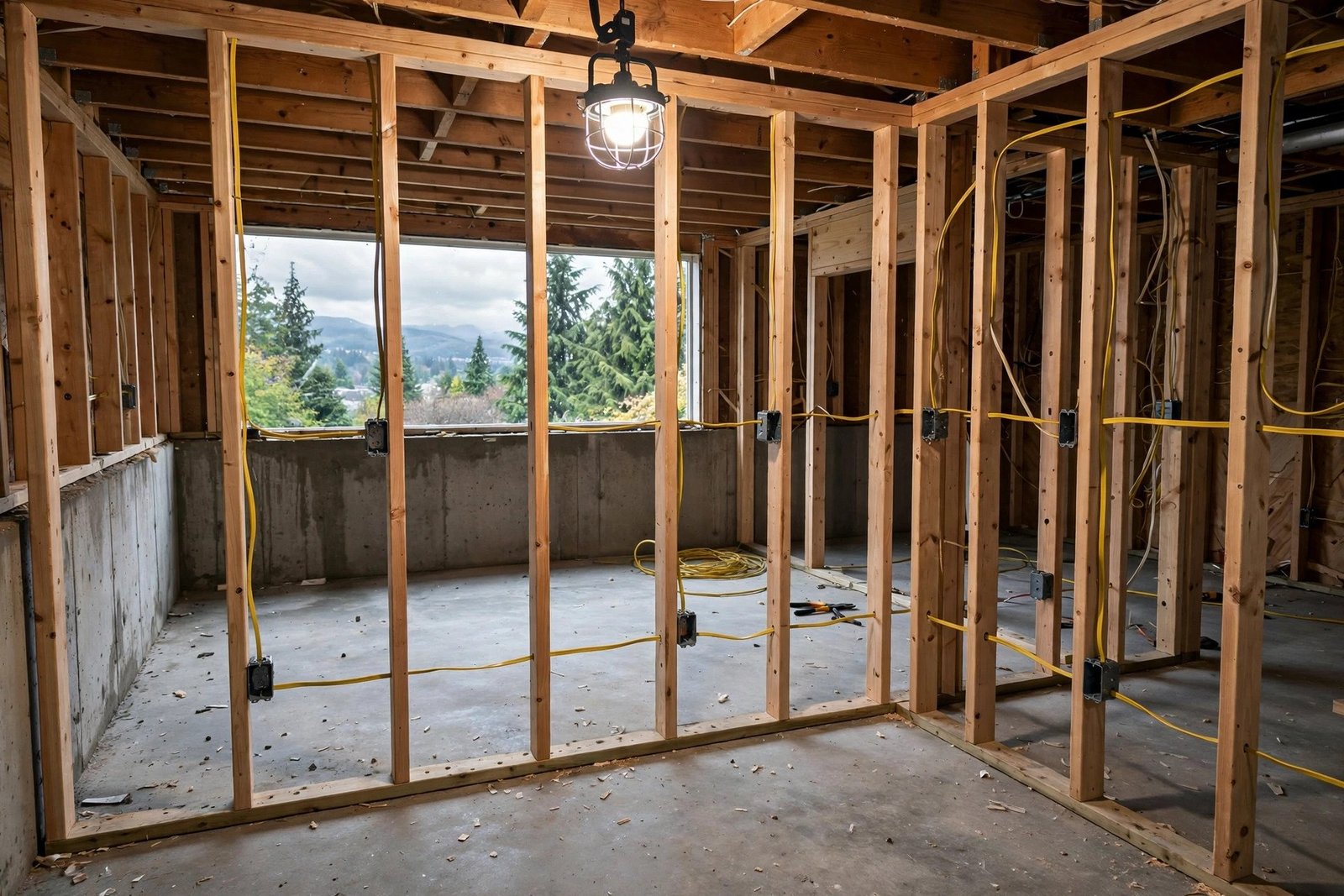
In a basement suite, the ceiling is the battleground. It carries airborne sound. Voices, the TV. It carries impact sound, too — footsteps on the floor above — and impact is the harder problem. A standard drywall ceiling, screwed directly to the joists, transmits every footstep.
The effective approach layers three strategies:
- Decouple with resilient channel or acoustic clips. The drywall hangs on flexible metal channel. It is not screwed rigidly to the joists, so vibration cannot travel straight through. For footstep noise, this is the single biggest upgrade.
- Add mass with double 5/8″ drywall. Two layers of Type X. A damping compound between them, ideally. You roughly double the mass blocking airborne sound.
- Absorb with insulation. Mineral wool batts — Roxul Safe’n’Sound is the usual one — sit in the joist cavities and dampen the hollow drum effect. Standard fibreglass helps; dense mineral wool helps more.
2026 planning range: a proper acoustic ceiling assembly — resilient channel, insulation, double 5/8″ drywall — adds $3,000–$6,000 over a basic drywall ceiling. That is for a typical 600–800 sq ft suite. These are planning ranges, not quotes.
4. Walls: Simpler Than the Ceiling, Still Worth Doing
Suite walls matter less than the ceiling. Most noise complaints are vertical, not horizontal. But shared walls still deserve treatment — the furnace room wall, the laundry, the stairwell. The recipe is the same trio. Insulation in the cavities. Resilient channel or staggered studs to decouple. Double drywall for mass.
Staggered-stud walls are excellent for new partition walls. The studs alternate on a wider plate, so neither drywall face touches the same stud. And they cost little extra in lumber. Keeping an existing wall? The practical retrofit is a second layer of drywall, with damping compound.
One detail people skip. Extend acoustic treatment the full height. Above drop ceilings. Into joist bays. All of it. Sound flanks around the ends of partial treatments like water around a breakwater.
5. Doors, Penetrations, and the Weakest-Link Problem
Here is the uncomfortable truth about soundproofing. The assembly is only as good as its weakest point. And the weakest points are almost never the drywall.
- Doors: a hollow-core interior door rates around STC 20. Single-handedly, it ruins an STC 50 wall. Suite entry doors should be solid-core. Full weatherstripping. A door sweep or an automatic door bottom. Budget $400–$800 installed per door, seals included.
- Penetrations: every pipe punches a hole in your acoustic assembly. Every wire. Every duct and recessed light. Seal them all with acoustic sealant. It stays flexible, where regular caulking cracks. Pot lights in a suite ceiling are particularly bad. Each can is a hole. Use sealed, IC-rated housings, and seal around them. Or use surface-mount fixtures in the most critical rooms.
- Ducts: shared ductwork carries voices between floors. Beautifully, unfortunately. If the suite shares the furnace, add duct liner, or flexible insulated duct runs. And never put a supply register from the same trunk directly above and below another one.
6. New Build vs Retrofit: Very Different Projects
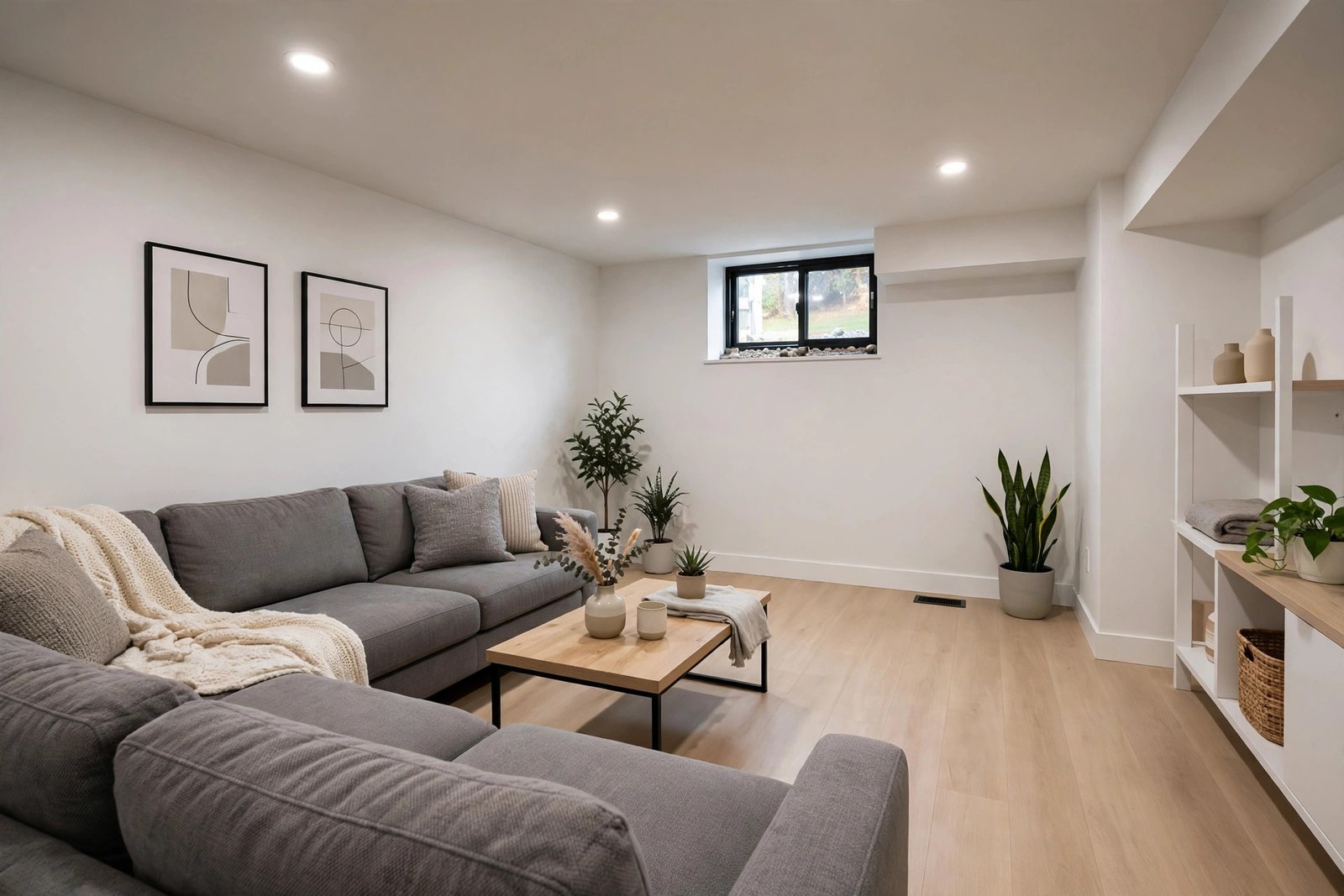
Finishing a basement from bare joists? Soundproofing is cheap at that stage. Mostly material cost. A bit of extra labour on work you are doing anyway. Resilient channel, mineral wool, double drywall — add perhaps $4,000–$8,000 to a full basement finishing project. Our basement finishing cost guide puts the whole project in context.
Retrofitting an already-finished suite is a different animal. You are tearing down a finished ceiling to rebuild it. Demolition. The acoustic assembly. Re-drywall, mud, paint. New flooring protection. Realistically $8,000–$15,000+ for the ceiling alone in a typical suite, plus the disruption. This is why soundproofing belongs in the original plan. Not as an afterthought. Still at the planning stage? Review the legal suite requirements, and design the whole project right the first time.
| Method | What it does | Typical STC gain | 2026 planning cost |
|---|---|---|---|
| Mineral wool in cavities | Absorbs cavity resonance | +4–6 | $1–$2/sq ft installed |
| Resilient channel (ceiling) | Decouples drywall from joists | +8–12 | $1.50–$3/sq ft installed |
| Double 5/8″ drywall + damping | Adds mass, damps vibration | +5–10 | $2–$4/sq ft over single layer |
| Acoustic sealant (all gaps) | Kills flanking paths | +3–5 | $200–$500 in materials |
| Solid-core door + seals | Fixes the weakest link | +10–15 at the doorway | $400–$800 installed |
Gains are approximate and assembly-dependent. Costs are 2026 BC planning ranges, not quotes.
7. Quick Wins Under $500
Not ready to open the ceiling? These smaller moves help. Genuinely. And they cost little:
- Acoustic sealant on every penetration — plumbing, electrical, duct. Every penetration through the suite ceiling and walls. A few tubes and an afternoon.
- Door sweeps and weatherstripping on the suite entry door — that under-door gap leaks more sound than the drywall beside it.
- Seal the laundry and furnace room — shared mechanical rooms are noise highways. A solid-core door there pays off disproportionately. So do sealed penetrations.
- Soft furnishings in the suite — rugs with thick underpad. Upholstered furniture. Curtains. They absorb reflected sound inside the unit, and less reflected sound means less gets transmitted.
None of these replace a proper assembly. Together, they take the edge off. They buy you some quiet while you plan the real work.
Frequently Asked Questions
What STC rating does a basement suite legally need in BC?
STC 50 minimum between dwelling units. The BC Building Code (Section 9.11) requires the separation. A dwelling unit must sit apart from every other space where noise may be generated, behind an assembly rated at STC 50 or better. Or ASTC 47, when the adjoining construction is counted. Your permit drawings should show an assembly that meets this. And meeting code is the floor. Many owners build beyond it, for tenant satisfaction.
Can I soundproof a finished suite without tearing down the ceiling?
Partially, but the big gains need the ceiling opened. You can add a second layer of drywall, with damping compound, over the existing ceiling. Upgrade to solid-core doors. Seal every penetration. All worthwhile improvements. But resilient channel and in-joist insulation need the existing ceiling removed. Coming down for another reason anyway — plumbing, electrical? That is the moment to do it properly.
Does insulation alone soundproof a ceiling?
No. Insulation helps, but it is not soundproofing by itself. Mineral wool in the joist bays dampens the hollow-cavity resonance. It adds a few STC points. But decouple nothing and add no mass, and footsteps and voices still transmit through the rigid structure. The three strategies work as a system. Insulation alone is the most common half-measure.
How much does it cost to soundproof a basement suite in Abbotsford?
As a 2026 planning range: $4,000–$8,000 added to new construction. A retrofit of the ceiling runs $8,000–$15,000+. The spread depends on suite size. Whether walls and doors are included. How much demolition a retrofit needs. Get itemized quotes. And be wary of any contractor who promises “soundproof” from insulation alone.
Will soundproofing let me charge more rent?
It helps you keep good tenants. That is worth more than a small rent premium. Abbotsford’s rental market is competitive. A quiet, well-built suite stands out in listings. More importantly, it avoids turnover, and turnover costs a month’s rent each time. Price it against comparable suites. Then let the quiet be the reason tenants stay.
Do I need a permit to upgrade soundproofing in my suite?
Generally yes — if you are opening walls or ceilings and altering the assembly. Cosmetic work needs nothing. Adding a door sweep, say. But removing and rebuilding a ceiling is construction. And if your suite was never permitted, this is a good moment to look at full legalization. Our basement suite permit guide covers the steps.
Build the Quiet In From the Start
Soundproofing is one of those things that costs a little during construction and a lot afterward. If a basement suite is in your plans — or already earning rent above your head — design the acoustic assembly now, not after the first noise complaint.
Our basement finishing services include acoustic assemblies built to code as standard practice, because a suite you cannot hear is a suite that keeps paying.
Code references are to the BC Building Code as published; confirm current requirements with the City of Abbotsford Building Department for your specific project.