
Cabinets get priced by the foot in BC. Not by the kitchen. Not by the box count, not by the door style you spent three weekends choosing, and not by the hardware — the little lever-or-knob decisions — that somehow ate an entire Saturday at the showroom.
The foot.
And a per-foot figure is a budgeting average, nothing more scientific than that — a blender number, really — that takes the cheap boxes and the expensive boxes, the sink base that costs almost nothing to build and the drawer bank that costs a small fortune in joinery, and flattens them all into one tidy figure so a whole kitchen can be estimated in about ninety seconds.
Cabinets are also the biggest line in most kitchen renovations. Usually a quarter to a third of the entire project. Bigger than the countertop. Bigger than the appliances in a good many mid-range jobs. So what the per-foot number covers matters — and what it quietly leaves out matters more, because that is exactly where quotes go sideways.
The short version: for 2026, plan on $150–$350 per linear foot installed for stock or RTA cabinets, $350–$650 for semi-custom, and $650–$1,200+ for custom. A standard 10×10 kitchen runs roughly $4,000–$9,000 in stock, $9,000–$16,000 semi-custom, and $16,000–$30,000+ custom, installed. The countertop, sink and removal of the old cabinets are normally extra.
1. What a Linear Foot Counts
A linear foot is one foot of cabinet run. Measured horizontally. Along the wall.
A 10-foot wall of base cabinets is 10 linear feet whether those feet hold drawers, doors, a sink base, or some combination the designer sketched on the back of a quote sheet — the tape measure does not care what is behind the doors, and neither, frankly, does the per-foot price.
Upper cabinets count too. Along their own run. A typical 10×10 kitchen carries roughly 20–25 linear feet in total — uppers and lowers added together — which is precisely why the industry uses that kitchen, the humble little 10×10, as its standard reference whenever it quotes anything at all.
The per-foot price normally covers:
- Cabinet boxes
- Doors and drawer fronts
- Standard hardware
- Installation labour
It normally does not cover:
- The countertop
- The sink and faucet
- Crown moulding and decorative end panels
- Pull-out organizers and specialty inserts
- Removal of the old cabinets
This is why two quotes can both state $450 per linear foot and land thousands of dollars apart on the very same kitchen. Thousands.
One quote includes the uppers — all of them, right into the corner — plus the soft-close upgrade and the tall pantry unit standing at the end of the run, while the other counts base cabinets with basic hinges and quietly stops there, and neither number is exactly lying to you; they are simply pricing two different kitchens that happen to share an address.
Between suppliers it is the same story. The same kitchen. $300 a foot from one supplier and $900 from another — and most of that gap is inclusions, not greed, a question of what is inside the number and what got left standing on the loading dock of the estimate.
Per-foot pricing also averages the boxes together, which is the polite way of saying it hides things. A sink base is basically a box with a hole in the front. A drawer bank is joinery — real joinery, dovetails and runners and tolerances. The figure blends them into the same foot anyway. The number works for budgeting. It does not work — not even slightly — for comparing a galley kitchen of simple door cabinets against an island kitchen full of drawer stacks and pull-outs.
2. The Three Tiers
| Cabinet tier | 2026 cost per linear foot (installed) | Typical 10×10 kitchen | Lead time |
|---|---|---|---|
| Stock / RTA | $150–$350 | $4,000–$9,000 | 1–4 weeks |
| Semi-custom | $350–$650 | $9,000–$16,000 | 4–8 weeks |
| Custom | $650–$1,200+ | $16,000–$30,000+ | 8–14 weeks |
Stock and RTA. Built to standard sizes. Set finishes. Big-box stores and online suppliers carry them, and the installed price is the lowest in the industry — full stop. Assemble the RTA boxes yourself and pay only for the installation, and a further amount comes off the total, which is real money if your weekends are cheaper than an installer’s hours. The limits are real too, though. Fixed widths — so fillers cover the gaps where the run refuses to divide neatly. A short finish list. And particleboard construction on the cheapest lines, the boxes that swell the first time a sink fitting weeps behind them. If the budget allows, choose plywood boxes. Even down here in the stock ranges. Especially down here.
Semi-custom. This tier starts from the standard box and starts adding choices — depth modifications, finished interiors, soft-close drawers and doors, a wider finish range, sizes adjusted to the actual walls of your actual kitchen rather than to a catalogue grid. Most mid-range Fraser Valley kitchen quotes land here. Right here. And the difference from stock is not obvious on day one; it shows up years later, in hardware that still glides, in a finish that has survived daily cooking and steam and small children and one large dog without peeling at the edges.
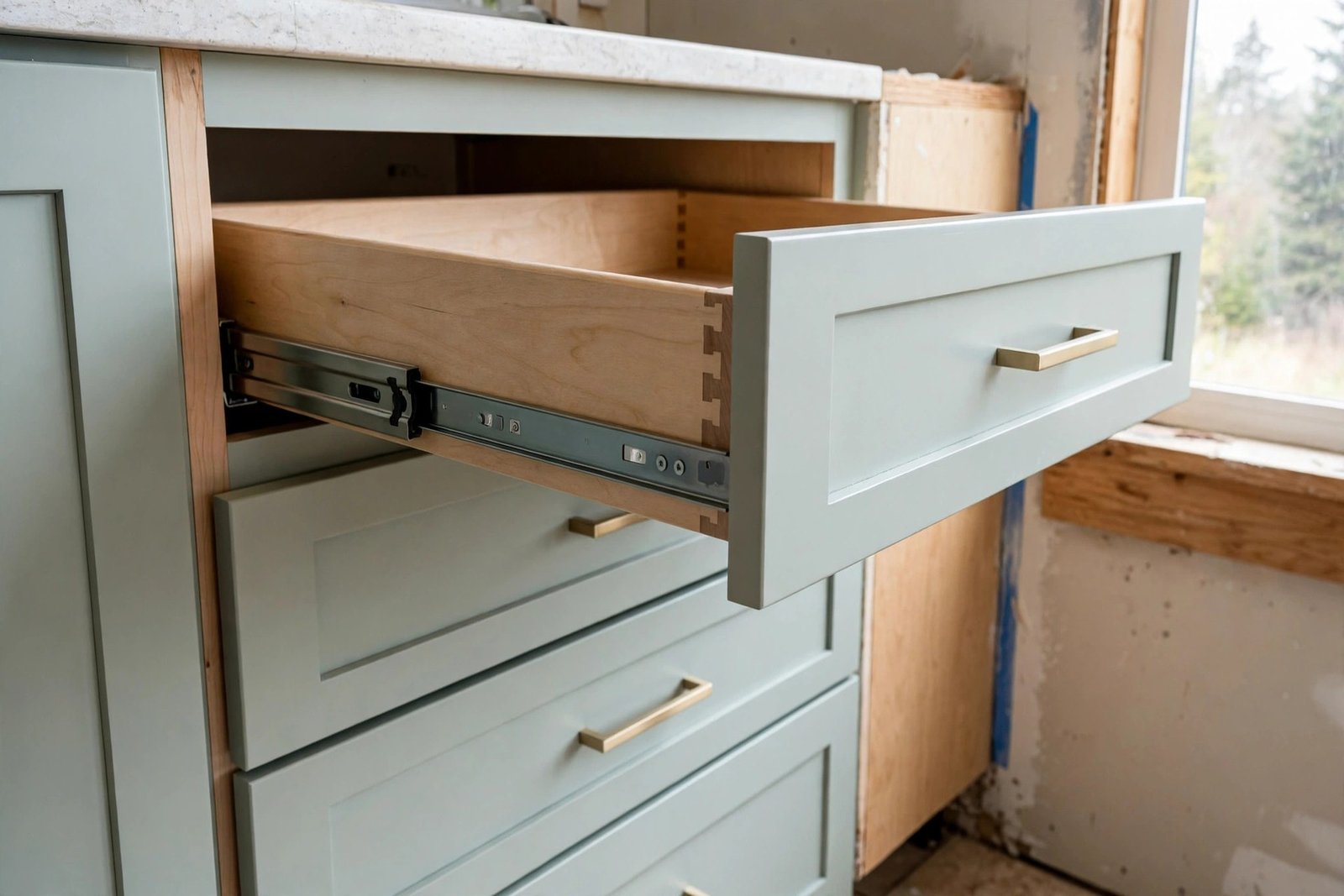
Custom. A cabinet shop builds to exact dimensions. Exact species. Exact finish. Dovetailed drawers, inset doors, odd corners fitted without a single filler strip apologizing for the gap. In older Abbotsford homes — the uneven walls, the unusual layouts, the floors that slope like a boat deck — custom is sometimes the only route to a kitchen that looks truly fitted rather than approximately installed. The main cost is not even the money. It is the wait. At 8–14 weeks, custom cabinets set the schedule for the whole renovation, and every other trade stands around waiting on them.
3. Installation Labour and Removal
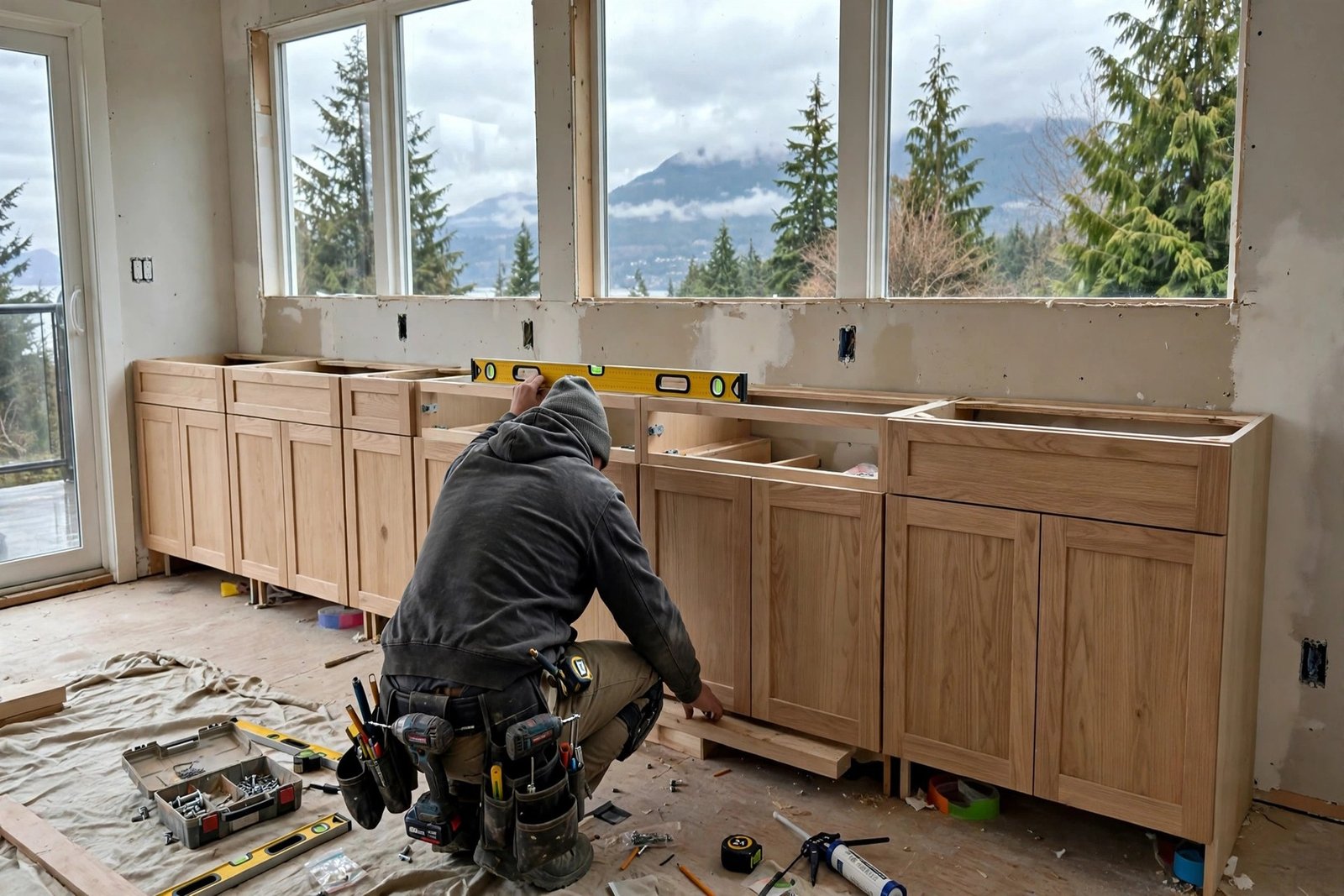
Installation labour accounts for $75–$150 per linear foot of a per-foot quote — roughly a quarter to a third of the installed price at the semi-custom tier — and it covers far more than the word “installation” suggests: delivery, unboxing and assembly for the RTA boxes, levelling and scribing the boxes to the walls, hanging the uppers, fitting fillers, panels and moulding, and setting every door and drawer front so the gaps run even, those shadow lines a visitor never notices precisely because somebody got them right.
Levelling and scribing are the skilled part. The part you are actually paying for.
Few BC homes have flat floors or plumb walls — particularly the 1970s and 1980s ranches common in Abbotsford neighbourhoods such as Clearbrook and West Abbotsford, houses that have been settling into themselves for forty years. So the installer shims. The installer scribes. Until the cabinet tops run level — dead level — because this matters well beyond appearance: the countertop template is taken from the cabinet tops, and an unlevel cabinet line produces a wavy countertop, and a wavy countertop is forever. Countertop fabricators will not template until the cabinets are set and verified level. Not early. Not as a favour.
Removal is a separate cost. A separate line. Tearing out the old cabinets, patching the wall behind them and hauling the debris runs $500–$1,500 for a standard kitchen, and it usually sits outside the per-foot price entirely. One wrinkle worth knowing: if the old cabinets are solid wood and in decent shape, some installers discount the removal, because the boxes have resale or donation value. Ask. Before demolition starts — not after the bin is already full.
4. Reface or Replace
Before ordering new cabinets, price the road not taken. Refacing.
If the existing boxes are solid, square and sitting in a layout that works, then new doors, drawer fronts and a matching finish give you most of the visual change for 40–60 percent of the replacement cost — and refacing runs $100–$250 per linear foot in BC — while skipping the demolition, skipping the wall patching, and skipping the long lead times that come with boxes that do not exist yet.
Replace instead when the boxes are damaged. When the layout wastes space. When the cabinet heights conflict with the countertop plan. Or when structural changes are needed — a wider range opening, a deeper fridge surround — the kind of change no handsome new door front can disguise.
Paint is the lowest-cost option of all, when the boxes and doors are sound and only the colour is dated, that honey-oak time-capsule look staring back at you every morning. Our kitchen cabinet painting cost guide for BC prices that option, and our cabinet refacing vs replacing guide compares all three routes in full.
The working rule is short. If the layout is changing, replace. If the layout works and the boxes are sound, reface or paint — and put the savings where they actually show, into the countertop or the appliances.
5. What Moves the Price Per Foot
Within a tier, these factors move the number:
- Drawer banks vs doors. Drawers cost far more to build than doors. Far more. A kitchen heavy on drawer stacks prices higher per foot than one of simple door cabinets.
- Wood species and finish. Painted MDF is the budget finish. Stained maple, oak and walnut cost more. Two-tone kitchens — painted perimeter, stained island — carry a finish upcharge.
- Height and depth. 42-inch uppers cost more than 30-inch uppers. Deeper uppers and full-height pantry units price above standard boxes.
- Specialty units. Lazy Susans, pull-out pantries, appliance garages, tray dividers and built-in spice racks are priced per unit on top of the foot rate. Budget $150–$600 each.
- Soft-close and hardware upgrades. Often an add-on at the stock tier and standard at semi-custom.
- Island and peninsula. Islands are priced per linear foot as well, but they need finished panels on all exposed sides and often a support structure. Budget 20–30 percent above the wall-run rate for island cabinetry.
6. Frequently Asked Questions
How much do kitchen cabinets cost per linear foot in BC?
For 2026, plan on $150–$350 per linear foot installed for stock or RTA cabinets, $350–$650 for semi-custom, and $650–$1,200+ for custom. A standard 10×10 kitchen runs roughly $4,000–$9,000 in stock, $9,000–$16,000 semi-custom, and $16,000–$30,000+ custom, installed. These are planning ranges, not quotes.
What does the per-linear-foot price include?
Usually the boxes. The doors. Standard hardware and the installation labour. It typically excludes the countertop, the sink and faucet, decorative moulding and end panels, specialty organizers, and removal of the old cabinets — which is why the only safe way to compare two quotes is to ask for the itemized list of inclusions, in writing, before the numbers mean anything at all.
Are RTA cabinets worth it in BC?
For budget renovations, yes. Genuinely yes. RTA cabinets give the lowest per-linear-foot cost available anywhere, and mid-range RTA lines with plywood boxes are good quality — not pretend quality, actual quality. The trade-off is assembly time and fixed sizes that need fillers. If full installation is being paid for anyway, compare the assembled, installed price against semi-custom before deciding.
How long do custom kitchen cabinets take?
Eight to fourteen weeks. That is the honest answer for custom — 8–14 weeks from order to delivery, on top of design time — while semi-custom runs 4–8 weeks and stock 1–4 weeks. The cabinet lead time usually sets the schedule for the whole kitchen renovation, the critical path everything else hangs off, so order early and plan the demolition around the delivery date rather than the other way around.
Should I reface or replace my kitchen cabinets?
The layout decides. If the boxes are solid and the layout works, reface or repaint — it costs 40–60 percent of replacement and skips the demolition entirely. Replace when the layout wastes space, when the boxes are damaged, or when structural changes are needed, such as a wider range opening. If the layout is changing at all, replacement is almost always the right call.
Planning a Kitchen Cabinet Project in BC
Measure the kitchen first. Then decide the tier — stock when the budget is tight, semi-custom for most full renovations, custom when the layout genuinely requires it — and get the inclusions in writing before comparing per-foot prices between suppliers, because a per-foot number without its inclusion list is just a number wearing a suit.
Order early. The cabinet lead time runs the project schedule — it always runs the project schedule — so do not demolish before a delivery date exists. And run the reface-vs-replace comparison before committing to anything; the saving on sound boxes can pay for the countertop upgrade on its own. If you would like a second set of eyes on your plan, call us at (236) 613-0038 and we will talk through tiers, lead times and a realistic 2026 budget. No pressure, just straight answers.