
November in Abbotsford does something to a backyard. October rain settles in and just keeps coming. By the third week the lawn has gone spongy underfoot — and the dog? Muddy paws at the door, every single time, no matter how often you wipe them. That is the moment most people start pricing turf — and the artificial turf installation cost BC question that follows has an annoyingly wide answer.
Put a number on it for 2026 and it lands, roughly, somewhere between $14 and $30 per square foot. Installed. All in. Most Fraser Valley jobs sit in the middle of that band — $18 to $24 a square foot, give or take. And the spread? Almost none of it is about the grass you can see. It is about what sits underneath it.
People shop the roll. Makes sense — it is the part you look at. It is just not the part that decides whether the job holds up five winters from now. A cheap roll over a properly built base outlasts a premium roll laid on compacted clay. Abbotsford soil is heavy clay in a lot of neighbourhoods, from East Abbotsford through to Matsqui, and clay holds water the way a bathtub holds water.
Artificial Turf Installation Cost BC per Square Foot
Grades are really a fibre story. How the fibres are built — that is what you are paying for. Budget rolls run short, thin fibres. Lighter backing too. Step up to mid-range and you get height, plus a denser pile. It stays standing — a month of kids running across it and it still springs back, instead of lying flat. Premium turf mixes fibre shapes, mixes colours, so the surface stops looking so uniform. Backing is thicker. Tougher, too.
| Turf grade | Material cost per sq ft | Installed cost per sq ft* | Best for |
|---|---|---|---|
| Budget (25–30 mm pile) | $4–$6 | $14–$17 | Low-traffic side yards, rental properties |
| Mid-range (35–40 mm pile) | $6–$9 | $18–$22 | Family backyards, regular play |
| Premium (40–45 mm pile) | $9–$13 | $23–$30 | Front yards, heavy use, pet areas |
| Pet-specific turf | $8–$12 | $21–$28 | Dogs, high-traffic pet runs |
*Installed cost includes turf, base aggregate, drainage, infill, seaming, edging and labour. Prices are 2026 BC planning ranges, not quotes.
Take a 500-square-foot backyard, mid-range rate, and the maths comes out around $9,000 to $11,000. That is the real turf lawn cost for a family yard. Not the roll-only number on a website — the whole job. Same yard, premium turf, drainage upgrade thrown in — now you are closer to $12,500. Maybe $15,000. A front yard that nobody walks on does not need a 45 mm pile. A backyard where two kids and a Labrador live does.
The Base Is Where the Money Goes
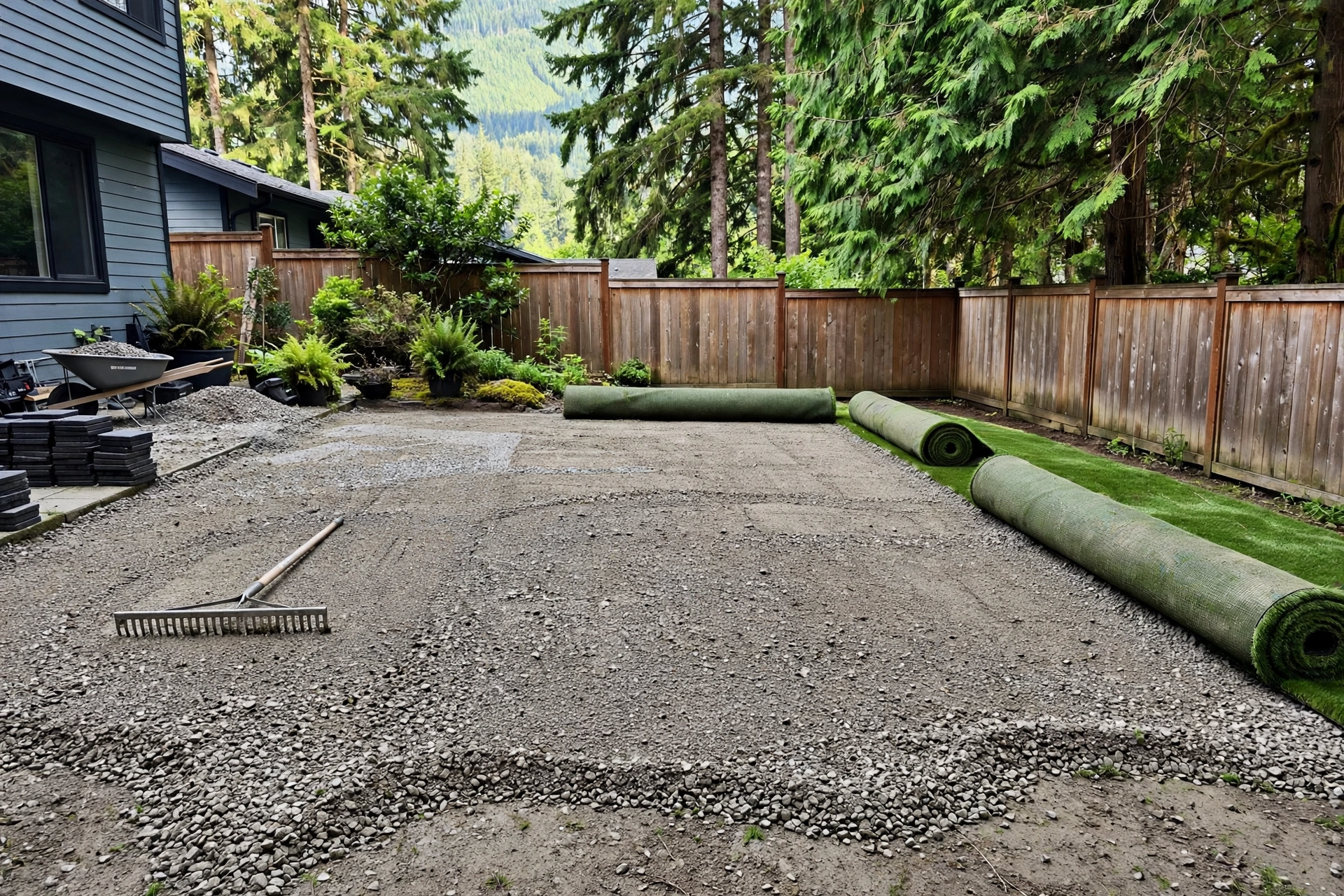
Nobody photographs the base. Digging out the old lawn, hauling it away, building the layers underneath — least glamorous part of the whole job. Also the part that decides everything. A standard Fraser Valley residential base? 3 to 4 inches of crushed aggregate. Usually 3/4-inch minus road base, compacted in layers — then a finer levelling layer on top, about an inch of it. Flat ground, decent soil, and that base works out to roughly $4 to $6 per square foot of the total job. Clay changes the maths. So does a yard that already pools water. Deeper base, drainage pipe in the ground — and the cost climbs toward $7 to $9 a square foot.
Drainage deserves its own paragraph. BC rain is not a footnote in this job. It is the whole design problem, really. A properly built turf system drains through the backing and into the aggregate base, then away from the house. A yard that already drains toward the foundation? Sort that out first. Before the turf goes down — not after, when fixing it means lifting everything. A French drain, a slight regrade — figure on $1,500 to $4,000 extra. Depends on the yard.
Pet-Friendly Turf: What Dog Owners Should Know
Dogs change the calculation. Three ways, and the colour of the grass is none of them. First, urine. Pet-specific turf has a backing with bigger drainage holes. The infill is antimicrobial — a coated sand, usually, or a zeolite product that traps odour. Figure on roughly $1 to $2 per square foot more than standard silica sand infill. Second, wear. Same fence line, every day, same dog running it — a budget pile flattens in a season. Shorter, denser turf holds up under paws. A tall, soft pile does not. Third, cleaning. Turf will not clean itself. It just sits there. A hose rinse once a week, an enzyme cleaner now and then — that is what keeps it from smelling in July. That is when the sun bakes everything the winter rain washed in.
The pet run deserves a mention. It is the most common small turf job in the Fraser Valley, and it is not close. Picture it: a side yard, three or four feet wide, running the length of the house. By February it is paved in mud. Turf just that strip — 150 to 250 square feet — and you are looking at roughly $3,500 to $6,000 installed. More often than not, the muddy-paw problem lives in the side yard. Not the whole backyard — the strip.
One thing worth knowing before the crew arrives: turf gets hot. A sunny August afternoon in the Fraser Valley — dark green synthetic fibres can run well above the air temperature. Hot enough that a dog will not lie on it. Hot enough that a barefoot toddler hops straight off. Lighter-coloured turf helps. So does a shade structure. Or the simplest fix of all: hose it down before playtime.
Kid-Friendly Yards and the Fall Question
Parents ask about safety. The honest answer — turf over a proper base is firmer than a lawn, softer than concrete. Middle of the range that matters, in other words. Under a swing set, under a climbing frame — that is where a shock-absorbing pad layer goes in. Foam or rubber underlay, usually 20 to 30 mm. It adds roughly $3 to $5 per square foot, but only in that zone. Worth it under anything a child can fall from. Turfing the whole yard with underlay is unnecessary. Turfing the play zone with it is sensible.
The other kid question is mud, and turf wins it outright. A real lawn in a Fraser Valley winter is a mud patch with ambitions. Turf stays usable through the rain. Which means the kids actually go outside in February — instead of staring out the window at a mud patch.
Synthetic Grass Installation Cost: The Line Items That Surprise People
Quotes vary. And the variation usually hides in the small lines — not the big ones. Seaming is one. A yard wider than a single turf roll needs seams, at roughly $1 to $2 per linear foot of seam, and a bad seam is the first thing anyone notices. Edging is another. Turf needs a border. Without one it creeps, and the edge never looks finished. Usually a bender board, or a concrete mow strip — roughly $8 to $15 per linear foot, installed. A long, curvy edge costs more than a plain rectangle. Curves always cost more.
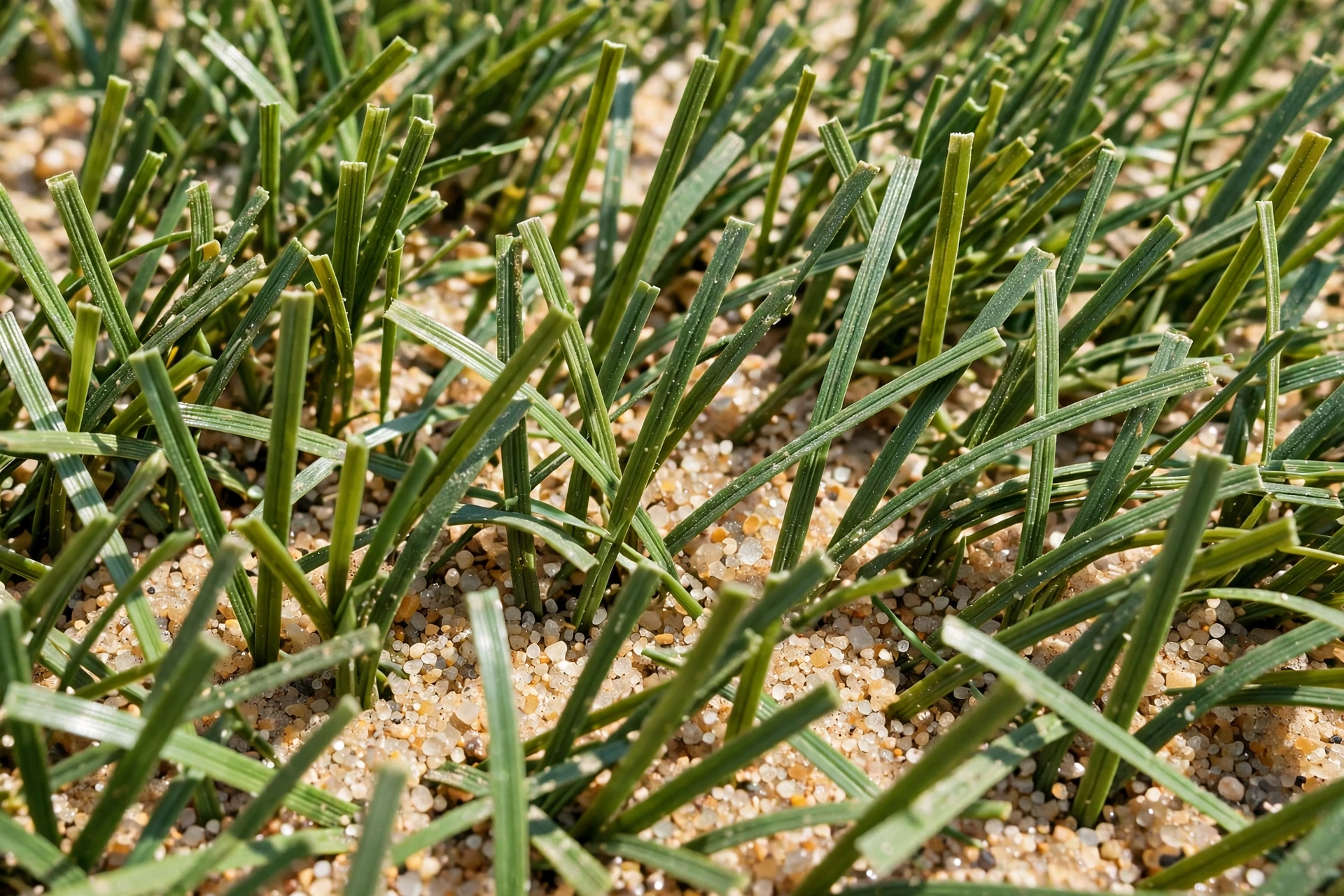
Infill is the line people argue about most. It is also the line where cheaping out shows fastest — within months, sometimes. Infill is what gets brushed into the fibres. Sand, or a coated granule — it holds the fibres upright, adds weight. Standard silica sand infill runs roughly $0.50 to $1 per square foot, installed. A coated antimicrobial infill for pet yards runs $1.50 to $3. Skip the infill — or spread too little of it — and the turf goes flat. Spongy underfoot, too, within months.
Labour is the last big line. It is also the one that varies most between installers. A two-person crew, straightforward job — roughly 300 to 500 square feet a day. Slopes, curves, trees, tight access? That kind of job runs slower. A lot slower, sometimes. In 2026 BC pricing, labour typically accounts for $4 to $7 per square foot of the installed total. A quote with labour far below that range — that usually means a crew cutting corners on the base. And the base is the one place corners should never be cut.
Where Turf Makes Sense and Where It Does Not
Turf is at its best in the places real grass fails in this climate. Shaded yards under big trees. Grass thins out there, moss takes over — turf does not care about the shade. Small urban lots where the lawn is more mud than grass by March. Dog runs, and rental properties where the tenant will not mow. It is at its worst on steep slopes, where water runs off faster than the base can drain it. And turf is plastic: it will need replacing after 12 to 15 years.
Strata rules are the other check that catches people out. Townhouse complexes in Abbotsford, and across the Fraser Valley, often have strata bylaws about front-yard appearance. Some of them want approval before any landscaping change at all. Rules vary by strata. Ask the strata council before ordering anything — before, not after the delivery truck shows up.
Getting a Quote You Can Actually Compare
Three quotes, same scope, same measurements. That is the whole method. It works because turf quotes are so easy to make incomparable — that is the trap. One installer quotes the roll only. Another quotes everything. The cheapest number wins — until the extras arrive. Ask every installer for the same breakdown. Turf grade and pile height, base depth and material, drainage plan, infill type and amount, edging, seaming, removal and disposal — all of it, from all of them.
Timing matters too — not just the price, the calendar. Spring is the busy season. Crews book out weeks ahead. Late fall and winter run slower. Some installers offer better rates then, when the rain keeps other jobs away. Bigger than turf alone, the yard project? Plan the deck and the fence together with the turf. Then the edges meet cleanly, and the pet area is defined from the start.
The Bottom Line on Cost
For most Fraser Valley homeowners in 2026, the artificial turf installation cost BC numbers settle into a clear band. No surprises, once you know the band. Budget turf, installed: roughly $14 to $17 per square foot. Mid-range — the right choice for most family yards — runs $18 to $22. Premium turf: $23 to $30. A typical 500-square-foot backyard lands between $9,000 and $12,000 all in. A larger 1,000-square-foot yard lands between $18,000 and $24,000.
The number that matters most, though, is not the per-square-foot rate. It is the base. A yard with a proper base, real drainage, and the right infill will look good in five years. A yard without them will not, whatever the turf cost. Spend the money underground first. Choose the grade for how the yard is actually used. And get the scope in writing before anyone digs.
Weighing turf against other yard projects? Want help thinking through the scope for your own yard? Call (236) 613-0038 and talk it through before you commit to a quote.
Frequently Asked Questions About Artificial Turf Installation Cost in BC
How much does artificial turf installation cost in BC in 2026?
Most residential jobs in BC in 2026 run roughly $14 to $30 per square foot, installed, all in. A typical 500-square-foot Fraser Valley backyard costs about $9,000 to $12,000 at mid-range grade. A 1,000-square-foot yard runs about $18,000 to $24,000. The final figure depends mostly on four things: the turf grade, the depth of the base, the drainage work, and how easy the yard is to access.
What is the fake grass cost per square foot in BC for materials only?
Material-only, prices run roughly $4 to $13 per square foot depending on grade. Budget turf sits at $4 to $6, mid-range at $6 to $9, premium at $9 to $13. Those figures cover the turf roll alone. Base aggregate, drainage, infill, edging, seaming, labour — none of that is in them.
Does artificial turf drain well in BC rain?
Yes — when the base is built properly. That is the whole condition. Quality turf backing is permeable. Water drains through it, into a compacted aggregate base, then away from the house. Problems start when the base is too shallow. Or the yard slopes toward the house. Or the soil is heavy clay with no drainage plan at all. On yards that already pool water, a French drain or regrade may be needed. Rules vary by city — check with your municipality before work starts.
Is artificial turf safe for dogs and kids?
Turf is widely used in pet and family yards. Pet-specific turf — permeable backing, antimicrobial infill — handles urine and heavy paw traffic better than standard turf. For kids, a shock-absorbing pad layer under swings and climbing frames adds fall protection. Worth having, since a standard aggregate base compacts firm. Turf does get hot in direct summer sun. Hose it down, or provide shade, before playtime on warm days.
How long does artificial turf last in the Fraser Valley?
A well-installed residential turf lawn typically lasts 12 to 15 years in the Fraser Valley. Pet yards, very high-traffic areas — those sit on the shorter end of that range. Longevity depends more on the base and the infill than on the turf roll itself. Regular brushing and rinsing keep the pile standing upright for longer, too.