
Use This Checklist Before You Fall for a Material Sample
That little board sample under the showroom lights? It tells you nearly nothing. Not what the deck will cost. Not how it’ll hold up through an Abbotsford winter of rain. So work the decisions below in order. Material’s one of them. And no, it’s not first.
Decision one is size. Decision two is height. Only then does the pressure-treated versus composite debate mean anything, because the same material at two different heights on two different lots can produce quotes that look unrelated.
For a rough anchor, start here. A professionally built deck in Abbotsford runs $25 to $90 per square foot, installed, in 2026. A standard 300 sq ft deck? Somewhere between $8,000 and $27,000, all in. One neighbour pays $9,000 for pressure-treated. The next pays $28,000, composite, glass railings, the works. Both of them can have paid a fair price. The checklist explains why.
Decision One: Lock the Size and Shape
Start with use. How will you actually live on the thing? Dining for six is one footprint. Dining for six, plus a lounge corner, plus a barbecue lane that doesn’t slice through the seating? Bigger. Plan for the second one if that’s your life. Rectangles are cheap to frame. They waste less material too. Decks full of cutouts and angles cost more, so make every jog in the outline earn its place.
Use the 300 sq ft benchmark to test quotes. At that size the numbers split by board. Pressure-treated, $7,500–$13,500. Cedar, $12,000–$18,000. Composite runs $15,000–$22,500, and PVC tops the list at $18,000–$27,000. Smaller deck? Don’t just scale those numbers down in your head. It doesn’t work like that. Stairs don’t shrink. Railings don’t, footings don’t, not in proportion to the boards anyway. That’s why small decks look pricey per square foot.
Decision Two: Admit What Height Does to the Bill
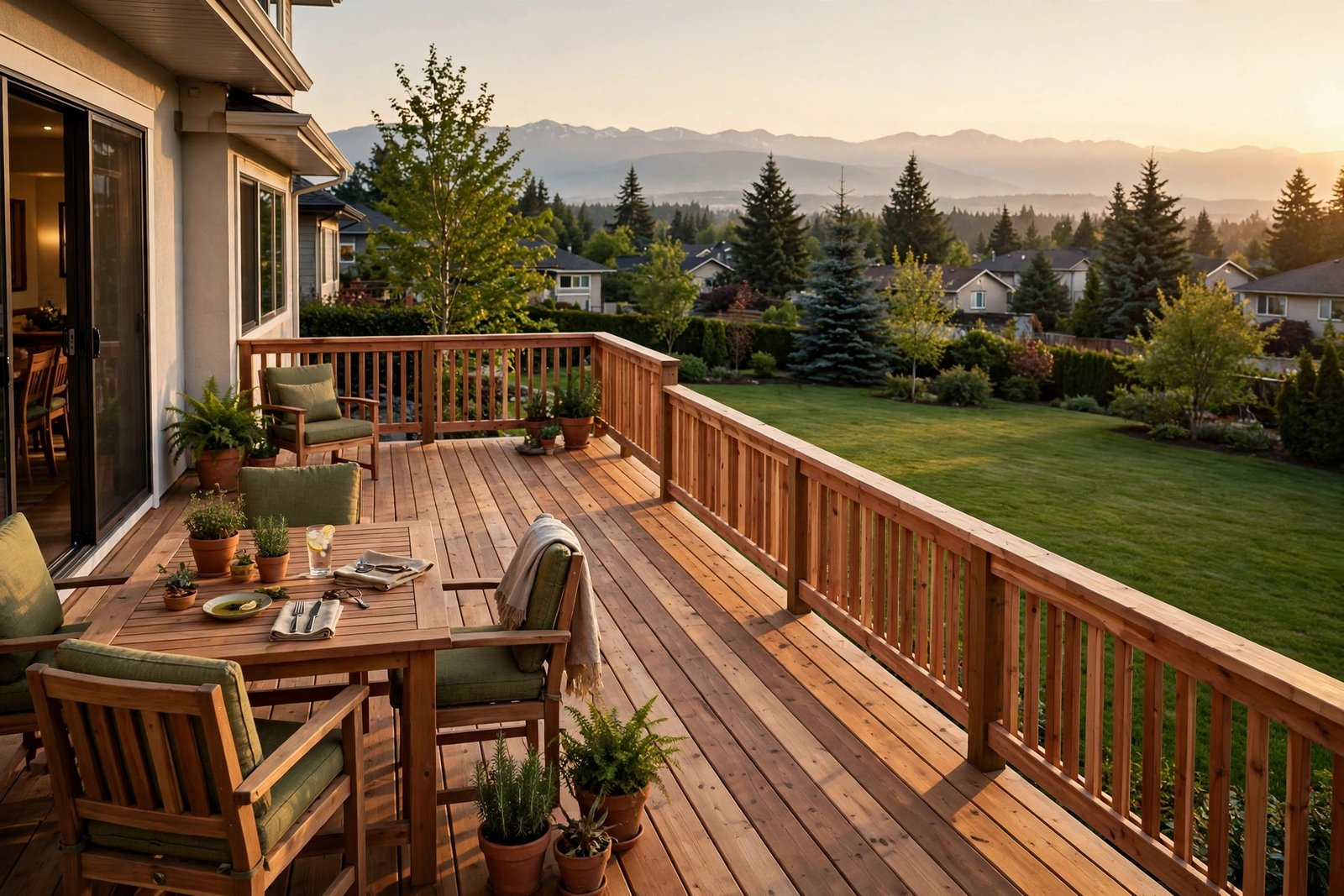
A ground-level deck is a straightforward build. A second-storey walkout deck, common on hillside homes in Auguston, is a different structure. Taller posts. Bigger footings. Engineered connections. And stairs that actually run the full height.
After material, height is the biggest cost multiplier you’ve got. Settle it honestly. Settle it first. Raise the design halfway through quoting and watch what happens. Footings reprice. Framing reprices. Railings and stairs too, all at once.
Give stairs their own line in your notes. Most quotes fold basic stairs in. Wide ones aren’t. Neither are multi-landing or curved. If your design calls for them, budget an extra $500 to $1,500 per staircase, on top of that basic allowance.
Decision Three: Choose the Board You Will Actually Maintain
Pressure-treated lumber at $25–$45 per square foot installed is the budget workhorse. It is strong, available everywhere, and familiar to every Fraser Valley builder. A basic 200-square-foot pressure-treated deck can land under $9,000. Rentals use it. First decks use it. That’s why. The trade is upkeep. Stain or seal it every few years, with a cycle often described as within 3 years in this climate, and expect a service life around 15 years when that upkeep happens. Skip the upkeep and it shows. Checking. Warping. Soft spots, and sooner than you’d think.
Even under premium boards, the hidden frame is usually pressure-treated. Most builders do it that way. That’s not a shortcut. It’s standard practice. The frame’s structural. It’s protected. The visible surface is where you spend for looks and maintenance.
Cedar’s the local natural option. $40–$60 per square foot, installed. Western red cedar grows right here in BC. It shrugs off rot and insects better than treated pine does. And on a Clearbrook bungalow, or an Auguston two-storey, it just looks right in a way synthetic boards rarely pull off. It splits easily, though. So pre-drill it, use stainless fasteners, and feed it a penetrating stain every few years if the colour matters to you. Or don’t. Let it weather and it goes silver-grey, which plenty of owners here actually prefer. Looked after, cedar pushes past 20 years. Even 15 years is the conservative marker, and that’s for a deck getting only basic care.
Composite is the low-maintenance pick, and rain is why it’s surged across the Fraser Valley. Trex, TimberTech, Fiberon, the big names run $50–$75 per square foot installed. No rot. No splinters, not the way wood does it. Your main chore is a wash, soap and water, once or twice a year. Warranties run around 25 years on most composite products. Plan a well-built composite deck around that horizon, because that’s the life you’re buying. Two cautions matter. Dark boards bake. Direct summer sun, a south or west-facing yard, no shade, and you’ll feel it through your shoes. Lighter tones help. And composite boards on a weak frame are still a weak deck, because the structure underneath is wood and must be built properly.
PVC at $60–$90 per square foot installed, with Azek as the best-known name, is fully synthetic with no wood content and no moisture absorption. On genuinely wet sites, such as low-lying Matsqui properties or shaded north-facing yards that never fully dry, that indifference to water is a real advantage. It is also the priciest option and, for most Abbotsford backyards, more than the site requires. Composite usually hits the balance point. PVC earns its premium on problem sites.
A quick life check helps sort the premium. Unmaintained wood fails early here. Maintained pressure-treated gets framed around 12 years in local planning discussions. A cautious mid-life reference, that is. Composite and PVC get talked about at 25 years to 30 years, assuming the frame underneath stays sound. Paying triple for boards? Only makes sense if you’re staying long enough to collect the extra life.
Decision Four: Price Railings, Footings, and Access Separately
Railings change a quote faster than most owners expect. Basic wood railings are the baseline in the per-square-foot ranges above. Go aluminum and you add $30–$60 per linear foot. Glass panels? $80–$150 per linear foot, installed. Take a deck with 60 feet of railing. Glass alone can add $5,000. So measure your railing run before you decide composite’s out of reach, because the board might not be the problem. You might be pricing the railing. Not the board.
Footings depend on soil. Clay-heavy ground changes things. So do high water table sites near the Fraser River. Either one can mean deeper footings, or helical piles instead of simple concrete sonotubes. Frost depth drives the call. Bearing conditions too. And your builder should flag it while quoting, not after the excavation’s done. Local deck planning throws around one technical marker, 500 mm. Memorizing it isn’t the point. The point is asking. What depth does your lot need, what footing type, and then getting that written into the quote.
Put access and demolition on that same page. Tearing out an old deck? $1,000–$3,000. Older Clearbrook lots, tight side yards, they add labour. Everything gets carried in by hand instead of wheeled. Comparing quotes? Confirm they’re covering the same scope. Footings, framing, decking. Railings, stairs, hardware. All of it, in every bid. And a quote that looks $3,000 cheaper because the railings quietly fell out of it? Not cheaper. Not at all.
Decision Five: Settle the Permit Question Early
Attached to the house? Elevated above grade? In Abbotsford, either one usually means a building permit, through the City Building Permits and Licences Division. A ground-level freestanding platform may be exempt. May. Setbacks still apply, lot coverage still applies, BC Building Code rules still apply, so don’t guess off your neighbour’s project.
Skip the permit and it follows you. It complicates a future sale. It creates insurance problems for anything attached to it. And legalizing it later costs more than the permit would have at the start. Our guide to renovations that add the most value in the Fraser Valley puts decks in context with other outdoor value, and permit timing should be built into your schedule before a builder promises a start date.
Build time itself is shorter than many owners expect. Once the permit’s issued, most residential decks take about 3 weeks, and that’s the upper end of a typical build window. Simple ground-level decks finish in under a week. A large elevated composite deck with glass railings? The full stretch, maybe more.
Decision Six: Match Maintenance to Your Real Habits
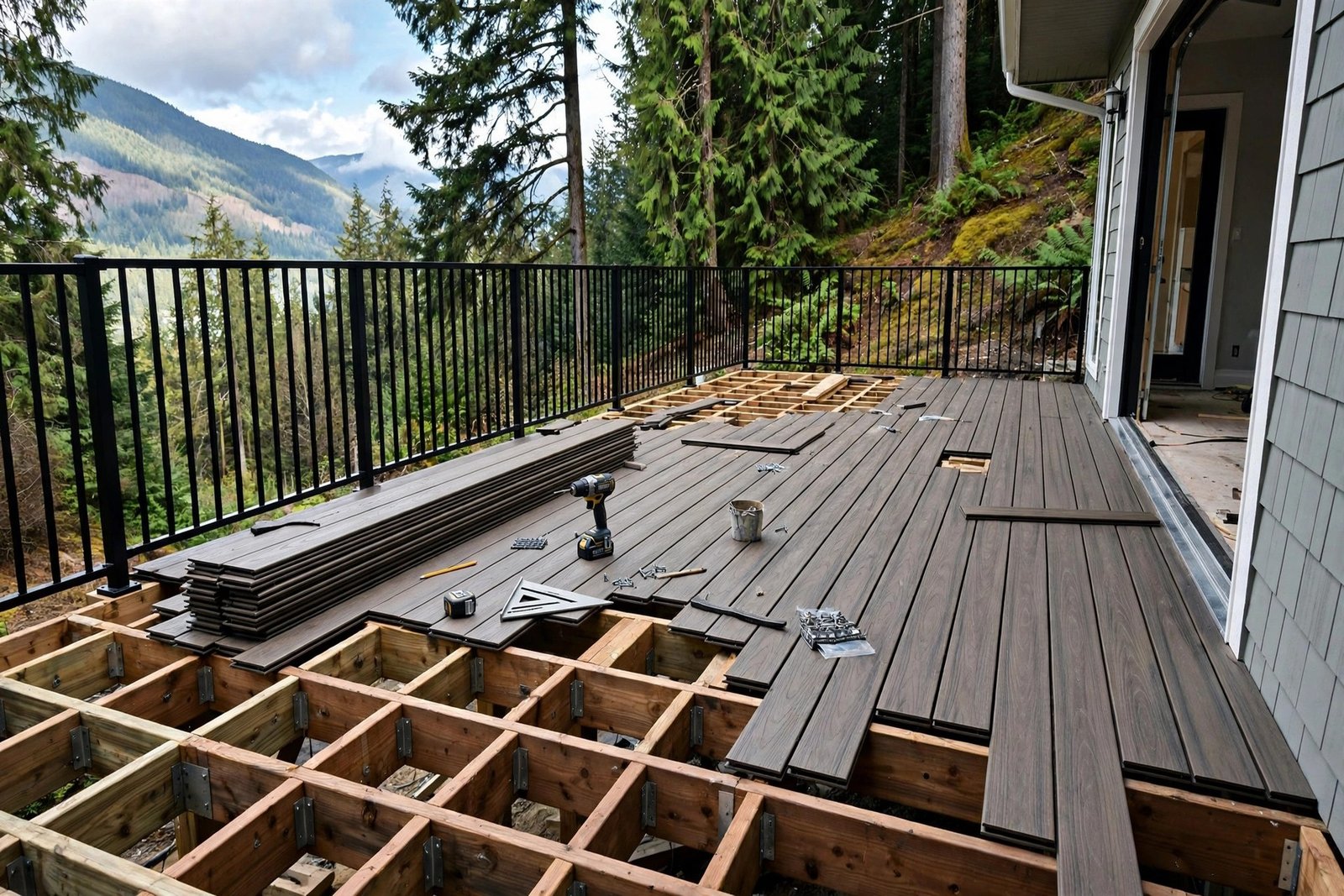
Abbotsford gets roughly 1,500 mm of rain a year, in the framing used for local planning. About double Toronto. And water decides how long your deck lasts, end of story. Boards need gaps. Small ones, plus a slight slope, so the water runs off instead of sitting. Skirted decks need air underneath them. Without ventilation, trapped moisture rots the framing from below. Where nobody looks.
Be honest about yours. Wood wants stain, or seal, on a regular cycle. Late spring’s ideal, during a dry stretch. Never do it on a damp deck, because you’ll trap moisture right under the finish. Composite and PVC ask for less. Washing, mostly, and clear gaps, since leaves and needles packed between boards hold moisture hard against the frame. Fasteners? They matter everywhere. Use stainless steel. Or coated fasteners rated for pressure-treated lumber. Standard screws corrode, they stain boards, and eventually they fail. Keep the space under an elevated deck clear too. Stored lumber and soil piled against the posts block airflow, and blocked airflow speeds up decay.
DIY belongs in this decision too. A ground-level freestanding deck looks approachable. It does. But where a deck meets the house, that ledger board attachment is the leading source of deck failures, and of water damage to the house itself. Footing depth carries code requirements. Beam spans do, guardrail heights do, and a video tutorial can gloss over every one of them. Hiring out? Get three quotes, itemized. Ask about insurance, ask about WorkSafeBC coverage, ask for references, and ask who’ll actually be on site building it.
A Smaller Deck, Priced Honestly
Owners ask about one size constantly. The 12 by 16. That’s 192 square feet. Pressure-treated puts it at $5,000–$8,500. In cedar it is $7,700–$11,500. In composite it is $9,600–$14,400. And PVC? $11,500–$17,300. Those are installed ranges. Basic railings are in, basic stairs are in. Permits, demolition, premium railings, those cost extra.
Notice what that example proves. Even at a modest size, the material spread runs from $5,000 at the low end to well past $11,500 at the low end for PVC, before any glass or site extra is added. One Abbotsford deck price? Doesn’t exist. There’s a set of decisions instead. Each one has a price attached. The cheapest path through them is simple, a rectangular pressure-treated deck, ground level, basic wood railings, and honest budgeting for repeat staining.
So choose the deck you’ll actually maintain. Footings your soil requires. A permit where one is needed. Then build it once, and build it right. A deck that gets used daily, May through October, repays its owner in ordinary evenings as much as it ever will in resale. And build it well and buyers still credit it. Appraisers too, as functional outdoor living space, in family neighbourhoods across the Fraser Valley.
Frequently Asked Questions
How much does it cost to build a deck in Abbotsford in 2026?
Per square foot, installed, a professionally built Abbotsford deck runs like this. Pressure-treated, $25–$45. Cedar, $40–$60. Composite, $50–$75, and PVC, $60–$90. A standard 300 sq ft deck starts at $7,500–$13,500 in pressure-treated. In PVC it’s $18,000–$27,000.
How much does a 12×16 deck cost in Abbotsford?
For a 192-square-foot 12×16, the split goes by material. Pressure-treated, $5,000–$8,500. Cedar, $7,700–$11,500. Composite runs $9,600–$14,400, and PVC lands at $11,500–$17,300. Permits cost extra. So do demolition and premium railings.
How long does a deck last in the Fraser Valley?
Pressure-treated lasts about 15 years, if you keep up the staining. Cedar, looked after, goes 15 years to 20 years. Composite and PVC get planned at 25 years to 30 years. And unmaintained wood? In Abbotsford rain it can fail in under a decade.
Do I need a permit to build a deck in Abbotsford?
In Abbotsford, yes, usually. If the deck’s attached to the house, or elevated above grade, it usually requires a building permit. Ground-level freestanding platforms may be exempt. But setbacks apply anyway. Lot coverage and building code rules too, so confirm with the City before you build.
What is the cheapest way to build a deck in Abbotsford?
Keep it simple. A rectangular ground-level deck, pressure-treated lumber at $25–$45 per square foot, basic wood railings, minimal stairs. That’s the cheapest way in. Just budget for staining every few years. A low upfront price only stays low if somebody maintains the wood.