
Adding a bathroom is the single most requested upgrade in a BC basement renovation, and it is also the one with the widest price spread. Two neighbours can add what looks like the same three-piece bathroom and pay $8,000 apart, and the difference is almost never the tile or the vanity. It is what is happening under the concrete. A basement bathroom lives or dies on its drainage: where the pipes are, how deep the sewer runs, and whether gravity is on your side. Here is what each scenario costs in BC in 2026, and how to find out which one your basement is before you fall in love with fixtures.
The short version: a complete basement bathroom addition in BC runs roughly $10,000–$25,000 in 2026. If your basement already has a plumbing rough-in, the plumbing tie-in is usually $1,500–$4,000 and you will land at the low end. If new drain lines have to go in under the slab, expect $4,000–$10,000+ for the below-grade plumbing alone. If your bathroom sits below the sewer line, add a sewage ejector pump at $1,000–$3,000. The fixtures are the easy part — the drains set the budget.
1. Basement Bathroom Costs at a Glance
The three drainage scenarios, and what each does to the total (2026 BC planning ranges):
| Your basement’s drainage | Plumbing cost | Typical full-build total |
|---|---|---|
| Rough-in already in place | $1,500–$4,000 | $10,000–$16,000 |
| No rough-in, gravity drainage works | $4,000–$10,000+ | $14,000–$22,000 |
| Fixtures below the sewer line (ejector pump) | $5,000–$12,000+ | $16,000–$25,000+ |
The full-build total covers framing, insulation, drywall, waterproofing, tile or vinyl flooring, a shower or tub, toilet, vanity, ventilation, electrical and finishing. The spread inside each row is mostly finish level and bathroom size; the spread between rows is pure plumbing.
2. The Three Plumbing Scenarios
Scenario 1: the rough-in is already there. Many BC homes built from the 1990s onward have capped drain stubs in the basement — a toilet flange pipe and shower or tub drain roughed in during construction, often near the furnace room or under the main floor’s plumbing stack. If yours lines up with where you want the bathroom, a plumber ties in, adds water lines and vents, and the underground work is mostly done. This is the cheapest path by a wide margin, which is why the rough-in check is step one of any basement bathroom plan. Our plumbing rough-in cost guide for BC explains what a rough-in includes and how to spot one.
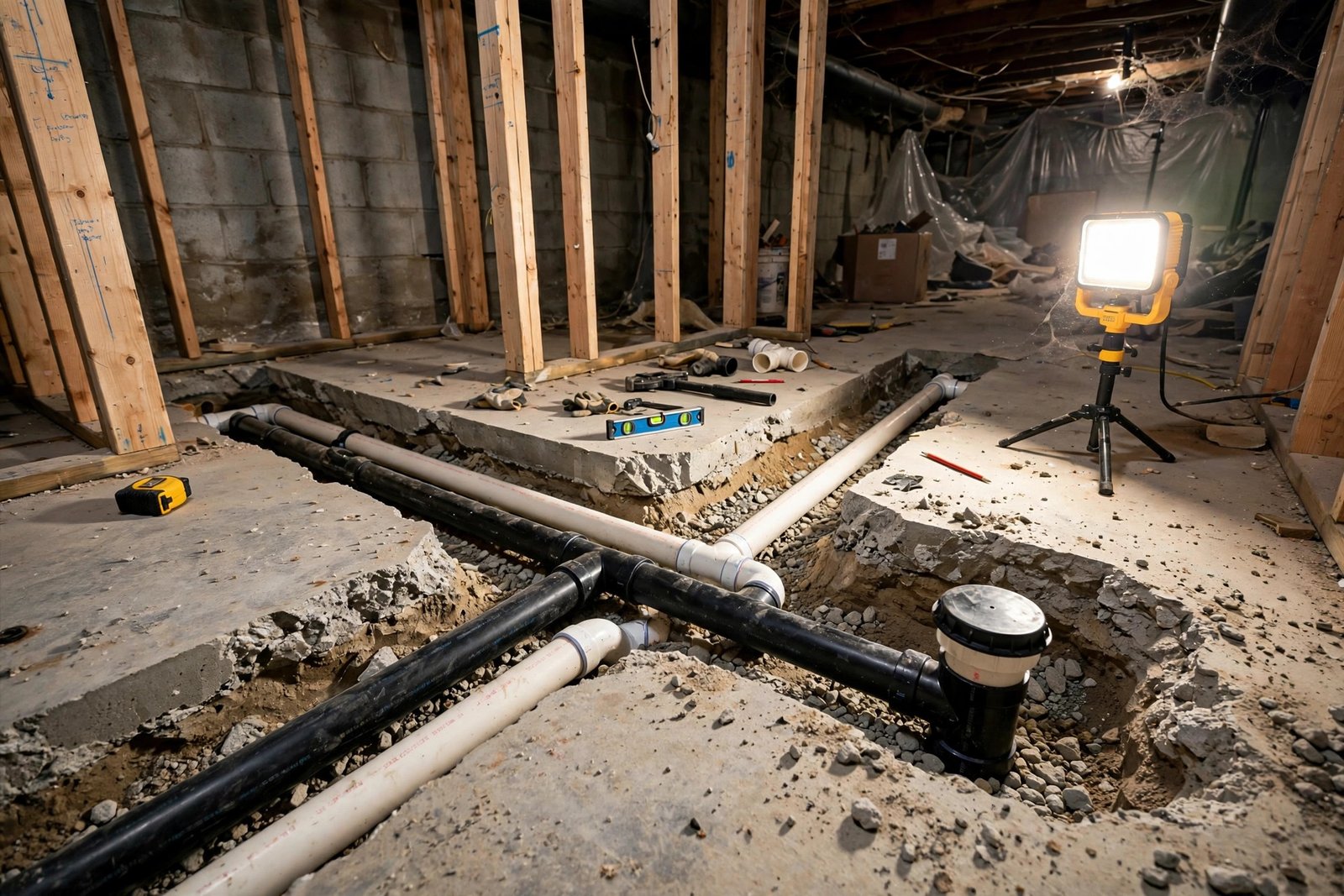
Scenario 2: cutting the slab for new drains. No rough-in, or the rough-in is in the wrong spot? The concrete floor gets saw-cut, a trench is dug, new ABS drain lines are laid at the proper slope, inspected, and the slab is re-poured and patched. It is dusty, loud, and entirely normal — but the cutting, hauling, plumbing hours and concrete work are why this scenario starts around $4,000 and climbs past $10,000 on longer runs or tricky layouts.
Scenario 3: the ejector pump. Drainage works by gravity, and if the basement floor is below the level where your sewer line leaves the house, waste cannot flow uphill on its own. The fix is a sewage ejector system: a sealed basin set into the floor that collects waste and pumps it up to the main line. The pump, basin, check valve and installation run $1,000–$3,000, and the system needs power and occasional maintenance. A plumber can tell you in one visit whether your depth works for gravity or needs the pump — get that answer before you design anything.
3. What the Rest of the Build Costs
Once drainage is solved, the remaining costs behave like any small bathroom:
- Shower or tub: a tiled shower is the big-ticket finish item, typically $3,000–$6,000 built and waterproofed; an acrylic tub-shower unit lands closer to $1,500–$3,000 installed.
- Fixtures: toilet $250–$700, vanity with countertop $600–$2,000, faucets and shower trim $300–$1,000, plus installation.
- Ventilation: a properly ducted exhaust fan ($300–$800 installed) is not optional — BC’s building code requires mechanical ventilation in bathrooms, and a basement bathroom without one becomes a mould farm.
- Walls, ceiling and floor: framing, insulation, drywall and finishing $1,500–$3,500 for a typical three-piece; vinyl plank or tile flooring $800–$2,500.
- Electrical: a dedicated circuit, GFCI protection, lighting and the fan connection, usually $800–$2,000 through a licensed electrician.
Stack those on top of your plumbing scenario and you can see exactly how the $10,000–$25,000 band forms — and why a quote is meaningless until someone has looked at your floor drains.
4. Permits and Inspections in BC
A basement bathroom addition needs permits, and in BC the plumbing side is municipal. Technical Safety BC regulates gas and electrical work in the province, but it does not regulate plumbing — plumbing permits and inspections are handled by your city or regional district, and the work must be done by a licensed plumber (a homeowner policy exists in some municipalities for owner-occupiers, but below-slab drainage is not where you want to learn on the job). Expect a plumbing permit, a rough-in inspection before the trench is backfilled and the walls close, and a final inspection. If the bathroom is part of a larger finishing project or a secondary suite, a building permit applies as well. Skipping permits on a bathroom is a false economy: unpermitted plumbing is the first thing a home inspector flags at resale, and it can void insurance coverage if a leak causes damage.
5. How It Fits Into a Full Basement Project
If you are finishing the whole basement anyway, adding the bathroom mid-project is dramatically cheaper than doing it later — the slab work, framing and trades are already mobilized, and no finished surfaces need to be opened. The bathroom typically adds its cost on top of your per-square-foot finishing budget, which our basement finishing cost per square foot guide breaks down. Planning a full renovation? Our basement renovation cost guide for Abbotsford covers the whole project, and our basement finishing service page explains how we sequence the plumbing before anything else gets built. Sequence matters: drains first, then framing, then finishes — never the other way around.
6. Ways to Keep the Cost Down
- Build beside the stack. Placing the bathroom against or near the main plumbing stack and the existing rough-in stubs shortens every run of pipe. Wet rooms that share a wall with the laundry or sit under the upstairs bathroom are the cheapest seats in the house.
- Choose an acrylic shower or tub unit instead of a full custom tile build if the budget is tight — you keep the function and cut several thousand.
- Do the bathroom during the main finishing project, not after. Standalone, every trade charges a fresh minimum; mid-project, the marginal cost drops hard.
- Skip the ejector pump if gravity works. It is sometimes proposed out of caution; ask your plumber to confirm the elevations before agreeing to one.
7. Frequently Asked Questions
How much does it cost to add a bathroom in a basement in BC? Plan on $10,000–$25,000 for a complete three-piece basement bathroom in BC in 2026. Homes with an existing rough-in land near the bottom of the range; homes that need new under-slab drains or a sewage ejector pump land near the top. All figures are planning ranges, not quotes.
What is a sewage ejector pump and do I need one? It is a sealed basin and pump installed in the basement floor that lifts waste water up to your home’s main sewer line. You need one only when the bathroom fixtures sit below the level of that sewer line, so gravity drainage cannot work. The system typically adds $1,000–$3,000 to the project.
Do I need a permit to add a basement bathroom in BC? Yes. New plumbing requires a municipal plumbing permit and inspections in BC, and the work must be done by a licensed plumber. Technical Safety BC does not regulate plumbing — your city or regional district does. A building permit is also required if the bathroom is part of finishing the basement or creating a suite.
Can I add a basement bathroom without breaking the concrete floor? Usually only if a rough-in already exists in the right location. Otherwise the drain lines have to run under the slab, which means saw-cutting and patching a trench. Above-floor macerating systems exist for special cases, but they cost more to buy and maintain and are a second choice, not the standard approach.
How long does a basement bathroom addition take? Most take three to five weeks of active work once permits are in hand: under-slab plumbing and inspection first, then framing, rough-ins, waterproofing, tile and fixtures. Permit processing time with your municipality comes on top of that.
For the bigger picture, our bathroom renovation in Abbotsford page covers complete bathroom projects, from layout changes and walk-in showers to full gut-and-rebuild work across the Fraser Valley.
Adding a Bathroom to Your Basement in BC?
Start with the drains, not the tile catalogue. If you would like help figuring out which plumbing scenario your basement is, what the permit path looks like, and what a realistic budget is for your layout, call us at (236) 613-0038. We will talk through the options straight — no pressure, and no quote until someone has actually looked at your floor.