
The lights work.
That is the trap, and nearly every homeowner with old wiring falls into it, because the lights working feels like evidence — the switch clicks, the room glows, the kettle boils — and it proves almost nothing, because plenty of Abbotsford houses were wired for a different era entirely, for a household whose entire electrical load was a fridge, a stove and a handful of lamps, a load so modest by modern standards that the wiring installed to carry it was never asked, not once in seventy years, to do what a modern household now asks of it before breakfast.
In older pockets around Clayburn, Aberdeen and parts of Mission, open a wall and you find exactly that era, preserved.
Knob-and-tube in the oldest homes. Aluminum branch wiring in the houses from the sixties and seventies. Undersized fuse panels in more than a few of both — panels installed when the heaviest draw in the house was a oven element and a washing machine, now feeding induction ranges, hot tubs, EV chargers in the garage, and a home office that never sleeps.
None of that automatically means a house is unsafe. It does mean the system was designed for a fraction of a modern household’s draw — a fraction, sometimes a small one — and the question of cost usually follows, as it should, once an electrician, a home inspector or an insurer finally flags it.
The short version: for 2026, a full house rewire typically runs $12,000–$30,000 for an average family home. Smaller condos and townhouses land around $8,000–$15,000, while large or difficult-access homes reach $35,000–$50,000+. Partial work runs $800–$6,000 per room depending on what is being wired. The biggest cost lever is not the wire. It is access. Open walls and an unfinished basement keep the price down; finished walls on every surface push labour hours — and the bill, climbing right alongside them, indifferent to your budget — up fast. All figures are planning ranges, not quotes.
1. Whole-Home Rewire Costs
2026 BC planning ranges, by house size:
| Home size | Typical scope | 2026 planning range |
|---|---|---|
| Condo or townhouse, ~1,000 sq ft | Full rewire; access is often straightforward through attics and shared walls | $8,000–$15,000 |
| Bungalow, ~1,500 sq ft | Full rewire; a crawlspace or unfinished basement helps a lot | $12,000–$22,000 |
| Two-storey, 2,000–2,500 sq ft | Full rewire; more circuits and two floors of fishing wire through walls | $18,000–$32,000 |
| Large or complex home, 3,000+ sq ft | Full rewire plus sub-panels, long runs and finished walls throughout | $28,000–$50,000+ |
The bands are wide. There is a reason, and the reason is labour — a rewire is mostly labour, hour upon billed hour of it, because copper, boxes and breakers cost less than most homeowners expect, sometimes startlingly less, while the hours go into fishing wire through finished walls, through insulation and blocking and the accumulated archaeology of a house, and bringing each circuit, one by one, up to current code.
Two identical floor plans can price thousands of dollars apart. Identical. Same streets, sometimes — one with an open unfinished basement where an electrician can walk the runs standing upright, the other with finished ceilings everywhere and every wire coaxed blind through drywall. BC quotes reflect Fraser Valley labour rates, so out-of-province numbers found online — numbers from markets where labour costs what it cost here fifteen years ago — will usually look low. They are low. For there.
2. Per-Room Costs for Partial Rewires
Partial rewires make sense when the rest of the house is already sound.
A kitchen gut is the classic example: the walls are open anyway — cabinets off, drywall down, the room already a construction site — so running new dedicated circuits for the range, the fridge and the counter receptacles adds far less, dramatically less, than doing the identical work as a standalone job later, when the walls are closed and finished and every wire has to be fished.
| Room or area | Typical work | 2026 planning range |
|---|---|---|
| Kitchen | New dedicated circuits for appliances, GFCI protection, lighting | $2,500–$6,000 |
| Bathroom | GFCI circuit, exhaust fan, lighting | $1,200–$3,000 |
| Bedroom | Receptacles, lighting, arc-fault protection | $800–$2,000 |
| Home office | Dedicated circuits, extra receptacles | $1,000–$2,500 |
| Unfinished basement | Lighting, receptacles, rough-in for future rooms | $2,000–$5,000 |
| Detached garage or shop | Sub-panel feed, lighting, receptacles | $2,500–$6,000 |
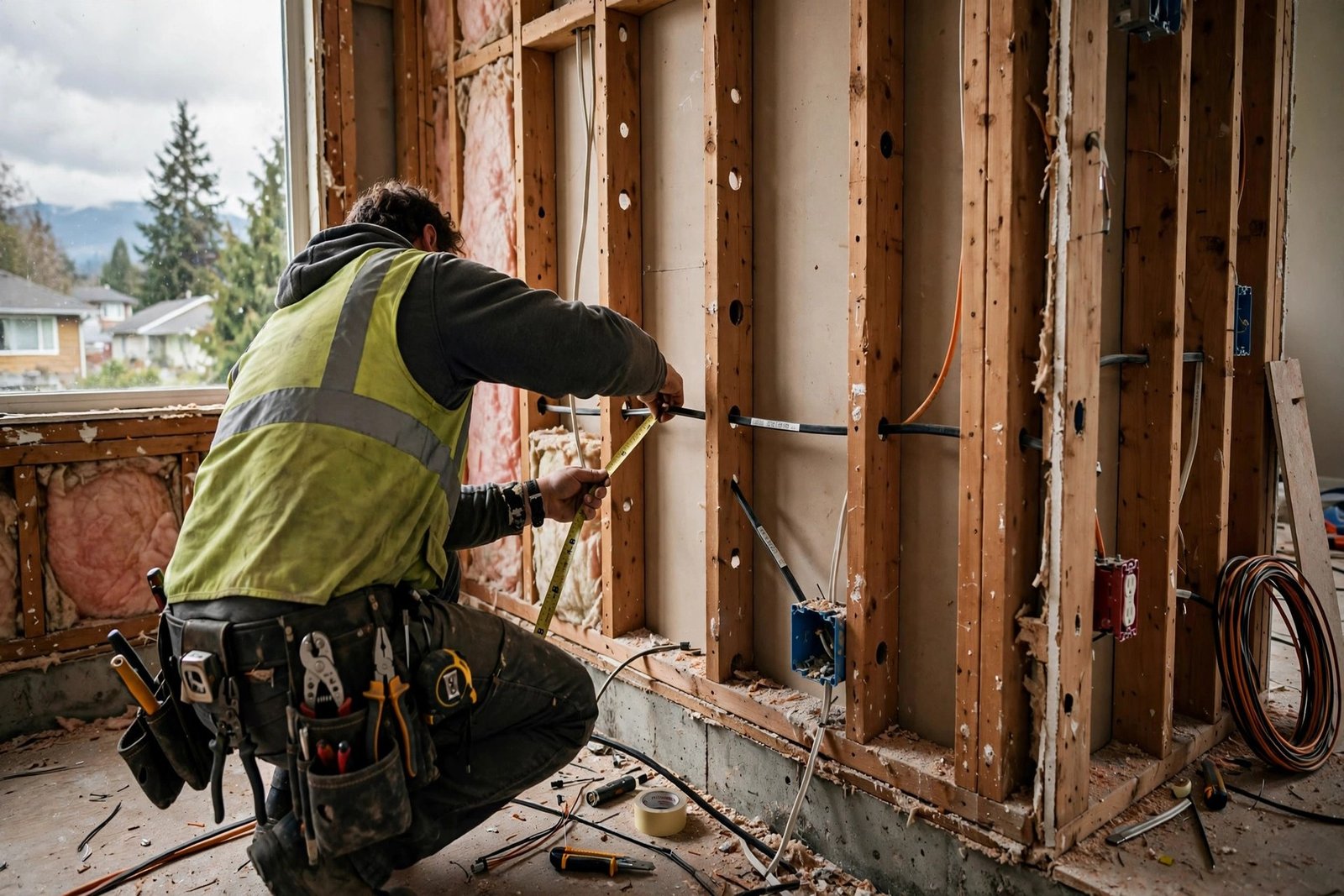
3. Knob-and-Tube Replacement
If your house was built before about 1950, some knob-and-tube wiring may still be in the walls.
It was the standard method of its day: single conductors on porcelain knobs and tubes, cooled by open air. It worked fine in 1925. Genuinely fine — the system was sound engineering for the loads of 1925, which is precisely the problem, because the problems came later, decades later, when owners buried it under insulation it was never meant to touch, spliced into it without junction boxes, and loaded it — with space heaters, with window air conditioners, with everything modern life plugs in — far beyond what it was ever sized for.
On the specific question of knob and tube replacement cost, BC homeowners typically see $15,000–$30,000 for a full replacement in an average-sized home, often bundled with a panel upgrade. The work means new grounded copper circuits to every outlet, switch and fixture — every one, no exceptions, no grandfathered corners — arc-fault protection where current code calls for it, and the old wiring removed or safely abandoned. Attic work is usually part of it. Hot, dusty, unavoidable attic work.
Two things usually force the issue:
- Insurance. Many BC insurers ask about knob-and-tube on the application, and some decline the policy or add a surcharge until it is gone — gone, documented, signed off. Talk to your insurer early.
- Sales. A home inspection will flag it during a sale, with buyers discounting more than the rewire costs. More. Buyers price in fear, and fear is expensive.
If walls are already being opened for another project, that is the cheapest moment to deal with it.
It is not close.
4. Rewire, Panel Upgrade, or Both
A panel upgrade alone can be enough.
Sometimes. If the branch wiring is modern copper in good shape and the only problem is a full or outdated panel, a panel upgrade solves it — solves it completely, in a day or two of work, which is a much smaller job than the one this guide is mostly about.
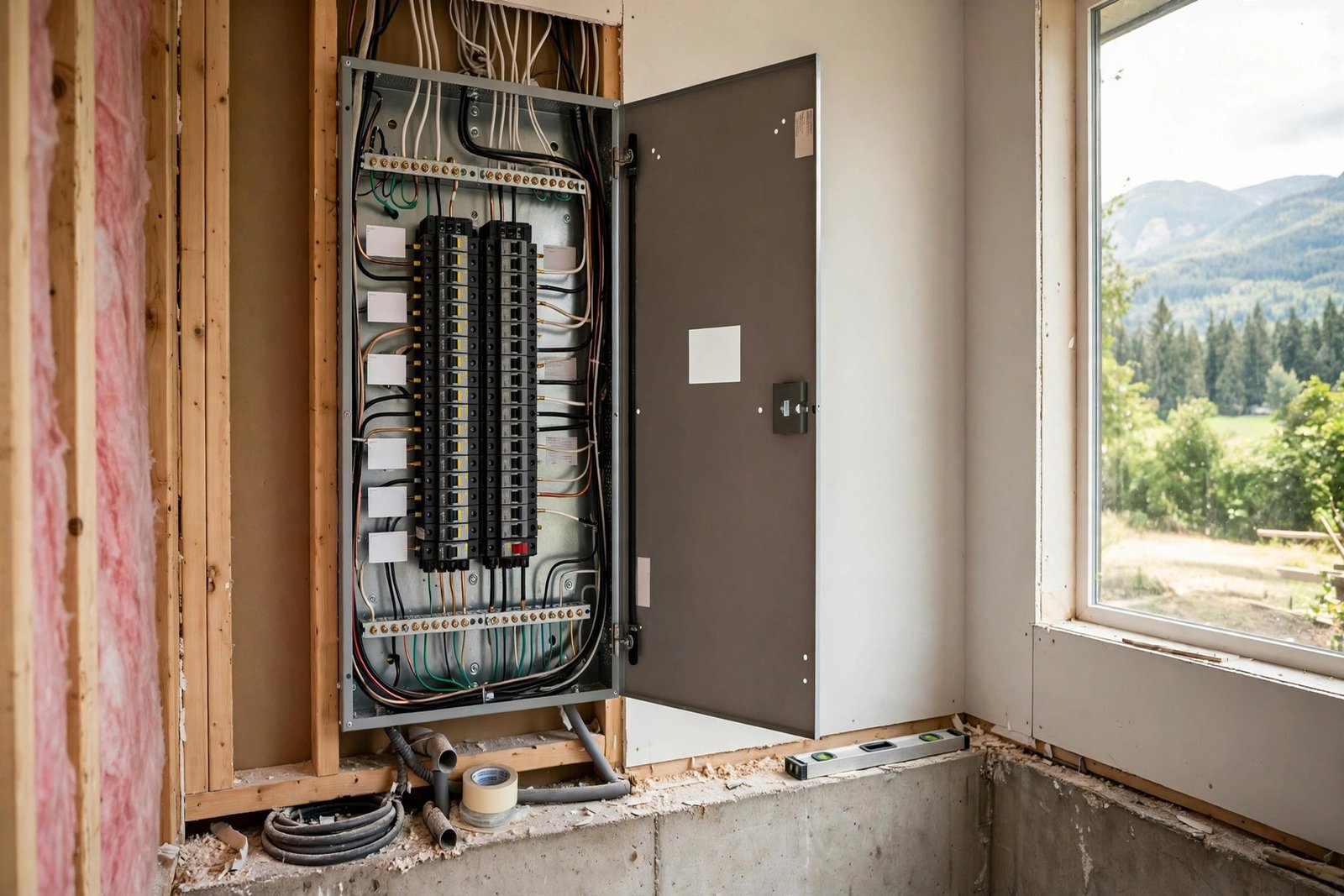
A new panel does not fix old wire. It cannot. If the branch circuits are knob-and-tube, damaged aluminum or crumbling cloth-insulated cable, a bigger panel just pushes more power — more capacity, more confidence, more current looking for somewhere to go — through wiring that should not carry what it already carries. When both the panel and the wiring are past their best, doing them together costs less than two separate jobs. Considerably less.
Price the panel side separately first. Our electrical panel upgrade cost guide for BC covers typical 2026 ranges and when an upgrade to 200 amps makes sense. Then get the branch wiring assessed. The two numbers together — panel plus branches, the whole system, honestly added — are your real project budget.
5. What Moves the Price Up or Down
- How the wire gets there. This is the big one — the biggest one, the one that swallows all the others. An unfinished basement, an accessible attic and open stud walls let an electrician run wire quickly. Finished drywall everywhere means cutting, fishing and patching in every room, which can easily double labour hours.
- The panel. A rewire usually ends at the panel, and the panel’s condition matters. If you still have fuses, a 60-amp service or a panel that is full, the rewire turns into a rewire plus a service upgrade. Our electrical panel upgrade cost guide for BC breaks down what that side of the job runs on its own.
- Code updates that come along for the ride. Electricians do not just replace wire like-for-like. Current code requirements get applied as they go — arc-fault breakers on bedroom and living-area circuits, GFCI protection where water is near, hardwired interconnected smoke alarms in many cases — which usually adds a few hundred to a couple of thousand dollars depending on the house.
- Permits and inspections. Electrical permits are standard practice in BC, and the work has to be done by a licensed electrician with inspections at rough-in and completion. Permit fees are a small line item, usually a few hundred dollars, but skipping them is a false economy — a spectacular one. Unpermitted electrical work can void insurance and kill a future sale. Confirm the exact process with your municipality before work starts, since the issuing authority varies.
- Patching and paint. Ask whether the quote includes drywall repair and repainting. Many electrical quotes cover rough patching at most, and the finish work falls to you or a separate trade. In a whole-house rewire that finish work is a real budget line, often $2,000–$5,000 on its own.
- Aluminum wiring. Homes from the mid-sixties to late seventies sometimes have aluminum branch wiring instead of knob-and-tube. Full replacement costs about the same as any rewire, but there is a middle option: approved remediation of the connections, which runs far less. An electrician can tell you which route your house needs after opening a few boxes.
6. Rebates, Timing, and Living Through the Work
Electrical work alone rarely attracts rebates. Rarely — but it sometimes qualifies inside a larger efficiency upgrade, such as panel work done for a heat pump, where the panel is the enabler and the rebate follows the bigger project. Programs change often, so check our BC home renovation rebates and grants guide for what is current, and keep every invoice and the final inspection record. Every one. In a folder. Forever.
Timing matters more than most people expect. Electricians in the Fraser Valley book out — weeks out, in the busy season — and winter tends to have better availability than the spring renovation rush, when every contractor in the valley is booked solid and the phone stops being answered. If you are planning any project that opens walls — a kitchen, a basement, whole-room repainting — schedule the electrical assessment first. First. Rewiring into open walls can cut the labour nearly in half compared with fishing through finished ones, and half is not a rounding error; half is the difference between a project you do and a project you postpone for another decade.
Most families stay in the house through a rewire. The electrician works in zones — this half of the house lit, that half dark, the fridge on a circuit that never goes off — keeping part of the home powered while another part sits silent. Expect some drywall dust. A few days of inconvenience. And one full day without power when the panel gets swapped, a day to plan around: freezer closed, phones charged, patience stocked. The electrical work takes roughly one to two weeks for an average home, plus patching and paint after. If you are budgeting the electrical upgrade cost in Abbotsford specifically, keep a little contingency for what turns up once walls open. Something always turns up.
7. Frequently Asked Questions
How much does it cost to rewire a house in BC?
For 2026, plan on $12,000–$30,000 for a full rewire of an average family home, $8,000–$15,000 for a smaller condo or townhouse, and $35,000–$50,000+ for large or difficult-access homes. Partial rewires run $800–$6,000 per room. Planning ranges. Not quotes — the house, its walls and its access will have their say.
How much does it cost to replace knob-and-tube wiring?
In a typical BC home, a full knob-and-tube replacement usually lands between $15,000 and $30,000, often done with a panel upgrade at the same time. House size drives the range. Wall access drives it harder — the same house, opened up for another renovation, is a different and cheaper job than the same house with every wall finished and painted.
Do I need a permit to rewire my house in BC?
Yes. You do. Electrical permits and inspections are standard practice in BC, and the work must be performed by a licensed electrician. Expect inspections at rough-in and at completion. The exact permitting authority varies, so confirm the process with your municipality before work begins.
Can I stay in the house during a rewire?
Usually, yes. Electricians work in zones so part of the house stays powered, and most families live through the project with a few days of disruption. Plan for dust. Plan for some drywall patching afterward. And plan for one day — one long, quiet, candle-adjacent day — without power when the panel is swapped.
How long does a full house rewire take?
The electrical work itself takes about one to two weeks for an average home. Patching, texture and repainting follow, so the full project from first cut to final paint is often three to four weeks. Three to four weeks. Then it is done — inspected, documented, and off the list of things the house has been quietly asking for since roughly the invention of the microwave.
Planning a House Rewire in BC
Start with an assessment, not a quote.
A licensed electrician opening a few boxes and checking the attic can tell you whether you need a full rewire, a panel upgrade, or targeted remediation — three different projects, three different orders of magnitude — and that diagnosis decides whether you are budgeting $5,000 or $30,000. Documented, permitted electrical work with a clean inspection record is one of the few renovations that directly protects both your insurance and your resale. To talk through your home’s wiring and what the options would realistically cost, call us at (236) 613-0038 and we will give you straight answers with no pressure.