
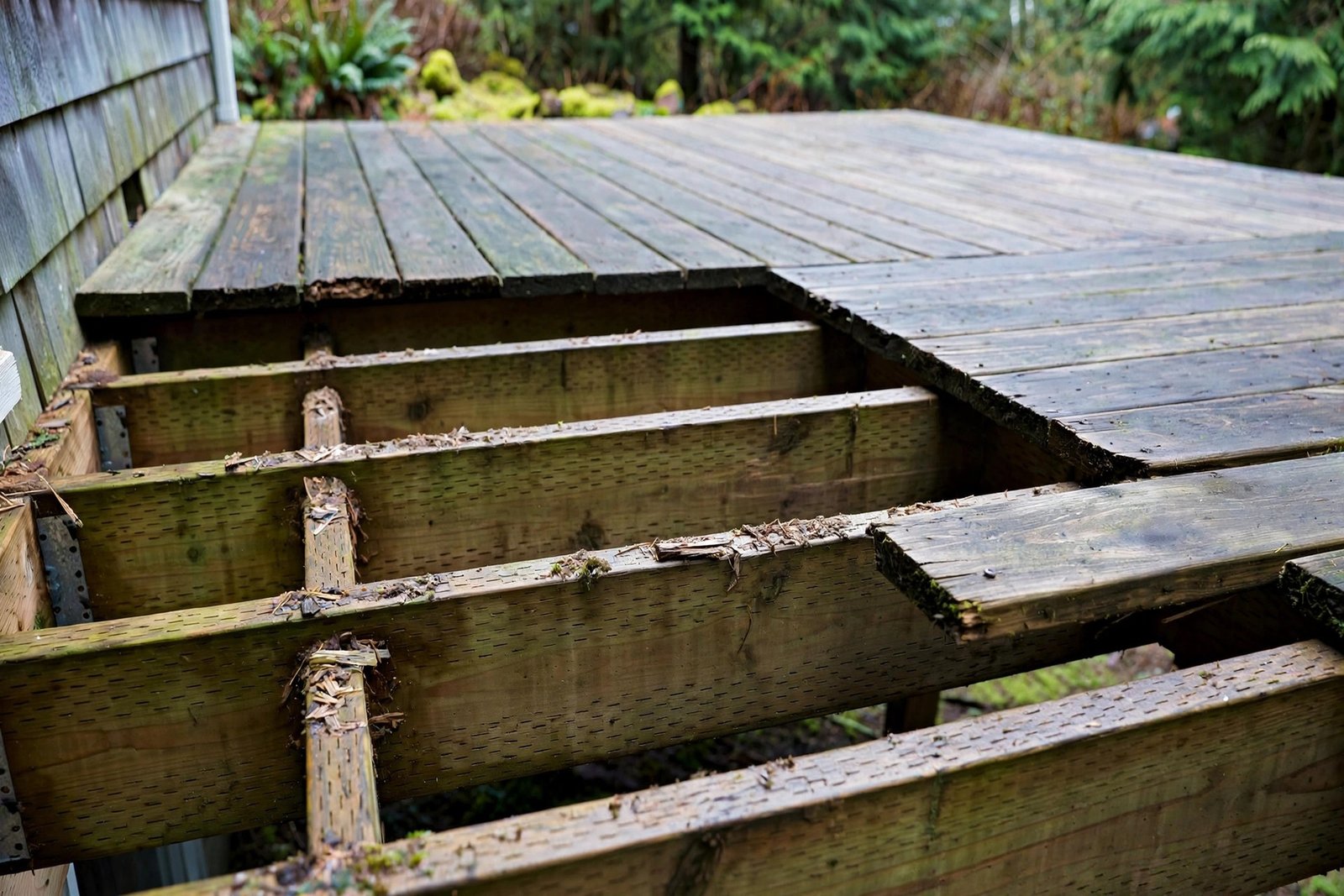
A worn deck surface tells you almost nothing. Nothing useful, anyway. Plenty of Fraser Valley decks wear rough, grey, splintering boards over joists and beams that are perfectly sound — and others look acceptable from the lawn, almost handsome from the lawn, while quietly rotting at the ledger board — the one connection where the deck meets the house, and the one place where failure actually matters.
The frame decides the project.
The frame always decides.
And the frame can be assessed in about ten minutes — ten honest minutes — with a flat screwdriver and a flashlight, which is what this guide sets out first: the assessment itself, then the 2026 deck resurfacing vs rebuilding cost in BC for each outcome it can hand you.
The short version: resurfacing a sound frame runs $8,000–$18,000 for a typical deck in 2026. A full rebuild runs $20,000–$45,000+. If the joists, beams, posts and footings are solid, resurfacing gives a new deck surface for a fraction of the rebuild price. If the structure is compromised, new surface boards do not fix it, and rebuilding is the only sound option.
1. The Assessment: Four Checks
Run these checks before pricing anything. Before the quotes. Before the brochures, before the showroom, before the neighbour’s opinion.
- The screwdriver test. Push a flat screwdriver into several joist ends, the ledger board (where the deck bolts to the house), and a few posts near ground level. Sound wood resists. Rotted wood lets the screwdriver sink in with a soft, fibrous give — like cake, like wet cardboard. In the Fraser Valley, the ledger board is the most common failure point: flashing that was installed wrong, or is missing entirely, lets rain sit against the house connection for years, silently, season after season.
- The bounce test. Walk the deck and feel for springy or spongy areas. A solid deck feels firm — boring, reassuring, firm. Boards that give underfoot point to failing joists or rotted deck boards, not just worn ones. The cost difference between the two findings is about twenty thousand dollars.
- The post and footing check. Look at where the posts meet the ground. Posts sitting in soil, cracked or shifted concrete, and heaved footings all show up as a deck that is no longer level, or a rail that has drifted out of plumb. Footing movement is common on older decks in parts of the valley with clay soils and heavy winter rain, particularly decks built before current footing depth practice.
- The hardware check. Look for rusted or missing joist hangers, nails pulling out where screws should be, and rails that wobble. No single item condemns a deck. Together, they justify a closer look underneath.
If everything below the surface passes, the deck is a resurfacing candidate. If the screwdriver sinks into joists or the ledger — if the deck moves in ways a deck has no business moving — price a rebuild instead — a real rebuild, down to the footings if the footings are what failed — and do not let a cheap surface quote talk you out of it.
2. The Two Projects, Priced Side by Side
2026 BC planning ranges for a typical 300–400 square foot deck:
| Project | What it involves | 2026 planning range |
|---|---|---|
| Resurface (cedar boards) | Remove old deck boards, inspect and repair frame, new cedar decking, new rail top | $8,000–$16,000 |
| Resurface (composite boards) | Remove old boards, frame repair, new composite decking and railing | $12,000–$22,000 |
| Full rebuild (PT frame, cedar surface) | Demo to footings or new footings, new frame and decking, new railings, stairs | $20,000–$35,000 |
| Full rebuild (composite surface) | New everything with low-maintenance decking, modern railing | $28,000–$45,000+ |
Resurfacing costs roughly a third to half of a rebuild. The saving is the frame — the footings, the framing, the stairs — kept in place, along with all their labour and materials. The gap widens with composite. Composite boards cost more than cedar, but the frame saving is the same either way, so resurfacing saves the most in absolute dollars on the expensive-board option — precisely where you would want the saving to land.
One caution on the resurfacing figures. If the assessment finds joists that need sistering, a ledger that needs re-flashing, or rotted stairs, those repairs are charged on top of the surface price. A $12,000 resurface quote with $3,000 of frame repair is still about half a rebuild. Get the repair list in writing before the surface boards come off.
Not after.
3. When the Frame Is the Real Problem
Rebuild if any of the following are true:
- The ledger board is rotted, or the flashing has failed. This is the connection holding the deck to the house — the connection, singular, that the whole deck hangs from.
- Multiple joists fail the screwdriver test, or the beam they sit on is soft.
- Posts are rotted at grade, and footings have heaved or settled unevenly.
- The deck was built without permits to old standards, with undersized joists — spans that would not pass today — and the bounce is structural rather than cosmetic.
A rebuild to current standards, verified by permit and inspection — paper, stamps, a file at the municipality — outlasts a patch by decades, because the new frame starts its twenty-year clock from zero instead of borrowing time from a structure that has already spent most of its life. Our deck permit guide for BC explains which deck projects trigger permits and what the inspection steps are. Confirm the position with your municipality before either project starts.
Age is the other factor.
A pressure-treated frame in the Fraser Valley climate typically lasts 20–25 years if it was flashed and drained well, and less — sometimes much less — if it was not. A 22-year-old deck with bad boards and a frame that seems sound has limited frame life left. Fitting premium composite boards to a frame with five years left is poor value — the boards will outlast the structure under them, and you will pay to lift every one of them again.
4. What Resurfacing Includes
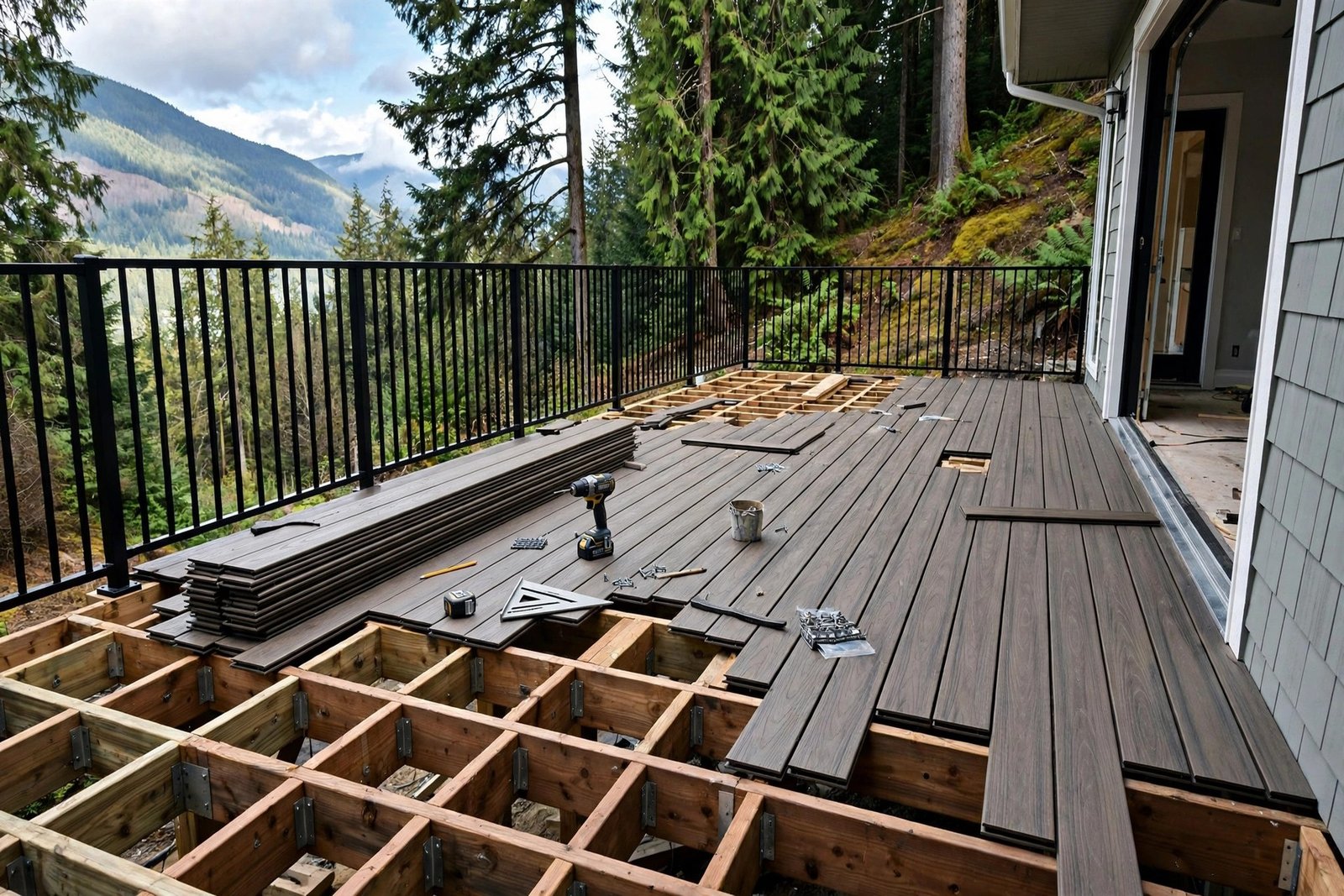
Resurfacing keeps the frame and replaces the surface. The crew removes every deck board — every single one, right down to the last splintered plank — inspects and repairs the frame, re-flashes the ledger if needed, and lays new decking.
From above, the result looks and feels like a new deck.
Board choice is the main decision inside the project. Cedar keeps the standard BC look, costs less up front, and needs staining every couple of years to stand up to the rain. Composite costs more, resists moisture, and needs no staining at all — none, ever — which is why it has taken over Fraser Valley resurfaces on decks with full weather exposure, decks that take the rain on the chin all winter long. Both go over the same repaired frame. The choice is about maintenance, not structure.
Railings and stairs are normally part of the same job. Most resurfaces include new rail tops and often new railing systems, because old rails rarely match new boards — they clash, visibly, from the street. Stairs are assessed separately: sound stringers get new treads, rotted stringers get rebuilt. Budget the stairs as their own line item — itemized, priced, written down — rather than assuming they are included.
The open deck is also the cheapest point to add small upgrades: wider stairs, a landing, under-deck drainage for a dry storage area below, lighting in the rail posts. These add hundreds — not thousands — at this stage, because the boards are already off and the crew is already standing there.
For comparison, our deck building cost guide for Abbotsford sets out full-build pricing by size and material. It is the baseline a rebuild quote should be compared against.
5. Timing, Permits and Comparing Quotes
Timing. Deck work in the Fraser Valley runs best from late spring through early fall. Resurfacing takes one to two weeks for a typical deck. A full rebuild runs three to six weeks, depending on permits and footing work — the inspections, the concrete, the weather, and whether the footing holes pass on the first dig or argue about it. Book early — demand peaks in May, and every good deck crew in the valley is spoken for by then.
Permits. Resurfacing that keeps the same footprint and structure generally does not trigger a building permit in most BC municipalities, because no structural changes are made. A rebuild usually does, particularly one that changes size, height, footings or the ledger connection. Gas or electrical additions — deck heaters, lighting circuits — carry their own permits. Confirm with your municipality before either project. The penalty for skipping a required permit is never cheaper than the permit.
Never.
Comparing quotes. Ask every contractor for the same split: surface work, frame repair (itemized), railings, stairs, and disposal. Two resurface quotes can look very different until it is clear that one includes frame repair — real repair, joists and ledger and all — and the other assumes a sound frame. Get the assessment in writing as well: which joists are being sistered or replaced, what happens to the ledger flashing, and what the price does if more rot is found once the boards are off — because more rot is found, on old decks, with dreary regularity.
6. Frequently Asked Questions
How much does deck resurfacing cost in BC?
For 2026, expect $8,000–$16,000 to resurface a typical deck with cedar boards, or $12,000–$22,000 with composite, assuming the frame is sound and needs only minor repairs. Frame repairs found during the work — a sistered joist here, a re-flashed ledger there, a set of stairs that turned out worse than they looked — add to these ranges. These are planning ranges, not quotes.
How much does it cost to rebuild a deck in BC?
A full rebuild runs $20,000–$35,000 with a pressure-treated frame and cedar surface, or $28,000–$45,000+ with composite decking and modern railings, for a typical 300–400 square foot deck in 2026. Size, height, footing work and stairs move these figures the most — in roughly that order, on most decks.
When should I replace deck boards instead of the whole deck?
When the frame passes the assessment. Solid joists, a sound ledger with good flashing, stable posts and footings, and no structural bounce — replace the boards then, and only then. New boards on a failing frame are wasted money. If the screwdriver test finds rot in the structure, rebuild instead of resurfacing.
How long does a resurfaced deck last in BC?
As long as the material lasts — cedar around 12–18 years with regular staining, composite 20–25 years with basic cleaning, those being the normal lives of each in this climate. The frame underneath needs enough remaining life to match, which is why the assessment matters more than the board warranty.
Do I need a permit to resurface my deck in BC?
Usually not, if the footprint and structure stay the same. A rebuild, an enlarged deck, or new footings typically do need a building permit, and gas or electrical additions need their own permits. Confirm with the local building department before starting either project.
Still Deciding Between Resurfacing and Rebuilding?
Run the assessment.
The screwdriver test and the bounce test settle the question, because the frame decides which project the deck needs — not the surface, not the stain colour, not what the neighbours did last summer. From there, the deck resurfacing vs rebuilding cost in BC is a matter of comparing like-for-like quotes: sound structure means resurfacing is the sensible spend, and compromised structure means a rebuild is the only fix worth paying for. For a second opinion on a deck, an assessment, or what a fair quote looks like, call us at (236) 613-0038 and we will walk through it. No pressure. Just straight answers.