
Here is the thing nobody tells you at the dealership: the charger is the cheap part. A perfectly good Level 2 home charger costs a few hundred dollars, and it will sit in its box while the real question gets answered — whether your electrical panel can feed it. The EV charger installation cost BC homeowners actually pay is decided less by the unit on the wall than by the service behind it: panel capacity, the distance from panel to parking spot, and whether your home’s electrical system was sized in an era when the biggest load in the house was a dryer. For 2026, most straightforward installs land between $1,200 and $2,800 all-in. Homes that need panel work can reach $4,000 to $6,500. This guide prices each scenario separately, because averaging them together helps nobody.
A note on who does this work: in BC, installing a charger circuit is electrical work that belongs to a licensed electrical contractor, with a permit and an inspection. That is not fine print — it is the reason the EV charger electrician cost BC quotes include permit and inspection time, and it is also why your home insurance stays valid afterward.
EV Charger Installation Cost BC by Scenario
Four scenarios cover nearly every BC home. Find yours before you look at charger reviews.
| Scenario | What is involved | 2026 planning range (charger + install) |
|---|---|---|
| Charger only, circuit already exists | A 240V receptacle or circuit is already in the garage; mount and plug in | $400 – $1,100 (mostly the charger itself) |
| Standard new install | New 40–60A circuit, panel has capacity, run under about 10 metres | $1,200 – $2,800 |
| Long run or detached garage | Trenching or a long conduit run, possibly a garage sub-panel | $2,500 – $5,000+ |
| Panel at capacity | Add a load management device, or upgrade the service/panel first | $2,000 – $6,500 depending on the route |
The standard install is the one most newer BC homes get. The panel has room, the car parks within a short cable run of it, and an electrician can complete the job in half a day to a day: breaker, wire, receptacle or hardwired connection, permit, inspection. The home EV charger installation cost BC ads quote — the tidy sub-$1,000 figures — usually describe this scenario with the charger itself left out of the number. Read quotes carefully for what is included.
Your Panel Decides the Price
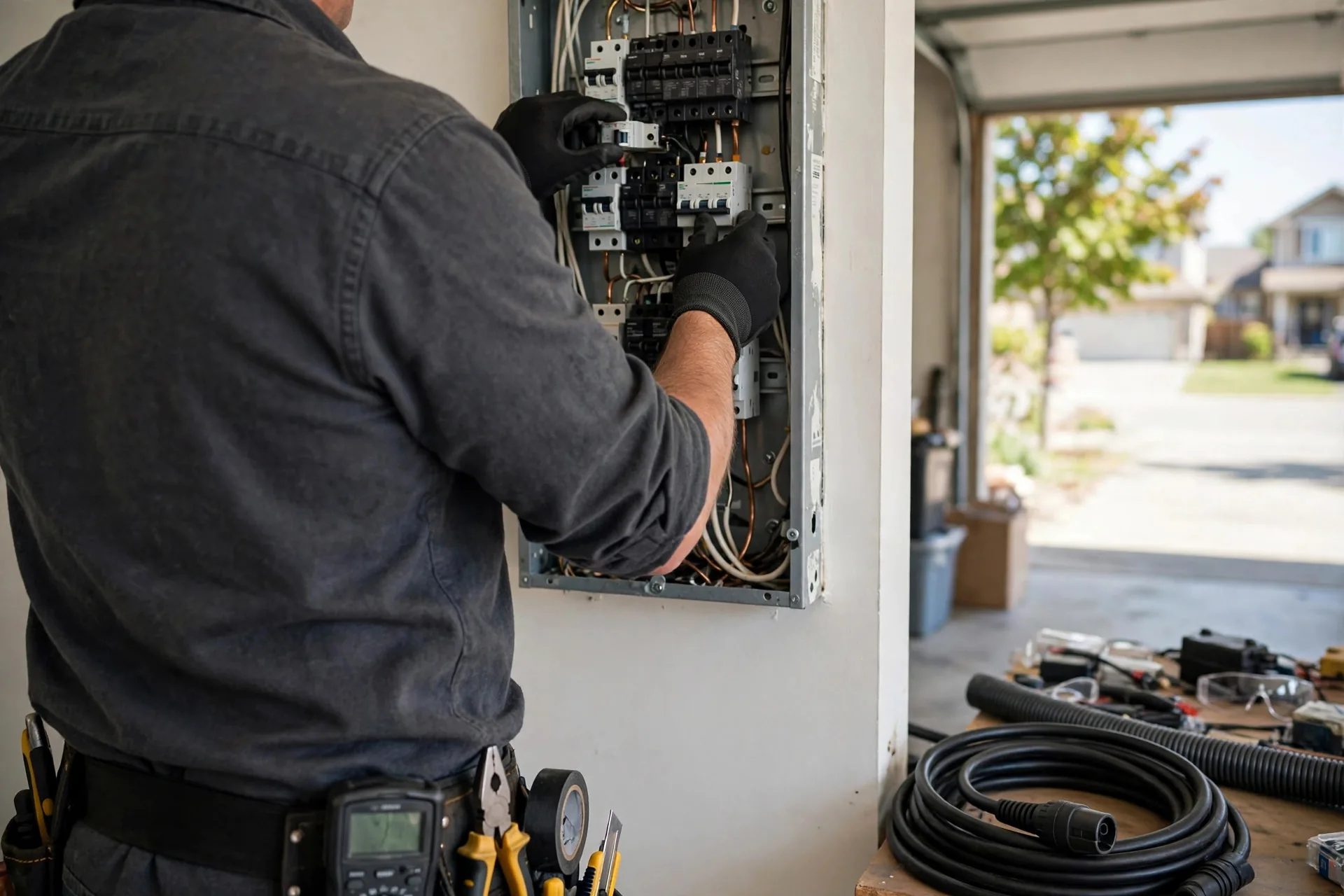
A Level 2 charger draws 32 to 48 amps continuously, which makes it one of the heaviest loads in a house. Before quoting, an electrician runs a load calculation under the Canadian Electrical Code, adding your existing demand — range, dryer, hot tub, baseboard heat, a suite if you have one — against your service size. Many older BC homes run on 100-amp service, and a 100-amp panel that already feeds electric heat and a rental suite may have nothing left to give.
When the calculation fails, you have two honest options. The first is a service and panel upgrade, commonly to 200 amps. It is the thorough fix and the expensive one: our electrical panel upgrade cost guide breaks down what that work runs in BC and what drives it. The second is an EV energy management device — a load manager that watches the home’s total draw and throttles or pauses the charger when the house is busy, so the total never exceeds the service rating. Installed, these typically run $900 to $1,800 on top of the standard install, and for many homes they make the upgrade unnecessary. Which route suits you depends on what else you plan to add electrically in the next decade; a hot tub and a heat pump on the horizon argue for the upgrade, a charger alone argues for the manager.
The Charger Itself: Units, Amps, and Hardwired vs Plug-In
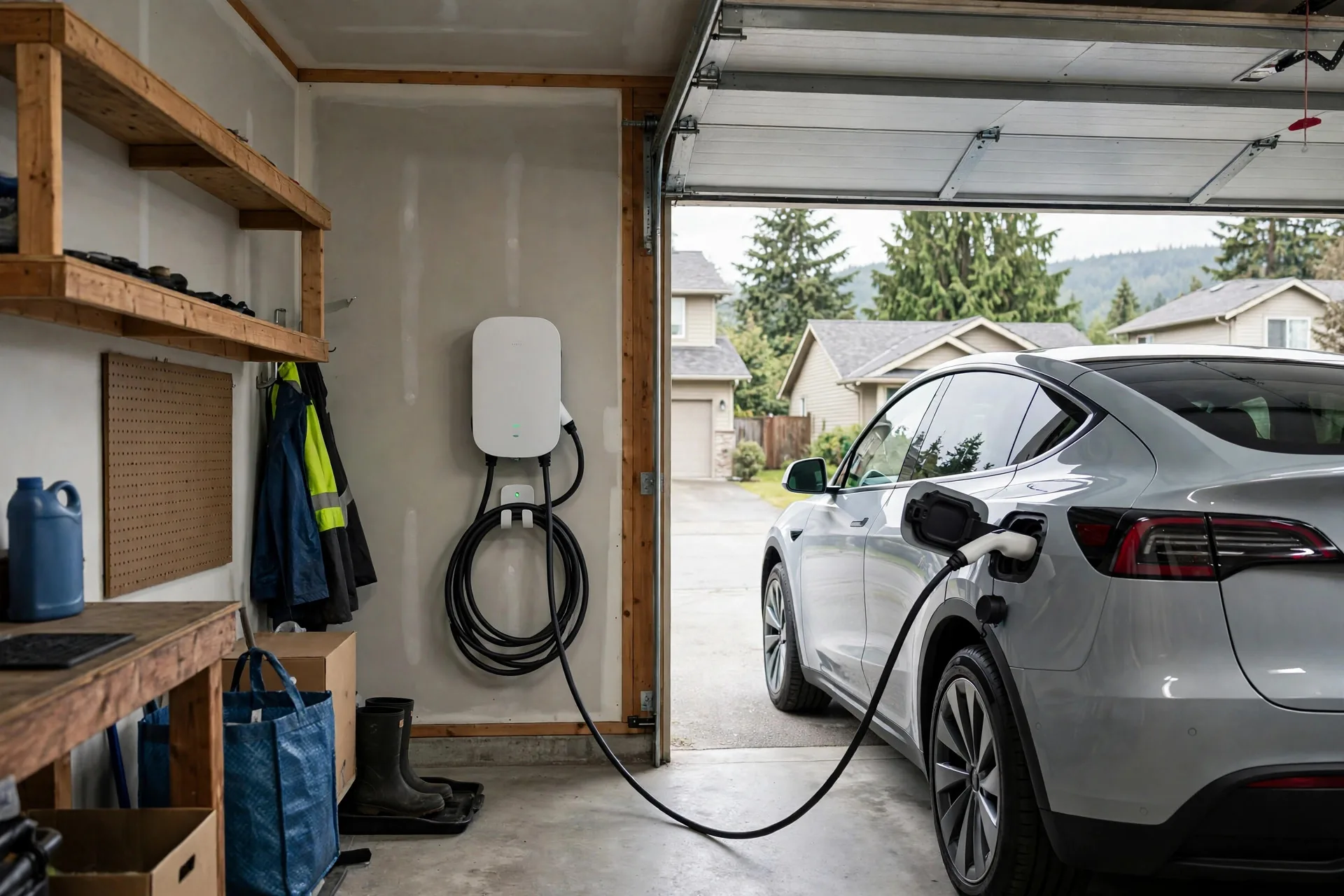
Level 2 charger units run about $400 to $1,100 depending on output and features. A 32-amp unit adds roughly 40 to 50 kilometres of range per hour of charging; a 48-amp unit gets closer to 60 to 70. For overnight charging — which is how most people actually use these — even the smaller unit refills a typical EV with room to spare, so paying for maximum amperage is often paying for a number you will never use. Hardwired installations suit outdoor mounting and higher amperage and remove the receptacle from the weather; plug-in units on a NEMA 14-50 receptacle cost a little more in parts but let you take the charger with you when you move. If the car will charge outdoors on the driveway, budget for a charger rated for it and a mounting post or wall position that keeps the cable off the ground in February slush.
Level 1 charging — the cord that came with the car, on a regular outlet — costs nothing to set up and adds about 5 to 8 kilometres per hour. For a low-mileage driver it is genuinely enough, and it is the right answer for some households. The level 2 charger installation cost only makes sense against your actual driving: add up a week’s kilometres and be honest about winter range loss before spending anything.
Permits, Inspections, and Rebates
Electrical permits for charger installs are handled through Technical Safety BC or your municipality depending on where you live, and the inspection at the end is part of the process, not an optional extra. A quote that treats the permit as your problem to sort out is a quote to walk away from. Timelines are usually painless — this is routine work for inspectors — but the permit belongs in the electrician’s scope and price.
On rebates: BC has offered home charging incentives through CleanBC Go Electric in recent years, at times covering a share of the charger and installation cost for eligible homes, and some municipalities and utilities have layered their own offers on top. Amounts, eligible equipment lists and program windows change, and programs have paused and relaunched before. Treat any rebate figure in any guide — including this one — as a lead to verify, not a promise: check the current CleanBC Go Electric and BC Hydro program pages for eligibility before you buy equipment, and keep every receipt and the permit number, because rebate applications ask for both. Our home renovation rebates and grants guide tracks the bigger picture of what BC homeowners can stack.
Strata, Townhomes, and Shared Parking
If you park in a strata building, the charger is the easy part and the governance is the job. Common-property electrical rooms, shared load capacity, and billing for the power you use all sit with the strata corporation, which generally means a written request, sometimes an electrical capacity study for the building, and a user agreement covering installation and removal costs. BC’s strata rules around EV charging requests have been evolving to make approvals harder to refuse outright, but the process still takes months in many buildings, so start the conversation before the car arrives, not after. Detached-garage homes in townhouse complexes sit in between: your panel, your cost, but strata approval for the exterior work is still the norm. Get it in writing either way.
Home Charging Questions: Frequently Asked Questions
What is the average EV charger installation cost in BC? For a home whose panel has capacity and whose parking is within a short run of the panel, plan on $1,200 to $2,800 all-in for 2026, charger included. Homes needing a load management device typically land at $2,100 to $4,300, and homes that go the full panel-upgrade route reach $4,000 to $6,500 or more. Quotes far below the standard range usually exclude the charger, the permit, or both — ask which.
How much does a Level 2 charger installation cost if I already have a 240V outlet? If a suitable 240V receptacle (such as a NEMA 14-50) already exists where you park, the charger itself is most of the bill: $400 to $1,100 for the unit, plus a short electrician visit if the circuit needs checking or the charger is being hardwired instead. Have the existing circuit verified before relying on it — a receptacle installed for a welder or dryer is not automatically rated for the continuous draw of a car charging all night.
Do I need a panel upgrade for a home EV charger in BC? Not necessarily. It depends on your service size and existing load, which an electrician confirms with a load calculation. Many 200-amp homes need nothing extra. Many 100-amp homes can avoid an upgrade entirely with an EV energy management device that pauses or throttles charging when the house is drawing heavily. An upgrade becomes the better answer when other big electrical additions — a suite, hot tub, or heat pump — are also in your plans.
Is there a rebate for home EV charger installation in BC? CleanBC Go Electric has offered rebates toward home charger purchases and installation in recent program windows, and eligibility rules, amounts and deadlines change between windows. Check the current program pages before buying, buy only listed eligible equipment, and keep your receipts and permit documentation for the application. Never let a rebate deadline talk you into skipping the permit — unpermitted electrical work is not eligible and not insurable.
Can I install an EV charger myself in BC? Homeowners in BC can take out an electrical homeowner permit for work in their own single-family home in some jurisdictions, but charger circuits involve load calculations, continuous-duty ratings and inspection sign-off, and a mistake lives inside your walls. Strata properties, rental suites and anything touching the service equipment are licensed-contractor territory regardless. Most homeowners find the electrician’s visit — typically a few hundred dollars of the total — is the cheapest part of doing this safely and legally.
Find Out Which Scenario Your Home Is
The four scenarios in the table are separated by one thing: what your panel can carry. If you are pricing a charger, a panel upgrade, or both, call (236) 613-0038 with your panel’s amperage (it is printed on the main breaker), the distance from panel to parking spot, and anything else big and electrical you are planning. That is enough to tell you which row of the table you live in — and whether the load manager or the upgrade is the smarter spend — before you buy a charger that may not suit the house.