
Fences in the Fraser Valley work hard. They hold back blackberry canes, keep dogs in and deer out, and give a backyard some privacy from the neighbours — and after a wet winter or two, the leaning cedar fence that came with the house starts to look like a project, not a boundary.
If you are budgeting a replacement, price by the linear foot. Material choice is the biggest lever, and in Abbotsford the spread between chain link and cedar is roughly three to one. Here is what each option costs installed in 2026, what gets added on top, and the height rules to check before anyone digs a post hole.
1. Cost Per Linear Foot by Material
These are installed prices for a standard 6-foot privacy fence (4-foot for chain link where noted), including posts set in concrete, panels or boards, and basic hardware. Canadian installed prices vary by province with BC at the higher end, and Fraser Valley quotes follow that pattern:
| Material | 2026 planning range (per linear foot, installed) | Lifespan | Maintenance |
|---|---|---|---|
| Chain link (galvanized) | $20–$40 | 20+ years | Almost none |
| Pressure-treated wood | $35–$55 | 15–20 years | Stain/seal every few years |
| Western red cedar | $45–$70 | 15–25 years | Stain to keep colour; weathers grey without it |
| Vinyl (PVC) privacy | $55–$85 | 25–30+ years | Wash occasionally |
| Composite | $60–$90 | 25+ years | Wash occasionally |
For a typical Abbotsford backyard — about 150 linear feet of fence — that works out to:
- Pressure-treated: $5,250–$8,250
- Cedar: $6,750–$10,500
- Vinyl: $8,250–$12,750
Height matters: dropping from 6 feet to 5 feet saves roughly 10–15% on wood fencing, and stepping up to a 6-foot vinyl privacy panel costs noticeably more than a 5-foot semi-privacy style.
2. Cedar vs Pressure-Treated vs Vinyl: The Real Comparison
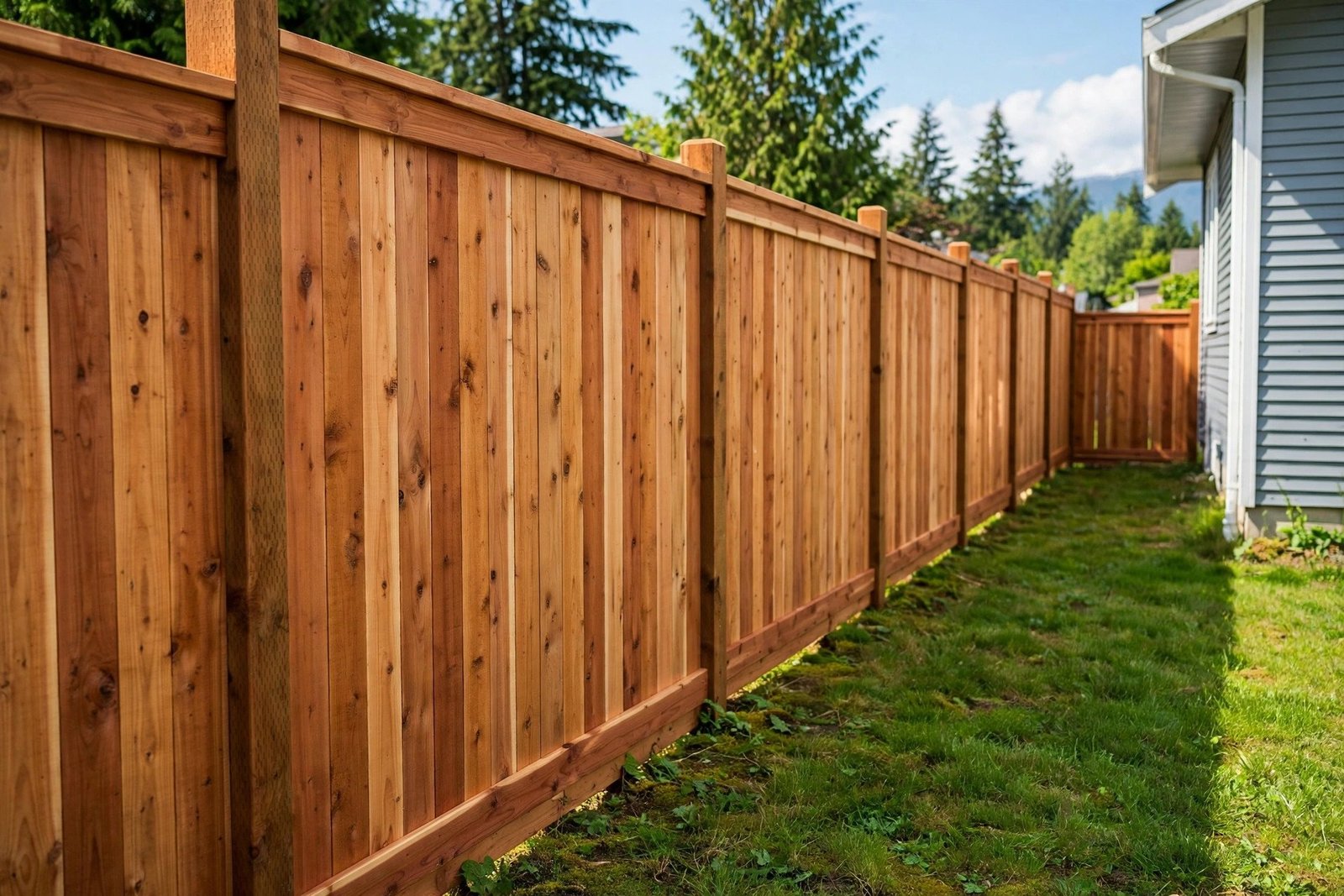
Cedar is the local default for good reason. Western red cedar resists rot naturally, takes stain beautifully, and is milled in our backyard. Its weakness is the Fraser Valley winter: constant moisture at the ground line rots posts first. Insist on posts set in concrete with the concrete crowned above soil level, and keep soil and mulch from piling against the bottom rail.
Pressure-treated lumber costs about 20–25% less than cedar up front. Modern treatments are far better than the green, splintery boards of twenty years ago, but the wood still checks and warps more than cedar, and it needs stain or sealant to look decent. A sensible budget pick for side yards and rental properties.
Vinyl wins on lifetime cost if you plan to stay put. It costs the most to install, then asks for almost nothing: no staining weekends, no board replacements, just a wash. In high-wind pockets of Abbotsford — the exposed Sumas Prairie side and ridgetops in east Abbotsford — specify reinforced bottom rails and posts, because a vinyl privacy panel is a sail.
Chain link is the honest budget answer at $20–$40 per foot, and with black vinyl coating it looks far better than the industrial stereotype. For dog runs, garden enclosures, and long rural boundaries, nothing else comes close on price.
3. The Extras That Move the Quote
The per-foot price is only most of the bill. Budget separately for:
- Gates: $300–$800 for a standard walk gate; $800–$2,000 for a double or driveway gate with proper posts and hardware. Gates are where cheap fences fail first — the hardware line in a quote is worth reading.
- Old fence removal: $5–$10 per linear foot to tear out, haul, and dispose of the old fence. Concrete post footings drive this number up.
- Sloped ground: stepped or racked panels on a slope add 10–25% to labour. Much of Abbotsford east of Clearbrook is anything but flat.
- Rocky or root-bound digging: hand-digging around mature trees and services costs more than clean auger work.
- Survey: if the property line is in any doubt, a legal survey costs a few hundred dollars and prevents the most expensive fence mistake of all — building on your neighbour’s land. Older Abbotsford lots with hedges “that have always been the line” are exactly where this bites.
Before anyone digs, the line locations of buried utilities need checking through BC 1 Call — it is free, and hitting a gas line with an auger is a very bad day.
4. Abbotsford Fence Height Rules
Fences in Abbotsford are regulated by the City’s zoning bylaw, and a standard residential fence that stays within the height limits does not usually need a building permit. The pattern across Abbotsford’s residential zones — and the Fraser Valley generally — is a maximum of about 1.8 m (6 feet) in side and rear yards, with lower limits in front yards and special sight-line rules on corner lots, where a tall fence near the driveway or intersection can block drivers’ views.
Treat those figures as the planning pattern, not the final word for your lot. Corner lots, lots backing onto arterial roads, and strata properties all carry extra rules, and strata approval is its own process on top of the bylaw. Before you commit to a height, confirm the exact limit for your zone with the City of Abbotsford — a two-minute check now beats rebuilding a fence run 15 cm shorter later.
One more local wrinkle: if your fence borders a watercourse or ditch — common on Abbotsford’s rural and semi-rural lots — streamside protection rules may control where a fence can sit at all. Ask before you dig.
5. Sharing the Cost With Neighbours
A fence on a shared property line is, by custom in BC, a shared conversation. No simple rule forces a neighbour to pay half of whatever fence you choose, so the practical approach works best: talk first, agree on material and height, and get the split in writing before work starts. If you want the cedar upgrade and your neighbour was happy with pressure-treated, expect to cover the difference yourself. Handle it early — not on the morning the crew arrives.
6. Timing and Getting Quotes
Fraser Valley fence crews book out hard from March through June. Fall installations often come with shorter waits and occasionally softer pricing. If the fence is one part of a bigger backyard plan, build it before a new deck goes in — posts go in easier before the deck framing does.
Get three quotes, each stating material grade, post size and depth, concrete, gate hardware, and removal in writing. The cheapest quote that says “wood fence, 150 ft” on one line is rarely the cheapest fence by year five.
Frequently Asked Questions
How much does a fence cost in Abbotsford in 2026?
For a standard 6-foot wood privacy fence, plan on $35–$55 per linear foot installed for pressure-treated and $45–$70 for cedar. A typical 150-foot backyard runs $6,750–$10,500 in cedar. Chain link starts around $20 per foot; vinyl privacy fencing runs $55–$85 per foot. Gates, old fence removal, and slopes add to the per-foot figure. All are 2026 planning ranges — local quotes decide the real number.
How tall can my fence be in Abbotsford?
Plan around 1.8 m (6 feet) as the maximum for side and rear yards in residential zones, with lower limits in front yards and near corner-lot sight lines. The exact limit comes from the City of Abbotsford Zoning Bylaw for your specific zone, and strata lots have their own rules on top. Confirm with the City before building — fences built over the limit can be ordered shortened.
Do I need a permit to build a fence in Abbotsford?
Usually not, for a standard residential fence within the zoning bylaw’s height limits. Retaining walls, fences enclosing pools, and fences on lots with watercourse setbacks are different stories. If your project includes a retaining wall over a metre, that wall has its own permit and engineering rules — ask the City before combining the two projects.
Which fence material lasts longest in the Fraser Valley rain?
Vinyl and composite, at 25–30+ years with minimal upkeep. Cedar lasts 15–25 years here when posts are set in crowned concrete and the wood is kept out of ground contact — the post bottoms, not the boards, are what rot first. Pressure-treated posts with cedar boards is a common local compromise that puts the durable wood where it matters most.
Should fence posts be set in concrete or gravel?
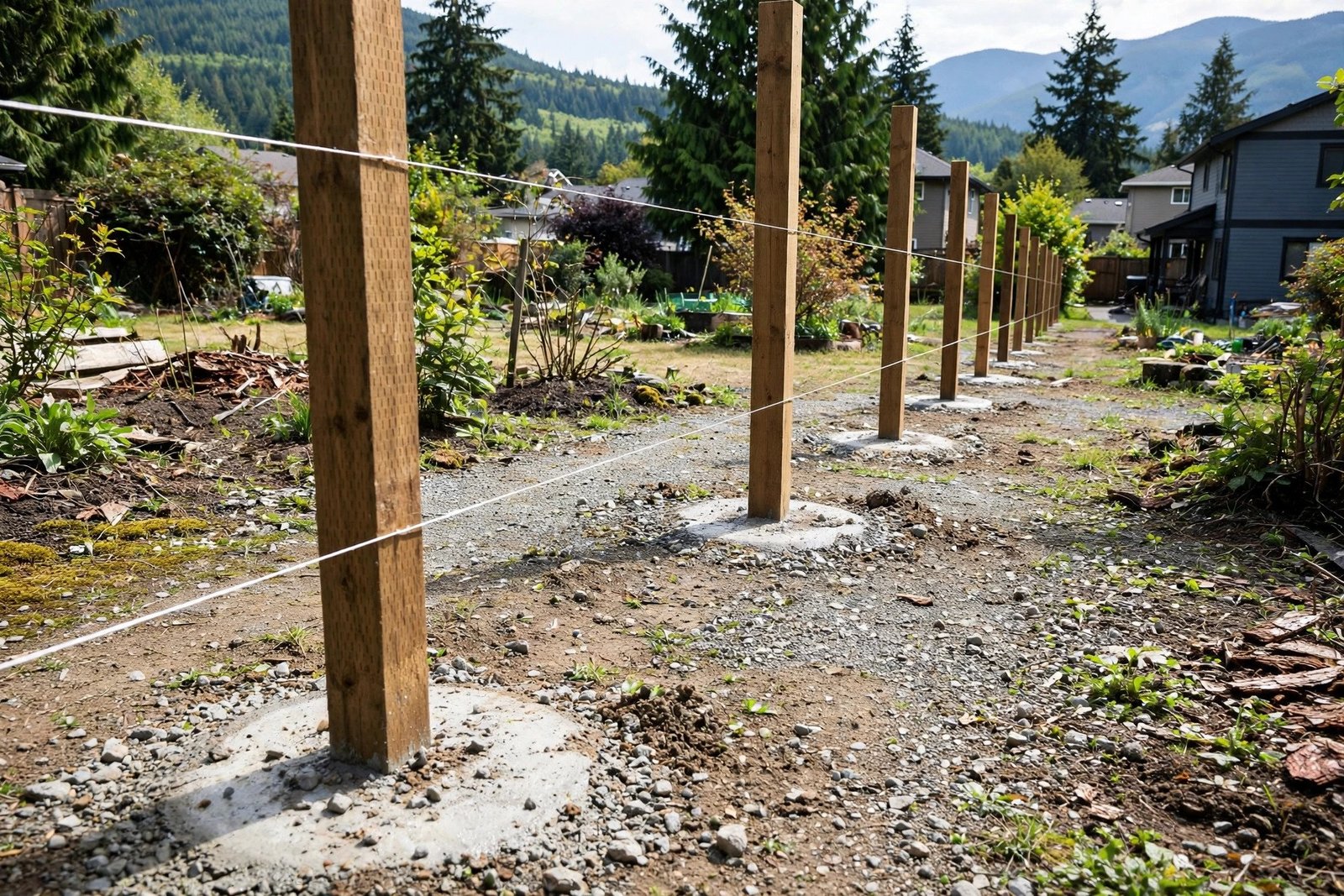
In the Fraser Valley, concrete — crowned so water sheds away from the post. Gravel-set posts drain well in dry climates, but our winter water table and heavy soils let gravel-set posts shift and lean within a few seasons. Post depth should reach below the local frost line, typically 600–900 mm here.
Can I build a fence in winter in Abbotsford?
Yes, with limits. Crews work through our winters when the ground is not frozen or flooded, and off-season scheduling is easier. Expect mud management to matter — a good crew mats their access path so your lawn survives the job.
Measure Twice, Talk to the Neighbours Once
The formula that works: pick the material by how long you will live with it, not just the install price; price the gates and removal separately; confirm the height limit for your lot; and sort the cost-share with your neighbour in writing before the first post hole. Do those four things and a fence is a one-week project with a twenty-year payoff.
Pairing the fence with a yard refresh? Our exterior house painting cost guide covers the other half of most curb-appeal budgets, and our home addition cost guide is worth a read before a fence goes up anywhere an extension might one day land.
All costs in this article are 2026 Fraser Valley planning ranges, not quotes. Fence heights and setbacks are set by the City of Abbotsford Zoning Bylaw and vary by zone — confirm the rules for your lot with the City before building.