
Almost every BC home has at least one foundation crack, and almost every homeowner who finds one has the same reaction: a quiet moment of dread, followed by a search for what it is going to cost. The honest answer is that foundation repair is really several different trades wearing one label. A leaking shrinkage crack is a half-day injection job. A wall that is bowing inward is a structural project with engineering, permits and heavy equipment. Here is what foundation repair costs in BC in 2026, what each repair actually does, and how to tell which kind of crack you are looking at.
The short version: epoxy or polyurethane crack injection runs $500–$1,500 per crack, an exterior crack repair with excavation runs $2,500–$5,000, and an interior drainage system tied to a sump runs $4,000–$9,000 in 2026. Structural work sits in a different bracket: underpinning piers run $1,500–$3,000 each, and a typical whole-job underpinning project lands at $25,000–$60,000 or more. A structural engineer’s assessment, roughly $500–$1,500, is the cheapest way to find out which bracket your house is actually in.
1. Foundation Repair Costs at a Glance
2026 BC planning ranges:
| Job | What it includes | 2026 planning range |
|---|---|---|
| Crack injection (epoxy or polyurethane) | Crack sealed from inside, ports and resin, no excavation | $500–$1,500 per crack |
| Exterior crack repair | Excavation down to the footing, crack patch and membrane, backfill | $2,500–$5,000 per crack |
| Interior drainage system | Interior perimeter drain channel tied to a sump pit and pump | $4,000–$9,000 |
| Carbon-fibre reinforcement straps | Bonded straps that stabilize a bowing or cracked wall | $400–$800 per strap |
| Underpinning piers | Steel or concrete piers installed down to stable soil | $1,500–$3,000 per pier |
| Whole-home underpinning | Multiple piers, engineering, permits, stabilization or lift | $25,000–$60,000+ |
| Structural engineer assessment | Site visit, written report and repair recommendations | $500–$1,500 |
Notice the shape of the table: water problems live in the hundreds to low thousands, movement problems live in the tens of thousands. That is why the diagnosis matters more than the quote. Paying injection prices for a wall that is still moving buys you a repaired crack that reopens, and paying underpinning prices for a shrinkage crack buys you nothing at all.
2. What Each Repair Actually Does
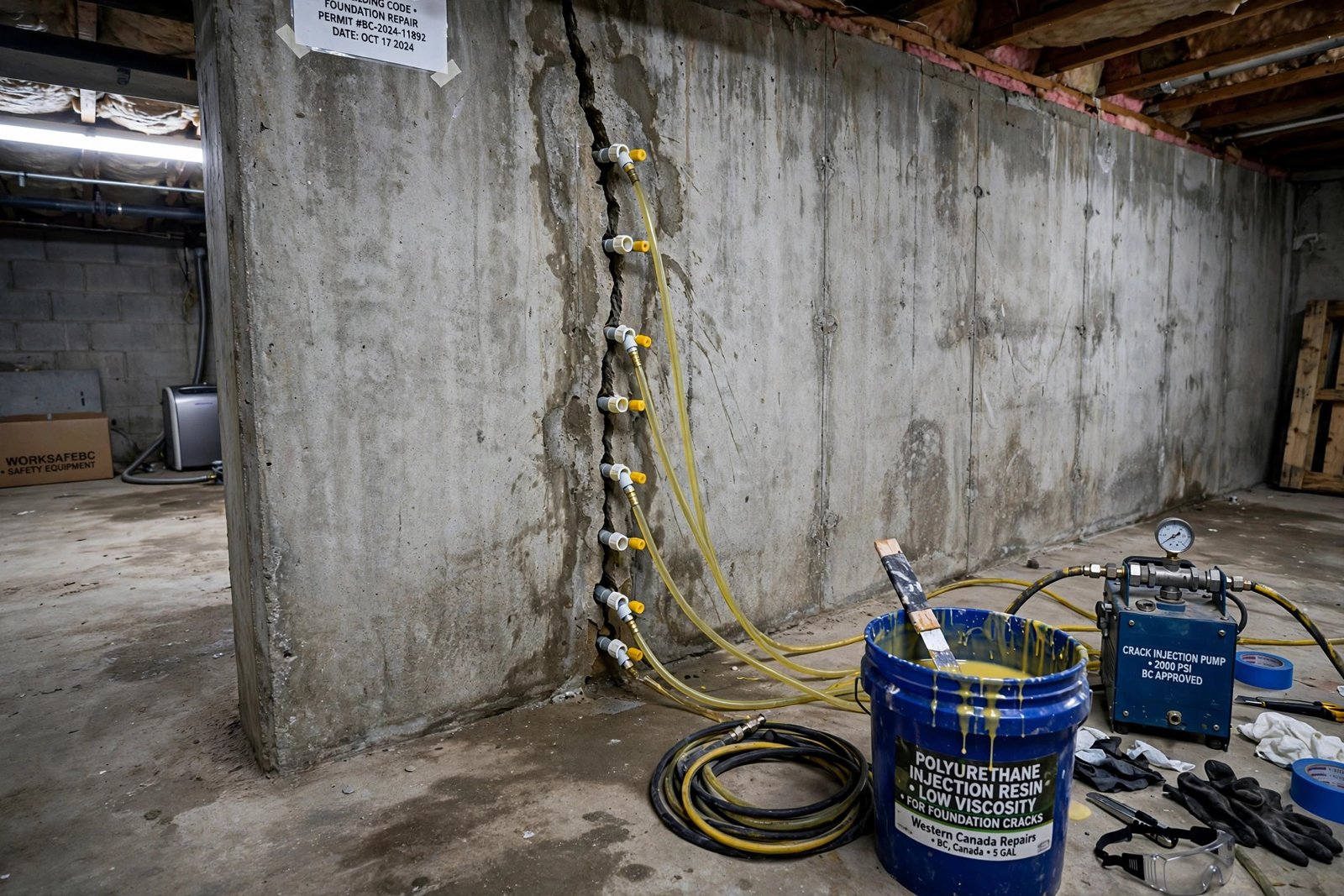
- Crack injection. A technician seals the crack face, sets small ports along it, and injects resin that fills the crack through the full thickness of the wall. Polyurethane foam expands and stays flexible, which makes it the usual choice for stopping active leaks. Epoxy is rigid and bonds the concrete back together, which suits cracks where restoring strength matters. Either way, there is no digging, and most single cracks are done in a few hours.
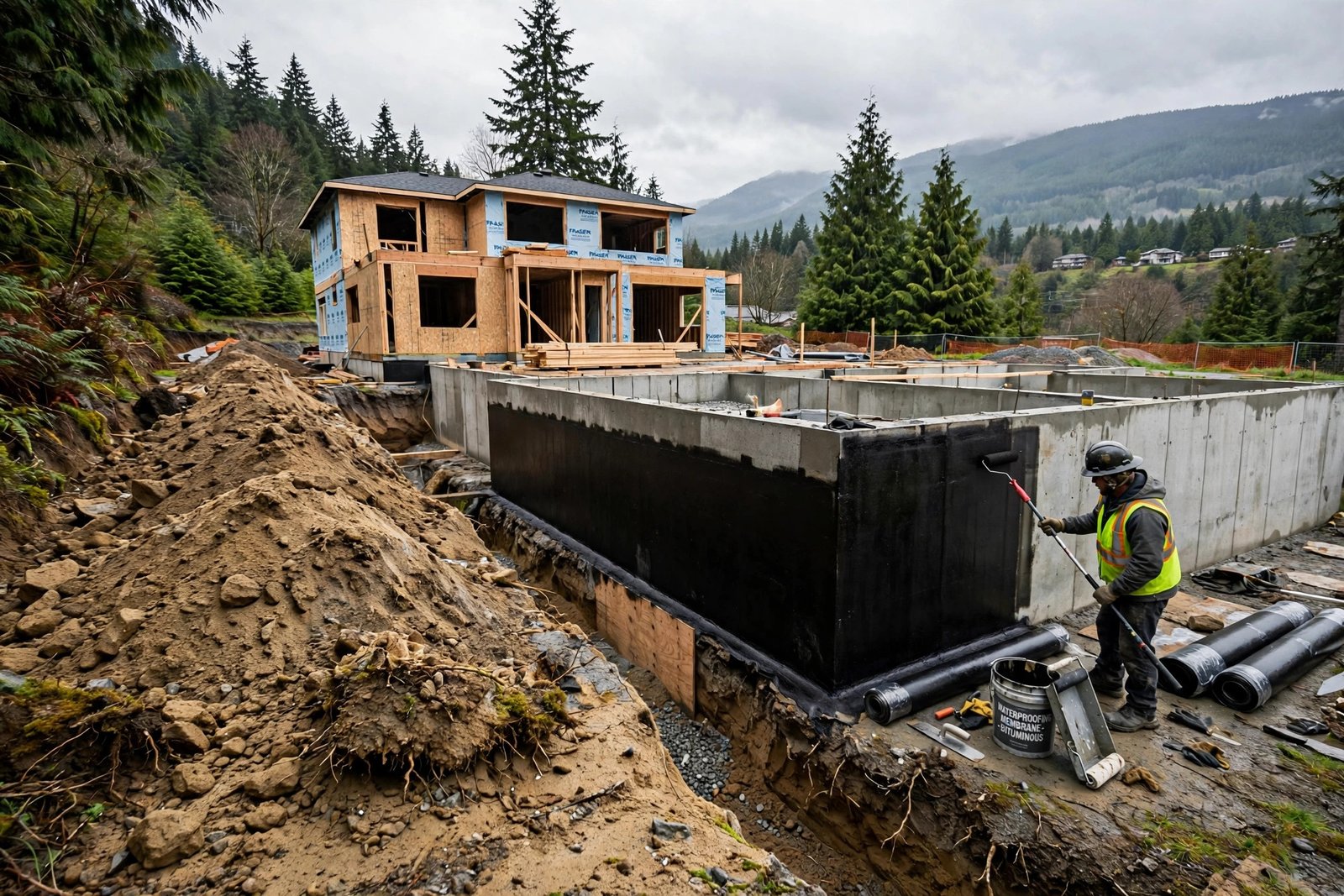
- Exterior crack repair. The crew excavates outside the wall down to the footing, cleans and patches the crack, and covers it with a waterproof membrane before backfilling. It costs several times more than injection because of the labour and machinery, but it seals the crack from the side the water actually pushes on. When the wall is already exposed, it is also the natural moment to look at the broader picture in our basement waterproofing guide for BC, since a tired drain tile or missing membrane often shows up in the same excavation.
- Interior drainage system. A channel is cut into the slab along the inside of the foundation wall, collecting water from the wall and floor joint and directing it to a sump pit, where a pump lifts it out of the house. It manages water rather than stopping it at the wall, which makes it a practical answer for homes where exterior excavation is blocked by additions, decks or property lines. Our sump pump installation cost guide for BC breaks down the pit and pump side of that system.
- Carbon-fibre straps. Thin straps of carbon fibre are bonded vertically to the inside of a block or poured wall with epoxy. Once cured, they hold the wall against further inward movement. They are low-profile, need no excavation, and suit early-stage bowing — a wall that has moved a small amount and needs to stop there. They stabilize; they do not straighten.
- Underpinning. Piers are installed at intervals along the footing and driven or dug down to soil that can actually carry the load, then connected to the foundation so the house rests on them instead of on the failing ground. It is the definitive fix for settlement, and the most expensive item on this page, because it is essentially re-founding part of your house.
3. Cosmetic Cracks vs Structural Problems
Most foundation cracks are cosmetic. Concrete shrinks as it cures, so hairline vertical cracks — thin enough that a credit card edge barely fits, running fairly straight down a wall, appearing in the first few years after construction — are a normal part of a house settling into itself. If a hairline crack is dry and has not changed in years, the decision is usually between a tube of sealant, an injection to keep water out, and simply watching it.
The signs that move a crack out of the cosmetic category:
- Horizontal cracks in a foundation wall, which usually mean soil pressure is pushing the wall inward.
- Stair-step cracks following the mortar joints in a block wall or running diagonally in a poured wall, a classic settlement pattern.
- Doors and windows that suddenly stick, or gaps opening at trim and ceiling corners.
- Cracks that are wider at one end than the other, or wide enough to fit a pencil into.
- Water entry through the crack, or the same crack reopening after a previous repair.
Any one of those is a reason to bring in a structural engineer before a repair company — roughly $500–$1,500 for an assessment and written report, hedged because pricing varies by firm and region. The engineer’s job is to tell you whether the wall is moving, why, and which repair actually addresses it. A simple home test helps in the meantime: draw a pencil line across the crack, write the date beside it, and photograph it with a coin for scale. Check it in three months. A crack that crosses your line is an active crack.
4. What Pushes the Price Up or Down
- Access for excavation. A clear side yard where a mini excavator can work is the cheap scenario. Cracks under decks, additions, concrete patios or tight property lines push the job toward interior methods or hand digging, and both cost more.
- Finished space inside. Interior drainage and injection are far cheaper in an unfinished basement. Cutting and patching around finished flooring, drywall and built-ins adds labour, dust protection and restoration work.
- How much wall is involved. One crack is one price. A drainage system priced by the metre, straps spaced along a full wall, or piers every couple of metres along two sides of a house multiply fast.
- Soil and water conditions. Parts of the Fraser Valley sit on clay and silt with a high water table, which means more groundwater pressure on walls and footings — and sometimes a drainage component added to a repair that looked purely structural.
- Restoration after the repair. Replacing landscaping, lawns, driveways and interior finishes disturbed by the work is rarely in the repair quote. Ask before you sign, not after.
- Timing relative to other projects. Foundation work is cheapest before you finish the basement around it. If a renovation is on your list, our basement renovation cost guide for Abbotsford shows the finishing numbers — and fixing the foundation first protects every dollar of it.
5. Permits and Engineering
Simple waterproofing-scale work — a crack injection, an interior drain, a pump — usually does not need a building permit. Structural work is different. Permits and engineer involvement are commonly required for structural repairs and underpinning in BC municipalities: an engineer typically designs the pier layout or wall reinforcement, the city issues a permit based on those drawings, and the engineer reviews the work as it proceeds and provides letters confirming it was built as designed.
Treat that paperwork as part of the product, not red tape. An engineered, permitted underpinning job comes with documentation that matters when you sell, refinance or make an insurance claim — an undocumented one raises questions a home inspector will happily ask on a buyer’s behalf. Rules and thresholds vary by municipality, so confirm what your city requires for your specific repair before work starts.
6. Frequently Asked Questions
How much does foundation repair cost in BC? It depends on the type of problem. For 2026, plan on $500–$1,500 per crack for injection, $2,500–$5,000 for an exterior crack repair with excavation, $4,000–$9,000 for an interior drainage system, and $25,000–$60,000 or more for a typical underpinning job. These are planning ranges, not quotes.
Is a crack in my foundation serious? Usually not. Hairline vertical shrinkage cracks are common in BC homes and are often only a waterproofing concern. Horizontal cracks, stair-step cracks, cracks that are growing, and doors that have started sticking are the patterns worth taking seriously — get a structural engineer to assess those before repairing anything.
Does foundation repair need a permit in BC? Structural work and underpinning commonly do, and they typically involve an engineer’s design and review. Crack injection and interior drainage usually do not. Requirements vary by municipality, so confirm with your city before the work begins.
Can a foundation crack be fixed from inside? Often, yes. Injection seals a crack through the full wall thickness from the interior, and interior drainage handles water without any digging. Exterior repair is the better choice when the soil side of the wall is accessible and you want the crack sealed against water pressure directly.
Should I repair a foundation crack before finishing my basement? Yes. Finishing seals the walls behind drywall and flooring, which makes later repairs slower, messier and more expensive — and an active leak will damage new finishes. Fix the foundation and confirm it stays dry for a season before you build over it.
Worried About a Crack in Your Foundation?
Start with the diagnosis: whether the wall is leaking, moving or just shrinking decides whether this is a $500 injection or a structural project. If you would like a second set of eyes on your foundation, call us at (236) 613-0038 and we will talk through what your home is showing you and a realistic plan — no pressure, just straight answers.