
The holding tank alarm went off on a Tuesday in a house on a Matsqui acreage, and the alarm meant the tank was full, and the tank was full because the field had stopped taking water, and the field had stopped taking water because it was thirty years old, and the septic installer who came to look at it said the field was done, and the tank was old too, and the septic system installation cost BC homeowners ask about next was the number that decided whether the house got a new system or a series of pump-outs, and the pump-outs were cheaper, and the pump-outs were also a countdown, because a field that has stopped absorbing does not start again, and a new system is the only fix.
Most of Abbotsford is on city sewer, and the houses that are not sit on the rural edges, Matsqui, Bradner, the far side of Sumas Mountain, the acreages along the Fraser River, and those houses run on septic, and a septic system is a private wastewater plant with two parts, a tank that holds the solids and a field that absorbs the liquid, and both parts wear out, and both parts cost money, and a new system in BC in 2026 runs $20,000 to $45,000 for a standard gravity system, and the range is wide because the ground decides the price.
The Tank, the Field, and the Total
A standard septic system has three cost buckets, the tank, the field, and the rest, and the rest is the assessment, the permits, the design, the excavation, and the finishing, and the quote should show the total bucket by bucket, because a quote that shows one number hides the places the price can grow.
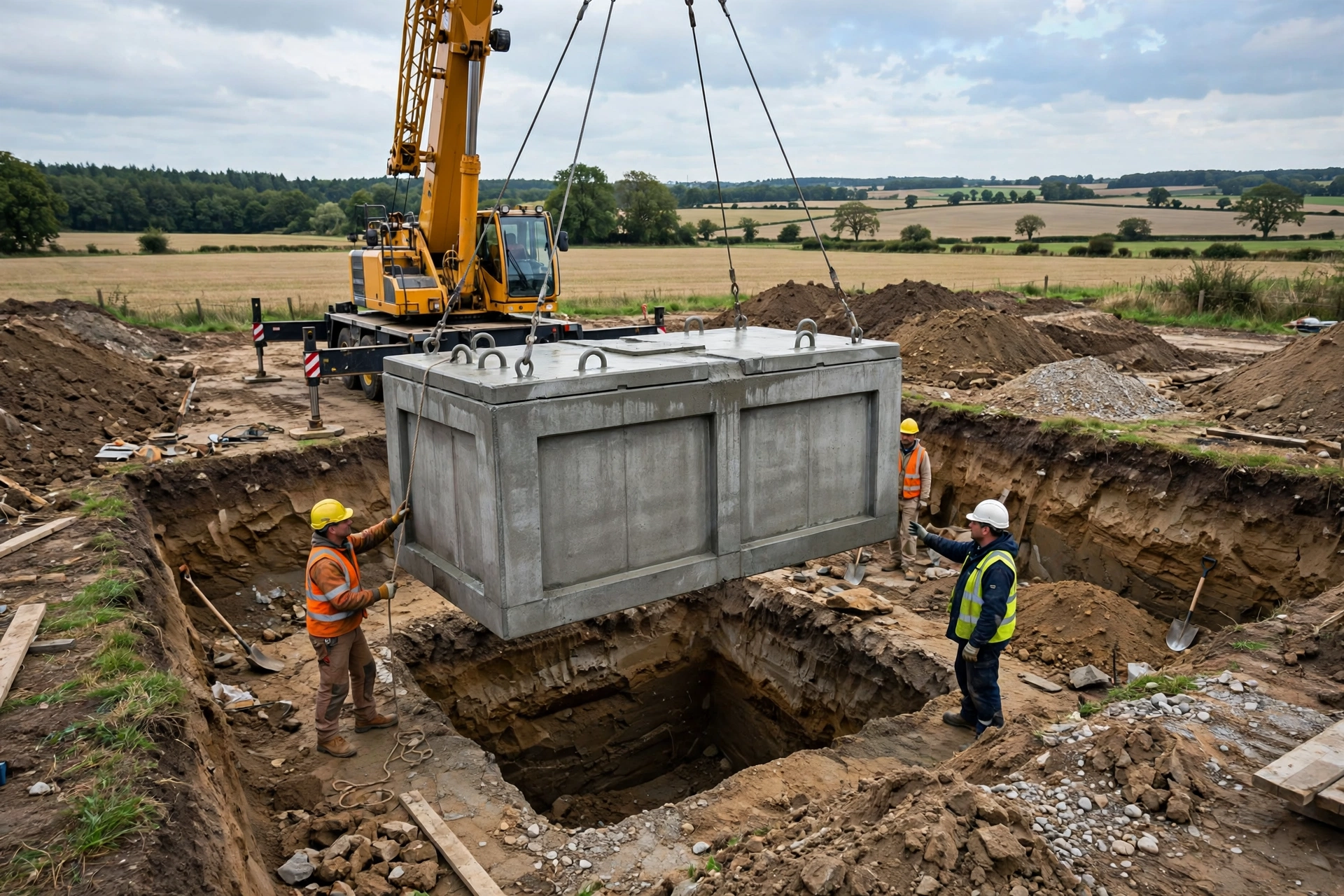
The tank itself, a concrete or fibreglass tank of 1,000 to 1,500 gallons for a typical three-bedroom home, runs $8,000 to $15,000 installed, including the tank, the excavation, the pipes, the risers that bring the lids to the surface, and the backfill, and the low end is a straightforward install on flat ground, and the high end is a deep install, or a tight site, or a tank that has to be craned in over a fence, and a tank alone, replacing a cracked tank while the field still works, is the cheapest septic job there is.
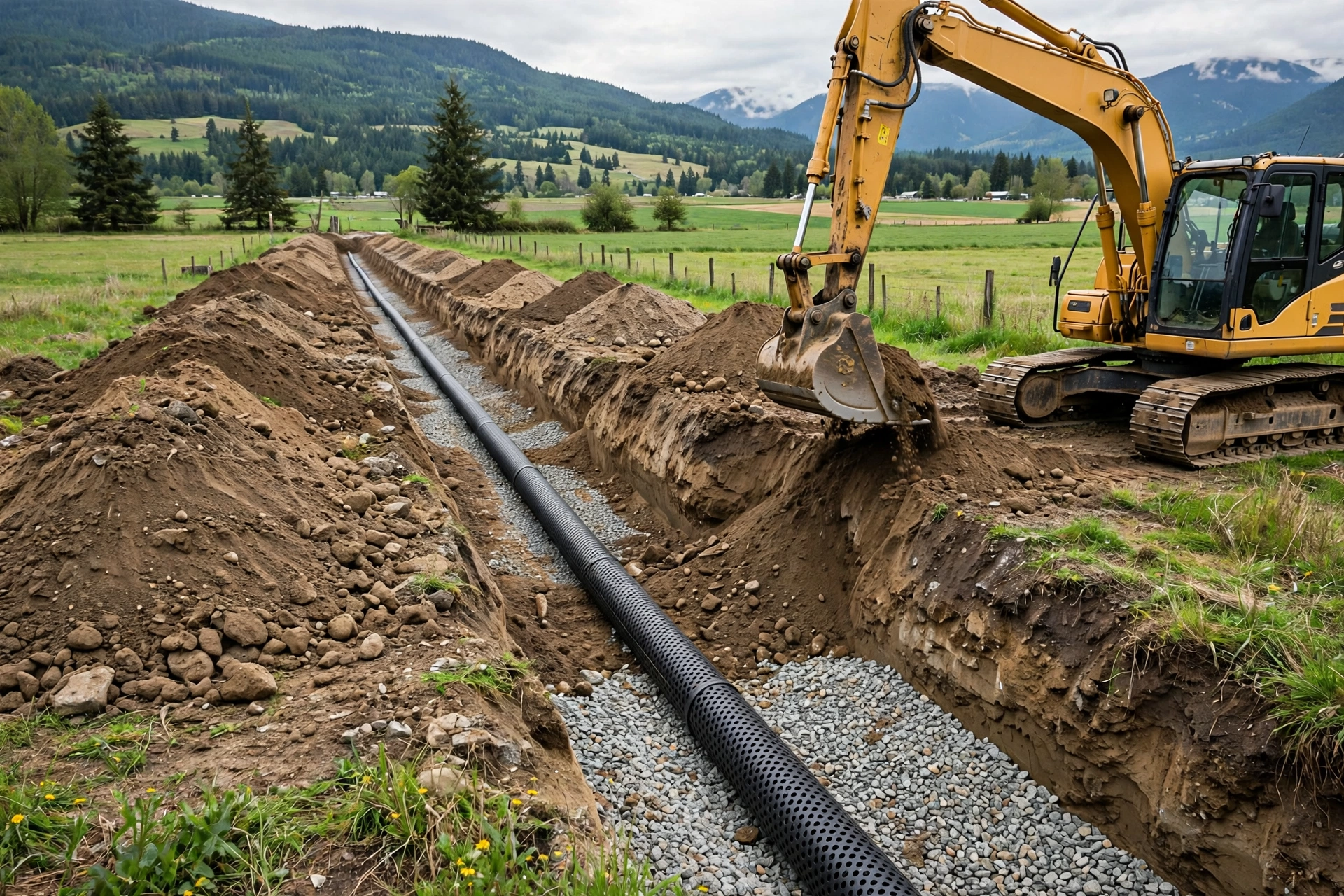
The field, the drainfield of perforated pipe in gravel trenches that absorbs the liquid, runs $12,000 to $30,000 to replace, and it is the expensive part because it is the big part, a large area of ground, and the trenches have to be dug to the right depth, and the gravel has to be the right size, and the soil has to accept the water, and the replacement is a new field, usually in a new location, because the old location is saturated.
A complete new system, tank and field together, on a lot with workable soil, runs $20,000 to $45,000, and the low end is a standard gravity system on good soil with easy access, and the high end is a system with a pump, a raised bed, or an advanced treatment unit, and the advanced systems appear when the soil is poor, or the water table is high, or the lot is small, and an advanced treatment system can run $35,000 to $60,000, and the assessment is what tells you which system your lot needs, before the quote, not after.
| System or component | 2026 installed range | Best for | Notes |
|---|---|---|---|
| Complete standard gravity system | $20,000–$45,000 | Good soil, flat lot, easy access | Most common rural Abbotsford install |
| Septic tank only, replacement | $8,000–$15,000 | Cracked tank, field still working | Cheapest septic job, field untouched |
| Drainfield only, replacement | $12,000–$30,000 | Failed field, tank still sound | Usually built in a new spot on the lot |
| Pump system, add-on | $5,000–$10,000 | Field sits higher than the tank | Pump, chamber, alarm, power |
| Advanced treatment system | $35,000–$60,000 | Poor soil, high water table, small lot | Treatment unit plus field, permits heavier |
| Site assessment and design | $2,000–$5,000 | Every new system | Test pits, soil tests, drawings, application |
The numbers above are 2026 planning ranges for the Fraser Valley, and they are ranges because the ground varies, the soil, the slope, the water table, and the size of the lot, and no quote can be firm until the assessment is done.
The Assessment Comes First, and It Is Not Optional
A septic system in BC is not a product bought off a shelf. It is a designed system, and the design starts with an assessment of the lot, done by a qualified professional, with test pits, soil tests, a check of the water table, and a measurement of the lot against the setback rules, and the assessment costs $2,000 to $5,000, and it is money well spent, because it says whether a standard gravity system will work, or whether the lot needs a pump, a raised bed, or advanced treatment, and the difference between those answers is tens of thousands of dollars.
The assessment also determines the field location, and the location matters, because a field needs a reserve area, a second spot on the lot where a replacement field can go in the future, and a lot that is too small for a field and a reserve area is a lot with a problem, and the setback rules, the distance from the field to the well, to the house, to the property line, to a watercourse, decide whether a spot on the lot can be used at all, and the rules are set by the health authority, and the health authority approves the system, and the approval is the permit.
What Pushes a System to the High End
Soil is the first driver, and it decides everything, because a septic field works by letting water soak into the ground, and ground that soaks well, sandy loam, well-drained glacial till, takes a standard field, and ground that does not soak, heavy clay, compacted fill, rock close to the surface, needs a bigger field, or a raised bed, or an advanced treatment unit, and each step up the ladder costs more, and the soil test is what places your lot on the ladder, and a lot in the Matsqui flats with deep sandy soil is a different job from a lot on the Sumas Mountain slope with shallow rock.
The water table is the second driver, and it surprises people, because a high water table, common on low lots near the Fraser River and in the Sumas Prairie, means the field has to sit above the water, and a field above the water means a raised bed, or a mound, and a mound is a visible hill of sand and gravel in the yard, and it is also an expensive hill, because the fill has to be brought in, and the pump has to lift the water up to it.
Access is the fourth driver, and it is the one the homeowner can see, because a lot with a wide driveway and room for an excavator is a lot where the machines work fast, and a lot with a narrow lane and trees everywhere is a lot where the machines work slowly, and slowly is money, and the excavation is the biggest labour cost in the job, and it is priced by the day, and a homeowner who clears the access and marks the utilities before the machines arrive saves money.
Repair or Replace: The Field Test
A septic system that is failing gives signs, and the signs are specific, and the first is slow drains throughout the house, not one sink, all of them, and the second is sewage smells in the yard or in the house, and the third is wet ground over the field, ground that stays soggy when the rest of the yard is dry, and the fourth is the high-water alarm on the tank, going off, and the fifth is the pump-out frequency, a tank that needs pumping every few months instead of every three to five years, and any one of these is a reason to call a professional.
A tank problem is the cheaper failure, and it is the one that can sometimes be repaired, because a cracked tank can be sealed, and a broken baffle can be replaced, and a collapsed lid can be swapped, and a tank that is structurally sound but old is a tank that can keep working, and the repair is a few thousand dollars, and the field is untouched, and the system carries on, and the homeowner should ask the installer whether the tank is sound, because a sound tank is worth keeping, and a cracked tank is worth replacing.
A field problem is the expensive failure, and it is the one that cannot be repaired, because a field that has stopped absorbing has stopped absorbing for a reason, and the reason is usually a biomat, a layer of bacterial slime that clogs the soil, or a field that has been overloaded for years, or a field built in soil that was never right, and none of those can be fixed by pumping, or by additives, or by resting the field, and the fix is a new field, in a new location, and the new field is the $12,000 to $30,000 line in the table, and a homeowner quoted a miracle additive that restores a failed field is being sold a story.
Our guide to the cost of a home addition in Abbotsford is worth reading alongside this one, because an addition that adds a bedroom also adds load to the septic system, and a septic system sized for three bedrooms cannot legally serve four, and the addition may need a system upgrade, and the upgrade is a cost that belongs in the addition budget.
What the Quote Should Include
A septic quote should name the system type, gravity, pump, or advanced treatment, and the reason for it, because the type is the answer to the assessment, and a quote that names a standard gravity system on a lot that needs advanced treatment is a quote that will not be approved. It should name the tank size and material, and the field size, and the location, because the field location is the part of the lot that is committed for decades, and the homeowner should know where it is, and that nothing heavy can be built over it, and no trees can be planted on it, and no driveway can cross it.
It should name the assessment and design fees separately, because those are paid before the construction, and it should name the permit fees, and the inspection schedule, because a septic system is inspected as it is built, and the inspections are the record that helps with a future sale, because a buyer will ask for the permit and the as-built drawing.
It should name the finishing, because a septic install is a large excavation, and the yard is torn up, and the topsoil and the grass are part of the job, or they are not, and the contract should say which, and the homeowner should know whether the yard is restored or left as rough grade, because rough grade is a second contractor, and a second bill.
Timeline, and Living Through the Install
A standard septic install takes one to two weeks from the first machine on site to the final inspection, and the assessment and design before it take two to six weeks, and the permit after the design takes another few weeks, and the total, from the first phone call to the final sign-off, is usually two to three months, and the homeowner should plan for that, because a septic system is not a job that starts on Monday because the alarm went off on Tuesday, and the holding tank and the pump-outs are the bridge, and the bridge is expensive.
Living through the install is manageable, because the house can usually stay occupied, and the water can usually stay on, and the disruption is the yard, not the house, and the machines are loud, and the ground is torn, and the driveway may be blocked for a day, and the homeowner should ask the installer what the day-by-day plan is, and when the water will be off, because the old system is disconnected only when the new one is ready, and the gap should be hours, not days.
A septic system is also a system that needs care after it is built, and the care is simple, because a system that is pumped every three to five years, that is not overloaded with water, that does not receive grease or chemicals or wipes, lasts twenty-five to thirty years, and a system that is neglected lasts half that, and the pumping schedule is the cheapest maintenance in the house, a few hundred dollars every few years, and the homeowner who keeps the pump-out receipts and inspection reports can prove the system was cared for, and the proof helps at sale time. A failing septic field and a wet basement can look alike from inside the house, and our basement waterproofing cost in BC guide covers the other problem, because the two have different causes, and different fixes, and the diagnosis should come before the spending.
The septic system installation cost BC homeowners face is a range, $20,000 to $45,000 for a standard system, $8,000 to $15,000 for a tank alone, $12,000 to $30,000 for a field alone, and $35,000 to $60,000 for an advanced treatment system, and the number that applies to your lot is the number in a written quote that names the system type, the tank, the field, the location, the assessment, the permits, and the finishing. The alarm on the Matsqui acreage was a Tuesday. The new system was the fix, a field in a new spot, a tank with risers to the surface, a permit on file, and a yard that was restored.
Questions about a septic quote, or the condition of an existing system, can be raised with a local septic professional before work starts, and general guidance on Abbotsford renovation costs is available by phone at (236) 613-0038.
Frequently Asked Questions About Septic System Installation Cost in BC
How much does it cost to install a septic system in BC? A standard gravity system runs $20,000 to $45,000 installed in 2026, depending on soil, slope, water table, lot size, and access. An advanced treatment system for poor soil or a high water table runs $35,000 to $60,000. Confirm the final price with a written quote.
How much does it cost to replace a septic tank in BC? A tank alone runs $8,000 to $15,000 installed, including excavation, pipes, risers, and backfill. A field alone runs $12,000 to $30,000. A tank replacement makes sense only when the field still works.
Do I need a permit to install a septic system in BC? Yes, a new septic system needs an assessment by a qualified professional, a design, and approval from the health authority before construction, with inspections as the work is built. The assessment and design cost $2,000 to $5,000.
How long does a septic system last? A well-built system lasts twenty-five to thirty years with regular care, which means pumping the tank every three to five years, avoiding excess water, and keeping grease, chemicals, and wipes out of the system. A neglected system can fail in half that time, and a failed field cannot be repaired, only replaced.
Can I install a septic system myself to save money? No, not in any practical sense. A septic system needs a professional assessment, a design, and health authority approval, and the excavation, tank setting, and field construction need licensed equipment and installers. A system built without approval cannot be legally used.