
By the third week of July, an Abbotsford lawn tells you everything. The grass on the south-facing slope in Auguston goes straw-coloured first. Then the homeowner on the driveway — hose in one hand — starts doing the maths. How many evenings. How many summers before a proper system pays for itself in time alone. That is the real question behind sprinkler system installation cost BC. And the answer is less tidy than a single number. A small front yard near Mill Lake is a different job from a half-acre lot out past Matsqui. The price follows the ground. Not the brochure.
Most Fraser Valley homeowners land in the middle. A typical detached lot runs four to six zones, and the bill for that kind of system — installed by a local contractor in 2026 — usually falls between $4,500 and $9,000. Smaller systems can come in around $2,800 to $4,500. Larger properties push past $10,000. And a full acre, drip lines running through the garden, can reach $14,000 or more. Those are planning ranges. Not quotes. Every lot has its quirks. The quirks are where the money goes.
What a Typical System Costs in BC in 2026
The cleanest way to think about lawn irrigation system cost? By the zone. One circuit of heads that runs at a time, controlled by its own valve. Water pressure decides how many heads each zone can carry. The lawn’s shape decides how many zones you need. A square lot is cheap to zone, while an L-shaped lot with a narrow side strip needs an extra zone of its own.
| System size | Zones | Typical 2026 BC planning range | Best suited to |
|---|---|---|---|
| Small | 2–3 zones | $2,800–$4,500 | Townhouse or compact lot |
| Medium | 4–6 zones | $4,500–$9,000 | Standard detached Abbotsford lot |
| Large | 7–9 zones | $9,000–$13,000 | Wide or corner lot, sloped ground |
| Estate | 10+ zones | $13,000–$18,000 | Half-acre and up, drip throughout |
Per zone, most Fraser Valley installs work out to roughly $900 to $1,500. That figure counts the heads, the valve, the piping, the trenching, and the labour for that circuit. That per-zone figure is the one worth holding onto when a contractor walks your lot. If a quote comes back far above it, ask what is driving the difference — a good contractor will point at the ground and show you.
Why Lawn Size Moves the Price More Than Anything
Nothing else in the job matters as much as square footage. A 3,000-square-foot lawn needs roughly half the heads of a 6,000-square-foot one, and heads are only the start — every extra head means more pipe, a longer trench, and another valve if the water pressure cannot carry the whole lot on one circuit. Abbotsford lots vary wildly: the newer subdivisions around Auguston sit on compact, regular lots where a four-zone system covers everything, while older properties in Clearbrook and out toward Sumas Mountain often have bigger, less regular yards, and the side strips alone can add a zone or two.
Shape matters nearly as much as size. A long, narrow side yard is the most expensive grass per square foot in the whole job, because rotary heads throw water in circles and a narrow strip wastes half of it on the fence unless it gets its own small zone with spray heads. Trees add cost too. And much of Abbotsford sits on clay-heavy ground — ground that digs hard in a dry August. Then there is what else gets watered. A lawn-only system is the cheapest version of this job. Add drip lines for the beds, though, and the zone count climbs fast. Drip adds a filter, a pressure regulator, and its own valve. Price it separately.
The Parts You Are Actually Paying For
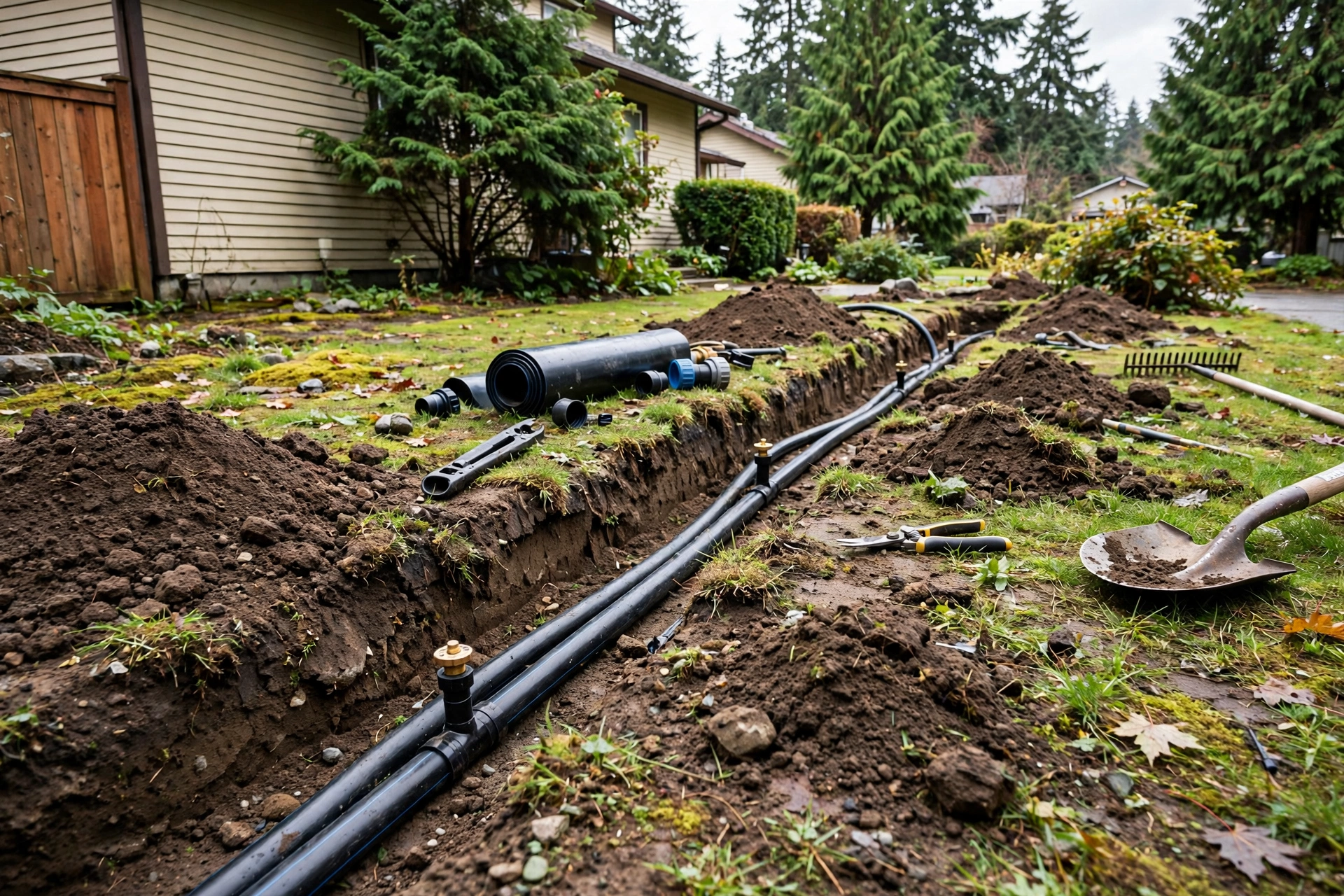
A sprinkler quote is a bundle. And the bundle breaks down into a handful of pieces. Spray heads are the small pop-ups that cover short distances. Those run about $15 to $30 each installed. Rotary heads throw water 25 to 35 feet across a big open lawn. Those run about $35 to $60 each. A medium system might have 25 to 40 heads. The heads alone, then, account for $800 to $2,000 of the job.
The controller is the brain. A basic four-to-six-zone timer costs $200 to $400 installed. A smart controller — one that checks the weather, skips a cycle after rain, and lets you run a zone from your phone — runs $450 to $800. Where a July can swing from a heat wave to three days of rain, it earns its keep quickly. Valves run $80 to $150 each installed. One per zone. Pipe and fittings add $600 to $1,500 in materials on a medium job. Trenching is where the labour concentrates. A crew of two can trench a standard lot in a day, and labour for the whole install typically runs $1,500 to $3,500 on a medium system.
Backflow Prevention: The Small Device With a Big Say
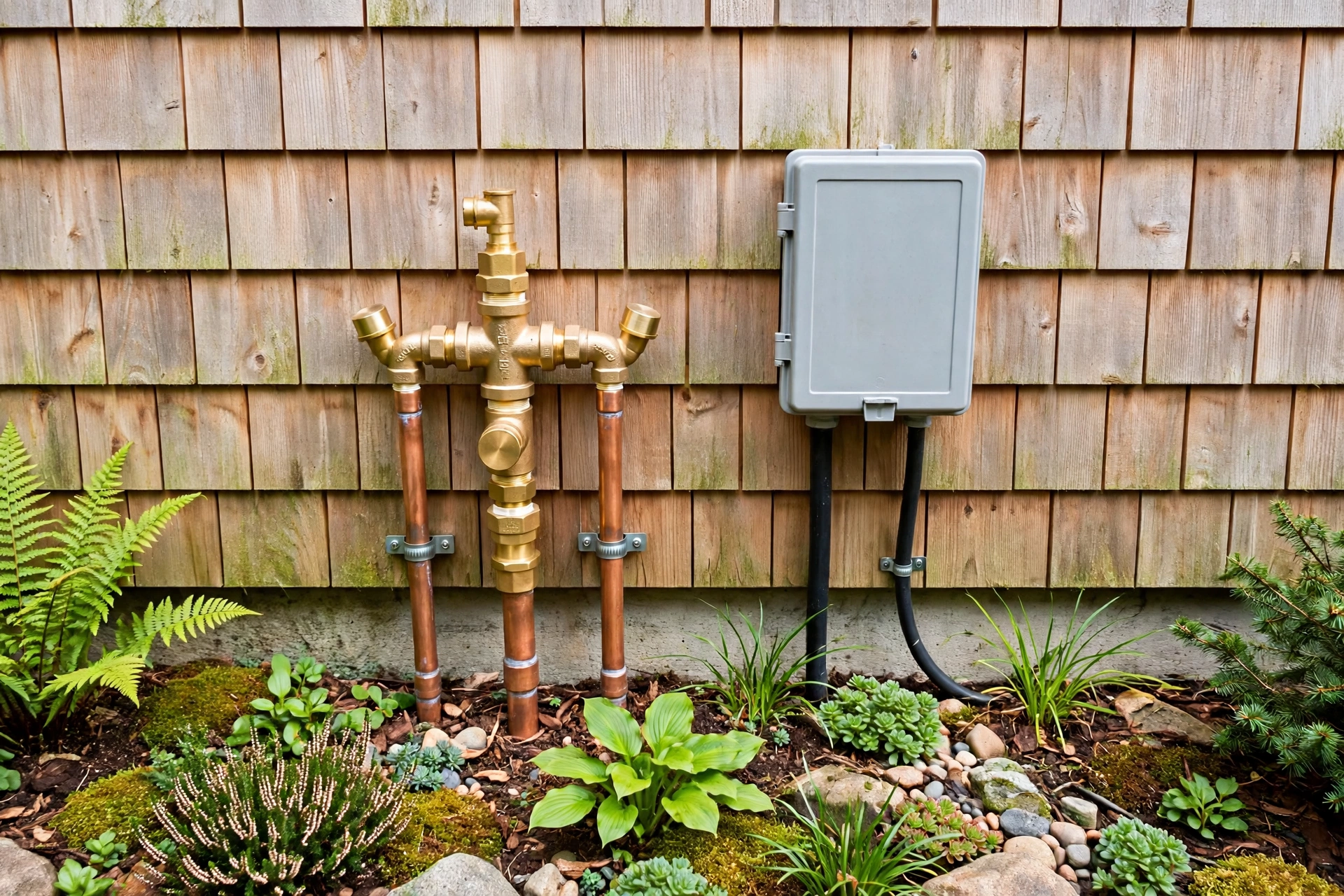
This is the part of the job most homeowners never see coming. Between your house water and your sprinkler lines sits a backflow prevention device. Its job is simple. Stop irrigation water from flowing back into the drinking water supply. The device itself costs $250 to $600, depending on the type. The installation adds another $200 to $400.
Rules vary by city — check with your municipality — and that matters more than the price of the device. Some Fraser Valley municipalities require a specific type of backflow preventer. Some require an annual test by a certified tester. And some require a permit or an inspection before the system goes live. Confirm the current requirement with the city before work starts. The annual test — where one is required — typically costs $75 to $150. Site the device somewhere accessible and protected from freezing. Otherwise it will cost you every time it needs a test.
Watering Restrictions Change How You Use It
A sprinkler system in the Fraser Valley is not a licence to water whenever you like. Abbotsford and neighbouring municipalities run staged watering restrictions through the dry months. The stage in force decides which days you can water. Sometimes which hours, too. The rules change with the season. Check the current stage with your municipality before you set a schedule.
This is where the system earns its money, oddly enough. A hose cannot water at 4 a.m., and it cannot water only the back lawn on Tuesday and only the front on Thursday — a controller can. Most homeowners run the system in the early morning and split the lawn into zones on alternating days, and the per-zone design that looked like a cost on the quote becomes the tool that keeps you inside the rules. Abbotsford’s summers have been getting hotter and drier. A lawn without irrigation goes dormant by mid-August — brown, crunchy, and alive underneath. Watering deeply twice a week rather than lightly every day grows deeper roots. It uses less water overall. Deep and infrequent beats shallow and daily, in clay soil that holds moisture well once it is wet.
What Installation Day Looks Like, and the DIY Question
A medium system? The whole job usually takes one to two days. Day one is trenching and pipe. The crew marks the head locations, cuts narrow trenches, and lays the main line and the lateral lines. Day two is heads, controller, backflow device, and testing — each zone runs while the crew checks for leaks and adjusts the spray patterns. The lawn looks rough for a week or two afterwards. The trench lines show as faint seams until the sod knits back together. Book at least a month ahead in spring. Irrigation contractors are busiest from April through June.
Doing it yourself — is that realistic? The parts for a medium system can be bought for roughly $1,500 to $3,000 — a saving of several thousand dollars against a contractor quote. The saving is real, but so is the work: trenching a whole lot by hand is a brutal weekend, and a mistake in the backflow connection is the kind of mistake that matters. Most homeowners in Abbotsford hire this one out. If you do go DIY, hire out the backflow connection regardless: the rules around it vary by municipality. Winterizing is not optional in BC. Before the first hard frost, the lines need to be blown out with compressed air so trapped water does not freeze and crack a pipe or a head — most homeowners pay a contractor $75 to $150 a year for the blowout, often bundled with the spring start-up.
What It Costs to Run, and Ways to Keep the Bill Down
The install is the big bill, but the running costs deserve a line in the budget. A medium lawn watered deeply twice a week through July and August typically adds $40 to $90 a month to the water bill in the peak months, and less in June and September when the rain does some of the work. Then the annual costs: the winter blowout at $75 to $150, the spring start-up at $75 to $125, and the backflow test at $75 to $150 where one is required. Heads wear out — budget $50 to $100 a year for replacements. All told, most homeowners spend $250 to $500 a year keeping a medium system running well.
The simplest saving on the install itself is timing. Book in the shoulder season — late March or early April, or September — when contractors have more room in the schedule and sometimes more room in the price. The second is scope. Water the lawn and the beds that matter. Leave the narrow strip behind the garage to a hose. Every zone you cut? Roughly $900 to $1,500 saved. And if you are already planning a fence installation or a retaining wall in the same season, ask whether the trenching can be coordinated. The yard is torn up once instead of twice. Finally, get three quotes, each listing the zone count, the head count, the controller model, and the backflow device by name. A quote that just says “sprinkler system, $7,000” cannot be compared with anything.
Frequently Asked Questions About Sprinkler System Installation Cost in BC
How much does a sprinkler system cost in BC? For a standard detached lot in the Fraser Valley, expect $4,500 to $9,000 for a four-to-six-zone system in 2026. Small systems start from $2,800. Large or estate systems run from $9,000 to $18,000. The per-zone cost — roughly $900 to $1,500 — is the best way to compare quotes. All figures are planning ranges, not quotes.
What is the sprinkler installation cost per zone? Most Fraser Valley installs work out to about $900 to $1,500 per zone. That covers the heads, the valve, the piping, the trenching, and the labour for that circuit. A zone for a narrow side strip costs more per square foot. A wide open lawn spreads the same cost over far more grass.
Does an underground sprinkler system need a permit in Abbotsford? Rules vary by city — check with your municipality. Some Fraser Valley municipalities require a permit or an inspection for irrigation systems. Many require a specific type of backflow prevention device, sometimes with an annual test by a certified tester. Before work starts, confirm the current requirement with the city.
How long does sprinkler installation take? A medium system on a standard lot usually takes one to two days. Trenching and pipe on the first day. Heads, controller, backflow device, and testing on the second. Larger or rockier lots can take three days. Book at least a month ahead in spring. That is when irrigation contractors are busiest.
Is a sprinkler system worth it in the Fraser Valley? For most homeowners with a lawn they actually use, yes. Mostly for the time it saves — and the control it gives. A controller that waters at 4 a.m. on alternating days keeps you inside watering restrictions. It keeps the lawn alive through a dry July, too, without the evening hose routine. For running costs, budget $250 to $500 a year.
Getting a Number You Can Plan Around
The honest version of sprinkler system installation cost BC? The range is wide because the lots are wide. A $2,800 townhouse system and a $14,000 estate system are both real prices for real jobs. And the one that matches your house depends on the ground, the shape, and the zones. Start with the per-zone figure. Count the zones your lot actually needs. Then get three itemized quotes that name the heads, the controller, and the backflow device. Want a local read on what your lot would take? Call (236) 613-0038 and ask. A ten-minute conversation about your yard beats a week of guessing at a national average that was never about Abbotsford in the first place.