
Renovating a detached house in Abbotsford means dealing with one authority: the City. Renovating a condo or townhouse means dealing with two — the City and your strata corporation. And the strata, frankly, is the one that surprises people. Homeowners plan a beautiful kitchen overhaul, order the cabinets, book the contractor… and then discover they needed written strata approval six weeks ago, and the flooring they chose violates the noise bylaw.
This is not a rare story. Strata renovations go sideways more often than almost any other project type in the Fraser Valley, and almost always for the same reason: the owner treated it like a house renovation. It is not. Here is how the two approval gates actually work in BC, what your council will ask for, and how to get through the process without fines, stop-work orders, or an angry neighbour below you.
A note on scope: This guide covers the standard framework under BC’s Strata Property Act and the Schedule of Standard Bylaws. Many strata corporations have amended these bylaws significantly — your own strata’s registered bylaws always win. When in doubt, read them or ask your property manager.
Gate One: Your Strata Corporation (Standard Bylaws 5 and 6)
Before the City enters the picture, your strata council has to say yes. The legal backbone is the Schedule of Standard Bylaws under the Strata Property Act — specifically two bylaws every BC condo and townhouse owner should know:
Standard Bylaw 5 requires you to get the strata corporation’s written approval before altering your strata lot where the work touches the structure of the building, the exterior, doors, windows or skylights facing the exterior or common property, fences or railings around patios and balconies, common property inside your lot boundaries, or parts of the lot the strata must insure.
Standard Bylaw 6 requires written approval before altering common property — including limited common property like your exclusive-use deck or parking stall — or common assets.
In plain terms: anything beyond paint and cosmetic finishes probably needs a letter from council first. New kitchen? The plumbing and electrical changes trigger Bylaw 5. New flooring? Most stratas regulate it explicitly (more on that below). Moving a wall, changing windows, touching anything on a balcony? Absolutely.
Two things people get wrong about this process:
- “Written approval of the strata corporation” means council, not a general meeting of all owners. Your council can approve routine alterations at a council meeting — you do not need to wait for the AGM. That said, councils typically meet monthly, so build that cycle into your timeline.
- The strata cannot unreasonably withhold approval — but it can require, as a condition, that you agree in writing to take responsibility for expenses relating to the alteration. This is the alteration agreement, and signing one is completely normal. It means future maintenance of that fancy new ensuite shower is on you, not the strata.
And the critical caveat: a huge number of stratas have replaced or heavily amended the standard bylaws. Some require refundable damage deposits ($500–$2,500 is common). Some ban certain flooring types outright. Some have specific renovation hours, elevator booking procedures, and approved contractor lists. Read your strata’s actual registered bylaws before you plan anything — the standard schedule is the default, not the guarantee.

What Your Alteration Request Package Should Include
Councils say yes faster to complete, professional applications. A strong alteration request typically includes:
- A clear written description of the work — what is changing, room by room
- Drawings or plans for anything structural, plumbing, or layout-related (a kitchen designer or contractor can usually provide these)
- Your contractor’s details — company name, liability insurance certificate, and WorkSafeBC clearance letter
- Product specifications for flooring, including acoustic ratings (see below)
- Proposed schedule and work hours, confirming you will respect the strata’s noise bylaws
- The signed alteration agreement, accepting responsibility for the alteration and any related expenses
- A damage deposit cheque, if your bylaws require one
Submit it to your property manager or council well ahead of your start date — six to eight weeks is a sensible allowance, because councils meet monthly and may ask for clarifications that push you to the next meeting. Starting demolition before written approval arrives is how stop-work orders happen, and strata fines in BC can run up to $200 per contravention (and weekly for continuing ones, depending on the bylaws).
Choosing the right contractor matters double in a strata: you need someone comfortable with strata paperwork, elevator bookings, and restricted hours. Our contractor interview checklist covers the ten questions to ask — pay special attention to insurance and WorkSafeBC, which your council will demand to see.
Gate Two: The City of Abbotsford (Yes, You Still Need Permits)
Strata approval does not replace municipal permits — it sits alongside them. If your renovation involves plumbing, electrical, or structural changes, the City of Abbotsford requires a building permit exactly as it would for a detached house. The strata cannot waive this, and the City does not care that your council already said yes.
Common strata projects that need City permits:
- Kitchen or bathroom remodels involving plumbing or electrical changes
- Removing or altering walls (even non-load-bearing ones, in many cases)
- New or moved plumbing fixtures
- Electrical panel work or new circuits
The practical wrinkle: the City may ask for strata approval as part of its application package, and your strata may ask for the City permit as part of its approval. This circular paperwork is normal — start both processes early and let each side know the other is in motion. Our Abbotsford building permit guide walks through the City side step by step, including what triggers a permit and where to apply.
One more thing: in a strata, the building’s original construction may predate current code in ways that complicate your renovation. Older Abbotsford townhouse complexes from the 1980s and 90s sometimes have plumbing stacks, electrical capacity, or fire separations that limit what you can change inside your unit. A contractor who has worked in strata buildings will spot these constraints during the quoting stage — another reason to hire strata-experienced trades.
Flooring: The Number One Strata Battleground
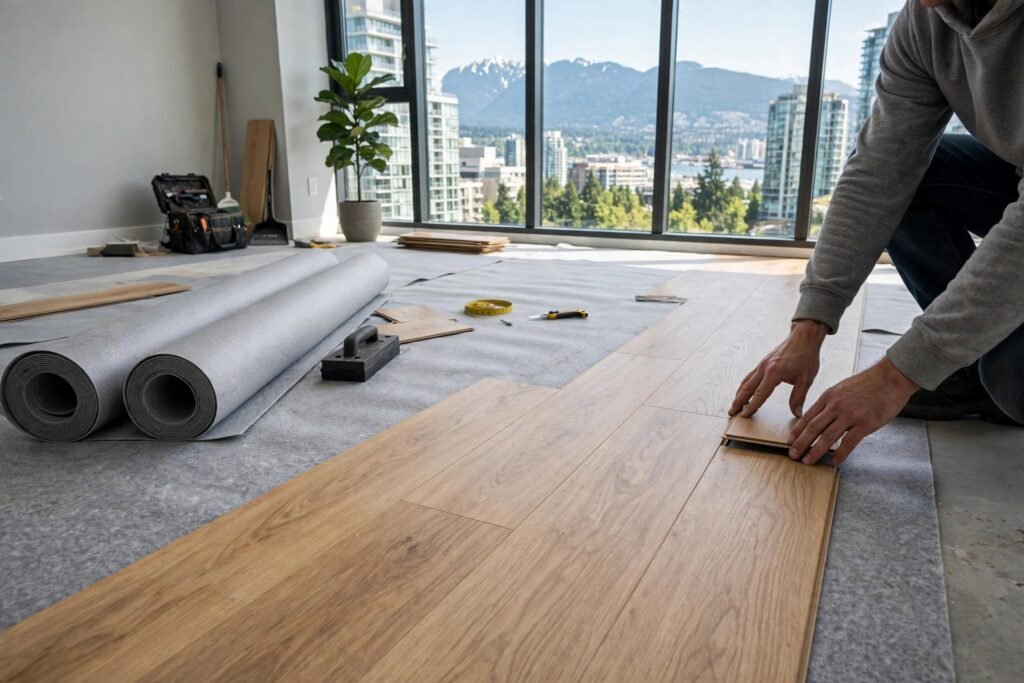
If there is a single renovation choice that causes more strata disputes than all others combined, it is flooring. Here is why: in a multi-unit building, your floor is someone else’s ceiling. Hard surface flooring — hardwood, laminate, tile, luxury vinyl — transmits impact noise (footsteps, dropped objects) far more than carpet, and your downstairs neighbour hears every bit of it.
Most BC stratas address this through bylaws or rules requiring:
- Minimum acoustic ratings for underlay — commonly expressed as IIC (Impact Insulation Class) and STC (Sound Transmission Class) values. A typical requirement is an underlay rated IIC 70+ / STC 70+, though thresholds vary by building.
- Approved product lists — some stratas only allow specific flooring products or underlay combinations that have been acoustically tested in their building type.
- Professional installation with acoustic underlay throughout, including closets and transitions — no cutting corners at the edges.
- Pre-approval of the exact product, with spec sheets submitted to council before purchase.
The expensive mistake looks like this: you install beautiful engineered hardwood throughout, the neighbour complains, the strata tests the noise, it fails the bylaw — and you are ordered to remediate at your own cost, which can mean ripping up a $10,000 floor. Never buy strata flooring before written council approval of the specific product and underlay. Get the acoustic specs in writing from your flooring supplier; reputable ones provide them routinely. Our flooring installation cost guide for BC covers what quality installation runs — and in a strata, the underlay line item is non-negotiable.
Carpet-to-hard-surface conversions draw the most scrutiny, because you are removing the building’s original acoustic treatment. Some stratas prohibit them entirely on upper floors. If yours allows it, expect the strictest version of the requirements above.
Renovating a Townhouse: Slightly Different, Same Gates
Abbotsford has a lot of townhouses — from the complexes along Whatcom Road to the newer developments in Auguston — and owners sometimes assume townhouses are “basically houses” for renovation purposes. Legally, they are usually still strata lots, and both gates still apply.
The practical differences: townhouse stratas often give owners more latitude over interiors (fewer shared walls, no one below you in an end unit), but the building envelope — roofing, exterior walls, windows, and anything affecting the look of the complex — is almost always strictly controlled. You generally cannot change your windows, front door colour, or deck railing without approval, even though they feel like “yours.” And anything involving the roof, foundation, or exterior drainage is common property: hands off without council sign-off.
Bare-land stratas (where you own the land too) are the exception that proves the rule — but most Abbotsford townhouse complexes are conventional stratas, so assume the full framework applies until your bylaws tell you otherwise.
Timelines: Plan for Both Queues
A realistic strata renovation timeline in Abbotsford:
| Phase | Typical Duration |
|---|---|
| Read bylaws, choose products, get contractor quotes | 2–4 weeks |
| Strata alteration request → council approval | 4–8 weeks (1–2 council cycles) |
| City permit application → issuance (if needed) | 3–6 weeks |
| Construction (kitchen, e.g.) | 4–8 weeks |
| Total | 3–6 months |
The two approval queues can run in parallel, which helps — but neither can be skipped, and construction cannot start until both are cleared. The most common delay is not bureaucracy; it is owners discovering the strata gate after booking a contractor, then scrambling. Read the bylaws first, and the whole thing moves at a civilized pace.
Frequently Asked Questions
Do I need strata approval to renovate my kitchen in BC?
Yes, if the work goes beyond cosmetic finishes. Under Standard Bylaw 5, alterations involving structure, plumbing, electrical, or exterior elements need the strata corporation’s written approval before work starts — and most stratas have additional specific requirements. A full kitchen remodel with plumbing and electrical changes definitely qualifies; repainting the cabinets probably does not. Check your registered bylaws.
Can my strata refuse my renovation?
They cannot unreasonably withhold approval, but they can set conditions. The strata may require you to sign an alteration agreement taking responsibility for related expenses, provide insurance and WorkSafeBC documentation, pay a damage deposit, or use specific products (especially flooring). If you believe a refusal is unreasonable, BC’s Civil Resolution Tribunal handles strata disputes — but most conflicts are avoided with a complete application.
What flooring can I install in a BC condo?
Only what your strata’s bylaws allow — get written approval for the specific product first. Most stratas require acoustic underlay meeting minimum IIC/STC ratings and pre-approval of the exact flooring product with spec sheets. Never install hard-surface flooring over carpet without council sign-off; failed noise compliance can mean ripping it out at your expense.
Do I need a City permit if my strata already approved?
Yes — they are separate approvals. Strata approval covers the corporation’s interests; the City of Abbotsford covers building code and safety. Plumbing, electrical, and structural work needs a City building permit regardless of what your council said. Start both processes early since each may ask about the other.
How long does strata renovation approval take in BC?
Plan on 4–8 weeks for council approval, since most councils meet monthly and may request clarifications. Add 3–6 weeks if a City permit is also needed (these can run in parallel). From first quote to finished renovation, three to six months is realistic for a kitchen or bathroom project.
What happens if I renovate without strata approval?
Stop-work orders and fines. The strata can order work halted, levy fines per contravention (amounts depend on your bylaws), and require you to restore the unit at your own cost. Unapproved alterations can also complicate a future sale — buyers’ lawyers and inspectors do ask about permits and approvals.
Renovate Right in Your Strata
Strata renovation is not harder than house renovation — it is just a different process with two gates instead of one. Owners who read their bylaws first, submit complete alteration packages, get flooring pre-approved in writing, and run the City permit in parallel have boring, uneventful projects. That is the goal.
If your plans include new floors, a kitchen refresh, or a bathroom update inside your condo or townhouse, work with a renovation team experienced with strata requirements — one that handles council paperwork, restricted hours, and elevator bookings as routine. The renovation itself is the easy part; the approvals are the craft.