
Luxury vinyl plank is the floor Fraser Valley homeowners ask about most — and the one with the widest gap between the price on the box and the price on the invoice. A plank can cost $2.50 or $7 a square foot, both boxes say “waterproof,” and they are not the same floor. This guide breaks down what vinyl plank actually costs installed in BC in 2026, explains the SPC versus WPC choice that decides how your floor feels and lasts, and covers the strata sound-rating rule that stops condo projects cold when owners learn about it too late.
The short version: in BC, expect $2.50–$7 per square foot for LVP materials and $2–$4 per square foot for professional installation — an all-in planning range of roughly $5–$10 per square foot, with most family homes landing in the $5–$8 band.
1. Vinyl Plank Costs at a Glance
| Product tier | Materials per sq ft | What you get |
|---|---|---|
| Budget SPC (big-box specials) | $2.50–$3.50 | Thin wear layer (6–12 mil), basic print quality, shorter warranties |
| Mid-range SPC / entry WPC | $3.50–$5.00 | 12–20 mil wear layer, attached pad, realistic wood texture |
| Premium WPC / high-end SPC | $5.00–$7.00 | 20 mil+ wear layer, embossed-in-register texture, wide/long planks |
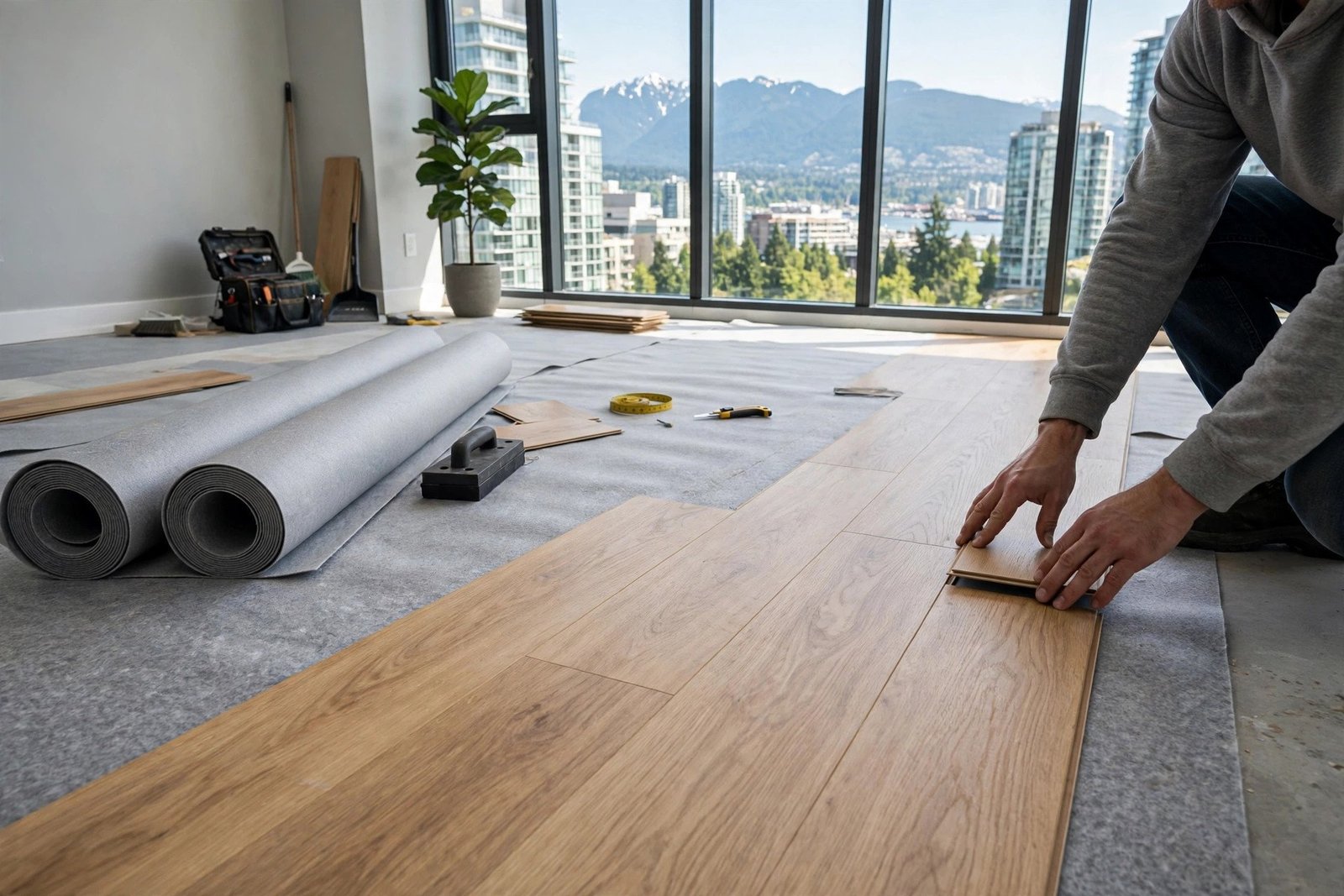
Labour in BC runs $2–$4 per square foot for click-lock floating installation, consistent with the labour table in our broader flooring installation cost guide. Extras that land on real invoices: old floor removal and disposal, subfloor levelling, transitions, and baseboard work. Say it’s an 800 sq ft main floor. Mid-range SPC, $4 materials, $3 labour. You’re planning on roughly $5,600 before extras. Keep a few hundred aside for those extras, too. They always show up.
2. SPC vs WPC: The Choice Inside Every Box
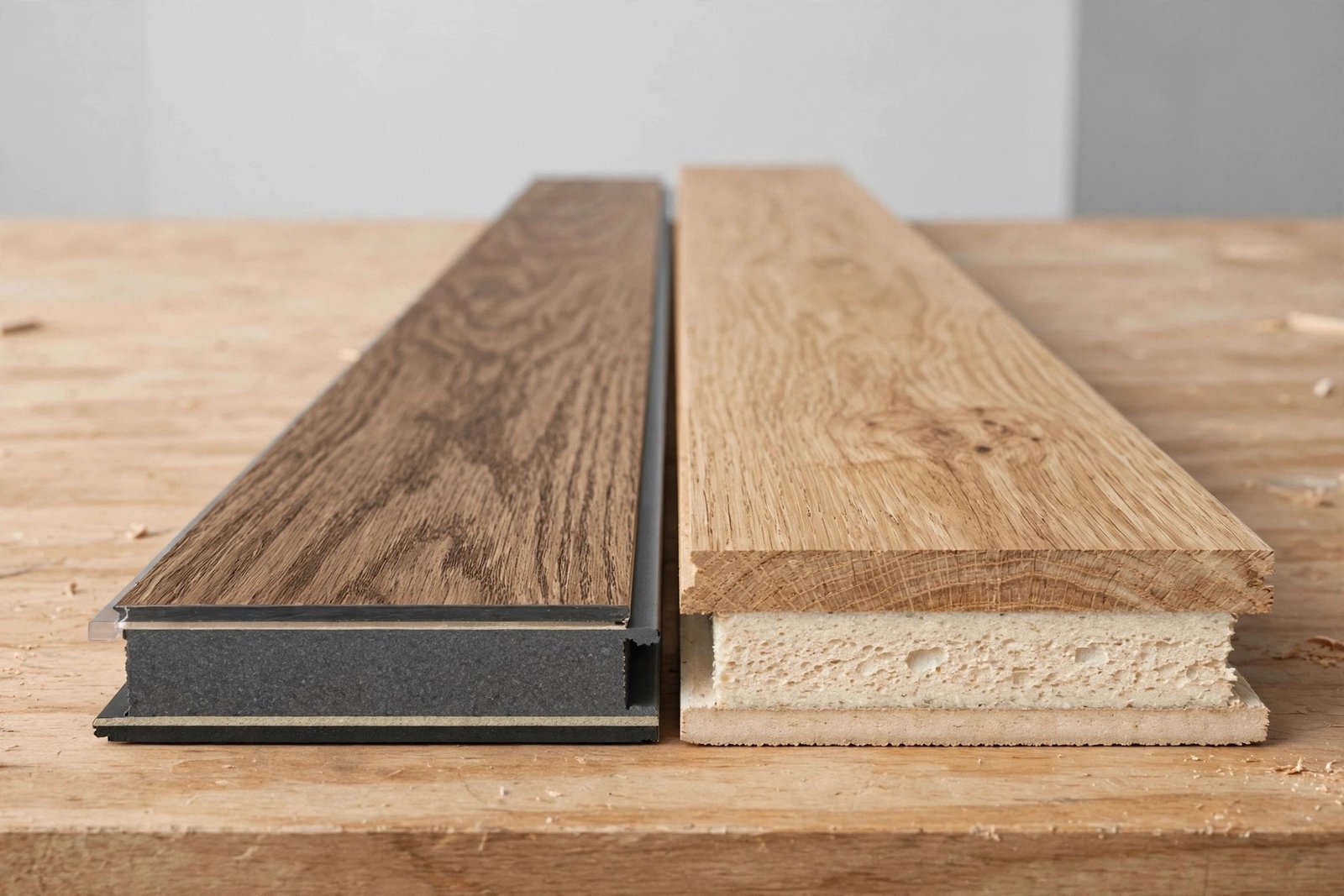
Both are rigid-core vinyl. The core recipe is the difference:
| SPC (stone plastic composite) | WPC (wood plastic composite) | |
|---|---|---|
| Core | Limestone powder and PVC — dense, hard, thin | PVC with wood flour and a foaming agent — thicker, cushioned |
| Feel underfoot | Firm, closer to tile; can feel cool | Softer and warmer; quieter to walk on |
| Dent resistance | Excellent — the choice for heavy furniture, rentals, commercial use | Good, but heavy items can leave dents |
| Water resistance | Fully waterproof core | Fully waterproof core (the “waterproof” claim is about the core, not the seams, on both) |
| Subfloor forgiveness | Low — telegraphs bumps and dips through the plank | Higher — thicker core bridges minor imperfections |
| Sound | Tends to sound hollow without a good pad | Naturally quieter |
| Price | Usually the cheaper of the two at equal wear layer | Typically $0.50–$1.50/sq ft more |
Rule of thumb for BC homes: SPC for basements, rentals, mudrooms, and anywhere heavy use or moisture rules — it is the default pick in our best flooring for BC basements guide. WPC goes the other way. Upstairs, mostly. Bedrooms, living areas, anywhere bare feet land and quiet counts for more than dent-proofing.
3. The Spec That Actually Matters: Wear Layer
Price differences within a tier come down to the wear layer — the clear protective coat on top of the printed design:
- 6–8 mil: light residential use only. A spare room? Fine. A family kitchen? That’s a false economy.
- 12 mil (0.3 mm): where most homes should start. Below this, you’re cutting the spec too fine.
- 20 mil (0.5 mm): the right spec for busy households, dogs, rentals, and commercial-adjacent use. This is the spec LVP’s reputation is built on. Not the thin stuff.
Check the overall plank thickness too (4–8 mm — thicker usually points to WPC, or a premium SPC). Is an underlay pad pre-attached? And the texture: is it embossed in register? That’s where the grain under your fingers lines up with the grain your eyes see. Get that right and a floor reads as wood. Miss it and the same floor reads as plastic. Installation beats spec, by the way. A 12-mil plank laid properly will outlast a 20-mil plank floating over a wavy subfloor. Every time. So level first. Spend on upgrades after.
4. Condos and Townhomes: The Strata Sound Rule
This section saves projects. Most BC stratas regulate hard-surface flooring because footsteps travel. Before you buy anything, get your strata’s flooring rules in writing. Typical requirements:
- Written strata approval for replacing carpet with hard flooring — often required before installation, sometimes with the product spec submitted.
- A minimum sound rating for the floor assembly, commonly expressed as IIC (Impact Insulation Class) or FIIC in the mid-50s or higher for the tested assembly, sometimes alongside an STC requirement. The rating belongs to the assembly — plank plus underlay plus the structure below — not the plank alone. That “IIC 72” on the box? Tested on a concrete high-rise slab. Put the same product in a wood-frame building and it performs very differently. Your strata knows this, even if the brochure hopes you don’t.
- Underlay minimums. Many stratas specify an acoustic underlay regardless of attached pads. Acoustic membranes run roughly $0.50–$1.50 per square foot on top of the plank price.
The strictest cases are wood-frame low-rises. Some stratas there won’t allow hard flooring in bedrooms at all. Full stop. None of this is a reason to avoid LVP in a condo — it is a reason to read the bylaws before the flooring is in your garage. Noise complaints after the fact are how owners end up paying to remove a new floor. (If you are flooring a suite where you control the building, our basement suite soundproofing guide covers the ceiling side of the same problem.)
5. Where Vinyl Plank Loses — Honest Trade-Offs
- It cannot be refinished. Wear layer worn through? The floor’s done. It gets replaced, not rescued. Mind you, wearing through takes a while. A 20-mil layer in a normal home needs decades. A 6-mil layer in a rental kitchen? Tired inside five years, sometimes.
- It telegraphs the subfloor. Especially SPC. Dips and ridges show through and stress click joints; levelling is not optional.
- Heat and sun. Leave a budget product sitting in direct sun, the strong stuff that pours through south-facing glass, and it can expand. Fade, too. Quality SPC? BC interiors don’t bother it. But a dark floor behind floor-to-ceiling glass is a different conversation. Have it with the supplier, and ask about temperature ratings specifically.
- It is not a value-add like hardwood. People buy LVP for durability and cost. Buyers know that. They price it accordingly. Put it in a high-end home and nobody’s fooled, either. It reads as practical. Because it is.
Frequently Asked Questions
How much does vinyl plank flooring cost installed in BC?
Plan on $5–$10 per square foot all-in in 2026 — materials at $2.50–$7 plus installation labour at $2–$4. Most Fraser Valley homes using mid-range SPC land around $5–$8 per square foot before extras like old-floor removal, levelling, and baseboards.
Which is better, SPC or WPC vinyl plank?
SPC for hard use, WPC for comfort. SPC’s limestone core is denser, thinner, more dent-resistant, and usually cheaper — the pick for basements, rentals, and busy family traffic. WPC is thicker, warmer, and quieter underfoot — the pick for bedrooms and living rooms. Both cores are waterproof; choose by room, not by marketing.
What wear layer should I buy?
12 mil (0.3 mm) is the sensible minimum for most homes; 20 mil (0.5 mm) for homes with dogs, kids in sports cleats, or rental use. Below 12 mil, the price saving is small and the lifespan penalty is real. Wear layer matters more to how long the floor looks good than any other single spec.
Can I put vinyl plank in a BC condo?
Usually yes — with strata approval and the right sound assembly. Written approval is the norm at most stratas. So is a minimum IIC/FIIC rating for the whole floor assembly. Attached pads don’t get you out of it, either. The rating often still means an acoustic underlay underneath. So check the bylaws first. Get the approval in writing, before you order a single box. Wood-frame buildings? Strictest rules of the lot.
Is vinyl plank good for Fraser Valley basements?
It is the best budget-friendly basement floor we recommend. The waterproof core ignores the slab moisture that ruins laminate and threatens hardwood, and SPC’s rigidity suits below-grade use. The full reasoning is in our best flooring for BC basements guide — the short version: keep the slab dry first, because no floor fixes a water problem.
Can vinyl plank go over my existing floor?
Often, yes. Click-lock LVP floats. Over one layer of existing vinyl or tile it works, provided that layer is sound, flat, and bonded down tight. Skipping the removal saves real money. Carpet always comes out, and anything loose, cushioned, or uneven comes out too. Height at doorways and appliances is the usual limiting factor — your installer should confirm in person.
Buy the Spec, Not the Sale Price
Vinyl plank rewards buyers who read three numbers — wear layer in mils, plank thickness, and the sound rating of the full assembly — and punishes buyers who shop on the box price alone. In the Fraser Valley, mid-range SPC with a 20-mil wear layer, installed over a properly levelled subfloor, is the combination that keeps showing up in homes that still look good ten years later.
Strata rules and sound-rating minimums are set by each building — confirm your strata’s current requirements before purchasing.