
Basements in BC live a harder life than any other floor in the house. The Fraser Valley gets months of rain. Concrete slabs wick moisture upward. Sump pumps, weeping tiles, and the occasional overwhelmed foundation drain are facts of life from Abbotsford to Chilliwack. And when a floor fails in a basement, it fails ugly — buckling, mould, that unmistakable musty smell.
So basement flooring isn’t really a style decision first. It’s a moisture decision first, and a style decision second. Here’s how the seven realistic options rank for BC basements — by moisture tolerance, comfort, cost, and how they actually hold up in Fraser Valley homes.
Disclaimer: All prices in this guide are 2026 market ranges for the Abbotsford and Fraser Valley area, based on published local market data. Labour rates shown are typical BC ranges; your final cost depends on square footage, subfloor condition, and material grade.
The Golden Rule of Basement Flooring in BC
Before the rankings: no flooring survives a wet basement. If you have active water intrusion — seepage through cracks, efflorescence on the walls, a floor drain that backs up — fix the water first. Exterior drainage, crack repair, a sump pump: that’s the project. Lay flooring over a moisture problem that’s still there and all you’ve done is schedule the redo. It’ll cost more the second time.
Get the basement dry first. Or dry-ish, which, if we’re honest, is where a lot of Fraser Valley basements actually land. Then it comes down to one thing. Concrete slabs always carry some ambient moisture. Which floors can live with that? That’s what the ranking below measures.
The 7 Options, Ranked
1. Luxury Vinyl Plank (LVP) — the best all-rounder
LVP is the default recommendation for BC basements, and it’s not close. It’s 100% waterproof (not water-resistant — waterproof), warm underfoot compared to tile, convincing as wood, and reasonably priced.
- Moisture tolerance: Excellent — waterproof core, unaffected by slab moisture or minor spills
- Comfort: Good — warmer and softer than tile or concrete
- 2026 installed cost: roughly $4–$8/sq ft all-in (materials $2–$4 plus $2–$4/sq ft labour)
- Lifespan in a basement: 15–25 years
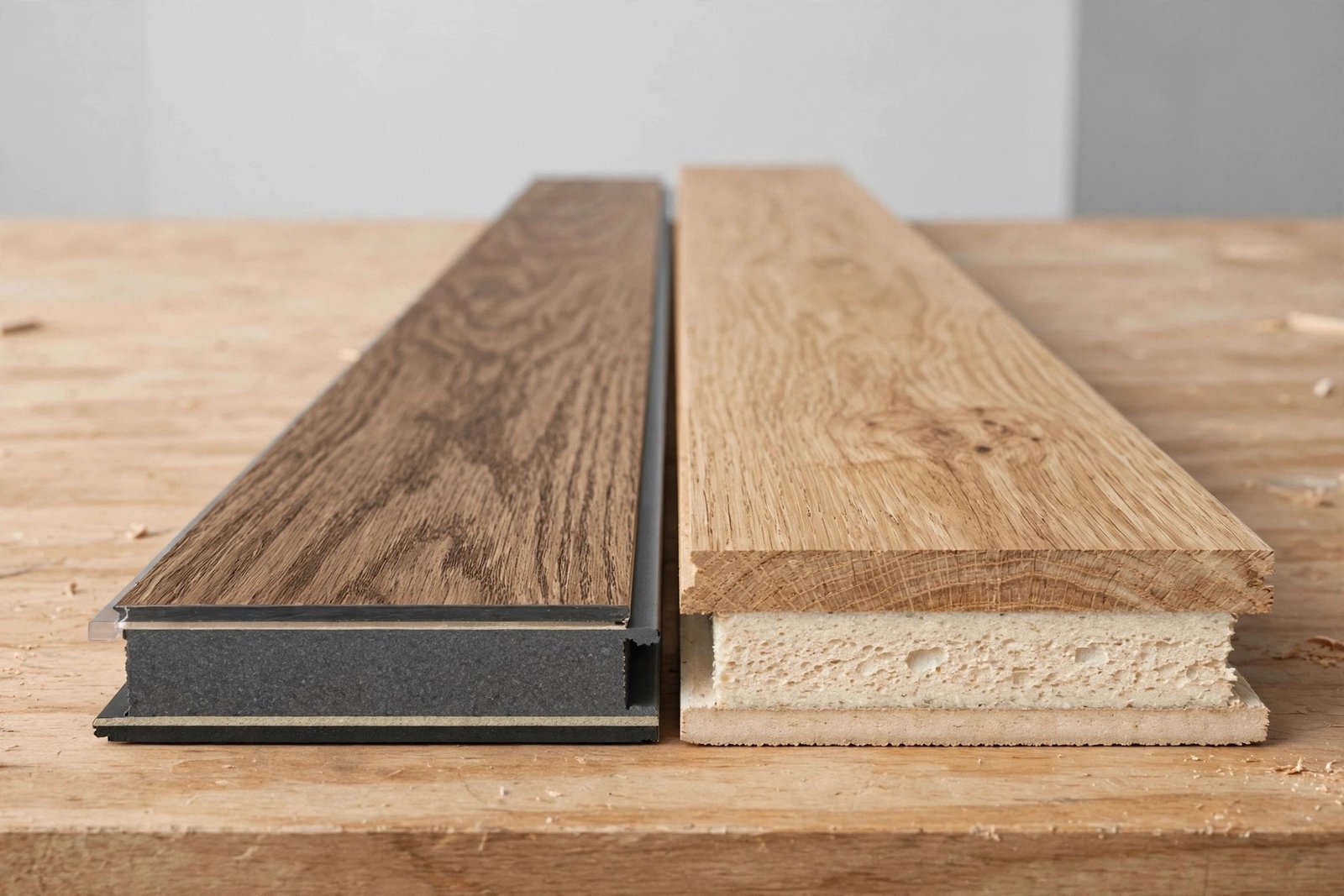
Rigid-core SPC (stone plastic composite) is the basement pick. Concrete shifts moisture and temperature around, and SPC barely reacts. Flexible LVP reacts more. Under it, non-negotiable: a proper moisture-barrier underlayment. Or a product whose attached pad is rated for concrete slabs. One of the two, every time. Legal suite going in? LVP again, near-universally. It shrugs off tenants. It’s durable. And suites finished in it rent well.
The catch: cheap LVP with a thin wear layer (under 12 mil) will show wear in high-traffic areas. Spend the extra dollar per square foot on a 20-mil wear layer. You’ll never regret it.
2. Porcelain/Ceramic Tile — the most bulletproof
If moisture tolerance is the only criterion, tile wins outright. Porcelain doesn’t absorb water, doesn’t mould, doesn’t care about floods. A tiled basement floor can be mopped, hosed, and forgotten.
- Moisture tolerance: Perfect — impervious to water
- Comfort: Poor — cold and hard underfoot (a real consideration in a BC winter)
- 2026 installed cost: roughly $10–$20/sq ft all-in (tile labour alone runs $8–$15/sq ft in BC, plus materials)
- Lifespan: Decades — essentially permanent
The comfort problem is solvable: in-floor radiant heating under tile transforms a basement. It’s a meaningful add-on ($8–$15/sq ft for electric mat systems), but a heated tile floor in a basement bathroom is genuine luxury. Without it, tile in a main living space feels institutional in January.
Best for: basement bathrooms, laundry rooms, entries — anywhere water is a certainty rather than a possibility.
3. Engineered Hardwood — beautiful, with conditions
Real wood veneer over a stable plywood core. It handles moisture better than solid hardwood does. The cross-ply construction helps. Cupping and gapping, the two things that kill solid wood in basements, get resisted rather than invited. Still wood, though. And wood plus moisture never becomes a solved problem down here. You manage the risk. That’s all.
- Moisture tolerance: Moderate — tolerates ambient humidity; not floods or sustained damp
- Comfort: Excellent — warm, natural, the nicest feel of anything on this list
- 2026 installed cost: roughly $8–$14/sq ft all-in (materials $6–$10 plus $2–$4.50/sq ft labour)
- Lifespan in a basement: 15–30 years if moisture stays controlled
Only consider engineered hardwood if: the moisture barrier goes in properly, a dehumidifier runs down there, and the basement is genuinely dry to start with. No history of seepage. None. In a Fraser Valley basement with any moisture history, this is a gamble. A beautiful gamble — but a gamble.
4. Polished/Stained Concrete — the honest industrial option
Look down. There’s already a floor in your basement. The slab. Polish it, stain it, coat it with epoxy, and the moisture problem never really gets a vote. Nothing moisture-sensitive goes down. There’s nothing down there for damp to ruin.
- Moisture tolerance: Excellent — nothing to rot, swell, or mould
- Comfort: Fair — hard and cool, though area rugs fix a lot
- 2026 installed cost: roughly $4–$10/sq ft for polish or epoxy (stained concrete less; decorative epoxy more)
- Lifespan: Decades with minimal maintenance
Epoxy coatings in particular have come a long way — metallic and flake finishes look sharp in rec rooms and home gyms. The downside is feel: it’s a hard surface, and in a living space it can read as cold. But for workshops and gyms, concrete is brutally practical.
5. Laminate — acceptable with caveats
Laminate has improved — some products now carry water-resistant (note: resistant, not proof) ratings. The core, though. Still wood fibre. And wood fibre that sits in moisture swells. At the seams, every time. Which is what laminate is in a BC basement. A compromise.
- Moisture tolerance: Fair — handles humidity; fails at standing water or wicking slab moisture
- Comfort: Good — warm underfoot, wood look
- 2026 installed cost: roughly $4–$7/sq ft all-in (materials $2–$4 plus $1.75–$3/sq ft labour)
- Lifespan in a basement: 8–15 years, moisture permitting
Only if: you put down a quality vapour barrier, the product carries a water-resistant rating, and the basement itself is dry. Really dry. Even then, LVP costs only slightly more and removes the risk entirely — which is why most Fraser Valley installers will steer you to vinyl for below-grade spaces.
6. Carpet (with the right setup) — comfort at a price
Wall-to-wall carpet in a basement is the comfort king and the moisture pauper. Modern basement carpet systems are a different animal, though. Synthetic fibres. Moisture-barrier padding. A dry slab underneath. Compare that to the mildewed berber that lined 1990s Fraser Valley rec rooms and it isn’t close.
- Moisture tolerance: Poor to fair — synthetic carpet dries; the pad and slab interface is the risk
- Comfort: Excellent — nothing beats carpet underfoot
- 2026 installed cost: roughly $4–$8/sq ft all-in installed
- Lifespan in a basement: 8–12 years
Consider it for: bedrooms. Dry-basement bedrooms, where comfort is the whole point. Go 100% synthetic fibre (nylon or polyester). Pad it with a moisture barrier underneath. And keep a dehumidifier running. Carpet tiles are worth a look too — if one section gets wet, you replace tiles, not the room.
7. Solid Hardwood — don’t do it
It makes this list for one reason only, completeness: solid hardwood has no business in a BC basement. The humidity down there swings with the seasons. Every Fraser Valley basement gets it. Solid hardwood answers by expanding. Then cupping. Then gapping. And the manufacturers know it. Install below grade and the warranty is void. Every flooring installer in the Lower Mainland will tell you the same thing. If you want the wood look below grade, that’s what engineered hardwood and LVP are for.
Side-by-Side Comparison
| Rank | Flooring | Moisture tolerance | 2026 installed cost (per sq ft) | Best basement use |
|---|---|---|---|---|
| 1 | LVP (rigid core) | Waterproof | $4–$8 | Living areas, suites, whole basement |
| 2 | Porcelain/ceramic tile | Impervious | $10–$20 | Bathrooms, laundry, entries |
| 3 | Engineered hardwood | Moderate | $8–$14 | Dry basements only |
| 4 | Polished/epoxy concrete | Excellent | $4–$10 | Gyms, workshops, rec rooms |
| 5 | Laminate (water-resistant) | Fair | $4–$7 | Dry basements, budget option |
| 6 | Carpet (synthetic) | Poor–fair | $4–$8 | Bedrooms in dry basements |
| 7 | Solid hardwood | Poor | $10–$16+ | Not recommended below grade |
Installation Realities for Fraser Valley Basements
The flooring choice isn’t the whole job, though. These next points matter just as much. More, in some basements:
- Moisture testing first. A calcium chloride or relative-humidity test on the slab ($100–$200, or often free with a flooring quote) tells you what you’re dealing with. Skip it and you’re guessing.
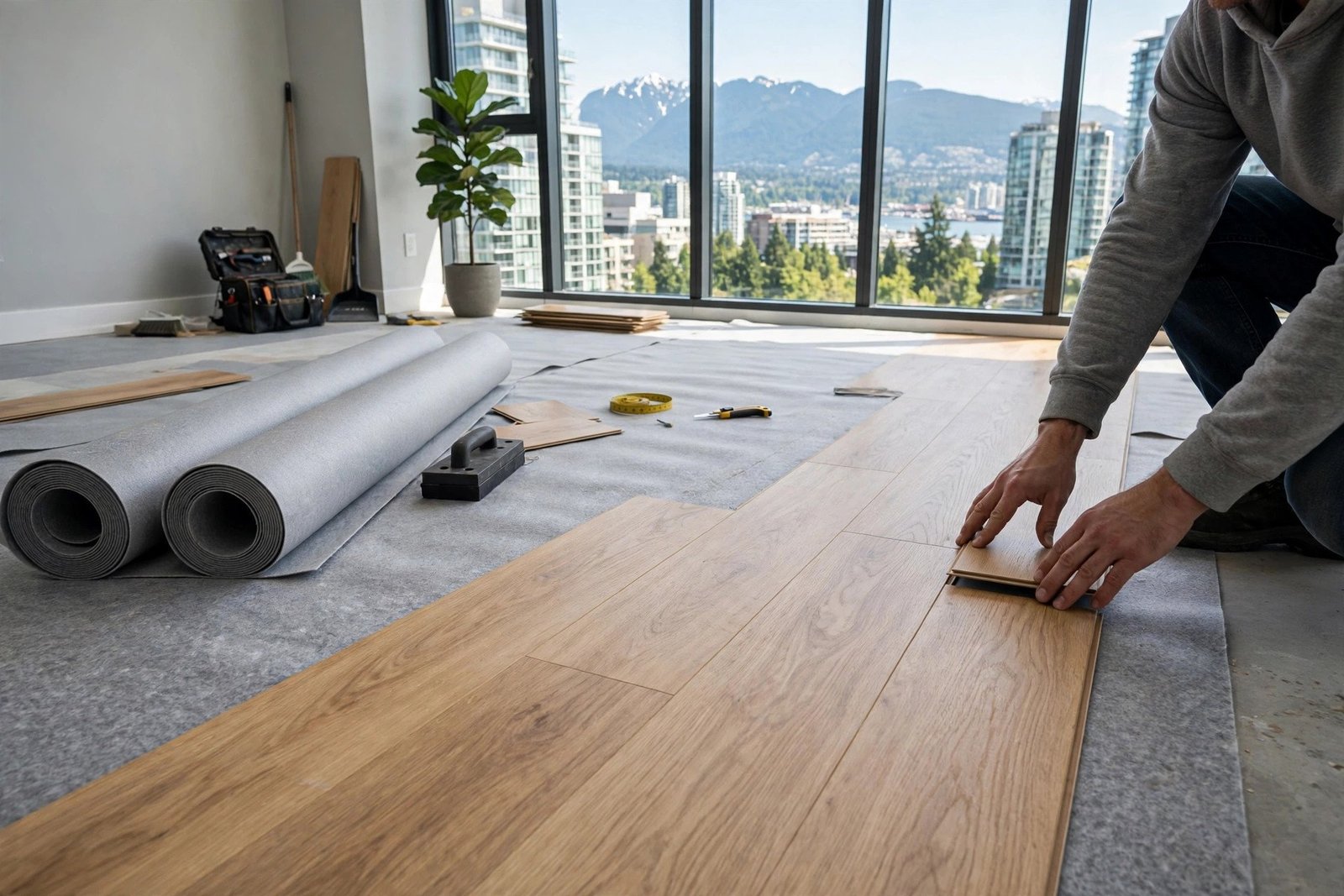
- Vapour barrier, always. Every floating floor in a BC basement needs a proper moisture-barrier underlayment over concrete. This is non-negotiable and costs very little.
- Subfloor systems. Products like dimpled membrane subfloors (which create an air gap above the slab) add $1.50–$3/sq ft but dramatically improve both moisture management and warmth. Worth it for living spaces.
- Dehumidification. A basement dehumidifier ($250–$400 for a good unit) is the cheapest insurance for any basement floor. Fraser Valley summer humidity plus a cool slab equals condensation — the dehumidifier breaks that cycle.
- Floor height. Everything you add under the floor lifts it. Subfloor membranes and underlayment, ½” to 1″+ by the time you’re done. Tight ceiling down there? Plan around that lift before you order anything.
What About a Legal Basement Suite?
Rental suite changes the math. Now the floor has two enemies. Moisture, sure. But tenants too, and it has to survive both. The standard Fraser Valley spec is rigid-core LVP throughout the living areas with tile in the bathroom — waterproof, durable, and easy to clean between tenants.
Basement Flooring FAQs — BC (2026)
What is the best flooring for a basement in BC?
Rigid-core luxury vinyl plank (LVP). For most BC basements it’s the best all-round answer going. Fully waterproof. Warm underfoot, too, and it lands at $4–$8/sq ft installed. Porcelain tile beats everything on moisture. Nothing gets through it. But it’s cold unless you add in-floor heating, which is why it suits basement bathrooms best.
Can you put laminate flooring in a basement?
It’s risky in the Fraser Valley. Standard laminate’s wood-fibre core swells with moisture. Water-resistant laminate over a vapour barrier works in genuinely dry basements, but LVP costs only slightly more and is fully waterproof — most local installers recommend vinyl below grade.
Is vinyl plank flooring good for basements?
Yes — it’s the top recommendation. SPC rigid-core LVP doesn’t care about water. It also holds its dimensions over concrete, and the ambient slab moisture you get in BC basements? Routine for it. Spec it right, though: a 20-mil wear layer, and a product actually rated for below-grade installation.
How much does basement flooring cost in Abbotsford?
Rough installed numbers for 2026. LVP runs $4–$8/sq ft. Laminate, $4–$7. Carpet sits at $4–$8, polished or epoxy concrete at $4–$10. Engineered hardwood costs more, $8–$14, and tile tops the list at $10–$20. Do the math on a 600 sq ft basement in LVP and you’re around $2,400–$4,800 for the flooring.
Do I need a moisture barrier under basement flooring?
Yes, always. Every floating floor installed over a concrete basement slab in BC needs a moisture-barrier underlayment at minimum. For living spaces, a dimpled membrane subfloor system ($1.50–$3/sq ft) adds an air gap that further protects against slab moisture and improves warmth.
What’s the warmest basement flooring option?
Carpet is warmest underfoot, followed by engineered hardwood and LVP. Tile is the coldest — but paired with electric in-floor heating ($8–$15/sq ft), a tiled basement bathroom becomes the warmest-feeling room in the house.
Planning a Basement Project?
Flooring is one piece of a finished basement — and in the Fraser Valley, the moisture strategy underneath it matters as much as the surface itself. Get the slab, drainage, and vapour management right, and any of the top-ranked options here will serve you for decades.
If you’re finishing or renovating a basement, take a look at our basement finishing services in Abbotsford to see what’s involved in a complete below-grade build — and our flooring installation services for the finished surface. The right floor on the wrong prep is money wasted; the right prep makes even a mid-range floor last.
Reminder: Prices in this guide are 2026 Abbotsford/Fraser Valley market ranges for planning purposes, not a quote. Subfloor condition, moisture levels, and material grade all affect final cost. For an accurate figure, get itemized written quotes from local flooring installers based on moisture testing of your slab.
5 Responses