
Most of us picture aging in place as something for “later.” Then a parent visits and struggles with the tub, or a knee surgery turns the bathroom into an obstacle course, and suddenly later is now.
The bathroom is where aging-in-place planning matters most. Smallest room in the house. Also the most dangerous one. Wet surfaces everywhere. Hard edges. Tight spaces. And fixtures designed for able-bodied twenty-somethings. Abbotsford’s housing stock dates mostly to the 1970s through 90s, and bathrooms from that era got zero thought for accessibility. High tub walls. Slippery fibreglass surrounds. Toilets at an awkward height. Doorways a walker can’t fit through.
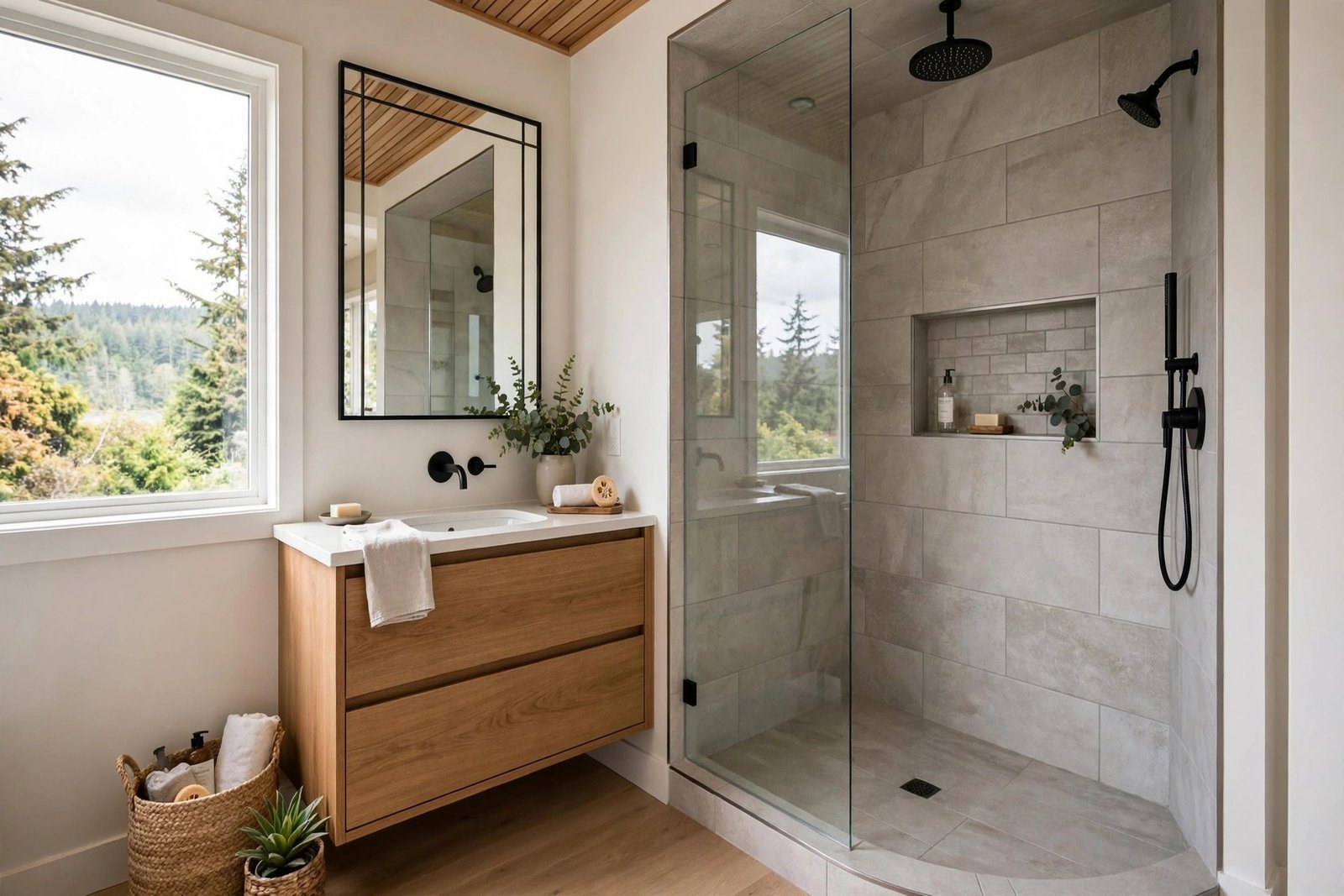
The good news? None of this has to look institutional. The best accessible bathrooms just look like beautiful modern bathrooms. The design principles overlap that much. A curbless shower. Good lighting. A thoughtful layout. Good design, full stop — it simply happens to keep you safe too.
Start With the Shower: Go Curbless
Start with the step into the shower. Eliminate it. That one change does more than anything else in this article. Tub walls are trip hazards. So are raised shower curbs. And stepping over either one — wet feet, limited mobility — is exactly how falls happen.
A curbless (barrier-free) shower has no threshold. None. The bathroom floor runs straight into the shower area and slopes gently toward the drain. Walk in. Roll in. Either way works. Add a fold-down bench, put a handheld showerhead on a slide bar, and the same shower serves everyone. Grandparent to grandchild.
Building one properly? Skilled work. The floor needs precise sloping — typically about 2% toward the drain. A continuous waterproofing membrane goes under the tile. And the shower base often needs structural preparation to recess it. Nothing cosmetic about any of this. It’s plumbing. Waterproofing. Tile work. All of it has to be right, because a failed curbless shower doesn’t drip politely. It leaks straight into the subfloor.
2026 planning ranges in Metro Vancouver: a properly built curbless shower runs $14,000–$22,000 as part of a bathroom renovation, more with a linear drain or frameless glass. A standard curbed walk-in shower is less ($8,000–$14,000) but keeps the threshold you’re trying to eliminate.
If you’re weighing the shower-versus-tub question more broadly — including what each means for resale — our walk-in shower vs bathtub guide breaks down the tradeoffs.
Grab Bars: Small Addition, Enormous Difference
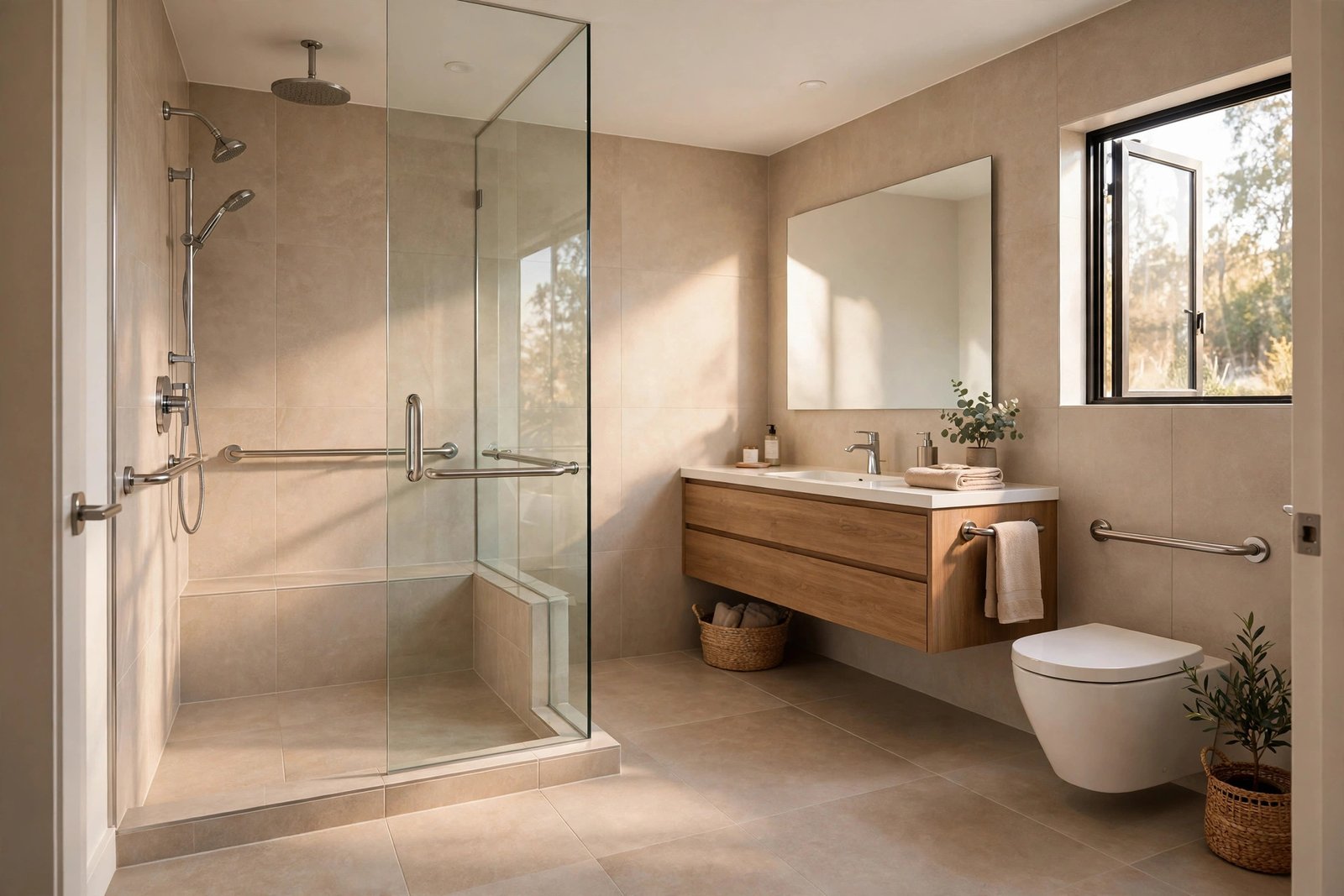
Grab bars are the cheapest high-impact upgrade in any bathroom. Also the most commonly botched. A towel bar? Not a grab bar. A suction-cup handle? Not a grab bar either. The real thing anchors into wall studs or solid blocking. It’s rated to support body weight. Nothing less counts.
Where they go:
- Beside the toilet — vertical or angled bar for push-up assistance
- In the shower — horizontal bar at about 33–36 inches high for entry, plus a vertical bar near the entrance
- Beside the tub (if keeping one) — for the step-over
What they cost: a few hundred dollars installed when blocking is already in the wall. More if the walls need opening to add reinforcement. So during any bathroom renovation, have your contractor add solid wood blocking inside the walls at grab-bar locations. Even if you’re not installing the bars yet. Think of it as cheap insurance. Future installation becomes a 30-minute job instead of a wall-opening project. “Blocking now, bars later.” It’s one of the smartest aging-in-place moves there is.
Worried about the institutional chrome look? Forget it. Today’s grab bars come in matte black. Brushed brass. Designs that read as towel bars — right up until the moment you grab one.
Comfort-Height Toilets and the Details Around Them
A standard toilet sits about 15 inches off the floor. A comfort-height (chair-height) toilet sits at 17–19 inches. Roughly chair height. That difference sounds small. Your knees and hips will disagree — sitting down and standing up get dramatically easier. And the swap itself runs $300–$600. It pays off every single day.
While you’re at it:
- Lever handles over knobs. Door levers, faucet levers, and shower controls operable with a closed fist or elbow. Arthritis makes knobs genuinely painful. Levers cost little more. Switch anyway.
- Bidet seats. A $400–$1,000 add-on that improves hygiene independence. Bring it up honestly with aging parents. It’s about dignity. Convenience is only half of it.
- Clearance. You need room. Room to manoeuvre. A wheelchair needs about 60 inches of turning space. And even without one, don’t cram fixtures so tight that a walker can’t pass.
Walk-In Tubs vs Curbless Showers: An Honest Comparison
Almost every family asks this question. Usually with a specific parent in mind. Both options have real merits. Both have drawbacks too — the kind nobody mentions in the brochures.
| Walk-In Tub | Curbless Shower | |
|---|---|---|
| Entry | Door opens; step over a low threshold (a few inches) | Zero threshold; walk or roll straight in |
| Best for | People who love soaking and can sit upright safely | Anyone with balance, mobility, or wheelchair needs |
| The catch | You sit waiting while it fills, then waiting while it drains — in cooling water | Needs skilled waterproofing and floor prep; higher build cost |
| Typical cost | $3,000–$8,000 for the tub plus installation | $14,000–$22,000 built as part of a reno |
| Resale | Niche appeal; some buyers see it as a limitation | Broad appeal; reads as a modern luxury shower |
| Water use | High — large volume per bath | Normal shower usage |
The honest answer? For most aging-in-place situations, the curbless shower wins. It serves the widest range of mobility needs. It never traps you in a cooling tub. Future buyers like it too. Walk-in tubs suit a narrower case. Someone who specifically wants therapeutic soaking. Someone with the patience — and the hot water capacity — for the fill-and-drain cycle.
Flooring: Non-Slip Is Non-Negotiable
Bathroom falls happen on wet floors. So treat the floor as safety equipment. What to look for:
- Slip resistance rating. Tile carries a DCOF rating (dynamic coefficient of friction). For wet areas, look for 0.42 or higher. Smaller tiles help too. More grout lines. More grip. Large polished slabs are the worst of it.
- Matte over polished. That glossy marble-look tile? Beautiful. Treacherous when wet. Matte and textured finishes are the choice here. Every time.
- Heated floors. Comfort is only part of it. Radiant heat dries the floor faster after showers. The wet-floor window shrinks. It adds roughly $1,500–$3,000 to a typical bathroom. Worth considering in a BC winter. Genuinely.
- No rugs as a safety plan. A loose bath mat on tile is itself a trip hazard. If you use mats, they need rubber backing and they need to lie perfectly flat.
Our basement flooring guide covers moisture-proof flooring principles that apply equally to bathrooms — the physics of wet floors doesn’t change between rooms.
Lighting: The Overlooked Safety Feature
Vision changes with age. We need more light to see the same detail. Glare bothers us more too. Bathroom lighting for aging in place means:
- Bright, even, shadow-free light. One overhead fixture won’t do it. It throws shadows exactly where you need to see. Layer the light instead. Overhead, plus vanity lighting at face height. Both sides of the mirror.
- Motion-sensor night lights. The 3 a.m. bathroom trip? A fall waiting to happen. A low motion-activated light fixes it. Hallway and bathroom both. Under $50, and nobody fumbles for a switch in the dark again.
- Rocker or motion-sensor switches. Easier on arthritic hands than toggles. Much easier. And place them with care. Reachable from a seated position. Reachable from the doorway.
- No harsh glare. Frosted fixtures beat bare bulbs. Indirect light beats both. Especially over glossy tile.
What an Aging-in-Place Bathroom Costs in Abbotsford
How far you go sets the bill. Abbotsford-area planning ranges for 2026:
- Grab bars + raised toilet + lever handles + night lighting: $1,000–$3,000 — meaningful safety gains without a renovation
- Tub-to-shower conversion (curbed): $8,000–$14,000
- Full accessible bathroom with curbless shower: $25,000–$45,000
- High-end accessible ensuite (larger space, premium finishes): $45,000–$65,000+
These overlap heavily with standard bathroom renovation costs in Abbotsford — because a well-designed accessible bathroom is a well-designed bathroom. The accessibility premium? Mostly details. Blocking. Curbless construction. Better fixtures. Not a separate project at all.
A note on timing. A full bathroom renovation takes 2–4 weeks of construction once permits are sorted. Renovation is for a parent with an urgent need? Don’t wait for it. The small upgrades can happen this weekend. Grab bars. A raised toilet. A handheld showerhead. Night lights. Plan the bigger work while those are already helping.
Every figure here is a 2026 planning range. Not a quote. Accessibility work involves plumbing and electrical changes, and those need proper permits and licensed trades. Get written estimates.
Frequently Asked Questions
What’s the most important aging-in-place bathroom upgrade?
The shower entry. Lose the tub wall. Lose the shower curb. You’ve removed the single biggest fall hazard in the bathroom. A curbless shower handles the highest-risk daily activity there is — add a bench and a handheld showerhead and it handles it well. Grab bars are the close second — cheap, fast, and effective everywhere else in the room.
Will an accessible bathroom hurt my home’s resale value?
Done well, it helps. Most buyers read a curbless shower as a modern upgrade. Same with a comfort-height toilet. Same with good lighting. None of it screams “accessible.” What hurts resale is the institutional look. Plastic grab bars screwed into tile as an afterthought. A bathroom built for one narrow need and nothing else. Design a beautiful bathroom first. The accessibility disappears into it.
Can I just add grab bars without renovating?
Yes — and you should. Anchor the grab bars into studs. Swap in a raised toilet seat, or a comfort-height toilet. Add a handheld showerhead. Lever-handle faucets. Motion-sensor night lights. Together they transform bathroom safety for $1,000–$3,000 — without touching the walls. Then, during any future renovation, add blocking inside the walls. More bars can follow later.
Are walk-in tubs covered by any BC rebates or programs?
Sometimes, partially. BC has run various home accessibility programs over the years. Eligibility changes. Funding changes. So check the current status of provincial healthy-aging and home-modification programs before you budget. But don’t count on rebates to fund the project. Budget as if you’re paying full cost. Any rebate that lands is a bonus.
How wide should a bathroom doorway be for a wheelchair?
Aim for a 32-inch clear opening at minimum. 36 inches is better. Standard interior doors are often 28–30 inches. Too narrow. Widening a doorway during a renovation is straightforward work — if the wall is non-load-bearing. Pocket doors are another good option. No swing into the room. No full renovation in the plan? Offset hinges can add about 2 inches of clearance. Cheaply.
Should I keep a tub for resale if I go curbless?
In most Abbotsford family homes, one tub somewhere in the house is enough. Kids’ bathroom still has a tub? The ensuite does? Then converting the main bath to a curbless shower is a safe move. One-bathroom home, though — think harder. Some buyers with small children want a tub. Our shower vs bathtub resale analysis digs into this tradeoff in detail.
Build a Bathroom That Works for Every Age
The best time to plan an aging-in-place bathroom? Before you desperately need one. Blocking added during a planned renovation costs almost nothing. A curbless shower chosen because it’s beautiful. Lever handles picked because they’re comfortable. Easy decisions now. Expensive retrofits later.
If a bathroom renovation is on your horizon, look at our bathroom renovation services. Accessible design is part of every project there. Not an add-on. Good design from the start. Your future self will thank you.
Cost figures in this article are 2026 planning ranges for the Abbotsford/Metro Vancouver area based on published contractor data, not quotes. Accessibility renovations involve plumbing and electrical work requiring permits and licensed trades.