
Why the Smallest Room Produces Such Serious Quotes
From the doorway? Looks easy enough. Small room. Nothing to it, you’d think. Five steps across. One window, maybe. Then the quote lands. And it stings. It’s way out of line with the floor area, or it feels that way, at least until you actually count what’s crammed into that little room.
Plumbing lives here. Tile lives here. Electrical’s in here too. So’s ventilation. Waterproofing, moisture-resistant finishes, the lot, and they’ll punish a shortcut. Every one of them. Fast. A full renovation here in Abbotsford? You’re typically looking at $14,000–$32,000 in 2026. Most jobs land at $20,000. That’s the common number. Just a cosmetic refresh costs less. Leave the plumbing alone. Keep the tub. Then you’re starting from around $8,000.
That spread is not random. Here’s why. The drivers below explain it. Roughly, anyway. They hit your budget in about that order too.
Driver One: Labour in a Room With No Room to Spare
Labour leads a bathroom budget, and the gap is wide. In a space of about 40 square feet, a plumber, a tile setter and an electrician each do slow, precise work in turn, often in the same few square feet on successive days.
Tile setting shows the point clearly. It is measured in days, not hours. Cuts have to line up. Falls to the drain have to work. Waterproofing first. Always. It’s got to be right before a single visible tile goes on, because a leaking shower isn’t just a slightly worse version of a good one. It fails out of sight. Behind the wall. You won’t see a thing, not until the damage is already done.
Take a typical $20,000 project. Labour’s 35–40% of it. Plumbing, tile setting, electrical, carpentry, all in, that’s $7,000–$8,000. At the top end that share reaches 40% on its own. Chasing the cheapest bid in this category is the riskiest saving in the whole renovation.
Driver Two: Tile and the Shower or Tub Zone
After labour, the wet zone decides the feel of the room. Tile, plus the shower or tub materials, usually runs 15–20%. At $20,000 that’s $3,000–$4,000. Hit 20% and you’re at the upper edge, which happens when coverage grows or the format gets fussier.
Big porcelain on the walls? It helps twice over. Fewer grout lines, for a start. So it goes up faster. And living with it day to day, cleaning it, that’s easier too. And the porcelain that copies marble now? Or natural stone. It looks convincing, honestly, and it’s a third of the price of the real material. No sealing either.
Mosaic? Keep it small-format. And keep it for one spot only, the shower floor. You need the grip there anyway. Be sceptical about pricey designer tile. Healthy scepticism. Once mid-range porcelain’s grouted and the lights are on, most visitors can’t tell it from far costlier stock anyway. Shift that money to a better shower valve instead. Decorative tile won’t miss it. Nobody regrets that trade.
Driver Three: Vanity, Countertop and Storage
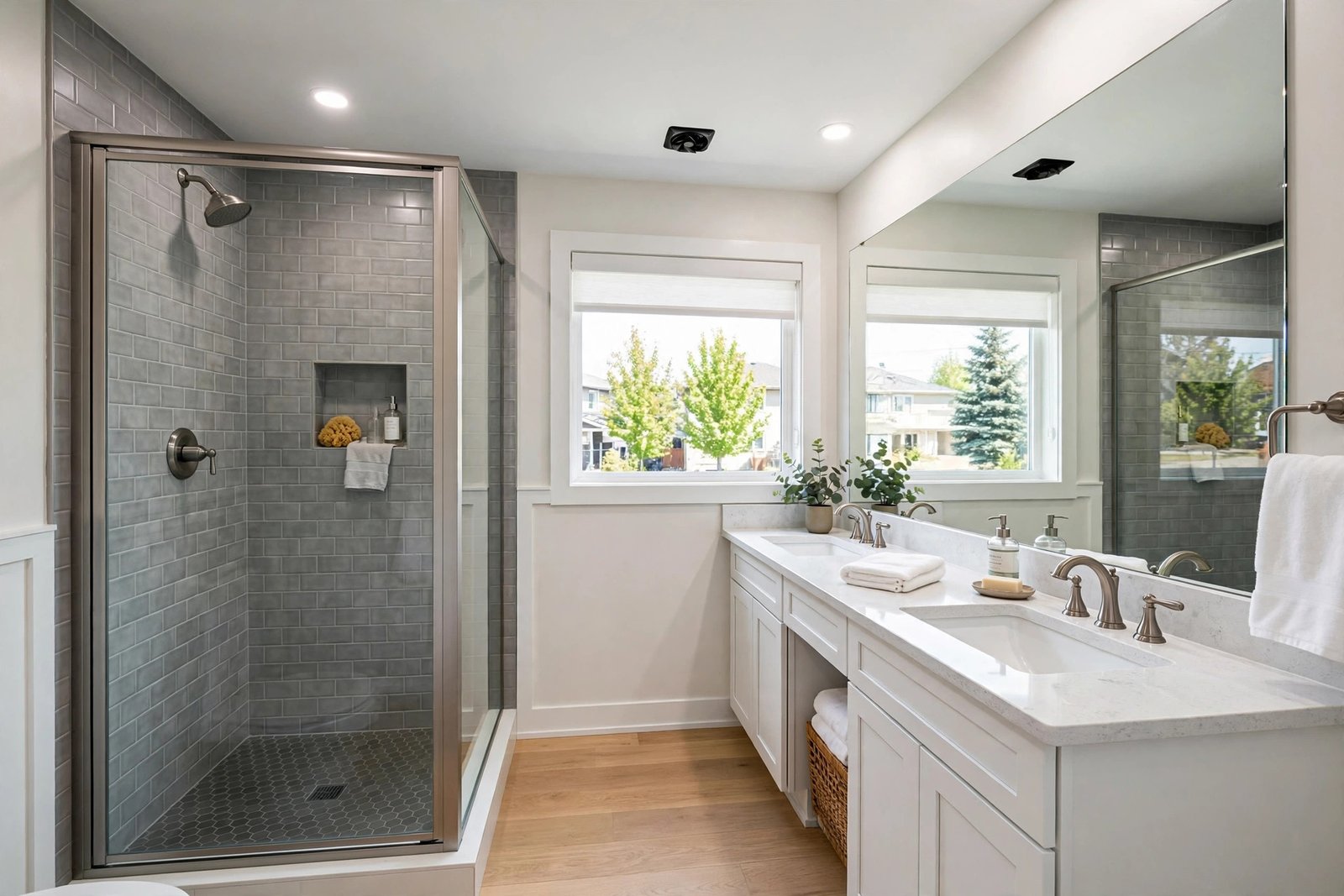
A vanity anchors the room visually, even though it is not the largest cost. Budget 10–15% for the vanity and countertop. That’s $2,000–$3,000 at $20,000. Stay standard on size, keep the top simple, and 10% is doable.
What’s typical here? In Abbotsford, at this level, it’s a new 36- to 48-inch vanity. Quartz top, or cultured marble. And a new faucet. Same footprint, though. That’s the trick, because it protects the plumbing budget too. The supply and drain lines already land right where the new unit needs them.
Wider custom vanities change that maths. So do stone tops with special edge work and nonstandard plumbing positions. On its own? None of those choices is wrong. It just has to be a choice. Deliberate. Not something you drifted into.
Driver Four: Ventilation, Because Abbotsford Winters Are Damp
This one stands alone. For local reasons. It gets its own section. Our winters are damp. And a bathroom that can’t clear moist air gets punished for it. No proper ventilation? Mould gets behind the tile. Rot works into the framing. And fixing that costs far more, way far more, than preventing it ever will.
A good, quiet exhaust fan ducted properly to the exterior is a few hundred dollars installed. Ducting into the attic doesn’t count as proper. Inspectors will flag it. Any decent contractor will too. Someone suggests reusing that tired builder-grade fan? To trim the quote a bit? Push back. For as little money as it costs, few line items in a $20,000 renovation buy you this much protection.
Lighting, then. Same practical conversation. It belongs here. New vanity lighting and a ceiling light go in that shared allowance covered later, once they’re updated to current electrical code. And every morning? You’ll feel the difference in how usable the room is.
Driver Five: Fixtures and the Middle of the Road
Fixtures punish extremes. Go cheapest on faucets and shower valves and they can fail early. Then what? You’re opening finished walls just to replace a valve. Designer pieces are the other extreme. Three to five times more. And they don’t work any better, not in daily use.
Mid-range is the sweet spot. Established brands. That’s what most Abbotsford bathrooms at $20,000 land on. One finish. Pick it early. Then carry it through the whole room. Brushed nickel and matte black dominate locally in 2026, and mixing metals across a small space tends to look accidental rather than layered.
As a budget share, fixtures covering the toilet, faucets and shower set run 8–12%, or $1,600–$2,400, with 12% at the top when the shower set gets more elaborate.
Driver Six: Glass, Tubs and Decisions You Can Reverse Later
A frameless glass shower door looks fantastic. It also costs $1,500–$2,500 installed.
A framed door does the same job. Quality framed, or semi-frameless. For roughly half that money. Or skip the door entirely. A shower curtain. $40, done. That’s why the enclosure’s such a clean place to save. You can pull $1,000 out of a quote there and build quality doesn’t drop at all, because glass can go in later. No walls reopened.
The tub offers a similar fork. Reglazing’s around $400–$700. It can make a tub that’s stained but sound look new again. Versus $2,000+ to replace it, that is. Comfortable shape? Solid structure? Then reglaze it. You’ll get years more use for a fraction of what replacement costs. Pause on that $2,000 replacement figure. Really pause. Before you commit to a tear-out you might not even need.
Glass and enclosure work runs 5–10% as a share. That’s $1,000–$2,000 at the typical level. Flooring’s separate, 5–8%, or $1,000–$1,600, and pricier tile and prep push that to 8% at the upper end.
What the Typical $20,000 Bathroom Actually Contains
Picture the standard main bathroom here. Abbotsford house, roughly 5 by 8 feet. Built anywhere from the 1970s to the 2000s, that era. The long side measures 8 feet, the room is tight, and at $20,000 the specification is complete without being custom.
You get the vanity described above. The shower or tub area? It becomes a porcelain-tiled tub surround. Or, the other way, a walk-in shower. Acrylic base, tiled walls. The toilet’s new too. A water-efficient model. Floors? Porcelain tile. Or luxury vinyl plank.
Ventilation’s a new fan. Quiet. Ducted outside, properly. Plumbing gets a new shower valve. Supply lines get inspected too, replaced where they’re accessible. Wet areas get moisture-resistant drywall. Then it’s fresh paint. A new mirror, accessories, done.
Movement, though? You don’t get that. Nothing moves. Not the toilet. Not the tub, not the vanity either, they stay in their existing locations. That single constraint does more for the total than any tile choice, any faucet brand or any mirror.
For the full service picture behind a specification like that, see our bathroom renovation in Abbotsford page.
The Rest of the $20,000, in One Place
Beyond the drivers above, lighting, fan, mirror, paint, permits and contingency together run 5–10%, or $1,000–$2,000. That bucket looks small until you need it. Permits, a better fan and a contingency for what hides behind old tile all compete inside it, so treating it as spare money at the start is a mistake.
Put the shares together and the pattern is clear. Labour at $7,000–$8,000. Tile and shower materials at $3,000–$4,000. Vanity at $2,000–$3,000. Fixtures at $1,600–$2,400. Glass at $1,000–$2,000. Flooring at $1,000–$1,600. The final shared bucket at another $1,000–$2,000. A quote that departs wildly from that shape deserves a line-by-line explanation.
The Three Price Tiers, Explained After the Drivers
Now the tiers should make sense. A cosmetic refresh runs $8,000–$14,000. For that you get repainting, new faucets and hardware, a reglazed tub. A new mirror and lighting too, plus recaulking and regrouting. Toilet, tub and vanity stay where they are, though.
A standard full renovation is $14,000–$24,000. That replaces the vanity and countertop, tiles the shower or tub surround, and puts in a new toilet and new flooring. Lighting and the exhaust fan get updated too. Most owners who say full renovation mean this tier.
High-end? That’s $24,000–$32,000. You get a custom-tiled walk-in shower, a frameless glass enclosure, heated floors. Layout changes too, plus premium fixtures and finishes. In the surveyed range it ends at $32,000. But stack several of those upgrades together and the total can move beyond $32,000. Easily.
The refresh band needs the same caution as any estimate. It depends heavily on the condition of the existing bathroom. The firmer surveyed ground is the full range of $14,000–$32,000, anchored by that typical $20,000 project where everything is new, nothing is moved and nothing is custom.
What Sends a Bathroom Toward $32,000
Moving the toilet is the big one. Relocating it means the drain gets rerouted. Slab-on-grade home? You’re cutting concrete. Two-storey? You’re opening the ceilings below. Nothing else costs that much. No other single layout change in a bathroom, anyway.
Next up? A custom-tiled shower pan. A site-built tile base looks incredible. Linear drain and all. But it adds days. Days of skilled labour, plus the waterproofing materials. An acrylic base with tiled walls gets you 90% of the look. For a fraction of the cost. That’s why that 90% figure keeps coming up in value conversations.
Any plumbing move works the same way. Smaller scale, same logic. A fixture moves, walls open. Simple as that. Pipes get rerouted.
Body sprays and thermostatic valves need larger supply lines and a pricier valve, while a strong single-function showerhead costs a tenth as much and satisfies most people in daily use. Heated floors on a January morning in the Fraser Valley feel lovely underfoot. No denying it. But they’re roughly $1,500–$2,500 installed for a typical bathroom, as a planning estimate, so price them as the luxury they are. Stone slab shower walls? Dramatic. Seamless. And billed accordingly, you can count on that.
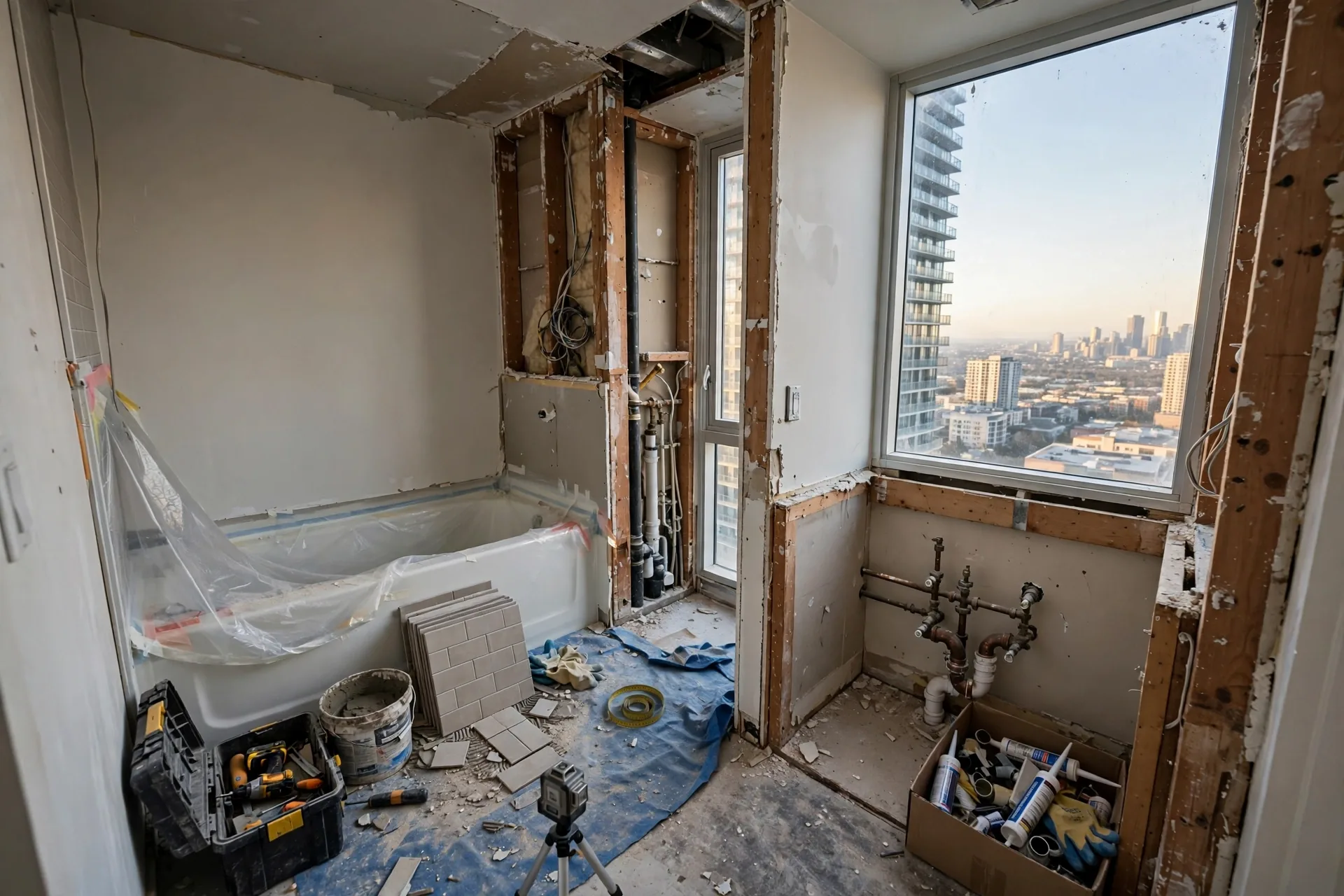
Older homes add risk underneath all of this. Houses from the 1960s through the 1980s hide things. Galvanized supply lines, for one, which should be replaced while the walls are open. Cast-iron drain stacks nearing end of life too, and in pre-1990 homes, materials that require asbestos testing before demolition. WorkSafeBC wants a hazardous-materials survey before demo in older buildings. Testing’s a few hundred dollars. Abatement costs more.
Change orders finish the list. An addition raised mid-project costs more than the same work priced in the original quote, every time.
Holding a Project Near $14,000
Do not move the toilet. Worth saying twice, in plain language. That one decision alone can save $3,000–$7,000.
Your tub’s sound? Reglaze it. Don’t replace it. Keep an acrylic base. Tile the walls around it. Pick porcelain that looks like stone. The visual gap’s closed. The price gap hasn’t. And the vanity? Same footprint. Then the plumbing stays untouched.
And refresh what is already sound where you can. Paint, new fixtures, a new mirror, recaulking and updated lighting can genuinely transform a dated but functional bathroom inside $8,000–$14,000, without pretending that a refresh is the same job as a full rebuild.
Permits, Timing and the Schedule Nobody Puts in the Quote
Plumbing work? Electrical, structural changes? Then the City of Abbotsford requires a building permit, through the Building Department at 32315 S Fraser Way. Like-for-like fixture swaps are different. They usually don’t need one. Cosmetic updates typically don’t either.
Fees are modest and scale with project value. Timing is not modest. Bathroom permits currently take about 2–4 weeks to be issued, so the wait can reach 4 weeks before work starts, and applying before you book a start date protects the whole schedule.
Construction itself is faster than a kitchen. A cosmetic refresh is quick. 1–2 weeks. A standard full renovation takes longer. 2–4 weeks, demolition to completion, and custom tile work, layout changes or older-home surprises stretch that window out.
Abbotsford Against the Rest of BC
The province-wide average bathroom renovation cost in BC is about $22,320. Abbotsford’s typical $20,000? It sits roughly in line with that average. A touch under it, perhaps.
For bathrooms, the regional spread is narrower. Narrower than for kitchens, anyway. A small bathroom takes similar trades hours in Abbotsford or Kamloops, so labour varies less by location. Vancouver is the outlier, where the same standard bathroom routinely prices $8,000–$15,000 above Abbotsford.
That puts Abbotsford comfortably in the middle of the BC range. Not the cheapest market in the province. Nowhere near the most expensive either.
Spending Less Without Spending Twice
Layout discipline first. Again. Then work outward from there. And reglazing beats replacing. When the tub’s sound, that is. Pair them together. Tiled walls, acrylic base. Porcelain that mimics natural stone is the pick. And you skip the sealing. Real stone demands it, this doesn’t.
One fixture finish. Buy it once, buy it on sale if your timeline allows, because fixture prices swing with retail cycles. Demo and painting you can handle yourself. If you’ll do both carefully, that is. That combination can save $1,500–$3,000.
Three quotes. Itemised, written, broken into comparable lines. Not three totals you can’t test against each other, get the lines. Check before you hire. Proof of liability insurance, WorkSafeBC coverage, references from recent local jobs. And agree to a deposit with milestone payments, not full payment upfront.
Add it up and layout discipline, reglazing, an acrylic base, porcelain tile and careful DIY on demo and paint can save $5,000–$8,000. Together, they can. That $5,000–$8,000 range matters. It’s often the difference, a project that stays at $14,000 versus one that drifts toward the middle. And no single dramatic decision caused the drift.
Still weighing the tub? Whether to keep it at all? In a family market the resale logic’s simple. Only one full bathroom in the house? Keep it. Two or more full baths changes it. You can convert one to a walk-in shower with far less risk then, and in the ensuite many buyers prefer that setup anyway.
Doing both rooms? Owners planning that often read this alongside our kitchen renovation cost guide for Abbotsford. Permit timing works the same there. So does the cost of moving services, just at a larger scale.
Close with priorities, not products. Money goes to the shower build first. And the ventilation. Put it there before anywhere else. The statement faucet can wait. Save it for a powder room, if there’s money left, because the main bathroom works hardest and gets admired least. A sound, dry, well-lit $20,000 room will outlast a prettier one. Especially one built on shortcuts.
Frequently Asked Questions
Can I renovate an Abbotsford bathroom for under $10,000?
Yes. As a refresh, you can. As a full renovation, no. Under $10,000 gets you a repaint, a reglazed tub, new faucets and hardware. A new mirror and lighting too, and recaulking everything. What won’t fit is new tile, a new vanity, plumbing work. Not in that budget.
Should I keep the bathtub or switch to a walk-in shower?
One full bathroom in the home? Keep the tub. Abbotsford’s a family market, and buyers with young children will filter out a home with no bathtub. Often, anyway. Got two or more full bathrooms? Then converting one to a walk-in shower is safer, and in the ensuite many buyers prefer it.
Why does moving the toilet cost so much, and how do I keep costs down overall?
It’s the drain. Moving the toilet means rerouting it, so in a slab-on-grade home you’re cutting concrete, and in a two-storey home the ceilings below get opened. To keep costs down, hold the layout. Especially the toilet. Reglaze the tub instead of replacing it, use porcelain that looks like stone, pair tiled walls with an acrylic base, and handle demolition and painting yourself. Together that can save $5,000–$8,000.
How long does a bathroom renovation take in Abbotsford, including any permit wait?
A cosmetic refresh? 1–2 weeks. A standard full renovation runs 2–4 weeks, demolition to completion. Need a permit and you add 2–4 weeks beforehand, for City of Abbotsford approval. Custom tile work or older-home surprises need extra time on top of that.
What is the most expensive part of a bathroom renovation?
Labour. It’s the biggest part, 35–40% of the total, or $7,000–$8,000 on a typical $20,000 Abbotsford bathroom. Plumbing and tile setting cost the most in there, trade-wise. Next biggest line item is tile and shower materials.
2 Responses