
Every January, the design world declares a new set of bathroom trends. Most are gone by March. Forgotten, even. But 2026 feels different, though. The direction isn’t coming from mood boards this time. It’s coming from data. Two major industry studies landed within months of each other: Houzz’s 2026 U.S. Bathroom Trends Study (1,619 homeowners surveyed) and the National Kitchen & Bath Association’s 2026 Bath Trends Report (design professionals across North America). And they agree on the big picture.
The headline: bathrooms are becoming calmer, warmer, more personal — and more expensive to renovate well. Median spend rebounded to US$15,000 in 2025, according to Houzz, up from US$13,000 the year before. It’s a wellness space now. Not a utility room. So here’s what the research found. Translated for Abbotsford and the Fraser Valley — grey winters, hard water, 1980s-era ensuites and all. That’s the lens for what “on trend” should mean in your house.
On the numbers: All statistics below are attributed to their source study. Houzz figures reflect the U.S. market. Canadian costs run higher. Fraser Valley costs run higher still — our bathroom renovation cost guide has local 2026 planning ranges.
1. Warm Minimalism Replaces Cold Modern
The all-white bathroom had a long run. High contrast, glossy everything. It’s over. Both studies agree — warmth is in, sterility out.
Ask NKBA’s designers and they’ll tell you light neutrals dominate. 96% named them the most popular bath colours. Off-white leads at 58%. Light brown and tan, 54%. White, 40%. But “neutral” in 2026 doesn’t mean “boring beige.” It means warmth, layered. Creamy plaster tones. Sandy tile. Greige stone. Texture you can see.
Around here, the trend fits the climate almost suspiciously well. Abbotsford gets little natural light from November to March. Picture 7 a.m. in January. Warm off-whites and honeyed woods feel restorative then, in a way glossy white tile never will. Want the biggest change for the least disruption? Warm the palette.
2. Sage and Olive: Green’s Quiet Takeover
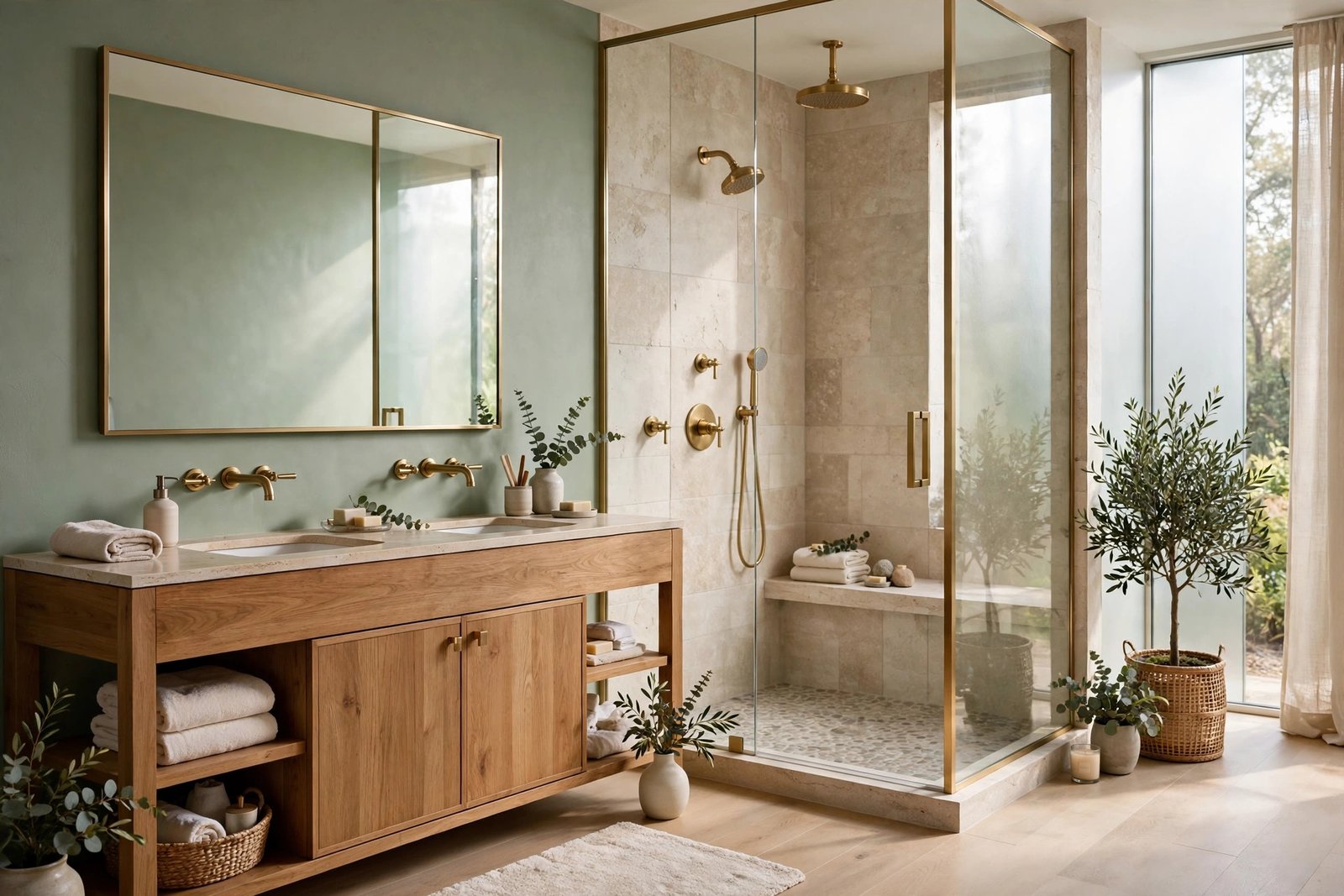
There is a colour story for 2026. It’s green. Not the emerald jewel tones from five years back, though. NKBA’s leaders are clear. First, sage (64%) and olive (43%). Both are brown-based, earthy greens. The bolder stuff trails — teal/turquoise at 19%, emerald/juniper at 16%.
Sage works in a bathroom. Really works. It pairs with warm woods and brushed metals. It flatters skin tones in mirror light. And it brings the outdoors in — handy when the outdoors is mostly rain. Try it on vanity cabinetry. Or a zellige-style feature wall. Or just towels and accessories. Take a small Abbotsford powder room. Sage vanity. Warm white walls. That’s about as 2026 as it gets.
3. Wet Rooms Keep Climbing
Wet rooms keep climbing. Houzz counts them — fully waterproofed, curbless shower areas that flow into the room — at 18% of renovated bathrooms, up from 13% two years ago. Why? Better use of space leads — 41% said so. Next comes accessibility or universal design (40%, up 14 percentage points).
Pay attention locally. Multi-generational households are common here. And “aging in place” isn’t a buzzword. It’s a real renovation driver. A curbless wet room kills the step-over curb — a genuine hazard with age or injury. And a compact 5×8 bathroom feels dramatically larger without it. The catch is real. A true wet room needs the entire floor tanked, with drainage falls that slope right. Skilled work. In our wet climate, shortcuts show up as leaks — into the suite below, into the crawlspace. Budget properly. Hire it out.
4. Double Sinks Become the Standard
Double sinks are having a moment. Per Houzz, installations jumped 17 percentage points year over year to 64%. Nearly two-thirds of renovated bathrooms. Undermount basins lead at 68%, up 11 points. Big vanities are winning too — models wider than 72 inches rose 7 points to 21%, past the 60- or 72-inch sizes.
The reason is unglamorous. Couples sharing a bathroom want their own zone. Their own sink. In a full gut, a second sink costs little — relative to the daily quality-of-life gain, and the resale signal. Space is the constraint. You need roughly 60 inches of vanity width, minimum, for two comfortable stations. Abbotsford’s 1990s townhouses have compact ensuites. Reaching that width might mean stealing six inches from the closet next door. Model it first.
5. Wood-Faced Vanities Overtake Painted Ones
Wood has overtaken paint. NKBA’s finding: wood-faced vanities have overtaken painted finishes in designer popularity. White oak. Walnut. Warm natural tones. They’re replacing the painted navy and black vanities that dominated the late 2010s.
It pairs beautifully with trends 1 and 2. Warm wood against sage walls, or creamy ones. Brushed brass hardware. Matte black, too. It’s practical, too. Not just pretty. Wood-look finishes handle bathroom humidity well. Real wood does too, with proper sealing. And both hide the small dings of daily life. Dark painted surfaces? They show every single chip. One local note. Fraser Valley water is hard, and mineral deposits show less on warm wood tones and brushed finishes than on glossy dark surfaces around the taps.
6. Showers Get Bigger, Tubs Get Rethought
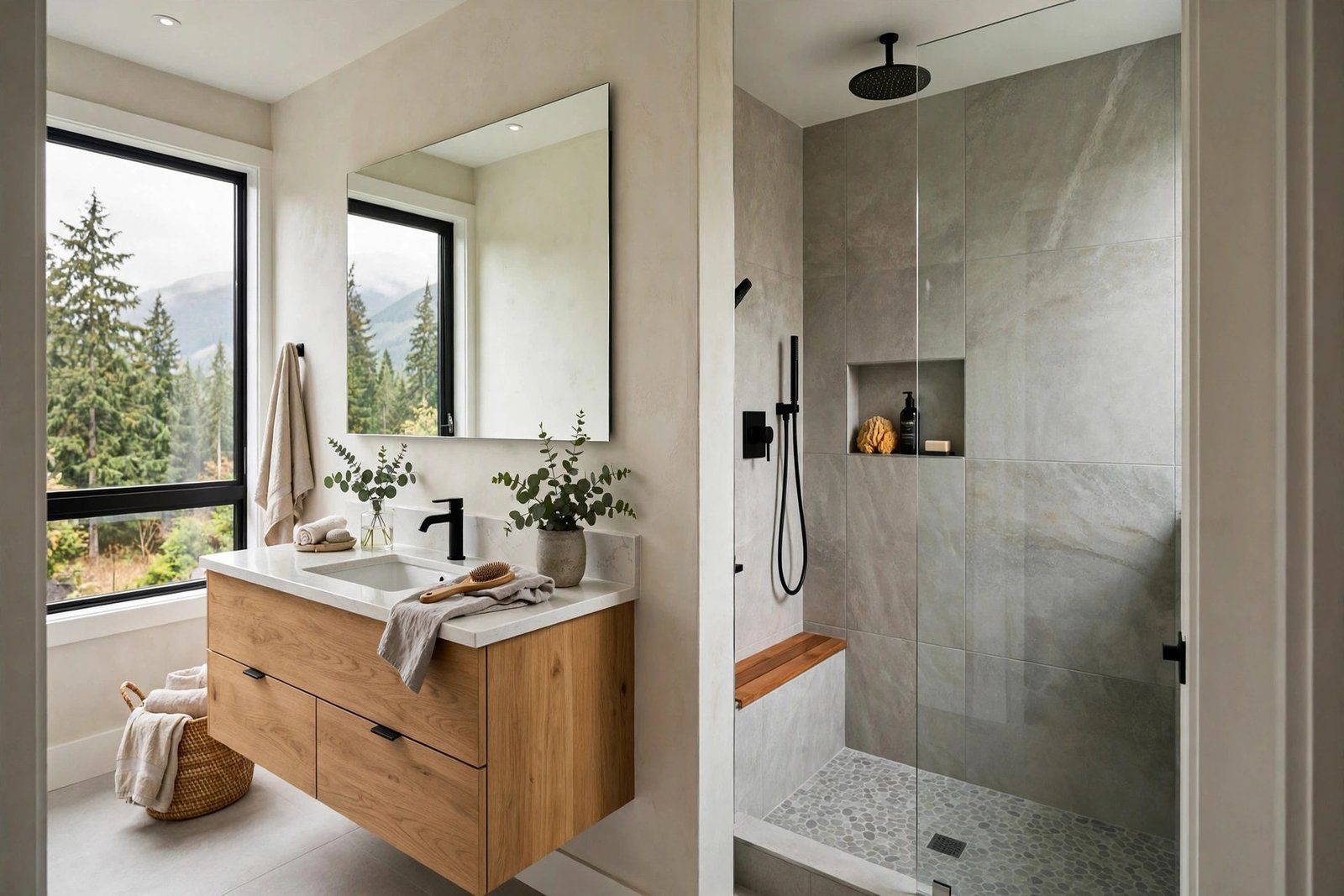
Nearly half of renovating homeowners made their showers bigger, per Houzz. The conversation has shifted — the shower is the bathroom’s centrepiece now. The main event. The wishlist: rainfall heads, body sprays, built-in benches, niches for products. The quiet luxury worth paying for? Thermostatic controls that hold temperature.
The standalone soaking tub, meanwhile, is changing status. It’s a deliberate choice now. Not a default. Start with our own comparison of walk-in showers versus bathtubs for resale — and Abbotsford buyers increasingly favour a great shower over an average tub. One exception: families with young kids still want at least one tub in the house. So here’s the 2026 move. Keep one good tub — the main bathroom, ideally — and make the ensuite shower exceptional. Not the other way around.
7. Pattern Over Colour on Accent Walls
Accent walls were upgraded in 34% of renovations, per Houzz. The twist — pattern (53%) has overtaken colour (48%). That’s now the way to make one stand out. Surface material follows at 45%. Texture sits at 25%. And the colours themselves? Blue and white, tied at 19% each.
Translation: the feature wall is back. About material interest now, not one bold paint colour. Think fluted wood panelling behind the vanity. A wall of handmade-look zellige tile. Large-format stone-look porcelain, dramatically veined. Good news locally. A beautiful material ages better than a trendy paint colour — and photographs well for resale listings years later.
8. “Grout Is Out”: Large-Format Tile and Fewer Lines
NKBA’s reporting here is blunt. “grout is out.” Designers say clients are actively asking for fewer grout lines. They want durable surfaces. Low-maintenance ones. And large-format tiles — 12×24, 24×24, and bigger — are now the expected standard for floors.
Fewer grout lines, less scrubbing. Fewer places for hard-water buildup to grab hold. A calmer room, too — right in line with the warm-minimalist direction. The trade-off: large tiles demand flatter substrates, and more skilled setting. Labour runs higher per square foot. Don’t let a bargain installer talk you into it — large-format tile over an unprepared floor. Lippage, uneven edges, shows mercilessly on big tiles. You can’t unsee it.
9. Finishes Go Soft: Matte, Brushed, and Mixed
Polished chrome is losing share. Gaining ground: matte, brushed, and satin finishes, per NKBA. And designers aren’t matching everything anymore. They’re increasingly mixing metals, deliberately. Picture one room. Brushed brass taps. Matte black shower fixtures. Champagne-bronze mirror frames. It works — in a well-designed room.
The practical note for Abbotsford: matte black shows water spots and soap residue. Brushed finishes hide far more — worth remembering in hard-water areas. Brushed brass patinas gracefully. Bronze too. Both hide mineral deposits. And unlacquered brass — the “living finish” — gets a specific call-out in the 2026 reporting.
10. Wellness Tech Moves Mainstream
NKBA counts three technology currents. First, AI-assisted design inspiration. Second, smart fixtures — intelligent showers, programmable lighting, ventilation and energy controls. Third, wellness tech — stress reduction, health features, and aging-in-place elements becoming mainstream expectations — standard fare now, not luxury add-ons. Houzz’s numbers back that up. Specialty toilet features — bidet seats, heated seats, air dryers — now show up in 47% of renovated bathrooms. Up 9 points, believe it or not.
The sensible 2026 approach? Wire for the future, gadgets or no gadgets. Consider the list. A heated floor on a programmable thermostat. A humidity-sensing exhaust fan. Blocking in the walls for future grab bars. A comfort-height toilet with a bidet seat. Modest costs, all of them, mid-renovation. Expensive retrofits later. NKBA’s Bill Darcy calls bath design deeply personal now. His words: “designers are focusing on how spaces support a homeowner’s individual rituals, preferences, and self-care routines.” So start there. How do you actually use the room?
What 2026 Trends Cost in the Fraser Valley
None of it matters if you can’t afford the trends you like. Money, then. Houzz’s US$15,000 median (about CAD $21,000) covers a mid-range bathroom. Major remodels with shower upgrades hit US$25,000 median. Abbotsford runs higher. Labour costs more here. Materials too. Our local planning ranges for 2026 put a full bathroom renovation at roughly $14,000–$32,000. Wet rooms push toward the top. So do curbless showers, and stone-look large-format tile.
Two budgeting truths, if you’re renovating around trends. First: spend on what you touch daily — the shower valve, the vanity hardware, the lighting. A $400 thermostatic control transforms every morning. Truly. A $400 decorative mirror? It does not. Second truth: save on what’s easily changed — paint, accessories, even the mirror. Tile is a commitment. Plumbing too. Everything else? A draft.
| Budget Tier | 2026 Look It Buys | Planning Range |
|---|---|---|
| Refresh | 2026 palette paint, new hardware, mirror, lighting, sage/olive accessories | $3,000–$8,000 |
| Mid-range | New vanity with double sinks, large-format tile, brushed-brass fixtures | $14,000–$22,000 |
| Full gut | Curbless wet-room shower, heated floors, stone-look tile, wellness tech | $22,000–$32,000+ |
Budget’s only half of it. For a realistic schedule, our bathroom renovation timeline guide maps each phase’s real timing.
Frequently Asked Questions
What are the most popular bathroom colours for 2026?
Light neutrals dominate. 96% of NKBA’s designer respondents named them the top bath colours. Off-white leads at 58%. Light brown and tan sit at 54%. White, 40%. For accents, look to green — sage at 64%, olive at 43%. The overall direction? Warm. Calming. Not high-contrast at all.
Are wet rooms a good idea in BC?
Yes, with proper waterproofing — and they are trending for good reasons. Houzz counted wet rooms in 18% of 2026 renovations — space efficiency drives it, accessibility too. But BC’s climate is wet. The entire floor must be tanked, sloped correctly to drainage. Hire experienced installers. Failures leak into the structure below.
Is a double sink worth it in a small ensuite?
If you have roughly 60 inches of vanity width, yes. Double sinks jumped to 64% of renovations in Houzz’s 2026 study. Below 60 inches, though, stations cramp. Abbotsford townhouse ensuites are compact — check whether borrowing closet space is feasible before committing.
Should I keep a bathtub or install a walk-in shower?
Most 2026 buyers would take an exceptional shower over an average tub. One caveat. Families with young children still want a tub in the home — at least one. The Fraser Valley solution: a great walk-in shower in the ensuite, one good tub in the main bathroom. Our shower-versus-tub resale analysis breaks it all down.
How much does a 2026-style bathroom renovation cost in Abbotsford?
Plan on $14,000–$32,000 for a full renovation in 2026. Wet rooms push toward the top. Curbless showers too. So do double sinks and large-format tile. And these are planning ranges, not quotes — the Houzz US median of $15,000 (≈CAD $21,000) runs lower than typical Fraser Valley costs.
Which 2026 trends will look dated fastest?
Bold statements age fastest. Warm neutrals age slowest. So do natural materials. NKBA’s rankings agree. Transitional/timeless scores 70%. Organic/natural, 65%. Selling within five years? Keep trends in the changeable layers. Tile and plumbing stay timeless.
Bring 2026 Home — Without the Regrets
The best of this year’s trends share one philosophy. Calmer rooms. Warmer materials. Design that serves the people who actually live there. That philosophy suits Fraser Valley homes beautifully — it is hard to argue with a warm, well-lit bathroom in February.
Doing trends right is just doing a renovation right. Decide what’s permanent. Decide what’s flexible. Spend where your hands and eyes land every day. And build the unglamorous stuff — waterproofing, ventilation, drainage — to outlast every trend cycle there is. If you are ready to plan yours, a bathroom renovation designed around how you live beats a catalogue of trends every time.