
Every Canadian home has a version of the same problem. October arrives. The rain settles in for its six-month stay. And the front entry becomes a swamp — wet boots, dripping jackets, muddy paws, hockey bags, school backpacks. By February, stepping into your own house feels like wading through a lost-and-found bin.
The mudroom is Canada’s answer — a dedicated transition zone between outside and inside where the mess of Canadian weather stops before it reaches your floors. Done well, it’s one of the most satisfying rooms in the house. Everything has a place. The floors survive winter. The rest of the home stays clean.
This guide covers mudroom design from the ground up: layout, storage, flooring that handles water, heating and drying, lighting, and what it all costs as 2026 planning ranges.
Why the Mudroom Earns Its Space
A mudroom isn’t a luxury. It’s infrastructure — for a climate where “outside” stays wet, muddy, or frozen for half the year. In the Fraser Valley, the challenge is rain. Not snow. Months of steady precipitation, boots and jackets that never fully dry. And floors? They take a beating from grit and moisture tracked in daily.
Consider what it replaces. The pile by the front door. The hallway closet crammed beyond use. Wet footprints across hardwood. The twice-daily tidying that never quite works. A well-designed mudroom doesn’t just organize the mess. It contains it. In a room built to be hosed down — literally and figuratively.
Real estate agents will tell you buyers notice mudrooms. In family-oriented markets like Abbotsford’s, a proper mudroom reads as a sign the house was designed for real life — and it’s the kind of feature buyers remember after the showing.
Location: Garage Entry vs Front Entry
Where the mudroom goes? That determines how it gets used. And it comes down to one simple rule: put it where people actually enter.
Garage entry mudrooms serve most suburban families best. Everyone comes and goes through the garage? Kids from school, groceries, sports gear — then that’s where the mudroom belongs. A small room works. Even a well-designed zone off the garage entry works — direct access to the kitchen or hallway, and it catches the daily traffic.
Front entry mudrooms suit a different kind of home. Townhouses. Homes without attached garages. Households that receive a lot of visitors — anywhere the front door is the main entrance. Here the mudroom doubles as the foyer, often. So it has to look good. And work hard.
What you need, minimum: about 5×7 feet. That gets you a functional single-wall mudroom (bench + hooks + storage). A true walk-in with lockers on both sides wants 7×10 or more. If you don’t have a spare room, a wide hallway section or enclosed porch can work — some of the best mudrooms started as dead space.
Storage: The Whole Point of the Room
No serious storage? Then it’s just a hallway with aspirations. Plan storage for the actual inventory of a Canadian family entry:
- Lockers or cubbies — one per person. Individual compartments end the “whose boots are these” problem and give kids ownership of their space. Open cubbies are cheaper and airier; closed lockers hide the chaos. For families with young kids, open wins — if they can’t see it, they won’t use it.
- A bench with storage underneath. The bench is for sitting. For pulling on boots. And the space beneath? That’s for the boots themselves. Bins or drawers under there keep footwear sorted — and off the floor.
- Hooks, not just a rod. Heavy-duty hooks, at two heights — adult and kid. Jackets hang on them. Backpacks, dog leashes, umbrellas too. A closet rod fits fewer items, and it hides them. Hooks don’t. Everything stays visible, grabbable.
- Overhead cabinets for the seasonal stuff. Snow pants in October. Rain gear in May. And the spare mittens — the ones that multiply on their own.
- A dedicated spot for the odd-shaped things. Hockey sticks, umbrellas, the dog’s towel, reusable grocery bags — plan a tall narrow cabinet or a corner for the things that otherwise lean against walls.
Budget roughly $2,000–$8,000 for mudroom millwork. Size drives it. So does the cabinetry — stock, adapted, or fully custom. Custom lockers with a bench — that’s the classic mudroom look. But stock cabinets can get you 90% there. Well-chosen ones, with added hooks and a cushion-topped bench.
Flooring: Built for Water, Grit, and Daily Abuse
Mudroom flooring has the hardest job of any floor in the house. It needs to handle standing water, road salt, mud, grit under boots, and daily mopping — while still looking like part of the home.
Best options, ranked for Canadian mudrooms:
| Flooring | Water handling | Durability | Feel underfoot | Notes |
|---|---|---|---|---|
| Porcelain tile | Excellent | Excellent | Cold (pair with heating) | The workhorse — nearly indestructible, endless styles |
| Natural slate/stone | Excellent | Excellent | Cold, textured | Beautiful, hides dirt, needs sealing |
| Luxury vinyl tile/plank | Very good | Very good | Warmer, softer | Great budget option; fully waterproof versions exist |
| Heated tile | Excellent | Excellent | Warm | Tile + radiant heat = the premium mudroom floor |
What to avoid: hardwood (water damage is a matter of time), carpet (obviously), and cheap laminate that swells at the edges.
Two details that matter: run the flooring slightly sloped toward a floor drain if you’re doing a full renovation — being able to mop toward a drain changes how the space gets used. And choose a medium-tone tile — very dark shows every speck of dust, very light shows every muddy footprint. The waterproof-flooring principles in our basement flooring guide apply directly here — wet is wet, whatever the room.
Heating and Drying: The Part Everyone Forgets
A mudroom full of wet gear that never dries is just a damp closet. In a Fraser Valley winter, jackets and boots come home soaked daily — the room needs to actively dry them.
- Radiant floor heating is the premium answer: warm floors dry boots from below, and the room becomes the most pleasant 60 square feet in the house on a rainy morning. Electric radiant runs roughly $12–$20 per square foot installed for a small area — very reasonable at mudroom scale.
- A wall-mounted drying rack or retractable clothesline for the truly soaked items — ski gloves, rain pants, the dog towel.
- Ventilation matters. A small exhaust fan or a heat vent in the room prevents the damp-closet smell. If the mudroom is enclosed with no window, don’t skip this.
- Boot trays as backup. Even with great flooring, large boot trays under the bench catch the worst of the melt and mud, and they’re easy to dump and rinse.
Lighting and Electrical: Small Room, Real Needs
Mudrooms are often afterthoughts electrically — one dim ceiling fixture and nothing else. Plan better:
- Bright overhead lighting on a motion sensor. Hands full of groceries is exactly when you don’t want to fumble for a switch.
- An outlet or two — for charging, for the boot dryer you’ll eventually buy, for the vacuum.
- Under-cabinet or locker lighting if you have enclosed storage — finding the right gloves in a dark locker at 7 a.m. is miserable.
Layout Ideas for Tricky Spaces
Not everyone has a spare 7×10 room. Some approaches for common situations:
- The hallway conversion. A wide hallway near the garage entry can become a single-wall mudroom. Bench, hooks, overhead cabinets — all along one side. The walkway stays clear. Minimum comfortable width? About 5 feet total.
- The porch enclosure. An existing covered porch, properly insulated and heated, makes a superb mudroom — it’s already where the mess arrives. Check permit requirements before enclosing; our permit guide covers when Abbotsford requires approval for this kind of scope change.
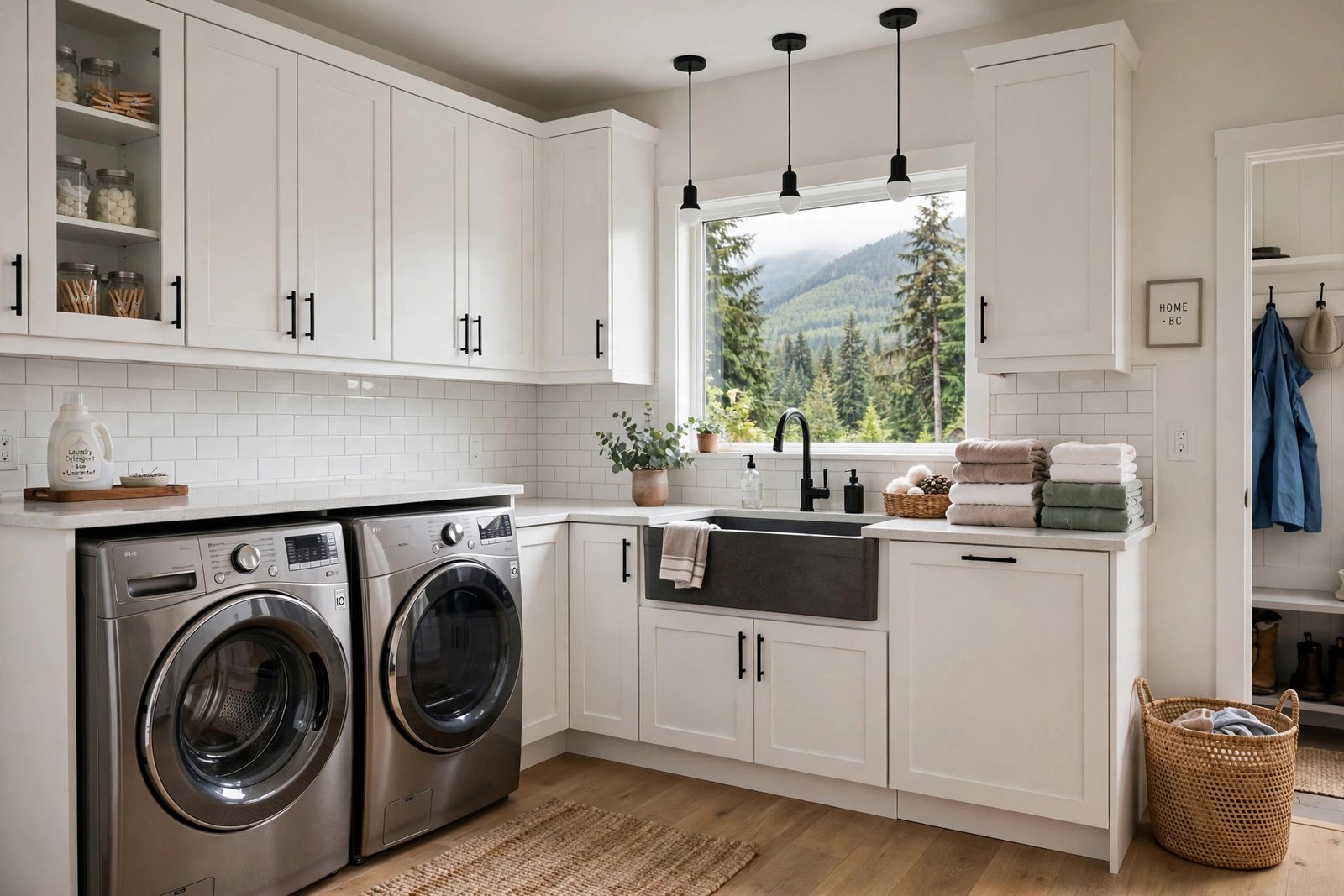
- The laundry combo. Combining mudroom and laundry is common in Canadian homes and genuinely practical — dirty sports gear goes straight from hook to washer. Plan the plumbing and venting properly, and give each function its own zone so they don’t fight.
- The split entry. In bi-levels and split-entries (common in Abbotsford’s 70s–80s stock), the landing area at the garage entry is often dead space — a bench and hooks there capture the traffic without a dedicated room.
What a Mudroom Renovation Costs in Canada
Mudroom projects span from weekend refreshes to small additions. As 2026 planning ranges:
| Scope | Typical range |
|---|---|
| Refresh (paint, hooks, bench, boot trays — no construction) | $1,000–$3,000 |
| Conversion (repurpose existing space: flooring, millwork, lighting, paint) | $5,000–$12,000 |
| Full build-out (new walls, plumbing-adjacent work, heated floors, custom lockers) | $12,000–$25,000 |
| Small addition (bump-out or enclosed porch with foundation/roof work) | $25,000–$50,000+ |
The heated floor is the upgrade owners talk about most. The one they’d never give up. At mudroom scale (40–60 sq ft), electric radiant heat adds roughly $800–$1,500 to the project. For a room whose entire job is managing wet Canadian weather, it’s money well spent.
All figures are 2026 planning ranges for BC/Canada. Not quotes. Additions and structural changes require City of Abbotsford building permits, so factor permit time into your schedule.
Frequently Asked Questions
Do I really need a mudroom in the Fraser Valley? We get rain, not snow.
Yes — arguably more than snow country. Snow melts and it’s done; Fraser Valley rain is a six-month daily event. Boots come home wet. Jackets, umbrellas — wet, from October to April. That moisture has to go somewhere. A mudroom gives it a designed place to land instead of your hardwood floors.
What’s the minimum size for a functional mudroom?
About 5×7 feet for a single-wall layout — enough for a bench, hooks above, and storage opposite or overhead. Below that, you’re not designing a room, exactly. More a well-organized entry zone. It can still work, though — a bench, heavy-duty hooks, boot trays in a hallway nook. The core functions get handled.
Tile or luxury vinyl for mudroom flooring?
Tile if the budget allows, quality LVP if it doesn’t. Porcelain tile is nearly indestructible. Standing water? It handles that indefinitely — the right answer for a room that gets hosed down. Fully waterproof luxury vinyl runs a strong second. Warmer underfoot. Easier install. Much lower cost. Either beats hardwood, which standing water will eventually destroy.
Should I put a floor drain in my mudroom?
If you’re renovating down to the subfloor, yes. A floor drain with a slight slope turns mopping into a two-minute job and handles the worst winter melt without drama. It’s a few hundred dollars in plumbing during construction and nearly impossible to add later. Not essential for a cosmetic refresh. For a full build-out? Close to it.
How do I keep a mudroom from smelling damp?
Heat. Ventilation. Airflow. Radiant floor heat dries gear actively. So does a heat vent. An exhaust fan — or an operable window — moves the moist air out. And open cubbies dry faster than closed lockers do. The damp-closet smell comes from wet things in still, unheated air — eliminate any two of those three conditions and the problem disappears.
Does a mudroom add resale value in Abbotsford?
It adds buyer appeal more than appraised value. Appraisers won’t add a line item for a mudroom, but in Abbotsford’s family-buyer market, a proper mudroom is a memorable feature that signals a well-thought-out home. It’s the kind of thing buyers mention after the showing — “the one with the great mudroom” — and that stickiness has real value in a competitive listing.
The Entry Your House Deserves
A mudroom is one of those renovations that pays you back daily rather than at resale. Every rainy morning when the boots are dry, the jackets are hung, and the floors are clean, you’ll wonder why the house didn’t come with one.
Whether it’s a hallway conversion, a porch enclosure, or a full build-out with heated floors and custom lockers, the principles are the same: contain the mess, dry the gear, and build every surface like it will get wet — because it will.
If flooring is part of your mudroom plan, our flooring installation services cover material selection and installation — and the waterproof options that make a mudroom work as hard as Canadian weather demands.
Cost figures in this article are 2026 planning ranges for BC/Canada based on published industry data, not quotes. Structural changes and additions require permits from the City of Abbotsford.