
What a Langley Bathroom Renovation Costs in 2026
You’ve got a house in Langley? Then you know. It doesn’t fit in one box. A post-war bungalow, say, the kind near the city core. Almost nothing in common with a 1980s two-storey in Walnut Grove, that one. And a newer build out toward Murrayville matches neither one. Their bathrooms do not price the same way either.
National averages? That’s the trap. All that history, decades of it, gets squashed flat. One figure. And then you’re left guessing. Which bit of it is your street? Your pipes? Your permit office? A range built for Langley won’t hand you a quote. It won’t. But at least you’re starting in the right neighbourhood.
Here is the planning picture for 2026. Say it’s a compact hall bathroom. Back to the studs, the whole job. Most owners land at $18,000–$32,000 there, budgeting-wise. Main bathroom next. Tiled shower in it, layout tweaked a bit here and there. That one more often sits at $28,000–$48,000. Then ensuites. Higher again. Typically $32,000–$58,000, and it’s not hard to see why, because the shower grows, the tile count climbs with it, and the finish list? It grows teeth.
Kept the layout? Picked stock fixtures? And nothing nasty turned up behind the walls? That’s the low end. That’s what it usually means. Now move a drain. Or rip out tired plumbing and upgrade it. Or hand a tiler intricate work and days of it. You’ll drift to the top. Fast. No mystery there. It is just how the labour stacks up.
| Project type | Typical scope | 2026 planning range |
|---|---|---|
| Small bathroom refresh | Same layout, new fixtures, paint and vanity, minor tile | $14,000–$24,000 |
| Small bathroom renovation | Gut to studs, new plumbing and electrical, full tile | $18,000–$32,000 |
| Main bathroom renovation | Full gut, layout tweaks, tile shower, new fixtures | $28,000–$48,000 |
| Ensuite renovation cost in Langley | Full gut, walk-in shower or soaker tub, premium finishes | $32,000–$58,000 |
Before you start comparing those rows, though. One thing. Watch the small rooms. On paper they look cheap. In real quotes? They rarely behave that way. Doesn’t matter if the floor’s forty square feet. Doesn’t matter if it’s a hundred. The plumber still has to show up. So does the electrician. So does the inspector. Take a full renovation bill now. Squeeze it down onto a tiny footprint. The per-square-foot figure jumps, that’s what happens. A finished 5×8 in Langley, for instance. It can run $350–$500 per square foot. A spacious ensuite, by contrast, might settle around $250–$350 for each square foot. Owners hate that math. It is still the math most contractors are working from.
Langley City vs Township: A Labour Note Worth Knowing
People talk about Langley as if it were one municipality with one set of costs. Doesn’t work that way. You’ve got the City first. Compact. Dense. Then the Township. It spreads. Aldergrove, Fort Langley, Walnut Grove, Murrayville, all of it, and rural pockets tucked in between.
And the bids show it. Quietly, but they do. A Township job, say. There’s often more travel time baked in. The schedule runs looser too, because crews can’t just bounce from one site to the next. City work packs tighter. Get a team working several jobs within a few blocks of each other, though? The driving shrinks. And the labour line? Sometimes it softens. By a few hundred dollars, sometimes.
Deliveries, though. They cut the other way. Highway 1 addresses? Easy drops. Same along the 200 Street corridor, suppliers love those. Head down a long rural driveway and you may face extra delivery charges, a second trip for a missed window, or a crew standing around waiting on tile. Across a full project those logistics usually add $500–$1,500, which helps explain why two similar bathrooms on different roads can produce noticeably different quotes. On a larger rural job the delivery and travel piece alone can reach $1,500.
None of that means one side is reliably cheaper. A clean City discount? A Township one? Whoever promises you either is oversimplifying, plain and simple. Ask a different question instead. How’s travel handled in this number? Delivery too. Get that answer out of the contractor first, before you decide if the bid’s high. Or fair.
Permits split along the same boundary. Each municipality? Its own counter. Its own fee schedule too, and its own pace for getting back to you. Now, those ranges in the table. Typical permit and inspection costs are already factored in. But fees do change. So check. Quick call to the right office, before work begins, it’s worthwhile. If you want the broader provincial picture first, our bathroom renovation permit guide for BC lays out how the process tends to unfold in Valley communities.
Older-Stock Plumbing: Langley’s Quiet Budget Driver
Age does a lot of the pricing work in this city, even when homeowners do not realise it at first. Brookswood still has plenty of 1970s ranches. The city core leans older, with post-war houses that have been renovated in layers over decades. Walnut Grove brings a wave of 1980s construction into the mix.
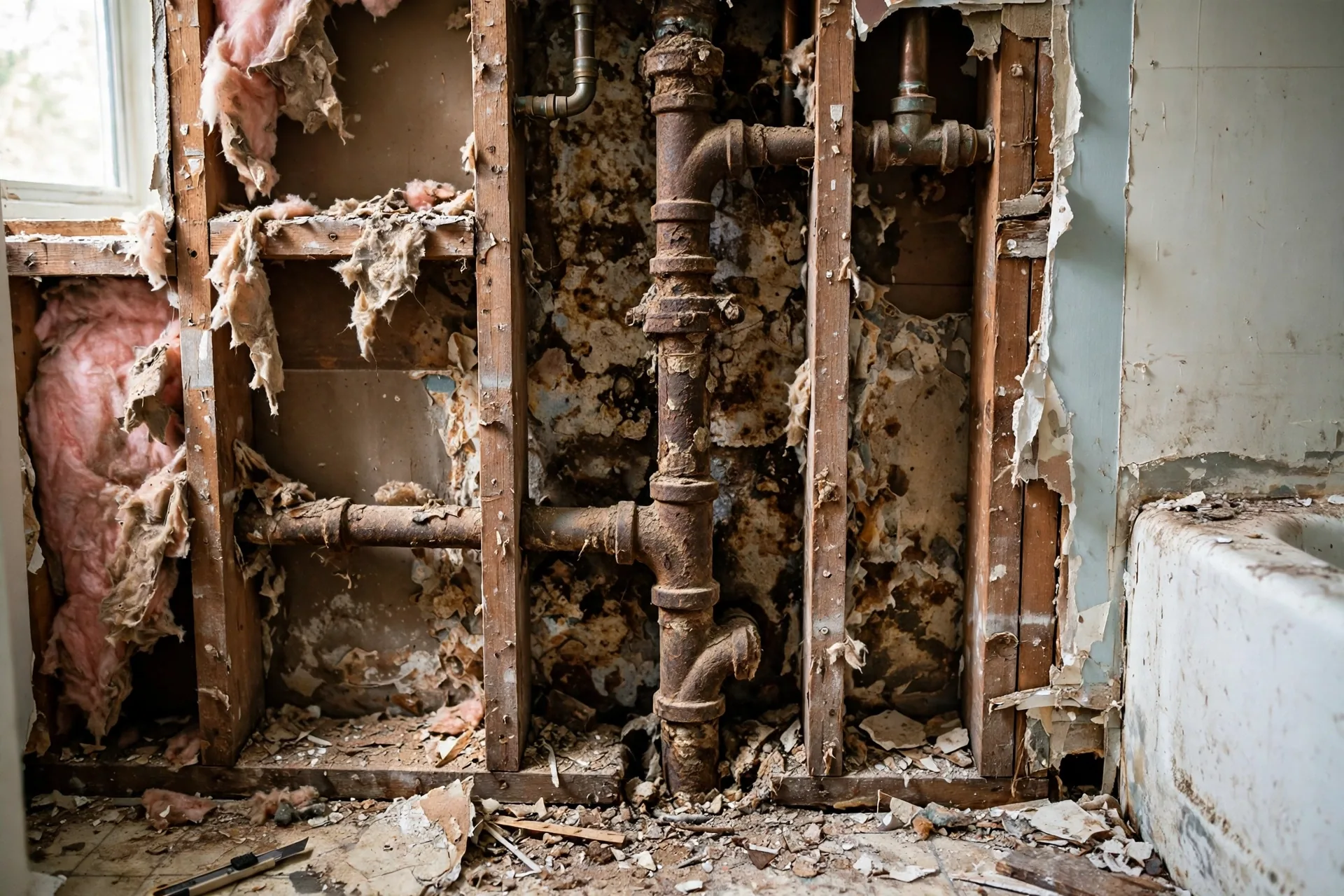
Open one of those earlier homes up. Peel the drywall back. The era tells on itself, every time. Galvanized supply lines, maybe. Choked with mineral scale, decades of it built up inside. Or cast-iron drains. Sturdy-looking from the outside, they are. Touch one, disturb a joint, and it crumbles. Then there are the 1990s ABS updates, some tidy, some less so, installed quickly during a previous owner’s weekend push.
So renovators who’ve done this a while? They flag $2,000–$6,000. That’s for older-home plumbing remediation, on a full gut renovation. Can a job blow past that band? Sure it can. A stack needing full replacement will do it. So will opening up a section of main line. But the common surprises, the usual stuff, the range covers it. Put a 1978 bathroom next to one built in 2008. The gap explains itself. The newer room often keeps a workable rough-in. The older room frequently cannot, and pretending otherwise helps nobody.
Cover yourself, then. How? Older stock changes it. Contingency-wise, carry more. More than feels comfortable, honestly. For a straightforward project, people quote Ten percent most often. But a house that predates modern plumbing materials? 15% is the safer cushion there. And no, you don’t set that money aside for fun. Nobody does. It’s room. Room for whatever the wall cavity’s hiding, because demolition gives you the first honest look inside and not a moment before. Before that look? A contractor’s pricing on faith, basically, because they can only price confidently on what they can actually see.
Where the Money Actually Goes
Totals lie by hiding things. One total on its own conceals more than it shows, every time. Split the project into parts instead. Suddenly the quotes you’ve collected get easier to compare, much easier. Take $35,000. A full renovation at that number. Worked example, call it. Now look where those dollars usually land.
Plumbing’s the first chunk. Of that total it tends to take $5,000–$9,000. What are you paying for? Rough-in work, mostly. Setting each fixture properly, that too. And a shower valve. Buried behind tile, that valve, likely for a couple of decades, so going cheap there? False economy, that is. Now convert a tub to a shower. This piece climbs. It has to, because the drain relocates. And older homes? They pile remediation on top of all of it.
Electrical next. Budget $2,000–$4,000 for it on a typical job, that’s the usual account. What’s in it? New bathroom circuits. A dedicated GFCI circuit. Lighting. And an exhaust fan, vented outside, to the exterior, because that’s what code demands. Heated floors in the plan too? Allow another $1,500–$3,000 then. How much floor you cover decides where in that range you land. On a cold Fraser Valley morning that extra spend earns fans quickly.
Tile. That’s where the biggest cheque usually gets written. Labour and materials together, $8,000–$15,000. Most homeowners stare at the price on the box. The box isn’t the cost, though. The installer’s hours are. Those matter far more. Say it’s 12×24 porcelain. Grid pattern, straightforward layout. That moves at a decent pace, it does. Now add things. A niche. A built-in bench. A mosaic band, a curbless threshold. Different week entirely for the tiler. Large-format pieces punish every flaw in the substrate, any flaw at all. And small mosaics? They multiply the labour. Every wall, every section.
Fixtures and a vanity. Most Langley projects? They land around $4,000–$8,000 there. Inside that envelope you’ve got the lot. The toilet. The vanity itself. Faucets, the shower valve and trim. Plus either a tub or a shower base. Stock options anchor the low end. Mid-range brands push you up, toward the middle, higher sometimes. Pick your level. And pick it early. The actual products drive the rough-in measurements, they do. Swap a vanity after the pipes are set and you’ve found yourself an expensive way to change your mind.
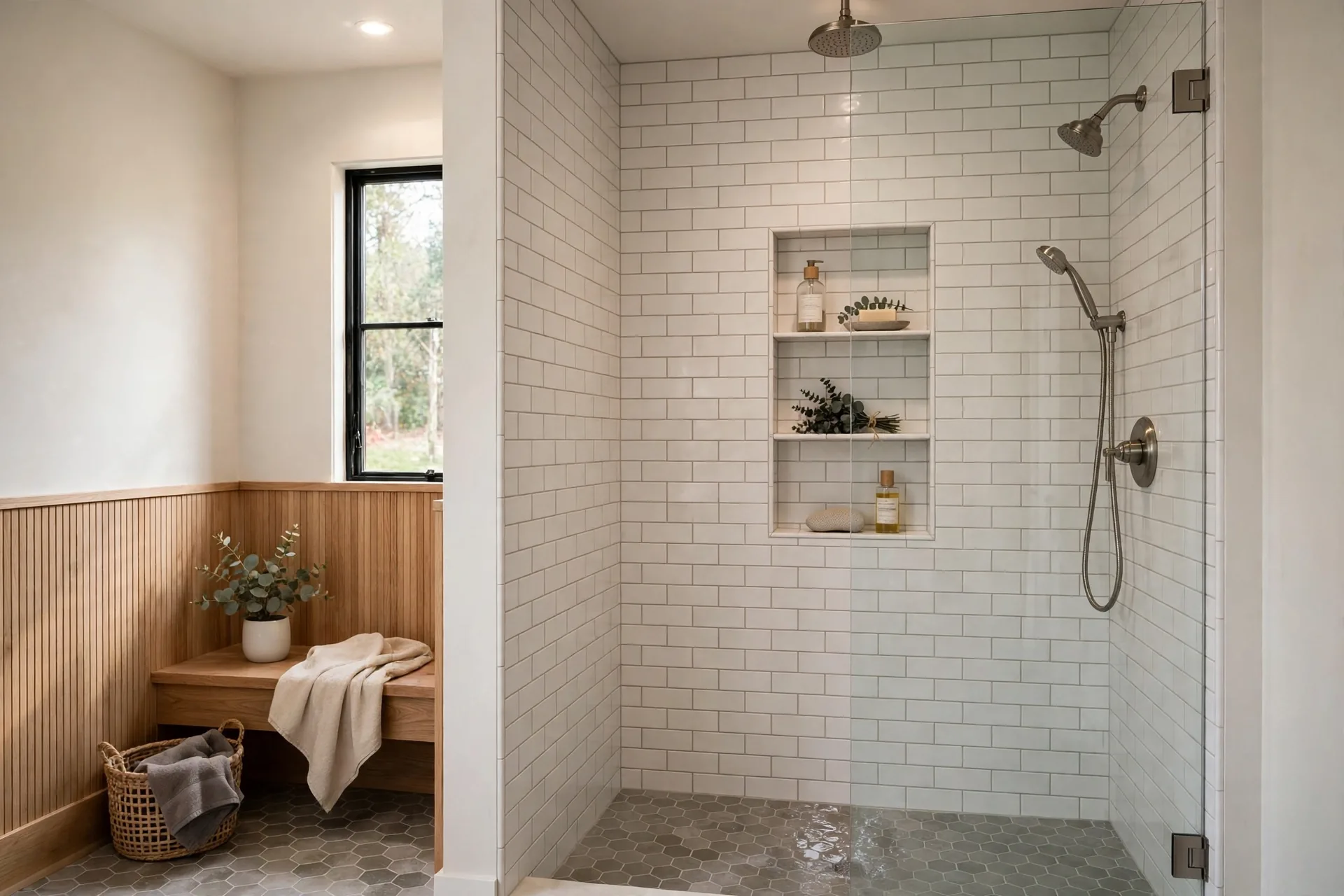
Then glass. Mirrors, accessories, the rest of it. Add a further $1,500–$4,000 for that lot. Frameless shower glass catches people out the most. It looks like almost nothing, that panel. Nearly invisible. But it still needs measuring. Custom measuring, and only after the tile work’s complete. Then a specialist crew to hang it. Hang it right.
Last stretch. Paint, drywall, finishing. Usually $2,000–$4,000, that stretch. Nothing glamorous in it. Moisture-resistant board. Careful priming. Paint that can take daily steam, day after day. Not glamorous purchases, any of them. But stare at them you will. Every morning, that surface. Rush them and it shows.
Finishes: Where Budgets Drift Sideways
Walls open? Structural work settles down after that. It tends to stay predictable, mostly. Finishes? Less obedient, the lot of them. A project starts around $30,000. It ends near $45,000. Happens all the time, and owners look back and can’t name the moment it happened. No single moment, though. There were forty small upgrades. Each one reasonable on its own. Each one adding a few hundred dollars while the total just climbed. Quietly.
That drift can be tamed, though. Rule set first. Before anyone quotes the job, that’s when. Two splurges. That’s the rule. And the rest of the list? Solid standard choices. Hold it there. Plenty of Langley households pick the same two. A walk-in shower, proper glass on it. Heated floors underfoot. Others go a different way. The allowance goes on a floating vanity. Concealed plumbing behind it, tile carried underneath. Everything else stays restrained with them. Either way it works out the same. Two priorities, picked honestly, keep a project sitting mid-range. Not pressed up against the ceiling.
Taste counts, sure. But order? It counts just as much. Fixtures first, settled well ahead of rough-in day. Tile selections? Finalise those before waterproofing begins. The membrane depends on them. So does the layout planning. And glass? The glass company measures last. Only after the tile’s finished. Cured too. Never earlier. Reverse a step and you’ve bought rework. And rework turns that relaxed we’ll figure it out later into a second bill. One you didn’t plan for.
Permits, Inspections and the Langley Timeline
BC rules, then. When does a building permit come into it? Move plumbing and it does. Alter electrical circuits, touch structure, same answer. Inspections come at rough-in. Plumbing, electrical, both of them. Before the walls close, before the work gets hidden, that’s the point. And here’s the Langley wrinkle. The City administers its own process. The Township administers its own too. Requirements differ between them. Timelines differ as well. So don’t borrow a neighbour’s experience. Not if they’re across the boundary. Confirm the current details with your municipality instead.
Permits sorted? Good. Now the build itself. A straightforward bathroom usually takes three to six weeks. On site, that is. And permit processing? That happens beforehand. Outside the window entirely. Then there’s spring. Busy, spring, right across the Valley. Permit waits stretch. Crew availability stretches with them. Catches people out, that does, the ones who assume a start date is theirs the moment they sign.
Materials cause the other classic delay. A custom vanity? It doesn’t show up overnight. Specialty tile doesn’t either. Neither does frameless glass. Order any of them late and watch what happens. Tidy four-week plans unravel. Into eight-week slogs, they unravel. Sounds backwards at first, the fix. It works though. Slow items first. Order them, confirm they’re actually on their way. Only then start tearing the room apart.
Comparing Langley numbers with a nearby city? Plenty of people do. Our Abbotsford bathroom renovation cost guide covers comparable ground, and it’s only a short drive east. The housing stock there, its age, how contractors are booked up? A familiar pattern, all of it.
Frequently Asked Questions
How much should I budget for a bathroom renovation in Langley in 2026?
Smaller bathroom first. Back to the studs with it? Budget $18,000–$32,000. Main bathroom? $28,000–$48,000. Ensuite with higher-end finishes? $32,000–$58,000. Planning bands, those. Not promises. And if your home’s got galvanized plumbing in it? Cast-iron that needs upgrading? Expect to finish up in the upper portion. Whichever band fits your project, the top of it, most likely.
Does living in Langley City instead of the Township change the price much?
Nothing consistent. Nothing you’d bank on. Township jobs pick up extra costs sometimes. Travel, delivery, that kind of thing. Toward Aldergrove especially, or out on rural roads. City jobs can work the other way. Crews stack nearby jobs close together and that helps. Across a whole renovation, though, the logistics gap? Most often it lands between a few hundred dollars and $1,500. So the boundary line matters less than you’d think. The contractor’s local workload matters more.
Why does a tiny bathroom cost so much for its size?
Because the fixed costs barely shrink with the room. You still need a plumber and an electrician to attend, inspections to pass, and a full set of fixtures to buy, yet all of that spend gets divided by very little floor area. Run the numbers on a compact 5×8 and you’ll see it. $350–$500 per square foot, it can reach. A larger ensuite settles closer to $250–$350 per square foot, by comparison.
Will my Langley bathroom project need a permit?
Moving plumbing? Changing electrical circuits? Altering structure at all? Then yes, in most cases you’ll need one. A surface-level refresh is different. Leave the plumbing untouched, leave the wiring untouched, and one may not be required. Offices, though. Langley City runs its own. The Township runs a separate one. So check first. Check with the office that covers your address, before any work starts.
How long will a typical Langley bathroom renovation take from start to finish?
Three to six weeks. That’s the site work, for a renovation without major surprises in it. Permit time goes ahead of that. Add it on. And if the walls open up and the older plumbing needs remediation? Add more again. Materials cause most of the slips, schedule-wise. So order early. The custom vanity, the specialty tile, the frameless glass, all before demolition begins. That protects your timeline better than almost anything else you could do.
Planning a Bathroom Renovation in Langley?
Two honest answers. Start there and the budget conversation gets easier, right away it does. First one. How old is the plumbing? The stuff hiding behind your tiles. Second one. Your fixtures. Staying put, are they? Or moving to new positions? Faucet finishes come later. Those two answers shape the cost more. More powerfully than any finish you’ll pick, honestly.
Permit route next. Confirm it with the correct Langley office, the one for your address. And quotes? Insist on separation when you compare them. Rough-in work on its own line. Tile labour on its own. Finish selections separate too, so you can actually see what you’re paying for. The contingency? Keep it aside. For whatever demolition uncovers. Even if you hope you never touch it.
Want to talk it through? Grounded in your layout, not a generic one, and in the age of your home? Call us at (236) 613-0038. Measurements help. Bring the room measurements with you, and a rough idea of what you want to change. Then we can walk it through together. A realistic 2026 range, for your place specifically. Before you commit to anything.