
The white crust on the kettle gave it away first. Then the spots on the glasses, the stiff towels, the shower head that sprayed sideways because half its holes were furred up with scale. The family in West Abbotsford had lived with it for years, assuming that was just how water was. It is, in parts of the Fraser Valley. Some of it, anyway. Groundwater here runs through limestone and mineral-rich soil, and it picks up calcium and magnesium on the way, and those two minerals are what make water hard. Hard water does not make you sick. It does make everything else harder — your appliances, your plumbing, your skin, your laundry. Water softener installation cost BC — the number depends on how hard your water actually is, what kind of system fixes it, and how far your plumber has to run pipe and drain to get the thing installed. Test first. Buy second. That order saves more money than any sale price ever will.
Test the Water Before You Spend a Dollar
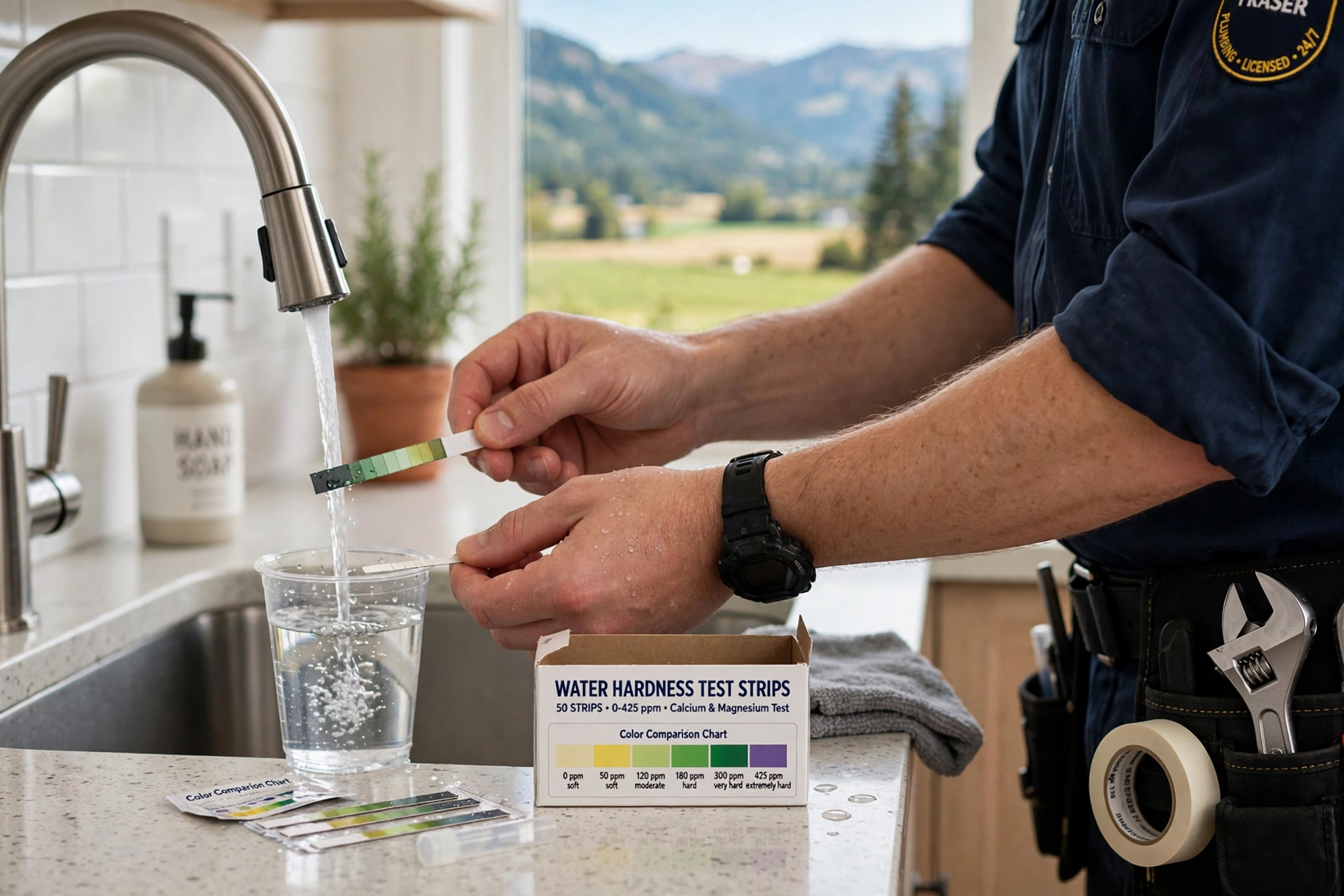
A test strip kit from a hardware store costs $15 to $30 and gives a rough reading in a minute. A proper lab test through a water treatment company runs $50 to $150 and tells you hardness plus iron, manganese, pH, and sediment — the other characters in the story, because iron in the water changes the system you need. Many plumbing companies in the Fraser Valley will test your water free as part of a quote, and that is worth taking them up on, provided you get the actual numbers in writing. Ask for grains per gallon. Ask for iron. Ask whether the water needs a filter before the softener, or a softener alone. A company that quotes a system without testing the water is guessing. Politely decline the guess.
Water Softener Installation Cost BC: The 2026 Ranges by System Type
For a standard home water softener installation BC project — system supplied and fitted by a licensed plumber, main-line install near the water entry, a drain and a power outlet within reach — most 2026 Fraser Valley projects land in these bands. The ranges below are 2026 planning ranges for BC, built from system pricing and local plumbing labour. A budgeting aid, not a quote.
| System type | Best for | 2026 planning range (installed) |
|---|---|---|
| Salt-based ion exchange, 32,000 grain | Small household, moderate hardness | $1,800 – $3,200 |
| Salt-based ion exchange, 48,000 grain | Family home, moderate to hard water | $2,500 – $4,500 |
| Salt-based ion exchange, 64,000 grain | Large home or well water, very hard | $3,500 – $6,000 |
| Salt-free conditioner, whole house | Light scale control, no salt wanted | $1,500 – $3,500 |
| Twin-tank salt-based system | Large household, no downtime wanted | $4,000 – $7,500 |
| Iron filter plus softener combo | Well water with iron | $4,500 – $9,000 |
| Reverse osmosis, kitchen tap only | Drinking water polish | $600 – $1,500 |
Water softener system cost on its own, device only, no install: a basic 32,000 grain salt-based unit runs $900 to $1,800, a mid-range 48,000 grain unit $1,400 to $2,800, and a premium twin-tank or high-capacity unit $2,500 to $5,000. Labour on top is usually $500 to $1,200 for a straightforward install, and $1,200 to $2,500 when the plumbing needs rerouting, a drain has to be added, or the water entry is in an awkward spot. The system is the big part of the bill here, unlike a thermostat, but the plumbing still moves the total by a thousand dollars either way. That is the part people forget to budget for.
The Drain, the Power, and the Plumbing That Moves the Price
The drain is the usual culprit. A softener regenerates by flushing salty brine through the resin bed, and that discharge water has to go somewhere legal. A floor drain nearby, a laundry standpipe, or a utility sink are all fine. No drain within reach, and the plumber has to run one — cutting into a drain line, adding a trap, running pipe through a finished wall — and that work alone can run $400 to $1,500. Some older homes in Clayburn have the water entry in a crawlspace with no drain at all, and the drain run becomes the job. Check where your main water line enters the house before you get a quote. Stand there. Look for a drain within a few metres. Look for a power outlet. Look at how much room there is around the pipe. A softener and its brine tank need roughly a metre of floor space, plus clearance to pour salt in. A cramped utility closet with the water heater, the furnace, and the laundry all fighting for space is a slow install, and slow installs cost more.
Plumbing reroutes are the second cost driver. The softener sits on the main line, so all the water in the house passes through it, or it sits on a loop that someone thoughtfully installed when the house was built. Newer homes in West Abbotsford sometimes have a softener loop roughed in near the water entry — two capped pipes waiting for a system — and an install on a ready loop can be done in half a day. No loop, and the plumber cuts into the main, adds bypass valves, and replumbs the entry. That is normal work, $500 to $1,200 in labour, but it takes longer in a house where the main is buried behind drywall or runs through a finished basement ceiling. Copper, PEX, or galvanized pipe all change the job slightly, and galvanized pipe in an older house can turn a simple cut into a replacement of a whole section. The plumber finds out when they open it up. Ask what happens if the pipe is worse than expected, and get the answer before the work starts, not after the wall is open.
Power is the cheapest of the three. A standard outlet within a couple of metres does the job, and most control valves draw very little power. No outlet nearby, and an electrician adds one for $200 to $400. Some softeners have battery backup for the control valve, which keeps the settings through a power cut, and that is worth having in a valley where winter storms take the power out a few times a year. A softener that loses its settings in a storm and regenerates at the wrong time wastes salt and water until someone notices.
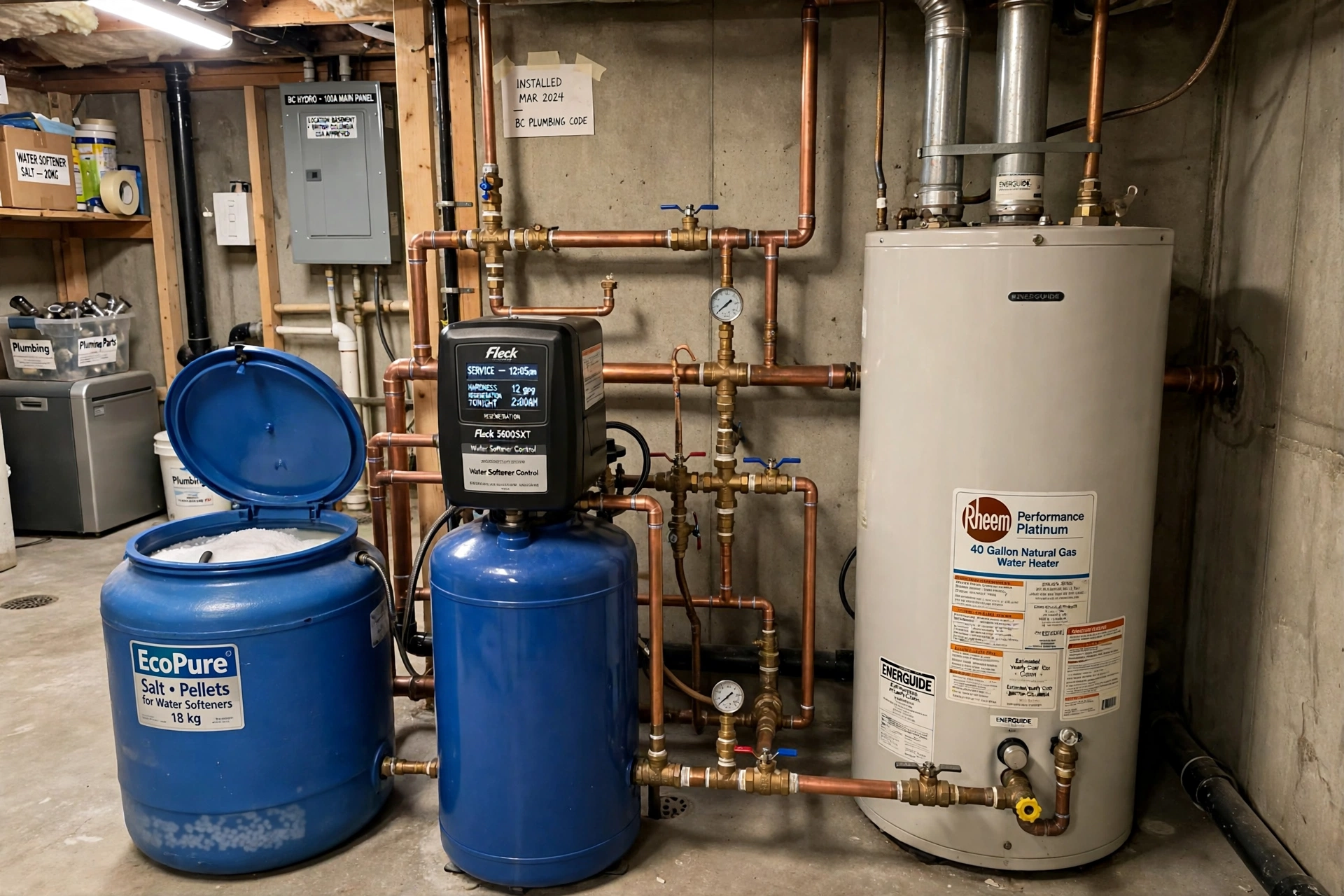
Well Water, Iron, and the Combo Systems
City water and well water are different jobs, and the price shows it. City water in Abbotsford is treated, tested, and generally consistent, so a softener alone usually does the work. Well water is untreated, untested unless you test it, and full of surprises. Iron is the common one. Iron stains laundry orange, stains fixtures, feeds iron bacteria that slime up pipes, and fouls a softener resin bed until the softener stops softening. A softener can handle a little iron, roughly under 2 parts per million, and beyond that it needs help. An iron filter in front of the softener, an air-injection oxidizer, or a greensand filter — $1,500 to $4,000 installed, depending on the type — and the combo system lands at $4,500 to $9,000 all in. Expensive. Also the only thing that actually works. A softener alone on high-iron well water is money spent on a problem it cannot solve.
Water Filtration System Cost: Softener, Filter, or Both?
People use the words softener and filter as if they meant the same thing, and they do not, and the confusion costs money. A softener removes hardness minerals. A filter removes other things — sediment, chlorine, iron, odour, or fine particles, depending on the filter. Some houses need one. Some need both. Some need neither and just want better-tasting tap water, which is a different job entirely.
Water filtration system cost in BC in 2026, as a rough guide: a whole-house carbon filter for chlorine and taste, $800 to $2,000 installed. A sediment pre-filter, $150 to $400. A UV sterilizer for well water with bacteria concerns, $1,000 to $2,500 installed, plus a pre-filter, because UV light cannot sterilize cloudy water. A reverse osmosis unit under the kitchen sink for drinking water, $600 to $1,500 installed, and that one only treats the kitchen tap, not the whole house. A full combo — sediment filter, iron filter, softener, and UV — on a problem well can run $7,000 to $12,000 installed. That sounds like a lot. It is also the price of water that does not stain, smell, or scale anything in the house, and for a family on a well, it is usually worth it. Get the lab test, get the quote itemized by component, and ask which component solves which test result. If a component does not map to a number on your test, question it.
Running Costs: Salt, Water, and the Bill After the Install
The install price is not the whole price, and the running costs deserve an honest paragraph before anyone signs. Salt is the big one for a salt-based system. A family home in the Fraser Valley typically uses 100 to 200 kilograms of salt a year, and a 20-kilogram bag runs $8 to $15 in 2026, so budget $50 to $150 a year for salt. Check the brine tank monthly at first, then settle into a rhythm. A tank that runs dry lets hard water through until someone notices, and a tank overfilled with a salt bridge — a hard crust that looks full from above while the water below is empty — does the same thing. Poke the salt with a broom handle now and then. It sounds silly. It works.
Maintenance beyond salt is light. An annual check, $100 to $200, where a tech tests the water, cleans the injector, checks the drain line, and confirms the settings still match the household. Resin lasts 10 to 15 years in city water, less on high-iron well water, and a resin replacement runs $600 to $1,200. The control valve is the part that eventually fails, usually after a decade or so, and a replacement valve runs $400 to $900 installed. Budget for it the way you budget for a water heater anode rod. Speaking of which, soft water is kinder to water heaters — less scale on the element and the tank — and if your tank is aging, our guide to hot water tank replacement cost in BC covers what a new one runs. The softener and the tank are on the same team, really, and the tank lasts longer with soft water feeding it.
Timing the Install With Other Plumbing Work
If the water entry work touches other plumbing, the timing matters. A softener install pairs naturally with a re-pipe or a rough-in, since the walls are already open and the plumber is already there, and our guide to plumbing rough-in cost in BC covers that side for bigger projects. Do the softener when the plumbing is already apart. It costs less that way, and the drain and the loop go in cleanly instead of as an afterthought.
Frequently Asked Questions About Water Softener Installation Cost in BC
How much does water softener installation cost in BC in 2026?
A standard salt-based system for a family home usually runs $2,500 to $4,500 installed. Smaller systems start around $1,800, larger or twin-tank systems run $3,500 to $7,500, and a well-water combo with an iron filter runs $4,500 to $9,000. All figures are 2026 planning ranges, not quotes.
How do I know if I need a water softener in Abbotsford?
Test your water first. A hardness reading above about 7 grains per gallon, plus scale on kettles and fixtures, spots on glassware, or stiff laundry, points to a softener. City water in Abbotsford is often moderate, while some well-water properties test much harder. Get the number in grains per gallon before buying anything.
What is the difference between a water softener and a water filter?
A softener removes hardness minerals, calcium and magnesium, through ion exchange. A filter removes other things, such as sediment, chlorine, iron, or odour, depending on the filter type. Some homes need one, some need both, and a carbon filter plus a softener is a common pairing. A filter alone will not soften water.
How much does a water softener cost to run each year?
Salt usually costs $50 to $150 a year for a family home, plus a little extra water for regeneration. An annual check runs $100 to $200. Resin lasts 10 to 15 years in city water, and a resin replacement runs $600 to $1,200. Demand-initiated systems use less salt and water than older timer-based models.
Can I install a water softener myself?
A handy homeowner can fit a basic unit where a softener loop, a drain, and a power outlet already exist. Most installs need plumbing cuts, a drain connection, and a correctly sized system, so a licensed plumber is the safer choice. A bad drain connection or a wrong size costs more to fix than the install saved.
Hard water is a slow problem. It does not flood the basement or burst a pipe. It just takes a little life off everything it touches, a kettle here, a shower head there, a water heater a few years early. A softener stops that quiet wear, provided the system matches the water, the drain is done right, and the size comes from a test rather than a guess. Water softener installation cost BC is really three costs in one — the system, the plumbing, and the drain — and the drain is the one that surprises people. Test the water. Get the numbers. Then buy the system that fits them. Want a straight answer for your own water and your own house? Call (236) 613-0038 and talk it through before you order anything.