
One decision runs this entire budget. Not the tile. Not the vanity, not the glass, not the fixture catalogue you have been scrolling through since Tuesday, and not the heated floor you have already half promised yourself in the shower.
The plumbing.
Whether the fixtures stay where they are — that is the decision, and nearly everything else in this guide is just arithmetic hanging off it, the honest, unglamorous kind of arithmetic that decides whether the number at the end has four zeros or five.
Keep the plumbing put and the money stays where you can actually see it — tile, fixtures, vanity, glass, the parts of the room you touch every single morning — but move a toilet, a tub, or a shower drain and the money vanishes into the floor instead, into opened subfloors and new drain runs and patching and hours of labour that leave nothing behind to admire.
That is the whole game, really.
A bathroom is also the one room nearly every trade has to pass through — plumber, electrician, tiler, glazier, painter, sometimes all of them in the same week — which is why, square foot for square foot, it costs what it costs.
The short version: a powder room refresh runs $8,000–$15,000 in 2026. A standard full bathroom runs $18,000–$35,000. An ensuite renovation runs $28,000–$55,000, and a luxury master bath runs $50,000–$80,000+. Moving one fixture can add $2,000–$5,000 on top of these ranges.
1. 2026 Cost Ranges by Project Size
Planning ranges, not quotes.
They are built on typical Fraser Valley contractor pricing for 2026, and they are worth treating as the shape of the budget — the rough outline of what a project like yours tends to cost once the quotes come in — rather than as the number that will eventually sit on a signed contract.
| Project size | Typical scope | 2026 planning range |
|---|---|---|
| Powder room | New vanity, toilet, flooring, paint, light fixture, same plumbing locations | $8,000–$15,000 |
| Standard full bath | Tub or shower, vanity, toilet, tile surround, flooring, lighting, same layout | $18,000–$35,000 |
| Ensuite renovation | Walk-in shower, double vanity, in-floor heat, upgraded tile and glass | $28,000–$55,000 |
| Luxury master bath | Curbless shower, freestanding tub, heated floors, custom tile, frameless glass | $50,000–$80,000+ |
Three things do it. Tile scope. Fixture quality. And whether the plumbing moves.
Chilliwack pricing tracks Abbotsford closely — usually within a few percent either way, sometimes close enough that the same quote gets reused — and most contractors bidding in Chilliwack work Abbotsford and Mission too, which means the crew pricing your bathroom has very likely already done one nearly identical to it a few streets or one city over.
The difference is the drive.
Chilliwack sits at the eastern end of the Fraser Valley; some trades price in the longer commute, and start dates can stretch — sometimes by weeks — in the busy spring and summer months, when every crew in the Valley is booked solid and nobody is in a hurry to drive forty minutes east for a powder room.
2. The Layout Question: Keep the Plumbing or Move It
The table assumes everything stays put. Move a fixture, though, and it is a different job entirely.
Drains have to slope. To the stack, at the right pitch, through joists and subfloor and whatever else the house has buried down there. So the subfloor opens. One moved fixture can add $2,000–$5,000 in labour and patching — and two or three moves can quietly push a standard renovation up into ensuite pricing, which is not where anybody planned to land.
Settle the layout first. Before the tile samples come home. Before the vanity catalogue. A layout that looks better on paper but moves every fixture is the most common reason a bathroom budget fails, and it fails early — everything after it is catching up, and paying for the mistake twice.
3. Why Small Bathrooms Cost More Than Expected
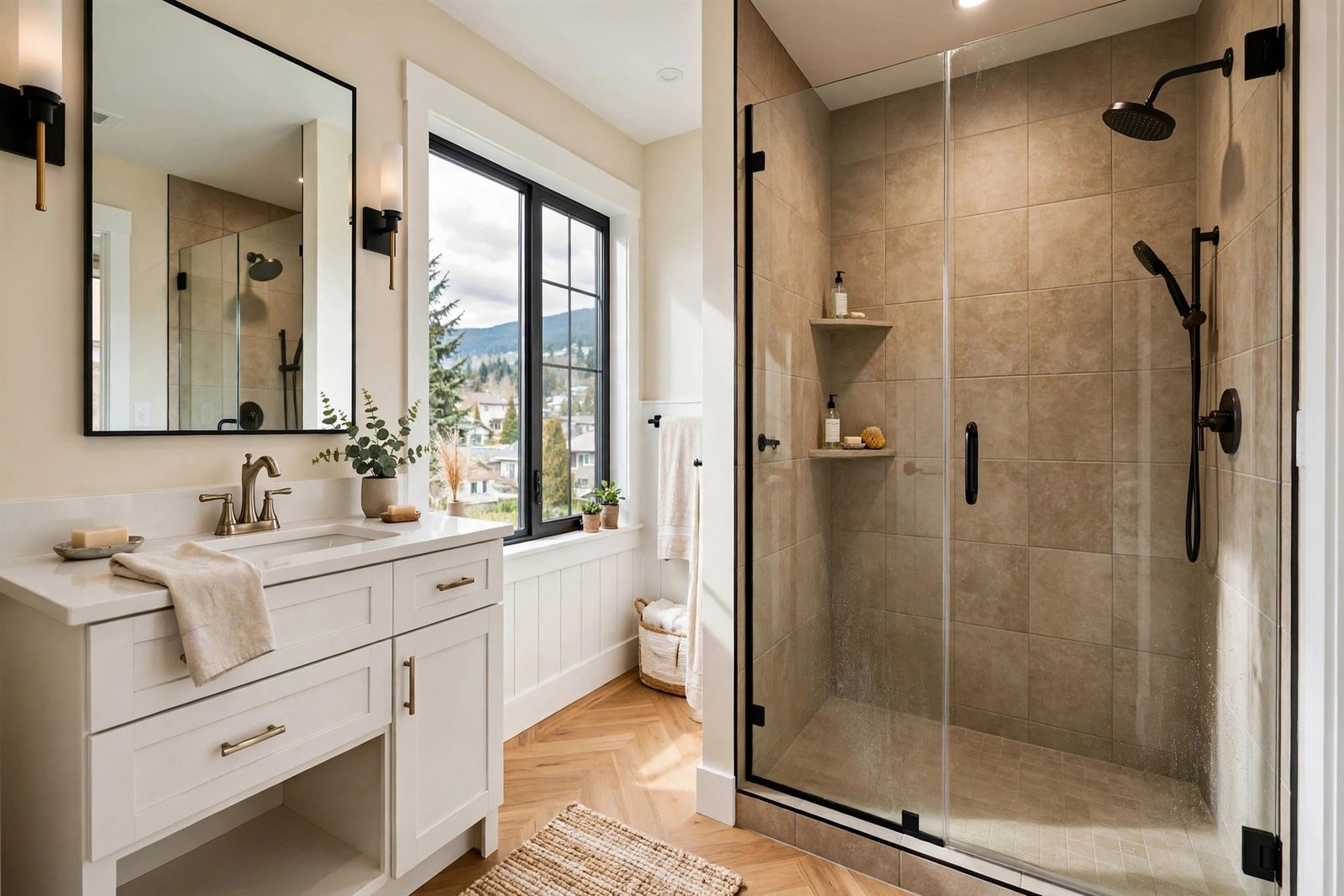
A small bathroom costs less. Just not proportionally less.
And the gap surprises people every single time — the quote comes in for the smallest room in the house and it reads like a typo, except it isn’t one, and the line items, once you actually walk through them, are depressingly easy to justify.
Blame the fixed costs. They barely notice room size:
- The plumber roughs in the same three or four fixtures.
- The electrician wires the same circuits.
- The tiler sets up, waterproofs and grouts the same wet area.
The result: a 5×7 hall bath in a 1970s Chilliwack rancher can land at $20,000–$30,000.
Real money.
And it is the smallest room in the house — which is exactly why the number shocks people when it lands on the kitchen table next to the tile samples they picked out on Saturday.
Materials are where a small bathroom gives some back — less tile, less flooring, a smaller vanity, a smaller glass panel — because square footage is the one thing a small room genuinely has less of, and materials are the one part of the bill that scales with it.
The rest can be held down:
- Keep the tub, or convert it to a simple shower instead of a curbless build.
- Choose a standard alcove tub over a freestanding one.
- Pick a vanity that fits the existing plumbing rough-in rather than forcing the rough-in to move.
- Consider a pocket door or barn-style slider where an in-swing door fights the vanity. A few hundred dollars, instead of the thousands a layout change costs.
The same logic applies to a small ensuite. Our guide to bathroom renovation costs in Abbotsford runs the fixture-by-fixture breakdown that applies across the Fraser Valley.
4. Chilliwack Housing Stock and What It Hides
Walls keep secrets.
The housing stock decides which ones.
Sardis and the older pockets near downtown hold 1960s to 1980s homes — original cast-iron tubs, galvanized supply lines, the occasional bathroom fan that was never vented anywhere at all, just a grille on the ceiling blowing moist air into the joists and calling it ventilation.
None of it shows. It surfaces once the walls open. And it adds to the bill.
Garrison Crossing and the newer subdivisions on the south side are a different story: bigger, newer bathrooms, mostly cosmetic work, fewer surprises — houses young enough that the plumbing is still the plumbing the builder put in, which sounds like a small thing until you have priced the alternative.
And out toward Rosedale, Popkum and the rural acreages, older homes sometimes have bathrooms tacked onto additions, with plumbing runs that take longer to service, which means every quote for those houses carries a little extra labour just for the distance the pipes have to travel.
Check three things before collecting quotes:
- Older homes often hide poly-B or galvanized pipe. If your home predates the mid-1990s and still has original supply lines, budget for replacing them while the walls are open. It costs now. It costs considerably more as an emergency later — behind finished tile, over a weekend, with water where water should never be — and most insurers and renovators in the Valley treat the planned version as a “while we are in there” upgrade.
- Ventilation is not optional in this climate. Chilliwack’s wet winters require a bathroom fan that vents outside, sized for the room, with a timer or humidistat. Mould remediation in a finished bathroom costs far more than a proper fan.
- Winter scheduling can work in your favour. Demand peaks in spring and summer. Book November through February and you may get a better start date — and occasionally sharper pricing — from crews that would rather keep working through the quiet months than lose their best people to whoever is hiring in April.
Get at least three detailed quotes. Then ask each contractor the question that separates the honest ones: what happens when something unexpected appears behind the tile? The honest answer is an allowance, or a per-item rate for surprises. A fixed price that claims to cover everything usually means corners get cut when the surprise arrives, because the surprise always arrives — a rotted sill plate, a drain elbow that crumbles in the plumber’s hand, wiring nobody alive remembers installing.
5. Where the Money Goes on a $25,000–$30,000 Bathroom
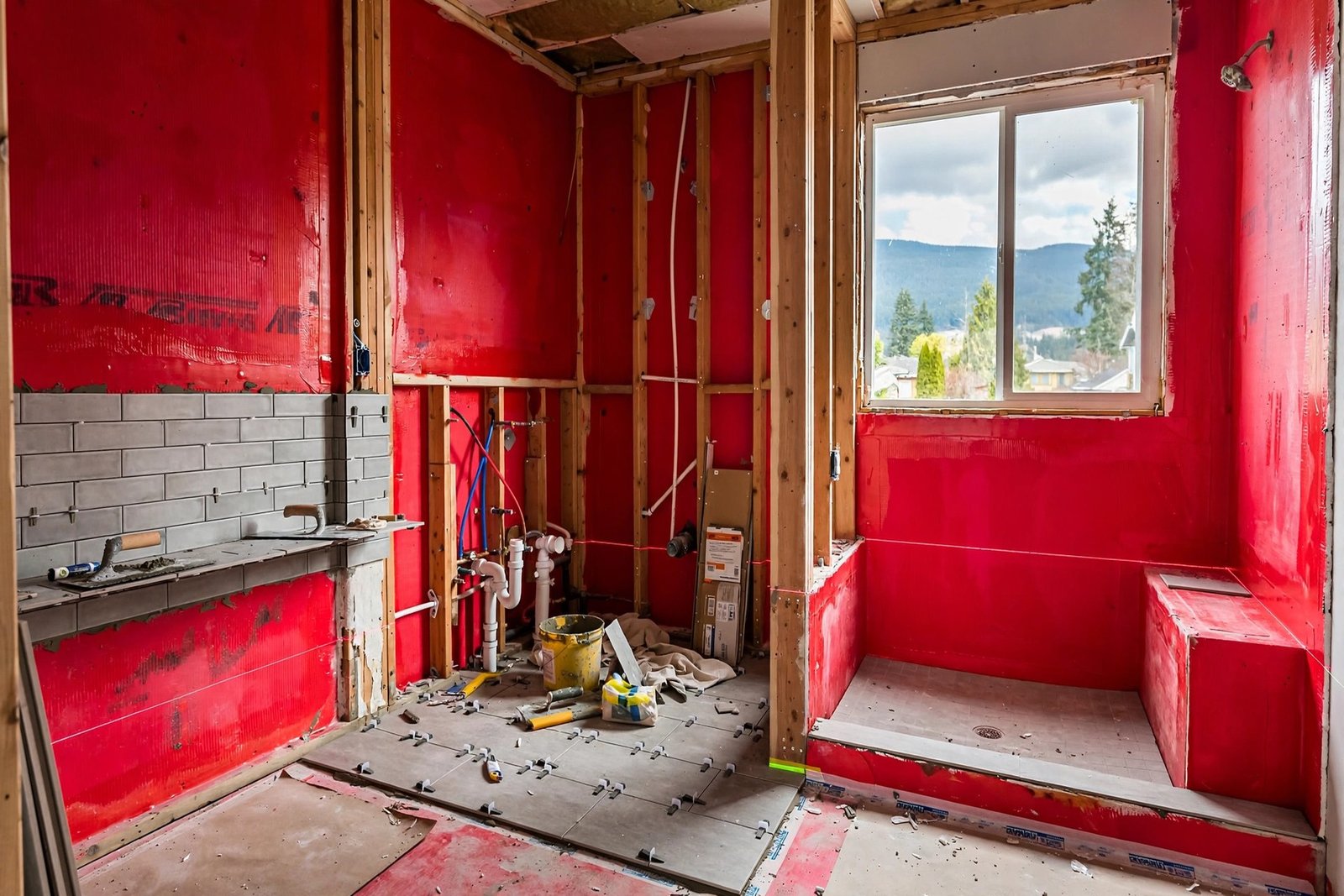
Take a standard $25,000–$30,000 full bathroom and split the total:
- Tile and waterproofing: 25–35 percent
- Plumbing fixtures and valves: 20–30 percent
- Labour for plumbing and electrical: 15–25 percent
- Vanity and counter: 10–15 percent
- The rest: glass, lighting, paint and small items
Tile labour is the line most people underestimate — badly, and usually by the most. Setting tile in a bathroom is slow work: niches, corners, plumbing penetrations, a pattern that has to line up around all three, on walls that are never quite as flat as the tile wants them to be, in a room too small for two people to work in at once. A large-format tile or a patterned layout takes longer than a basic subway pattern, sometimes much longer. Our breakdown of bathroom tile installation costs in BC prices the tile scope separately.
Waterproofing is the other underrated line.
A proper membrane system behind the tile in the shower area is standard practice among good Fraser Valley tilers, and it is the difference between a shower that lasts twenty years and one that leaks into the wall cavity at year six — quietly, invisibly, the whole time.
When a quote comes in notably cheaper than the others, check this first: is waterproofing beyond a basic backer board actually in it? Often it isn’t. That is where the money went.
6. Permits: What the City of Chilliwack Requires
It depends on what changes. It always depends on what changes.
Cosmetic work — new fixtures in the same locations, new tile, new vanity, paint, flooring — generally does not need a building permit, which is why a cosmetic refresh can start the day the materials arrive instead of the day a permit office gets around to your file. The moment plumbing moves or is added, or electrical circuits are added or relocated, permits and inspections generally enter the picture in BC. Structural changes, such as moving a wall or enlarging a window, are permit territory too.
In practice, most full bathroom renovations in Chilliwack that keep the layout still touch permits at least for the electrical work. Anything that relocates a drain or adds a shower where a tub used to be should expect plumbing inspections. The City of Chilliwack’s building department can confirm what a specific project needs.
Permit fees are modest.
The real cost of skipping them is a stop-work order — or a problem at resale, when a buyer’s inspector asks whether the work was permitted and nobody — not the seller, not the contractor, not the folder of receipts in the kitchen drawer — can produce the paper.
One rural note.
Homes on septic systems — common in the rural parts of the district — need care when adding bathroom fixtures, because the septic field was sized for the original fixture count, and it does not care that your teenagers now each want their own shower. Adding a bathroom to a septic-served home is a different project. Different rules entirely. Confirm capacity with the relevant authority before planning around it.
Frequently Asked Questions
How much does a bathroom renovation cost in Chilliwack, BC?
For 2026, plan on $8,000–$15,000 for a powder room, $18,000–$35,000 for a standard full bathroom, $28,000–$55,000 for an ensuite renovation, and $50,000–$80,000 or more for a luxury master bath built around a curbless shower and a freestanding tub. Moving plumbing fixtures is the biggest budget variable — keep the layout and a project typically holds to the lower half of its band. Planning ranges. Not quotes.
Do I need a permit to renovate a bathroom in Chilliwack?
Generally not, if it’s cosmetic — no plumbing or electrical changes, no permit needed in most cases. Moving or adding plumbing, relocating or adding electrical circuits, and any structural changes generally do require permits and inspections. Confirm the specifics with the City of Chilliwack before work starts. Requirements vary with the scope, and permitted work protects you at resale.
How much does it cost to renovate a small bathroom in BC?
More than you’d hope. A small hall bath typically runs $18,000–$30,000, because the fixed labour costs of plumbing, electrical and tile work change little with room size, and a tape measure, sadly, is not one of the tools that shrinks them. Materials cost less in a small room, so the levers that actually work are unglamorous: a standard tub, the layout left alone, modest tile.
What is the most expensive part of a bathroom renovation?
Tile and waterproofing labour, most of the time. It usually takes the largest share, followed by plumbing fixtures and the plumbing labour itself. After that come the usual suspects — glass shower panels, in-floor heating, custom vanities — the add-ons that push a project from the mid-range into the luxury band, one reasonable-sounding upgrade at a time.
How long does a bathroom renovation take in Chilliwack?
A powder room: one to two weeks. A standard full bathroom typically runs three to five weeks from demolition to final clean, assuming materials are on site. Ensuite and luxury projects run five to eight weeks, sometimes longer when the glass is late, and the glass, for reasons nobody has ever adequately explained, is very often late — plan for it. Custom tile, glass lead times and permit inspections are the usual schedule stretchers, so order the glass — and any special-order tile — before demolition starts.
Getting a Chilliwack Bathroom Priced Properly
Start with the layout.
Bathroom renovation cost in Chilliwack, BC stays predictable when the toilet, tub and shower stay where they are. If the plumbing has to move, get that number settled before choosing finishes — before, not after. Then get detailed quotes, confirm the permit situation with the City of Chilliwack, and make sure waterproofing is spelled out in the contract rather than assumed, because the most expensive words in any renovation are “I thought that was included,” usually spoken in week three, in a room with no floor. Want a second set of eyes on the plan, or a realistic budget range for your specific bathroom? Call us at (236) 613-0038 and we will talk it through honestly — no pressure, just straight answers.