
Half the ranchers in Clearbrook and Matsqui were built in the years when asbestos was still a standard ingredient in building materials. Drive through the 1970s and 80s subdivisions off Clearbrook Road or the older pockets of Matsqui Prairie and you are looking at thousands of homes where ceiling texture, vinyl floor tile, pipe wrap, and drywall mud may contain asbestos. That does not make those houses dangerous to live in. It does make testing a mandatory line item before you start tearing things apart — WorkSafeBC requires a qualified person to assess suspect materials in pre-1990 buildings before renovation work disturbs them, and high-risk removal has to be handled by a licensed contractor. This guide covers what testing costs in BC, what abatement costs by risk level, and the renovation moments that trigger the whole process.
The short version: budget $150–$500 for basic asbestos sampling (a full pre-renovation survey runs $500–$1,500), and $2,000–$30,000+ for removal depending on the WorkSafeBC risk classification — low-risk jobs like intact vinyl tile removal sit at the bottom, high-risk jobs like vermiculite insulation sit at the top. Testing is non-negotiable for pre-1990 homes; guessing is not a strategy.
1. Asbestos Testing and Removal Costs at a Glance
| Job | 2026 BC planning range | Notes |
|---|---|---|
| Single bulk sample (lab analysis) | $50–$150 per sample | Plus a callout or sample-collection fee |
| Targeted sampling visit (2–5 samples) | $250–$600 | Inspector collects, accredited lab analyzes |
| Full pre-renovation survey | $500–$1,500 | Whole-house or whole-project-area assessment with written report |
| Low-risk removal | $1,000–$3,000 | Non-friable materials, e.g. intact vinyl floor tile |
| Moderate-risk removal | $3,000–$10,000 | Drywall with joint compound, textured ceilings |
| High-risk removal | $8,000–$30,000+ | Vermiculite insulation, pipe insulation, friable materials |
Removal pricing is driven less by the material itself than by the containment it demands: sealed work areas, negative air pressure, decontamination units, specialized disposal, and clearance air testing at the end. A small job with a big containment footprint costs more per square foot than a large job in an open area. Every figure here is a planning range, not a quote — actual prices move with access, area size, and how booked the licensed contractors are.
2. Where Asbestos Hides in Fraser Valley Homes
Asbestos was not one product. It was an ingredient in thousands of them, and the houses most likely to contain it are exactly the ones Abbotsford renovates most: ranchers and split-levels from the 60s, 70s, and 80s. The usual suspects:
- Textured or “popcorn” ceilings, especially in homes built before the mid-80s.
- 9×9 vinyl floor tiles and the black mastic or backing under old sheet vinyl. The small square tile is the classic visual clue, though looks never confirm anything — only lab analysis does.
- Drywall joint compound — the mud on seams and corners — in homes built before 1990. This is the one that surprises people, because it means even “just” removing drywall can trigger testing.
- Vermiculite attic insulation, the pebble-like loose fill. The Zonolite brand is the one most often flagged; if your attic has it, assume testing before anyone touches it.
- Pipe insulation and furnace duct wrap, particularly in older basements.
- Exterior materials: stucco texture coats, cement siding and shingles, roofing felt.
Living with these materials undisturbed is generally considered low risk — the hazard is airborne fibres, and fibres get airborne when materials are cut, sanded, scraped, or broken. That is why the trigger is always the renovation, not the address. A 1978 Clearbrook rancher with original popcorn ceilings is fine to live in and a regulated project the moment you scrape them.
3. When a Renovation Triggers Testing
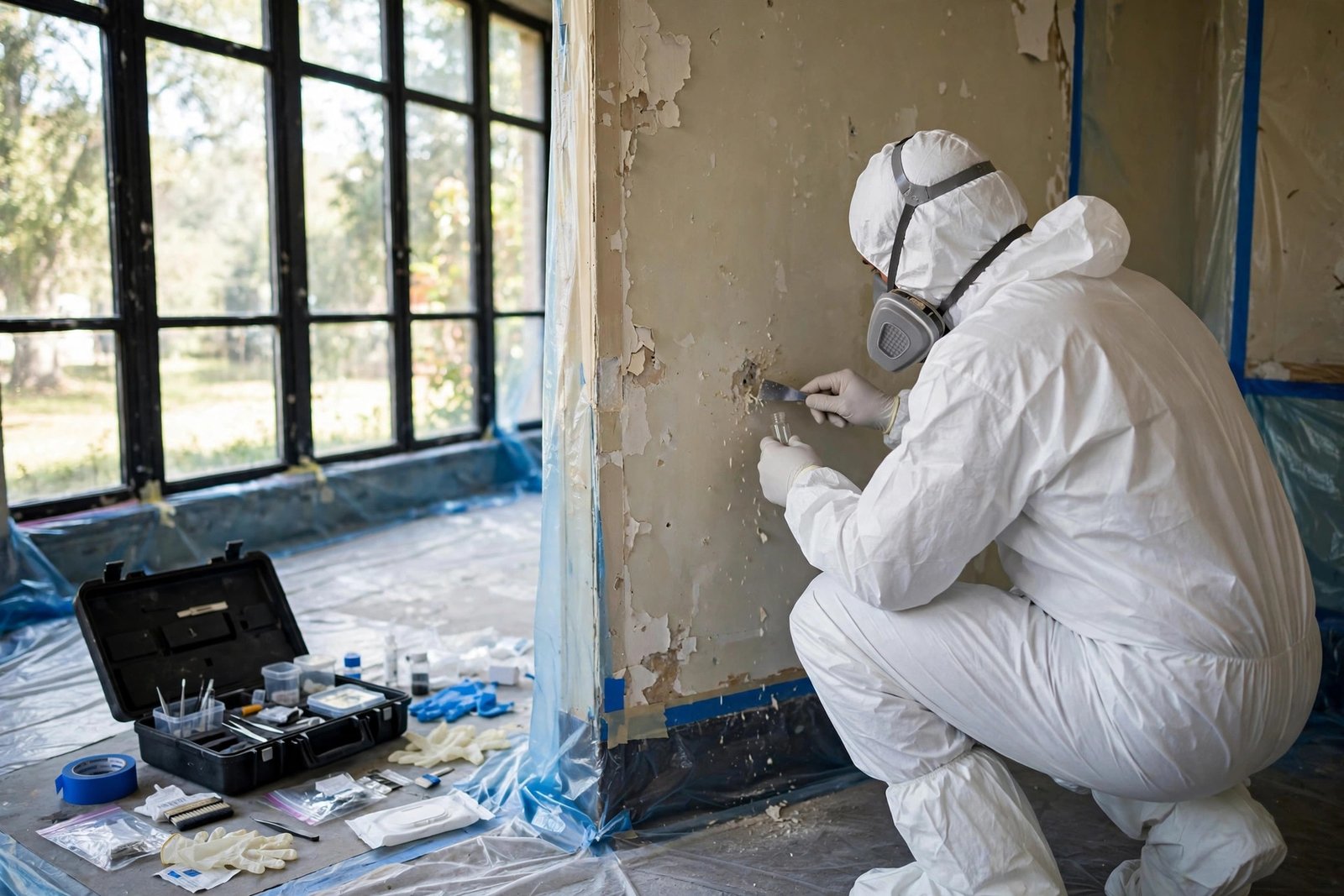
WorkSafeBC’s position is straightforward: before renovation or demolition work disturbs building materials in a pre-1990 building, a qualified person must assess whether asbestos is present. In practice, that means testing is triggered by the work, not by suspicion. If your project includes any of the following in a pre-1990 home, plan on a survey:
- Gutting a kitchen or bathroom — drywall, flooring, and ceiling texture all come out at once.
- Removing flooring, especially vinyl tile, sheet vinyl, or anything glued down before 1990.
- Opening walls or ceilings for electrical, plumbing, or structural work.
- Basement renovations where old insulation, duct wrap, or ceiling materials will be disturbed. If water is the reason for the basement work, our basement waterproofing guide covers the moisture side of that project.
- Topping up or removing attic insulation where vermiculite may be present.
- Exterior work involving old stucco, siding, or roofing.
Contractors who work the Fraser Valley full-time will often flag this themselves and refuse to start demo until the survey is done. That is a sign of a good contractor, not an upsell. And if your project needs a building permit, expect the testing question to come up there too — our Abbotsford building permit guide walks through the permit side of a renovation.
One practical note: schedule the survey early. Lab turnaround is usually a few business days, but the abatement contractor’s schedule is the real bottleneck — licensed firms in the Lower Mainland commonly book weeks out in busy seasons. Finding asbestos the week demo was supposed to start is how a six-week kitchen reno becomes a ten-week one.
4. What Asbestos Testing Costs in BC
A proper test has two parts: collection and analysis. A qualified inspector visits, identifies suspect materials, and collects bulk samples following a documented procedure — material type, location, chain of custody. The samples go to an accredited lab, which typically uses polarized light microscopy to identify asbestos fibres and estimate content.
What you will pay:
- Per-sample lab analysis: $50–$150. Most projects need multiple samples, because different materials — and sometimes the same material in different rooms — must be tested separately.
- Targeted sampling visit: $250–$600 for an inspector to collect a handful of samples from the specific materials your renovation will disturb. This is the right call for a defined project like a bathroom gut.
- Full pre-renovation survey: $500–$1,500 for a whole-house or whole-project-area assessment with a written report. Worth it for whole-home renovations, additions, or anything where the scope might grow mid-project.
Be wary of the cheapest option that skips the written report. You want documentation: which materials were sampled, where, and what the lab found. That report is what your contractor, your permit application, and any future buyer will ask for. A verbal “looks fine to me” from someone without credentials protects nobody.
5. Removal Costs by Risk Level
WorkSafeBC classifies asbestos work as low, moderate, or high risk, and the classification decides the containment, the crew qualifications, and — bluntly — the price. High-risk removal must be performed by a licensed contractor; the other tiers still require trained workers following prescribed procedures.
Low risk ($1,000–$3,000 typical): non-friable materials that can be removed without breaking them into dust — the textbook example is intact vinyl floor tile lifted whole. Containment is modest, the crew is small, and the job often finishes in a day.
Moderate risk ($3,000–$10,000 typical): drywall with asbestos-containing joint compound, textured ceilings, and similar jobs where the material breaks during removal. Expect sealed work areas, more crew time, and careful waste handling. This is the tier most Abbotsford kitchen and bathroom renovations land in when the 1978 drywall tests positive.
High risk ($8,000–$30,000+ typical): friable materials — vermiculite insulation, pipe insulation, anything already crumbling. Full containment with negative air pressure, decontamination units, respirators, a licensed contractor, and clearance air testing before the barriers come down. A full attic of vermiculite in a rancher is the classic $15,000-plus job; large or complex projects run higher.
What pushes any job toward the top of its range: difficult access (crawlspaces, steep attics), materials spread across many rooms, occupied homes that need the work area sealed off from living space, and disposal logistics. Asbestos waste goes to authorized facilities only — it is not a trip to the transfer station.
6. How Licensed Abatement Actually Works
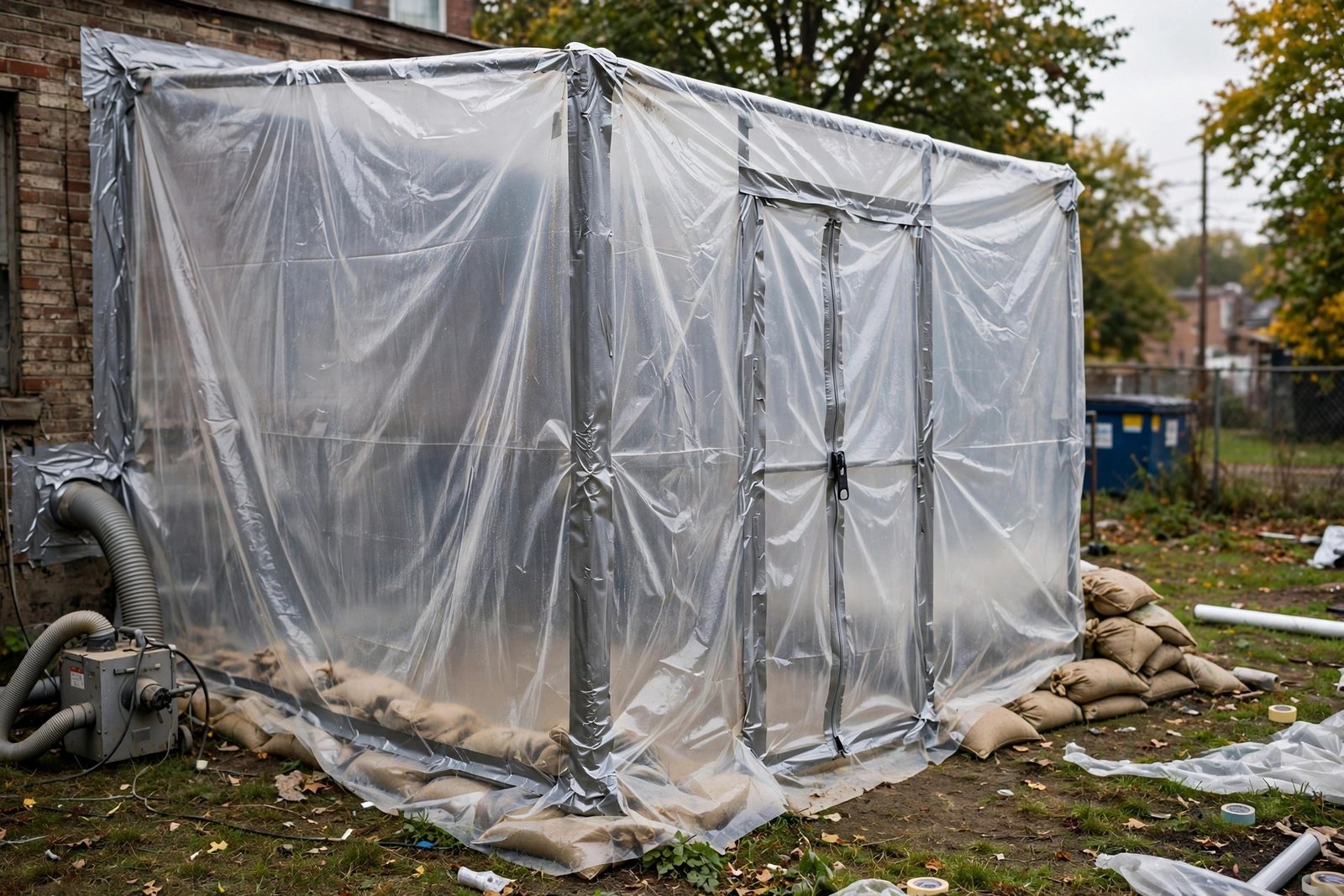
Knowing the process helps you read quotes and spot the contractors who cut corners. A legitimate abatement job follows the same shape every time:
- The survey report defines the scope. The contractor works from the lab results, not from a glance around the room.
- Containment goes up. Poly sheeting seals the work area from the rest of the house; for moderate and high-risk work, negative air machines with HEPA filtration keep air flowing into the containment, not out of it.
- Removal happens wet. Materials are kept damp to suppress fibres, removed in the largest pieces practical, and bagged in labelled asbestos waste bags inside the containment.
- The area is cleaned and inspected. HEPA vacuuming and wet wiping, then a visual inspection.
- Clearance testing for high-risk work. Independent air sampling confirms fibre counts are acceptable before containment comes down.
- Waste goes to an authorized facility, with documentation.
If a quote skips containment, skips the survey, or proposes dry removal with a shop vac, that is not a bargain — it is a liability. Fibres released into a home do not settle politely into one room.
7. Mistakes That Blow Up Asbestos Budgets
- Demo first, test later. The most expensive sentence in Fraser Valley renovations is “we already tore it out.” Once suspect material is disturbed without testing, the cleanup scope — and the regulatory exposure — multiplies. This tops our home renovation mistakes list for a reason.
- Testing too narrow. Sampling the kitchen drywall but not the hallway ceiling the electrician will open next week. Think about the whole project footprint, not just day one.
- Treating the survey as optional on “small” jobs. A powder-room gut in a 1982 townhouse is small. The drywall mud does not care.
- Hiring on price alone for abatement. Licensed, insured, WorkSafeBC-compliant contractors cost more because the containment, disposal, and paperwork cost more. The discount bid is discounting something.
- Forgetting the schedule. Abatement contractors book out. Build two to six weeks of testing-to-clearance time into the project plan before you promise anyone a finish date.
- Skipping the paperwork. Keep the survey report and the abatement clearance documentation with your renovation records. Future buyers, insurers, and permit applications may all ask for them.
Frequently Asked Questions
How much does asbestos testing cost in BC?
Plan on $250–$600 for a targeted sampling visit covering the materials your renovation will disturb, or $500–$1,500 for a full pre-renovation survey with a written report. Individual lab samples run $50–$150 each, and most projects need several. These are 2026 planning ranges — confirm with a local qualified inspector.
When do I need asbestos testing before a renovation?
Before any renovation or demolition work disturbs suspect materials in a pre-1990 building, WorkSafeBC requires assessment by a qualified person. Kitchen and bathroom guts, flooring removal, wall and ceiling demolition, and basement renovations in older homes all trigger it. If your situation is unusual, confirm the current requirements with WorkSafeBC or a qualified professional.
Can I remove asbestos myself in BC?
For most situations, no — and it is a bad idea even where the rules technically allow limited low-risk work. High-risk removal must be done by a licensed contractor, and even low-risk materials require trained workers following prescribed procedures. DIY removal risks contaminating your home and creating a far more expensive cleanup. Hire a licensed contractor.
What does high-risk asbestos removal involve?
Full containment with poly sheeting, negative air pressure with HEPA filtration, workers in respirators and protective suits, wet removal methods, HEPA cleanup, independent clearance air testing, and disposal at an authorized facility. It is performed by a licensed contractor and typically costs $8,000–$30,000+ depending on scope.
Will my building permit application trigger asbestos testing?
It can. If your permit drawings show demolition or alteration of a pre-1990 building, the City may ask how asbestos-containing materials will be handled. Having the survey done before you apply keeps the permit moving. See our Abbotsford building permit guide for the permit process itself.
Does finding asbestos affect my home’s resale value?
Handled properly, usually not much. A documented survey and professional abatement with clearance paperwork is something you disclose with confidence — buyers worry about unknown asbestos, not remediated asbestos. Undocumented DIY removal is exactly the kind of thing that kills deals.
Budget for the Test, Not Just the Reno
Asbestos is the rare renovation cost that punishes optimism. The homeowners who sail through it are the ones who test early, hire licensed, and treat the $500 survey as the cheapest insurance on the project. In a city where so much of the housing stock predates 1990, testing is not pessimism — it is just part of renovating in Abbotsford.
All costs in this article are 2026 BC planning ranges, not quotes. WorkSafeBC requirements are summarized from official guidance — confirm current rules with WorkSafeBC or a qualified asbestos professional before starting work.