
Why the Smallest Room in the House Draws the Biggest Gasps in Maple Ridge
Start small, why don’t you. The room nobody budgets for. The expensive surprise. The little hall bathroom. Five feet by eight feet, that’s it. Tub or shower jammed at one end. A toilet. A modest vanity squeezed in too, and a door that swings in, barely, scraping past the fixtures, because there’s no room to spare.
Owners in Maple Ridge often assume a space that compact will renovate for a compact price. Then the quotes land and the per-square-foot figure looks almost absurd, higher than what a sprawling ensuite down the hall would cost on the same basis. So what’s going on? Why’s it priced like that?
Nothing’s broken. Nothing’s gone wrong, either. It’s the maths. Brutal in a tiny footprint, it is. The trades don’t shrink, the approvals don’t shrink either, just because the floor did, and that’s the bit people miss. You still bring in a plumber. You still bring in an electrician. Inspections still happen, materials still get delivered, and a toilet or shower valve costs what it costs regardless of whether it serves forty square feet or a hundred.
Spread those unavoidable costs over a finished 5×8 and the total often reaches $350–$500, once you divide the bill by the area involved. Compare that with a generous ensuite, where the same fixed costs stretch over far more floor and the rate eases back toward $250–$350 per square foot. First-time renovators find this backwards. Second-time renovators nod, because they have already lived through the first quote meeting.
Hold onto that. Small room, big bill, that pattern. It runs through everything below, because Maple Ridge piles its own stuff on top, wild growth out east, pipes from another era out west, neither one’s cheap to deal with.
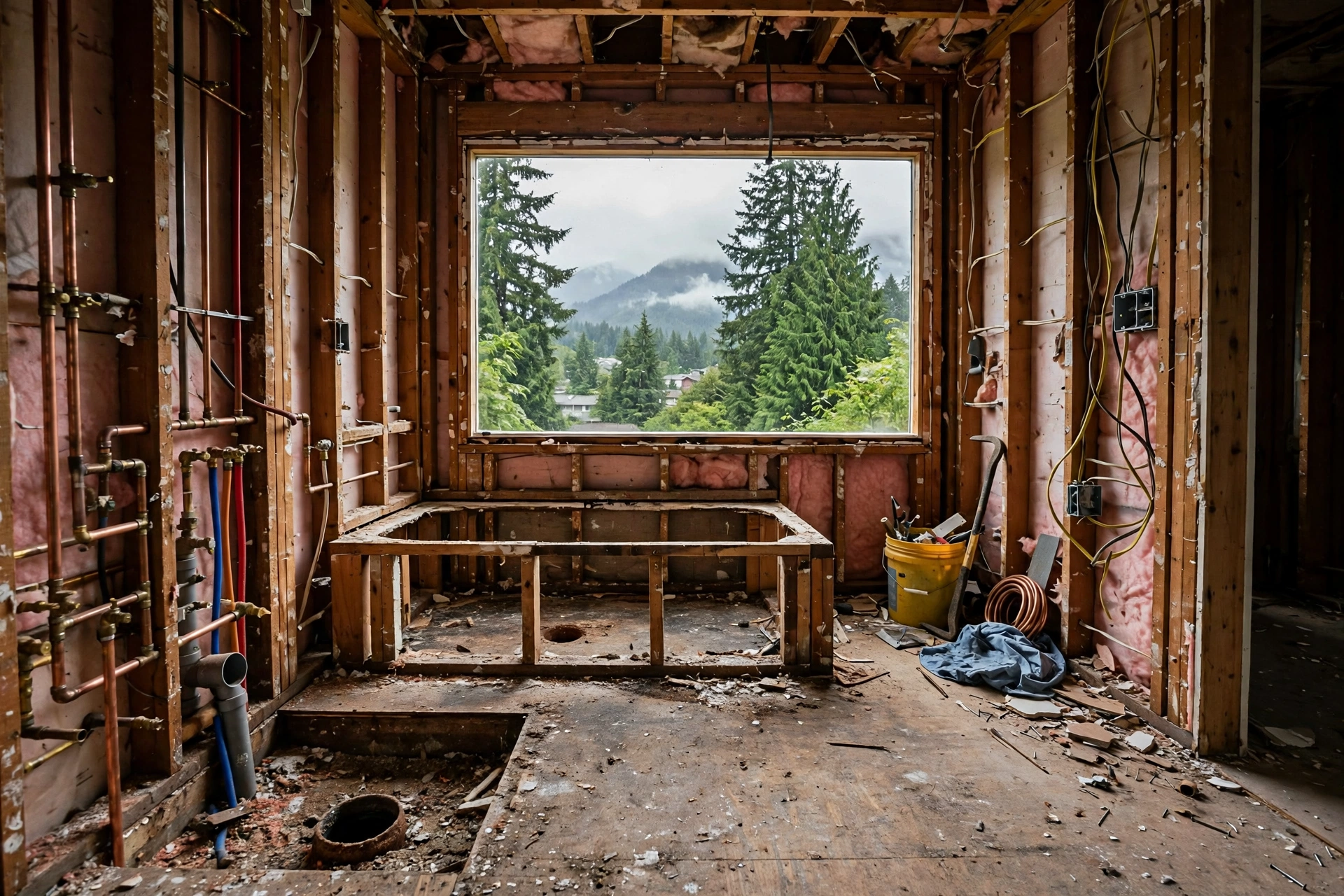
Dissecting a Mid-Range Budget, Starting With the Surfaces
A total on its own? Tells you almost nothing. Pull it apart first. Then it talks. So we’ll go backwards here. Finishes first, the stuff your hands touch every morning. Pipes last. You’ll never see them again once the walls close, not for years anyway.
Tile eats the budget. It just does. Labour plus materials in Maple Ridge, you’re usually looking at $8,000–$15,000, and for most households that’s the biggest single chunk, nothing else’s close. And here’s the odd bit. The tile’s sticker price? It barely moves that number. Owners stare at the box price. Wrong place to look. Pattern drives it. Patience drives it. That’s the cost. Plain 12×24 porcelain in a clean grid? A good tiler flies through that. Now wrap the shower round a niche, add a bench, throw in a mosaic accent, cut a curbless entry, and suddenly he’s in there most of the week, and you’re paying for every hour of it. Mosaics are the worst for hours. They multiply, fast. Big-format pieces aren’t forgiving either, get the prep underneath even slightly off and every lip shows, catches the light, catches your eye, forever. Seen something intricate in a showroom and can’t shake it? Read our bathroom tile installation cost guide for BC before you commit. It walks through how a layout becomes labour dollars. Showroom dream, meet job-site bill, that sort of thing.
Next come the fixtures and the vanity, a grouping that usually accounts for $4,000–$8,000 in total. That money buys the toilet, the vanity unit, faucets, the shower valve with its trim, and the tub or shower base. Cheapest stock pieces? They’ll hold you near the bottom. Recognisable mid-range brands cost roughly double the entry point, give or take, and designer lines? They don’t stop there, they climb well past it. No tier’s wrong. Not on its own. Pick what fits. Trouble only starts when the selection happens late, after rough-in dimensions have already been set to suit a different product, because changing the vanity at that stage can force plumbing to move twice.
Glass, mirrors, and the small accessories that finish a room contribute another $1,500–$4,000. Frameless glass catches everyone out. It looks like nothing, it’s clear, how much can it cost, right? But it can’t be measured till the tiling’s done, not properly, and it gets fitted by specialists, people who do glass and basically nothing else.
Paint comes last. Drywall too, final finishing, all of it. Budget $2,000–$4,000 for that tail end, that’s the usual run of it. Sounds minor, that line. It isn’t nothing, though. Moisture-resistant board underneath. Primer done right. Coatings that won’t peel after a year or two of daily steam hitting them, that’s what you’re buying.
Electrical work also lands at $2,000–$4,000 for most renovations. Included in that span are the bathroom circuits, a dedicated GFCI circuit, lighting, and an exhaust fan ducted outside as code requires. Adding heated flooring lifts the electrical and flooring budget by roughly $1,500–$3,000 depending on the heated area, and in this climate homeowners routinely call that upgrade the one they appreciate most on dark winter mornings when the tile would otherwise be ice cold underfoot.
Plumbing’s last here. Funny, that. It’s the foundation, the hidden bit everything sits on, and it’s $5,000–$9,000, rough-in, setting the fixtures, the valve assembly buried in the wall where nobody’ll see it. Swap a tub for a shower and the money lands here hardest. The drain has to move. Through an older framed floor, through a concrete slab, doesn’t matter, it’s cutting, it’s rework, it’s not a simple pull-one-out, drop-one-in job. Add those lines up. Sit with them a minute. A $35,000 renovation stops looking made up, doesn’t it? No mystery number. No figure pulled from thin air. It is just six or seven honest costs standing on each other’s shoulders.
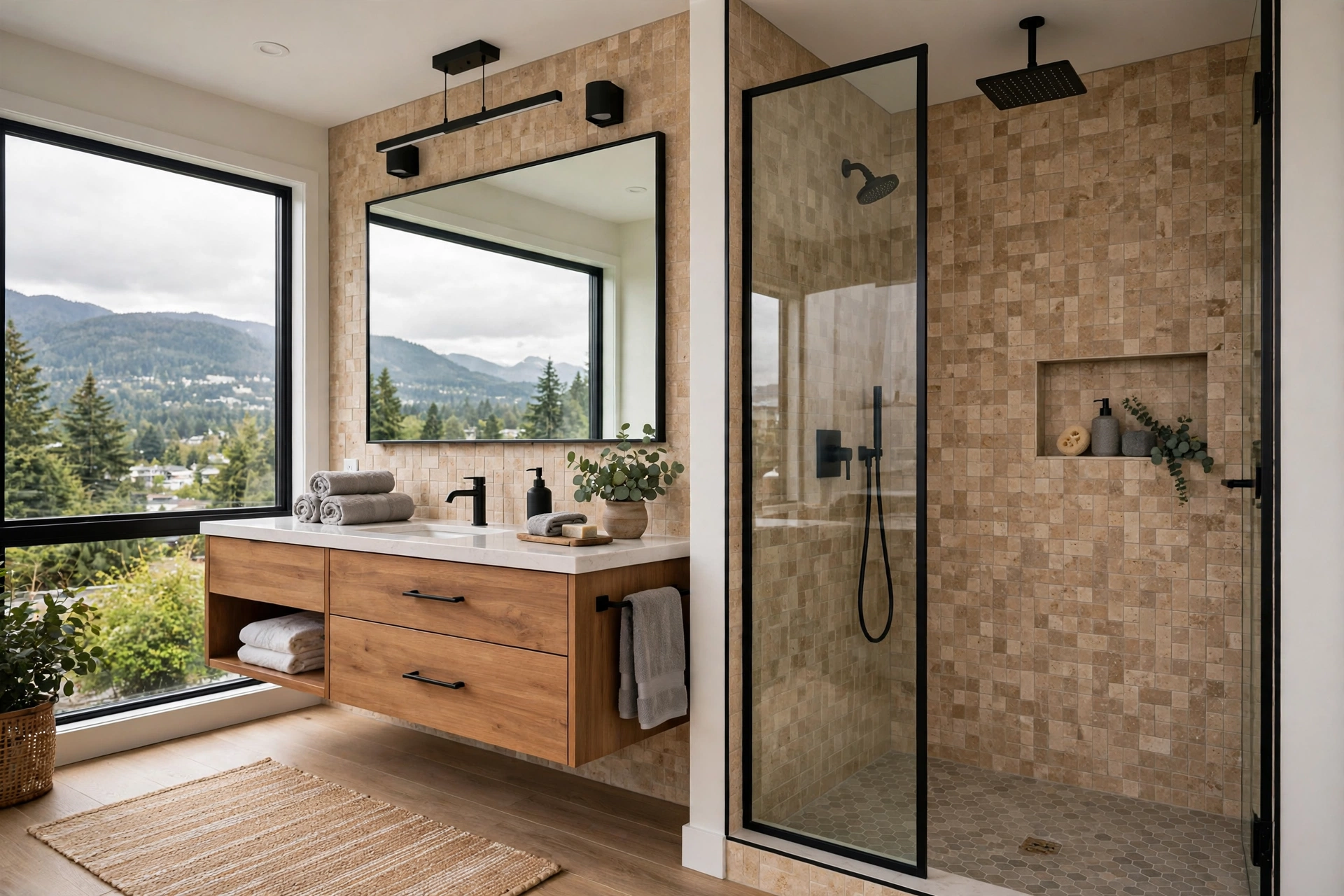
Putting the Full Ranges Together
Pulled apart like that? The headline ranges should click now. 2026 numbers, these. A light refresh first. Layout stays. Fixtures swapped, vanity swapped, paint freshened, tile only touched in small areas, that’s $14,000–$24,000 usually, that’s where it falls. Go further, then. Gut a small bathroom right out, new services in, tile everywhere. Different band. You’re at $18,000–$32,000. Main bathrooms cost more again. Full gut, layout nudged a bit, a tiled shower built properly, most of those need $28,000–$48,000, that’s the planning reality. Ensuites sit at the top. Walk-in shower, maybe a soaker tub, premium finish all through. Run the numbers and you’re at $32,000–$58,000.
| Project type | Typical scope | 2026 planning range |
|---|---|---|
| Small bathroom refresh | Same layout, new fixtures, paint and vanity, minor tile | $14,000–$24,000 |
| Small bathroom renovation | Gut to studs, new plumbing and electrical, full tile | $18,000–$32,000 |
| Main bathroom renovation | Full gut, layout tweaks, tile shower, new fixtures | $28,000–$48,000 |
| Ensuite renovation cost in Maple Ridge | Full gut, walk-in shower or soaker tub, premium finishes | $32,000–$58,000 |
Where do you land in a band? Partly your calls. Partly stuff you can’t control. Both push at once. Leave everything put. Every fixture, right where it sits today. Buy from stock lines. You’ll hug the lower boundary, that’s how it works. Move plumbing instead? Fix old pipework while you’re in there, spec tile that takes forever to lay, and you’ll shoot the other way. And fast. No warning, sometimes.
Permits and Timing, Handled Early Rather Than Late
Permits get left too late. Happens a lot in Maple Ridge. Design’s finished, everyone’s excited, then someone asks about the permit, and yeah, that’s risky, even if it’s understandable. In BC, here’s the trigger. Plumbing moves? Permit. Electrical circuits change, structural bits get altered, same answer, and the inspections, plumbing and electrical both, they happen at rough-in, before anything gets boarded over, not after. Maple Ridge runs its own show. Own fees. Own turnaround habits. And they shift, those details, they change over time, so ring the city yourself, check directly, before you lock a start date in, that’s the prudent bit, boring as it sounds. The planning ranges quoted here already allow for typical permit and inspection charges, so you do not need to bolt them on afterwards as an extra shock.
On the calendar side, expect three to six weeks of active site work for an uncomplicated project, with permit processing occupying the weeks before a crew ever lifts a hammer. The work itself? Rarely the delay. Actual renovation tasks, they move. Waiting’s the delay. A custom vanity that hasn’t shipped. Specialty tile stuck somewhere in a supply queue. Glass that can’t even be templated, not till the shower tiling’s finished, so everyone just stands around waiting on that one measurement. The jobs that finish on time? The owners look a bit unfashionable doing it. No secret trick. They order early. Slow pieces, before demolition, not after. They freeze the design before rough-in starts, they don’t touch the contingency either, they leave it alone instead of spending it up front on upgrades that caught their eye.
Hammond, Thornhill and the Age of the Pipes
Head west. Houses get older out that way. Older houses, older rules, budget rules especially, they write their own. Hammond’s got some of the earliest homes in the city. Downtown core too. Thornhill’s different again, a thick band of 1980s and 1990s houses sitting there, and every era left something different behind the bathroom walls, pipes included, none of it standard.
Open an early one up and look. Galvanized supply lines, sometimes. Narrowed right down inside, decades of mineral deposits choking them, barely a trickle getting through. Cast-iron drains show up too. Regular discovery, that. Looks solid from outside, it does, then a joint gets tested, a bit of pressure, and it gives way, just like that. Later retrofits add a third flavour of surprise, since some 1990s work was fitted with more enthusiasm than accuracy and does not survive a proper renovation untouched.
So plan for it up front. A full gut in an older Maple Ridge home, put $2,000–$6,000 in the plan for plumbing remediation, right from the outset, don’t add it later as a surprise. A failing drain stack? That can push you past that span, it can. Most common repairs won’t, though, they sit inside it, comfortably enough. Put it bluntly? A 1978 bathroom won’t cost what a 2008 one costs. Same tile picks, doesn’t matter. The younger house often keeps its rough-in, the older one usually can’t, and that’s the whole gap, right there.
Contingency’s your defence here. It is. And older properties need a bigger one, they just do, no way round it. A newer home might get by on the usual ten percent buffer. Fine. Pre-1990s stock’s different, set aside 15% there, that reflects the odds honestly, anything less is kidding yourself. That’s not pessimism. It’s not. It’s just odds. Until the finish comes off the wall, nobody can see the full condition of what is inside, and a contractor who prices an old bathroom with absolute certainty and no allowance for discovery should prompt questions rather than confidence.
Silver Valley, Albion and Pressure on Crew Calendars
Head east now. Different problem out there. Not age. Appetite. Silver Valley’s adding homes fast. Albion too. Reputable local crews get booked well in advance because of it, and that demand firms prices up across Maple Ridge, in a way a national average’ll never show you, not even close. Think about it from their side. A contractor whose calendar’s full of new-build finishing work, steady work, week after week, a one-off bathroom has to pay enough to justify bumping that, or why would they take it? Nobody’s gouging you. Nobody’s being unreasonable here. It’s not that. It’s supply and demand. Plain as that. Doing what it always does, and spring makes it worse, every household wants the same start window, all at once, same few weeks.
Distance layers on a second cost in the outer neighbourhoods. Crews coming in from Pitt Meadows or Port Coquitlam? Central jobs suit them, short hops, one address to the next, efficient day. Whonnock’s another story. Far east Albion too, longer drives each way, no chance to combine trips, the day just leaks away on the road. Out on the rural edge it costs differently again. Delivery surcharges pop up, tile, glass, fixtures, all of it, especially where access is tight, or the driveway’s long, steep, awkward for a truck. Add it up across a whole project and travel plus delivery usually totals $500–$1,500. Small slice of a $35,000 budget, sure. Big enough though, it explains a lot, two near-identical bathrooms, opposite sides of the city, quotes that don’t match, that’s often why. So ask, when you’re comparing bids. Ask each contractor straight, how’d you treat the travel in this number? A higher bid that costed the drive honestly might be fairer, a lot fairer, than a lower one that just pretended the drive doesn’t exist.
Growth stretches supply too. Lines, queues, all of it. It doesn’t just hit crews. When the whole eastern Valley’s building at once, everything slows down. Lead times stretch for exactly what a renovation needs, specialty tile, custom vanities, frameless glass, the lot, and order late, just once, and a job planned for four weeks drifts toward eight, that’s still the single most common reason it happens. For a valley-wide comparison that strips out this local growth pressure, our Abbotsford bathroom renovation cost guide looks at similar housing a few exits east under different market conditions.
Keeping a Project From Drifting Sideways
The mechanical work’s the skeleton. It holds steady, mostly. The finishes? They’re the wanderers, they’re what drifts a budget sideways, every time. Start at $30,000, say. Finish at $45,000. Happens without any single call feeling extravagant, not one decision owners can point to and say, that one, that broke it. A better faucet here. A feature wall there. Then it stacks. Heated floors. A rain head. A floating vanity with tile run underneath it, each one a few hundred, measured in hundreds on its own, and then suddenly you’re counting in thousands, a second budget, invisible, built inside the first one while nobody was watching the total.
Restraint only works if you agree it early. Before quotes. Before anyone prices anything, that’s the window. Pick two indulgences. Two, that’s it, and let them carry the room. A walk-in shower in real glass, maybe. In-floor heat alongside it. Everything else? Dependable standard products, hold the line there, no drifting. Do that and projects behave. They really do. Lots of Maple Ridge jobs sit near the middle of their band then, instead of scraping along the top of it, wondering how they got there.
Sequencing needs that same early look. It does. Leave it late and it bites. Fixtures, first in the queue. Decided before rough-in, not during. Tile picked before waterproofing starts, glass measured after tile’s finished, never before, that order isn’t flexible, it’s just how the work stacks. Break that order and you’ll pay. Rework. Delays. Both, plenty of times. Deciding as you go sounds relaxed, laid-back, easy, and it’s quietly one of the costliest habits in renovation, right up there at the top.
Frequently Asked Questions
What is a realistic starting budget for a Maple Ridge bathroom in 2026?
Full renovation, not a light refresh? Start here. Small bathroom, $18,000–$32,000. Main bathroom, jump to $28,000–$48,000. Ensuite done to a premium level, allow $32,000–$58,000, that’s your starting point for each. Planning ranges, those. For this area. For 2026, specifically. Move plumbing and the finish line shifts. Repair older pipework too and you’ll land in the upper half of your range, most projects do, that’s where they end up.
How does the growth in Silver Valley and Albion influence what I will pay?
Rapid building in those neighbourhoods keeps skilled crews in high demand, which supports firmer pricing, particularly for spring starts when diaries fill fastest. Where you are in Maple Ridge counts too. It does. Travel and delivery out to Whonnock, out to east Albion, that can add $500–$1,500 across a project, compared with a central address a crew can hit between other nearby jobs, five minutes away, no fuss.
Why does cost per square foot look worse for a small bathroom than for an ensuite?
The pricey bits don’t shrink. Room gets smaller, they don’t. Simple as that. Mobilisation stays put. Inspections too, trade visits, the fixtures themselves, all broadly constant, tiny bathroom or generous one, makes no difference, so divide that spend by a small area and the rate inflates, it has to. Do it in practice and you’ll see. A small finished bathroom can sit at $350–$500 per square foot. A large ensuite? Nearer $250–$350 per square foot, usually, the maths spreads out there.
When does a Maple Ridge bathroom renovation require a city permit?
A permit’s generally needed when plumbing moves. Electrical circuits changed counts too. Any structural work, same thing, you’re in permit territory then. Cosmetic work’s different. Leave the services exactly as they were, touch nothing behind the walls, and you might fall outside it, might not need one at all. Don’t borrow another town’s rules though. Maple Ridge runs its own permitting system, its own way of doing it, so check with the city, your address, your scope, specifics first, before you rely on advice that came from another municipality entirely.
What most often pushes a Maple Ridge bathroom project past its planned end date?
Waiting on materials wins that race. By a mile. Nothing else is close. Custom vanities take weeks. Specialty tile too, frameless glass too, all lead times, all measured in weeks, and older homes pile time on top, plumbing remediation after the walls open, nobody planned that day, there it is anyway. So order ahead. Long-lead products, before demolition, not after it starts. Allow three to six weeks for the site work itself, plus permit time beforehand, on top of that, and your schedule gets dependable, far more dependable than the guess-and-hope version.
A Different Way to Close Out Your Planning
Don’t end on a sales pitch. End on a calendar. A checklist, that’ll serve you better. Pick your season first. When do you actually want construction in your house, honestly? Then count backwards, permit processing, material lead times, all of it, and let that timeline tell you when decisions have to lock, not the other way round. Then put your contractor shortlist through three local questions. Three that matter here more than they do elsewhere, they really do. Did they price your plumbing’s age honestly, up front? Did they allow for where in Maple Ridge you live, what that drive does to their day, every day they’re on site? And their calendar, is it realistic, given how flat-out the growth areas have made every good crew in town, or is it just telling you what you want to hear?
Answer those well and the numbers stop being numbers. They turn into a plan. One you can defend, to yourself, to a partner, to anyone asking why it costs what it costs. Got a specific layout in mind? An older home in Hammond, one in Thornhill maybe, and you’re not sure how it prices? Direct those questions to (236) 613-0038, the conversation there can stay on your house, your pipes, and a 2026 range that actually reflects both of them, not a generic one.