
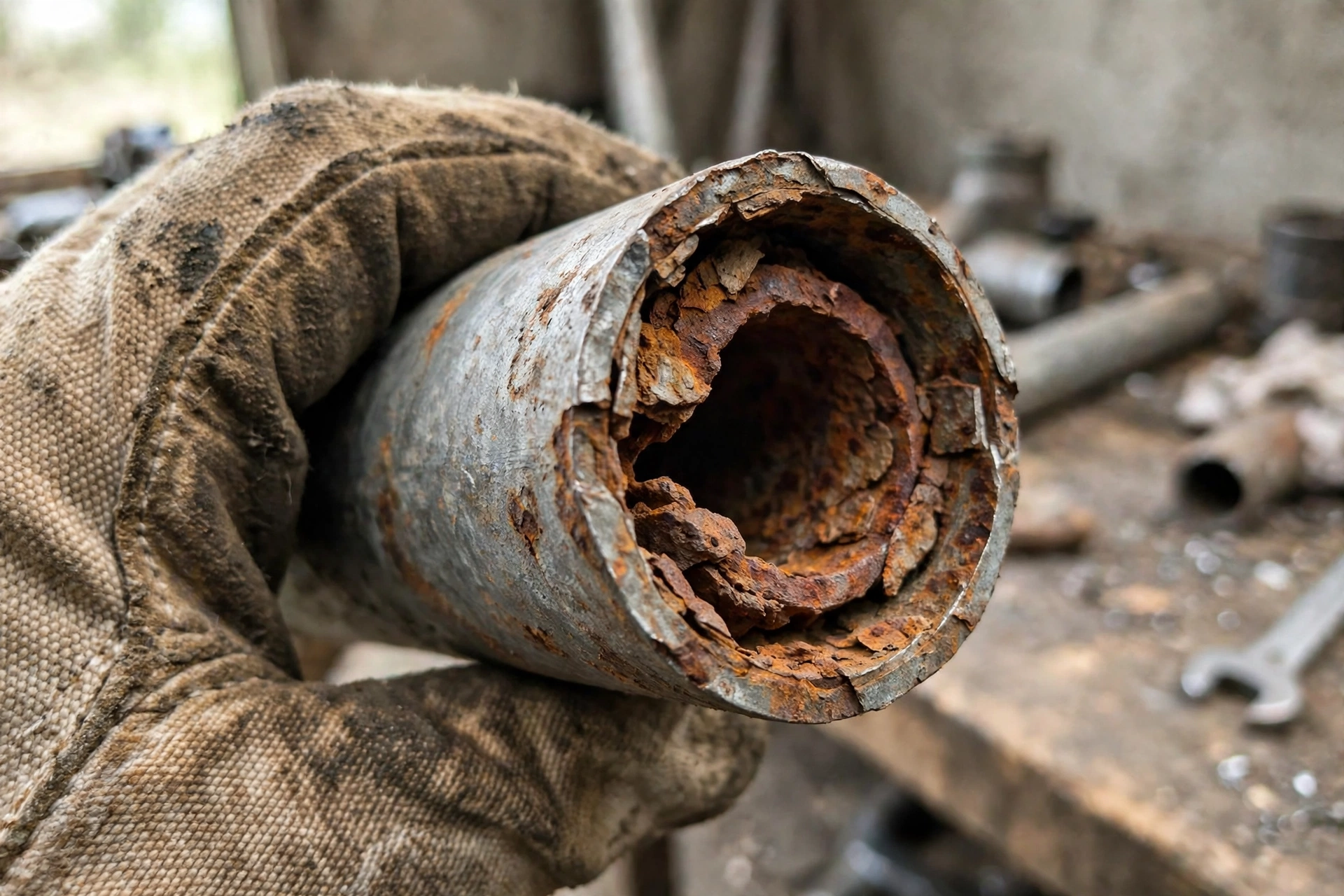
The water ran brown for ten seconds every morning in the 1968 bungalow off McMillan Road in Central Abbotsford, and then it ran clear, and the homeowner got used to it, because ten seconds of brown water is easy to get used to, and the shower pressure had been weak for years, and all of it felt like the normal behaviour of an old house, until a plumber came to fix a leak under the bathroom sink and cut open a section of pipe and held it up, and the inside of that pipe was nearly closed, a rust-coloured crust choking the bore down to the width of a pencil, and the plumber said the whole house was like that, and the galvanized pipe replacement cost BC homeowners ask about next was the number that decided whether the house got new pipes or another decade of brown mornings, and the new pipes were not cheap, and a pipe that bursts in a wall in January is a flood nobody planned.
Galvanized steel pipe was the standard water pipe in Abbotsford homes built from the 1940s through the early 1970s, and the zinc coating that gave it its name protected it for a while, and then the coating wore away, and the steel underneath started to rust from the inside out, and the rust narrowed the pipe, and the rust coloured the water, and the rust thinned the walls until they leaked, and a house with original galvanized pipe in 2026 is a house living on borrowed time, and the only question is whether the replacement happens on a schedule or on an emergency callout, and the scheduled version is cheaper.
What a Full Repipe Costs in BC
A full repipe of a typical Abbotsford home, every water line replaced from the main shutoff to every fixture, runs $8,000 to $20,000 in 2026, and the spread is wide because the houses are different, and the difference is the size of the house, the number of bathrooms, the number of storeys, the access to the pipes, and the material chosen, and a small one-storey bungalow with one bathroom and an open crawlspace sits near the bottom, while a two-storey home with three bathrooms sits near the top, and PEX is cheaper than copper, and the choice between them is covered further down this guide.
A partial repipe, replacing only the worst sections, runs $3,000 to $8,000, and it is the option that looks sensible on paper, because it costs less, and it fixes the worst pipe, and the rest of the pipe is still there, still galvanized, still rusting, and a partial repipe buys a few more years, not a new plumbing system.
A repipe is priced by the work, not by the metre, and a typical fixture adds roughly $800 to $1,500 in PEX, and $1,200 to $2,000 in copper, and a kitchen counts as two or three fixtures, and a house with eight fixtures is a bigger job than a house with five, and the quote should list the fixtures, because the fixture count is the job.
| Repipe scope | 2026 installed range | Best for | Notes |
|---|---|---|---|
| Full repipe, PEX, small home | $8,000–$12,000 | One-storey bungalow, 1 bathroom | Cheapest full replacement, fastest install |
| Full repipe, PEX, larger home | $12,000–$16,000 | Two-storey, 2–3 bathrooms | Most common Abbotsford repipe |
| Full repipe, copper, any size | $15,000–$20,000 | Homeowners who want copper | Dearest material, longest track record |
| Partial repipe, worst sections | $3,000–$8,000 | Budget fix, one bad run | Buys time, does not end the problem |
| Main line from street to house | $2,500–$6,000 | Old galvanized service line | Trenching, or trenchless if the ground allows |
| Drywall and paint repair after repipe | $1,500–$4,000 | Finished walls throughout | Often quoted separately, ask before signing |
The numbers above are 2026 planning ranges for Abbotsford and the Fraser Valley, and they are ranges because the house decides the price through its walls, its crawlspace, its fixture count, and its material, and no quote can be firm until the plumber has walked the house and looked at the access.
Partial or Full: The Split That Decides the Next Ten Years
The split between partial and full is not really about money. It is about whether the problem is one pipe or all of them, and in a house with original galvanized pipe, it is almost always all of them, because the pipes were installed at the same time, from the same steel, with the same zinc coating, and they are all the same age, and they are all rusting at roughly the same rate, and the pipe that leaks first is the warning, not the exception, and the next leak is already forming, in another wall, in another run, and a partial repipe fixes the warning and leaves the rest.
A full repipe done once, in one visit, is the job that ends the galvanized problem, and the drywall is opened once, and the paint is matched once, and the water runs clear from every tap, and the pressure is the same in the shower as it is in the kitchen, and the house has a plumbing system with a fifty-year life ahead of it, and the cost of doing it once is less than the cost of doing it in pieces, which is the arithmetic that matters, and the arithmetic is simple once the pieces are counted.
PEX Versus Copper: The Material Decision
PEX is the material most Abbotsford plumbers will quote first, and the reason is simple, because PEX is flexible, and a flexible pipe can be pulled through walls with fewer cuts, and fewer cuts mean less drywall repair, and less drywall repair means a faster job and a lower bill, and PEX does not corrode, and PEX does not rust, and PEX handles a Fraser Valley freeze better than a rigid pipe, because it can expand a little without splitting, and the fittings are crimped or expanded, and the system is proven, and a PEX repipe in a typical Abbotsford home runs $8,000 to $16,000 depending on size, and that is the number most homeowners end up paying.
Copper is the material with the history, and the history is fifty years of proven service, and copper is rigid, and rigid means more wall cuts, and more wall cuts mean more drywall repair, and more drywall repair means a longer job and a higher bill, and a copper repipe runs $15,000 to $20,000 for the same house, and the extra money buys a material every plumber knows, that some homeowners simply prefer, because it is the material their house was built with, and they trust it.
The choice is not about which material is better in the abstract. It is about the house. A house with an open crawlspace and an unfinished basement is a PEX house, because the runs are easy, and the saving is large, and the flexibility is used well. A homeowner planning to stay for decades may value copper’s track record, and a homeowner planning to sell in five years may value PEX’s price, and both are reasonable, and the plumber should explain the trade-off in plain language, not sell one material as the only right answer.
What Pushes the Price Up
Access is the biggest price driver, and it is the one the homeowner can see for themselves, because a house with an unfinished basement and a crawlspace a person can move in is a house where the plumber can work fast, and a house with finished walls on every floor and a slab foundation is a house where every run means cutting drywall, and cutting drywall means patching drywall, and patching drywall means paint, and the drywall and paint bill after a repipe runs $1,500 to $4,000 on a finished home, and it is often quoted separately, and it should be asked about before signing, because a repipe quote without the patching is a quote that is missing a third of the job.
The number of storeys matters too, because a two-storey home means vertical runs through walls, and a vertical run through two floors is harder than a horizontal run through a crawlspace, and a home with bathrooms stacked one above the other is easier than a home with bathrooms at opposite ends, because the stacked bathrooms share a wet wall.
The service line, the pipe from the street to the house, is a separate job, and it is often galvanized too, and it is often forgotten, because it is underground, and a repipe that stops at the front wall leaves the oldest pipe in place, and the service line runs $2,500 to $6,000 to replace, and the price depends on the length, the ground, and whether the plumber can pull a new line through the old one, a trenchless method that avoids digging up the driveway, and the homeowner should ask whether the service line is galvanized, and whether the quote includes it.
Signs Your Galvanized Pipes Are Done
Low water pressure at one fixture is a clogged aerator. Low water pressure at every fixture is a system problem, and in a house with galvanized pipe, the system problem is rust, and the rust is inside the pipe, and the inside of the pipe is the part nobody sees, and the pressure test is the part everybody feels, because the shower is weak, and the kitchen tap is slow, and the washing machine takes forever to fill, and the whole house feels tired, and the tiredness is the pipe, and the pipe is not going to get better.
Brown or rusty water, even for a few seconds in the morning, is the second sign, and it is the one that looks harmless, because the water runs clear after a moment, and the rust is coming from the pipe walls, and the pipe walls are thinning, and a pipe wall that thins far enough leaks inside a wall, and the leak is a flood nobody sees until the drywall sags.
Leaks are the third sign, and they end the argument, because a galvanized pipe that leaks once will leak again, and the second leak is the same corrosion in a different place, and a homeowner who has paid for two leak repairs in a year has already spent a meaningful share of a repipe, and the pipes are still galvanized.
Our guide to plumbing rough-in cost in BC covers the new-plumbing side of the same work, and the two guides together cover the whole decision, replacement or new install, and the prices that sit behind both, and a homeowner planning a bathroom or kitchen renovation should read both, because a repipe done during a renovation is cheaper, and the walls are already open.
What the Quote Should Name
A repipe quote should name the material, PEX or copper, by brand and type, because PEX is not one product, and the fitting system matters, and a quote that says PEX without naming the system is a quote that can be filled with the cheapest fitting available, and the cheapest fitting is the one that fails, and the failure is inside a wall. It should name every fixture included, because the fixture count is the job, and a fixture left out of the list is a fixture that costs extra later, and the extra is a change order, and the change order is a surprise.
It should name the drywall and paint repair, and whether it is included, and who does it, because a plumber who cuts drywall and leaves it did half the job. It should name the service line, and whether it is included, and whether it is galvanized, because the service line is the forgotten pipe, and the forgotten pipe is the one that fails next. And it should name the permit, and the inspection, and the warranty on the work, because a repipe without a permit is a repipe without a record, and a repipe without a warranty is a repipe without a promise.
The timeline matters too. A full PEX repipe on a typical Abbotsford bungalow takes three to five days, and a larger two-storey home takes five to seven, and a copper repipe takes longer, and the quote should say how long, and whether the water is off overnight, because the water is usually back on at night, and a plumber who plans the shutoffs is a plumber who has done this before. A 1960s home with galvanized pipe often has aging wiring too, and our guide to the cost to rewire a house in BC covers the electrical side, because the two jobs share the same open walls, and doing them together is cheaper than doing them apart.

Repipe During a Renovation, or On Its Own
A repipe done during a kitchen or bathroom renovation is the cheapest repipe, because the walls are open, and the drywall is being replaced anyway, and the patching bill disappears, and a homeowner planning a renovation in a house with galvanized pipe should get the repipe quoted as part of the renovation, not as a separate job, because the separate job costs more.
The decision is not really about the price. It is about whether the house gets new pipes on a schedule, or new pipes plus water damage on an emergency, and the galvanized pipe replacement cost BC homeowners face is a range, $8,000 to $20,000 for a full repipe, $3,000 to $8,000 for a partial, and $2,500 to $6,000 for the service line, and the number that applies to your house is the number in a written quote that names the material, the fixtures, the drywall repair, the service line, the permit, and the warranty. The brown water in the bungalow off McMillan Road was ten seconds every morning, and the pipe inside the wall was a pencil wide, and the repipe was the fix.
Questions about a repipe quote, or the condition of existing galvanized pipe, can be raised with a local plumbing professional before work starts, and general guidance on Abbotsford renovation costs is available by phone at (236) 613-0038.
Frequently Asked Questions About Galvanized Pipe Replacement Cost in BC
How much does it cost to replace galvanized pipes in BC? A full repipe runs $8,000 to $20,000 in 2026, depending on house size, fixture count, access, and material. PEX sits at $8,000 to $16,000, copper at $15,000 to $20,000. A partial repipe runs $3,000 to $8,000. These are planning ranges, so confirm the final price with a written quote.
Is it better to replace all galvanized pipes or just the bad ones? A full repipe is usually better, because all the galvanized pipe in a house is the same age and rusting at roughly the same rate, so fixing one bad section leaves the rest to fail next. A partial repipe makes sense only when a single run is the problem, such as a short section damaged by a freeze.
How long does a repipe take? A full PEX repipe on a typical Abbotsford bungalow takes three to five days, and a larger two-storey home takes five to seven days. Copper takes longer, because rigid pipe is slower to install. Water is usually off during the day and back on at night.
Does replacing galvanized pipes increase home value? New plumbing is a strong selling point for an older home, and it can help with insurance, because some insurers charge more for galvanized pipe. A repipe with a permit record and a plumber’s invoice proves the work was done.
Should I replace galvanized pipes before selling my house? A buyer or a home inspector will usually flag original galvanized pipe, and the flag can cost more in a price reduction than the repipe would have cost. A repipe done during a renovation, when the walls are already open, is the cheapest time to do it.