
Start with the rain. Not the brochure version — an actual Fraser Valley atmospheric river, the kind that parks over the valley for two days in November and drops water like somebody upended a tank. A 1,500-square-foot roof in a storm like that sheds several thousand litres. All of it has to go somewhere: along the eaves and down a downspout, out and away — or straight off the edge onto your fascia, your siding, your foundation, the basement wall. There is no third option, and BC rain does not ease off often enough to pretend otherwise.
So the gutter replacement cost BC homeowners pay in 2026 is mostly a per-foot conversation. Seamless aluminum, the default choice here and the stuff on nearly every house you drive past, runs about $9 to $16 per linear foot installed. Most whole houses land between $1,500 and $3,200 all-in. That’s the tidy version, anyway. The untidy version involves whatever has been quietly rotting behind your old gutters, which is where the real money gets decided — it’s in here too, further down.
What does a whole house come to?
Per-foot rates don’t mean much until you know your footage, and the measuring trick is simple: walk the rooflines, not the floor plan. Gutters only run where the eaves are. A typical Fraser Valley rancher needs 120 to 150 linear feet. A two-storey with a garage, 160 to 200. A larger place with multiple roof levels, 200 to 260. Downspouts usually sit every 30 to 40 feet of run, and at inside corners.
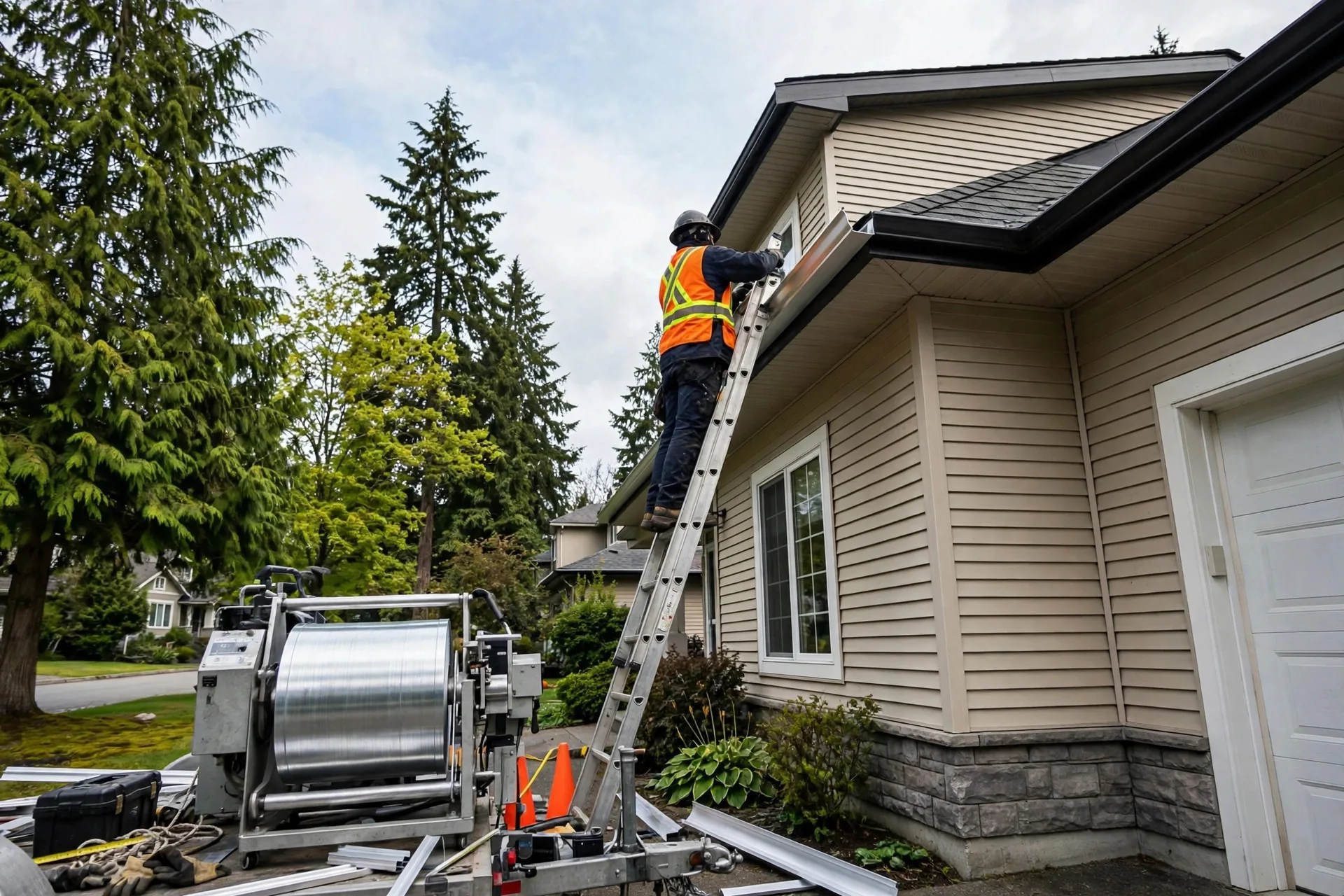
At seamless aluminum rates, the rancher lands around $1,300 to $2,200. The two-storey around $1,700 to $3,000. The larger multi-level home, $2,200 to $3,800 once the extra downspouts and corners get counted. And most of every one of those figures is labour. The aluminum itself is just a roll of metal on a truck; what you’re paying for is the forming machine, the ladders and scaffolding, and two installers who can hang a 40-foot run with the slope right. Gutters should fall roughly a quarter inch per 10 feet toward the downspout. Enough to drain. Not enough to see. Get it wrong and water pools in the run, and pooled water finds every seam and screw hole eventually.
Gutter Replacement Cost BC Per Foot, by Material
| Material | Installed per linear foot (2026) | Typical lifespan | Notes |
|---|---|---|---|
| Vinyl | $6 – $10 | 15 – 20 years | Cheapest per foot; joints and brittleness in cold snaps are the trade-offs |
| Seamless aluminum | $9 – $16 | 25 – 30+ years | The BC standard; formed on site to the exact run, fewest seams |
| Galvanized steel | $12 – $20 | 20 – 25 years | Stronger under ladders and snow load; heavier, rust eventually wins |
| Zinc | $22 – $35 | 40+ years | Premium, self-healing patina; specialty installers only |
| Copper | $30 – $50 | 50+ years | Architectural statement pricing; mostly seen on character homes |
Seamless deserves a word of its own, because it’s why the table shakes out the way it does. The installer feeds a flat roll of aluminum through a forming machine in your driveway and cuts each run to the exact length of that eave. No joint in the middle. Sectional gutters get joined together piece by piece, and every joint is a seam, and seams are where these systems leak first. The standard residential profile here is the 5-inch K-style; larger roofs and steep pitches sometimes justify 6-inch gutters and oversized downspouts, which add a little per foot and move a lot more water.
Comparing quotes? Check what the per-foot number actually swallows. Corners, end caps, hangers, sealant — included, or extra? And downspouts: some companies roll them into the per-foot price, others bill them per unit, which is how a low per-foot quote can finish higher than an honest all-in one. Ask first. Compare second.
What’s hiding behind your old gutters
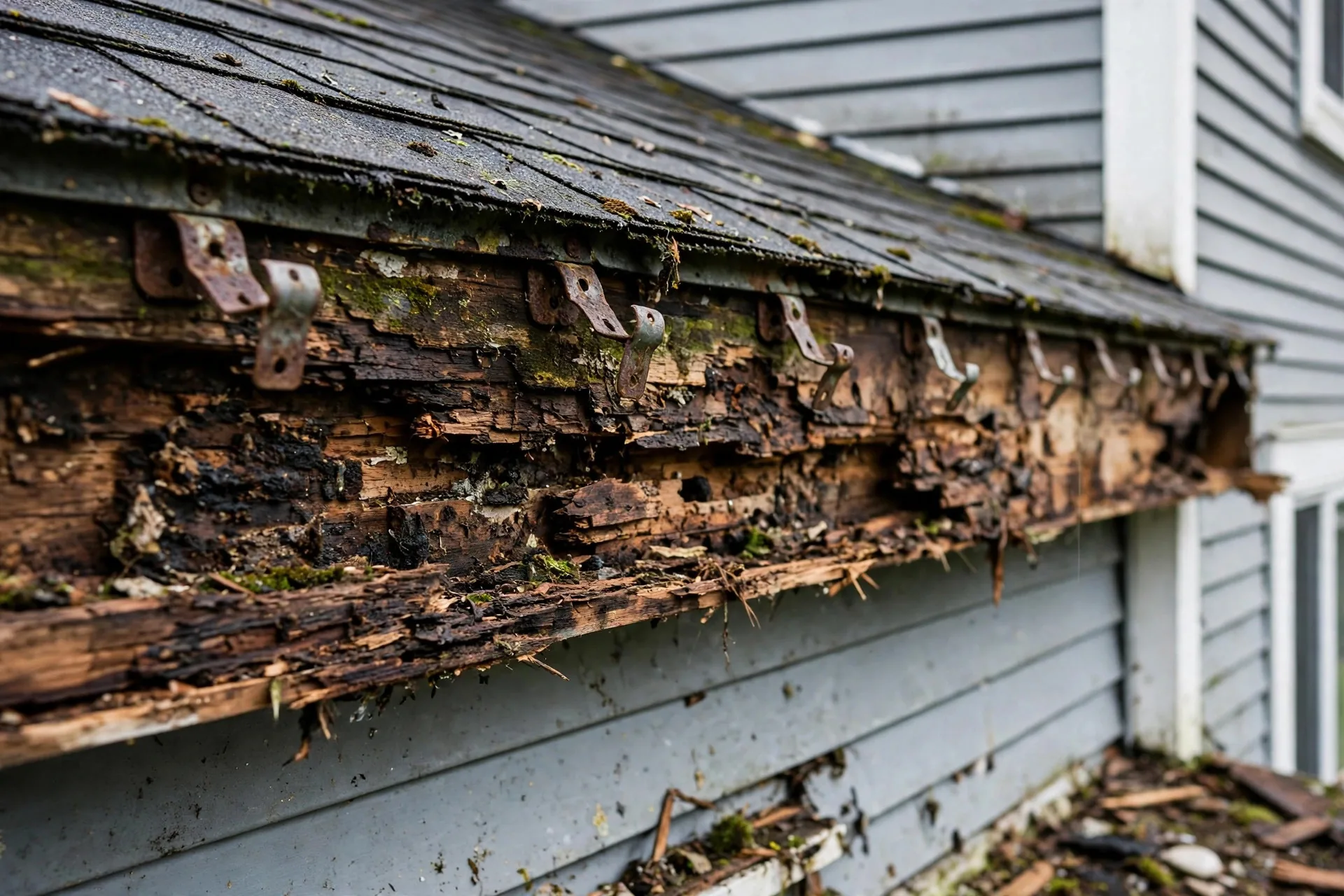
The most common change order in this trade isn’t a gutter. It’s the fascia board the old gutter was mounted on. Years of seam drips, overflow every storm, ice sitting at the eaves — the wood behind the metal rots, slowly, and nobody sees a thing until tear-off day, because the gutter itself is in the way. So it arrives mid-job as a surprise. Except it isn’t one, not on older houses.
Pricing depends on how far it spread. Replacing damaged fascia sections while the system is already off runs roughly $8 to $20 per linear foot. If the rot has reached the rafter tails, you’re into soffit and structural territory and it gets priced once it’s visible — there’s no honest way to quote it blind. On a 40-year-old BC home, keeping a contingency for 20 to 40 feet of fascia in the budget isn’t pessimism. It’s the pattern.
Most of it starts with a clog, and around here the clog is predictable: fir and cedar needles. They wash off the roof, settle, and mat down into a paste that tree seeds sprout in and water can’t push through. Corner overflows every storm, water sheeting down the siding — that’s usually the mat, not the metal. If your neighbourhood is conifer-heavy, cleaning twice a year is the minimum, and it costs less than anything else in this guide.
Extras: extra downspouts, guards, rain chains
Beyond standard spacing, downspouts run about $150 to $300 each installed, and oversizing them is cheap insurance on long runs. Rain chains are the decorative option, usually swapped in for a downspout at a front entry, and they’re priced per installation rather than per foot. Underground drains — downspouts tied into buried lines that carry the water well away from the foundation — get priced by the trench, and in BC they matter more than any cosmetic upgrade mentioned here. A downspout dumping its load right at the foundation undoes the whole point of the system.
Guards are the add-on everyone asks about. Mesh and screen systems run about $10 to $25 per linear foot on top of the gutter price; premium micro-mesh costs more. Honest version for this province: guards reduce how often you clean. They do not eliminate it, and fine needle debris defeats cheap screens quickly — same fir and cedar mat, now forming on top of the guard. Where guards make sense is two-storey eaves, where cleaning means tall ladders. Where they don’t is sold as a permanent cure. Spend first on correct slope, enough downspouts, and a cleaning schedule; add guards where getting up there is genuinely miserable.
Roof or siding in the next few years? Sequence it
Gutters keep company. If a roof replacement is anywhere in your plans, tie the two jobs together — our roof replacement cost guide covers the main event — because new gutters hung on a dying roof get knocked around when that roof is stripped, and nobody wants to form them twice. The new set goes on after the shingles and flashing are done. Exterior painting and siding work follow the same logic: our siding replacement cost guide prices that side of the envelope, and gutters come off and go back on around siding jobs anyway, so doing them together saves real labour.
As for season, it matters less than weather windows. Crews work year-round in the Fraser Valley, but dry stretches make for faster, cleaner installs, and late summer through early fall — after the cleaning season, before the November rains — is when most homeowners book. Book then and expect company in the queue.
Gutter Replacement Questions: Frequently Asked Questions
What is the average gutter replacement cost in BC? For a typical BC home in seamless aluminum, plan on $1,500 to $3,200 all-in for 2026, downspouts included. A smaller rancher can come in under that; a large two-storey with multiple roof levels will go over it. Fastest way to a realistic number before quotes: take the per-foot rate installers quote here for new gutters — $9 to $16 for seamless aluminum — and multiply by your roofline footage.
How many linear feet of gutter does a house need? Measure the eaves, not the floor plan. Most single-storey homes need 120 to 150 linear feet; two-storeys 160 to 200; larger or multi-level homes 200 to 260. Rooflines over garages, porches and additions all count. An installer will measure exactly, but your own tape measure gets you close enough to budget — and close enough to spot a quote that has clearly measured a different house.
Are seamless gutters worth the extra cost in BC? For most homes, yes. A sectional system leaks at its joints eventually, and BC rainfall hands every one of those joints thousands of litres a year to work on. Seamless runs take the mid-span joints out entirely; corners are the only joints left. The per-foot premium over sectional aluminum is modest, and it buys the longest stretch between services of anything short of zinc or copper.
How long do gutters last in BC’s climate? Seamless aluminum typically serves 25 to 30 years or more here; vinyl 15 to 20; galvanized steel 20 to 25; zinc and copper 40 to 50-plus. Those lifespans assume somebody cleans them and the slope stays honest. Leave an aluminum system stuffed with needle mat and it will rot the fascia behind it and stop doing its job years before the metal itself is done — around here, neglect kills gutters faster than weather does.
Should I replace gutters at the same time as my roof? Roof due within a couple of years? Yes — coordinate them, and have the gutters formed after the new roofing and flashing are complete. Put new gutters up first and they can get damaged during a later roof tear-off; sequenced properly, some of the labour (access, tear-off, disposal) overlaps too. If the roof has a decade left in it, don’t wait on it. Replace the gutters on their own schedule.
Get the roofline measured
A gutter quote is only as good as the measurement under it: footage, downspout count, and an honest look at the fascia once the old system is off. If your gutters drip, overflow in every storm, or haven’t been looked at since the house was painted last decade, call (236) 613-0038 with your home’s rough roofline footage and whether a roof or siding project is anywhere in your plans. That’s enough to place your house in the right row of the table — and to get the job booked into a dry stretch instead of mid-November, when the rain is already pouring over the corners.