
Today’s cheap roof? It can turn into the dear one. Not this year. Over the life of the house.
And that expensive roof. Flip it around. If you’re still living under it in 30 years, it can look very sensible indeed.
When homeowners compare metal roof vs asphalt shingles BC options, forget the catalogue for a second. Which material wins on paper isn’t really the question. It’s this. How many times do you want to pay for a roof? And how does it handle Fraser Valley rain?
Asphalt is familiar. It’s also far easier on a budget this year, no question.
Metal is the opposite. It costs much more up front. Then, for decades, it asks very little of you.
Installed well, both keep a house dry. Rushed details? Both fail early.
So look at the 50 year picture, the moss and the noise myth, and the answer gets clearer.
Why the Cheaper Roof Is Not Always Cheaper
Architectural asphalt shingles first. That’s the thicker, layered kind. You see it on most Abbotsford homes. As a 2026 BC planning range, it runs about $5 to $9 per square foot installed.
Standing seam metal is a different bracket. About $12 to $22 per square foot installed.
Metal shingles sit in between. About $10 to $16 per square foot.
Planning ranges only, mind you. Not quotes. Pitch moves every job. So does access. So does complexity.
On a 1,800 square foot roof, do the maths at those rates and asphalt might land in the $9,000 to $16,200 range. Standing seam? It could land in the $21,600 to $39,600 range.
And here’s the other side of it. A sound asphalt roof now beats a leaking roof saved for later. Every time.
Asphalt lasts about 20 to 30 years here. Metal lasts about 40 to 60 years.
So picture a homeowner who re-roofs at 40 with asphalt. They should expect to do it again. In their sixties. The metal buyer, for that same house, likely never buys another roof.
Cash now, or cash twice later.
Metal Roof vs Asphalt Shingles BC Over 50 Years
Tables will not pick your roof. But they stop the guessing.
This is the lifetime view. It uses the planning ranges above. And it makes one simple assumption, that a second asphalt roof will be needed inside a 50 year window.
| Factor | Architectural asphalt shingles | Standing seam metal | Metal shingles |
|---|---|---|---|
| Installed cost per sq ft, 2026 BC planning range | $5 to $9 | $12 to $22 | $10 to $16 |
| Typical lifespan | 20 to 30 years | 40 to 60 years | 40 to 60 years |
| Roofs needed over 50 years | Usually 2 | Usually 1 | Usually 1 |
| Routine maintenance | Check for lifted tabs, moss treatment, clear debris from valleys | Check fasteners and sealant at penetrations, clear debris | Check joints and penetrations, clear debris |
| Rain shedding | Good when tabs seal and flashing is sound | Excellent, long panels shed water fast with few horizontal seams | Very good, interlocking pieces resist wind driven rain |
| End of life note | Tear off and landfill at each replacement | Long service, and metal is widely recyclable at removal | Long service, and metal is widely recyclable at removal |
Two asphalt roofs can cost about the same as one standing seam roof. Sometimes more. That’s once you count a second tear off, which people tend to forget.
That is why the metal roofing vs shingles cost BC conversation should always name a time frame.
Over five years? Asphalt wins on cost. And it’s not close.
Over 50 years, metal often wins or ties. And it does so with less disruption, which matters more than the spreadsheet shows.
Disruption counts too. A re-roof is a week of noise and bins in the driveway.
Some owners will happily pay to do that once. Others won’t, and fair enough. They plan to move in eight years. They’d rather keep the cash.
Your time horizon is the tiebreaker.
For a house specific breakdown of tear off, underlayment and flashing costs that sit under either material, start with our roof replacement cost guide for BC and bring those line items to any quote meeting.
Rain, Moss and Wind Off the Mountains
The best roof for BC rain isn’t a product. It’s a system. One whose seams stay tight. Whose valleys stay tight. Whose penetrations stay tight, through a long wet season, not just one storm.
November in the Fraser Valley doesn’t test a roof the way a single summer thunderstorm does. Not even close.
It tests it with weeks of steady rain. With wind that pushes water uphill, for short bursts. With gutters that run full for days.
Metal sheds water quickly. Why? A standing seam roof has long continuous panels. It has raised seams. And on the field of the roof, it has very few exposed fasteners. Fewer places, in other words, for driven rain to work in.
Snow slides more readily too. Debris does as well. So installers may add snow guards above doors. That’s a detail worth asking about.
Shingles work differently. They shed water by overlapping, course over course. And that system works well. Until it doesn’t. Until tabs lift. Until sealant bonds age. Until a valley fills with needles and slows the flow.
Then there’s moss. The local headache.
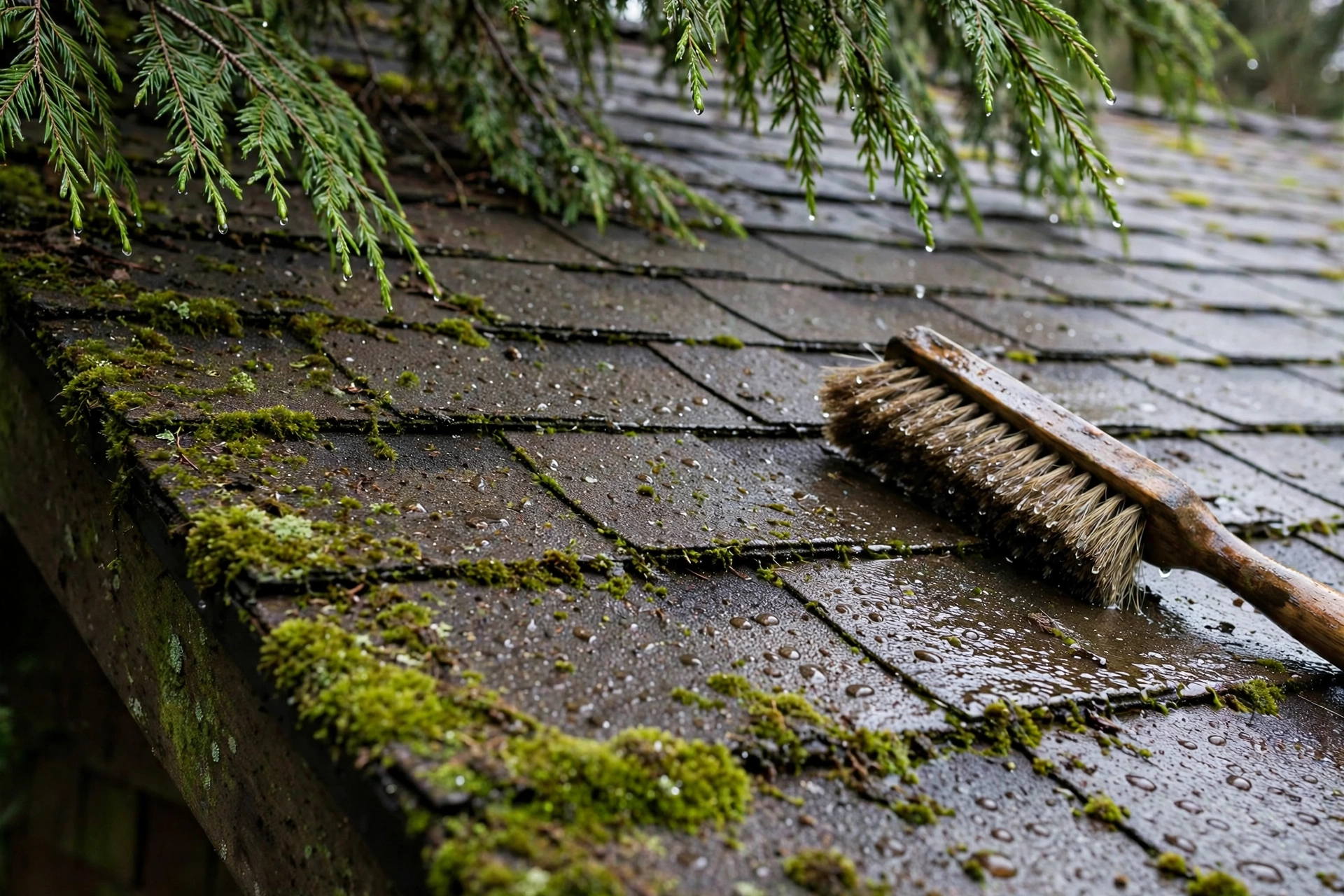
Shaded asphalt roofs grow it, especially under firs in Abbotsford and Mission. The moss lifts tab edges. It holds moisture against the surface. It needs gentle treatment. Never a pressure washer blast, that strips granules.
Metal doesn’t feed moss the same way. Its smooth surface is easier to keep clear, too.
Don’t overstate that, though. Moss and algae can still form on any roof. All it takes is damp debris sitting in a valley. Or behind a chimney.
So clear the debris. Trim what you can. And check the north slope each autumn. Put it on the calendar.
Wind matters as well, on exposed lots near the river especially.
Interlocking metal performs well when it’s installed to spec. Properly nailed shingles do too. Ask how edges and ridges are fastened. That boring detail decides storm performance more than the brand name.
The Noise Question, Answered Honestly
Will a metal roof sound like a drum in the rain?
On a barn, yes. Metal laid over open strapping, you’ll hear it.
On a typical house? That picture is mostly a myth.
Here’s why. Most residential metal roofs go over a solid deck. There’s underlayment. Above an insulated attic, there’s a ceiling. That stack dampens rain sound a lot, and many owners report rain on metal is no louder than rain on shingles, just a slightly different tone.
But watch the exceptions. They exist.
A vaulted ceiling with little insulation can carry more sound. If noise worries you, ask what deck and underlayment the quote includes.
And don’t decide from a video of a shed roof in a storm. Your roof assembly is not a shed.
Insurance, Resale and Other Fine Print
Some insurers view metal favourably. Long life is one reason. Fire resistance is another. And some policies, on the other side, treat an older asphalt roof as a risk factor as it nears the end of its life.
But it varies. A lot. By insurer. By policy.
No general article can tell you what yours will do. Check with your own insurer before you count on any premium difference. And if that answer affects your decision, put it in writing.
A newer roof helps a sale, whichever material it is, because buyers fear a re-roof bill in year one. That’s real. But don’t buy metal counting on getting every dollar back at sale. Buy it because the years you’ll live under it make sense. That’s the honest reason.
Warranties need the same sober read. A long warranty on a panel won’t help you if the failure is at a flashing. One that was detailed poorly on day one.
Where Skylights Fit Into the Decision
If your roof has a skylight, or you want one, plan it with the re-roof and not after it.
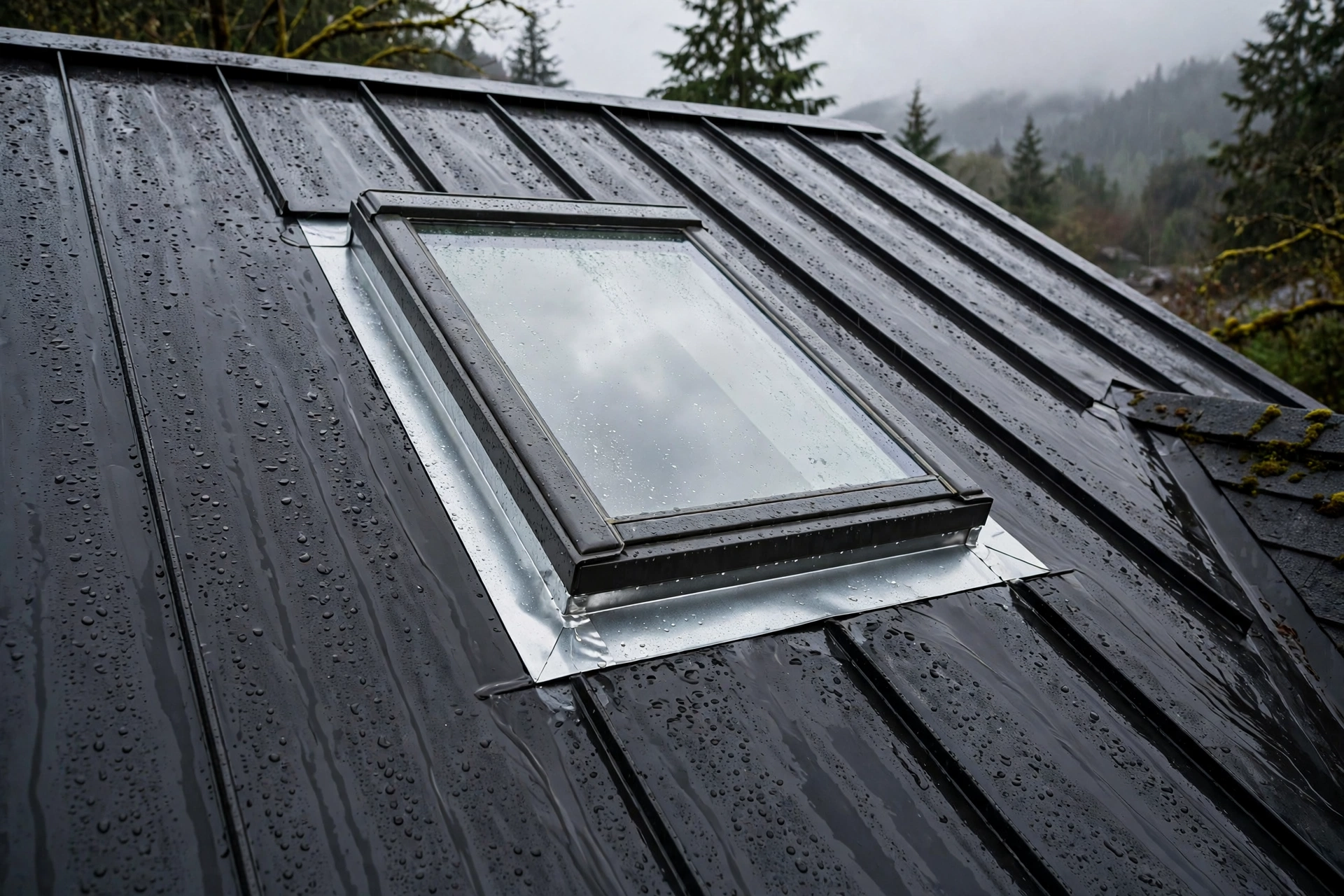
The standing seam vs asphalt shingles choice changes how the skylight is flashed. It has to. On one roof, the curb flashing has to tie into long metal panels. On the other, it has to tie into layered shingle courses. Different detail, different work.
Good crews coordinate that detail while the roof is open. They’ll replace tired skylight units at the same time if the seals are failing and make sure the new flashing kit matches both the skylight model and the roof type.
Can you cut a new skylight into a finished roof later? You can. It’s doable. But it costs more than doing the work during replacement.
The cheapest skylight, plain and simple, is the one planned before the new roof goes on. Our skylight installation cost guide for BC covers unit, flashing and interior finish costs to help you time the two jobs together.
Picture a skylight on a north roof. Fir needles on it all winter. That one needs more cleaning. And a closer eye on its seals.
Put the maintenance in your calendar. Not when a drip appears.
Roof Questions: Frequently Asked Questions
How much cheaper are asphalt shingles than metal in BC? Look at the 2026 planning range. Architectural asphalt runs about $5 to $9 per square foot installed. Standing seam metal runs about $12 to $22. In between sits metal shingles, at about $10 to $16. On a typical house, that gap can be two to three times the asphalt price. On install day, anyway.
Which roof lasts longer in Fraser Valley rain? Metal, usually. It lasts 40 to 60 years, compared with 20 to 30 years for architectural asphalt shingles. To reach those figures, though, both need the same basics. Sound flashing. Clear valleys.
Is a metal roof really noisy when it rains? Not on a typical house, no. If there’s a solid deck, underlayment, attic insulation and a ceiling below, rain noise is usually similar to asphalt. The drum effect is mostly a myth. Thin roof assemblies are the exception. So are vaulted ceilings with little insulation, those can carry more sound. If your bedroom sits right under the roof, ask about underlayment options.
Does a metal roof lower home insurance costs in BC? It might. It might not. Some insurers view metal favourably, but it varies widely, by insurer and by policy, and no saving should be assumed. Ask your own insurer before you decide and get the answer for your policy in writing.
Should I replace a skylight when I re-roof? If the skylight is aging or its seals are failing, replacing it during a re-roof is usually the smartest timing. The flashing can be built into the new roof properly and you avoid disturbing a finished surface later.
Your Next Step: Put a Time Frame on It
Write one number down before you get quotes.
How many years do you expect to stay in this house?
Under ten? Asphalt will often be the sensible spend. Installed well. Flashed properly.
Over twenty? Then run the 50 year maths seriously. Let metal compete on lifetime cost, not just on the install bill.
That single number clarifies almost every quote meeting that follows.
Take photos of any stains, lifted tabs or moss patches you can see from the ground. Share those with anyone quoting. If you are still weighing metal roof vs asphalt shingles BC choices for your roof and your time frame, call (236) 613-0038 to talk through the options and the next step for your home.